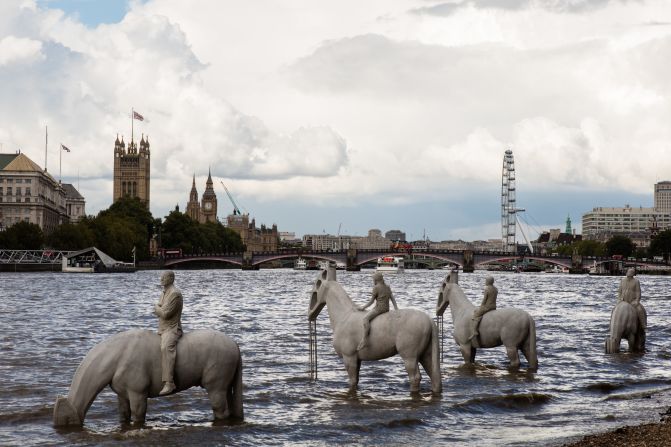
Rising Tide, part of the month-long Totally Thames arts festival, is the latest work from British artist Jason deCaires Taylor, and an intended statement on the future of fossil fuels.
Courtesy Jason deCaires Taylor
"I think it is a very powerful image having a suited businessman-slash-politician waist-high in rising water, in denial, ambivalent to the current situation," Taylor says. "The riders symbolize our desire to control natural forces, but [being] positioned in a vast body of moving water aims to highlight our fragility."
Taylor leaped at the opportunity to create an installation in London, where he received his art education. But the location resonated for deeper reasons.
Courtesy Jason deCaires Taylor
"The location is fundamental to the work," Taylor says. "Not only does it provide a disturbing metaphor for rising sea levels, demonstrating how little time we have to act, but crucially it offers hope for the future as it resets itself each day," he said.
"With both the houses of Parliament and the Shell headquarters in close proximity, I hope [Rising Tide] offers a stark reminder that fossil fuels clearly are not the future and we should be investing in a sustainable future, not looking into fracking or oil exploration in Antarctica," Taylor says.
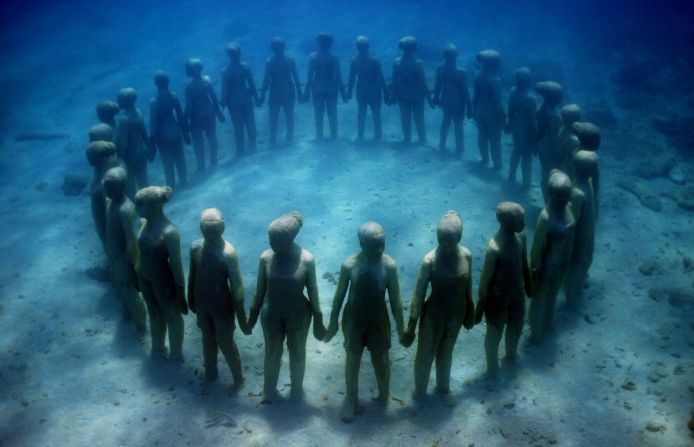
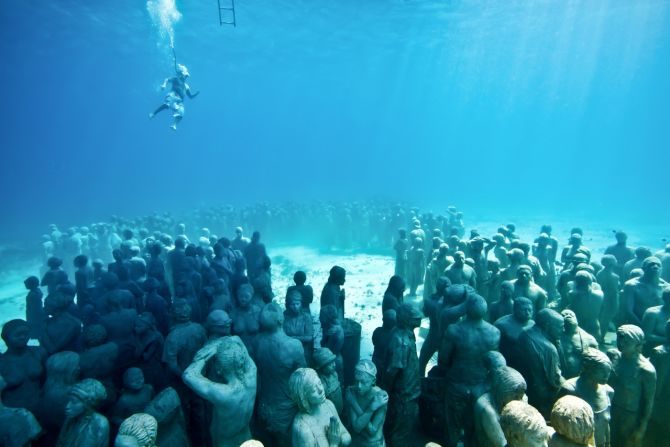
His sculptures there highlighted the need to protect marine environments.
Courtesy Jason deCaires Taylor
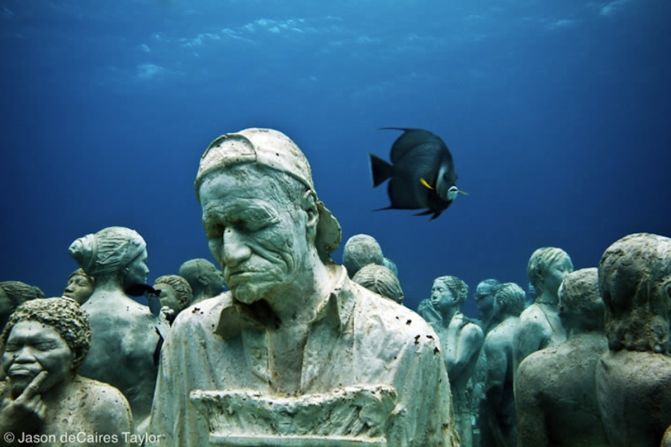
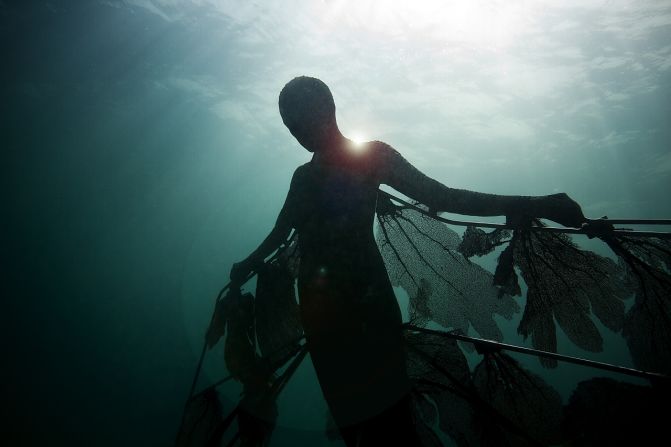
"[Water] dissolves the barriers we have between our physical and imaginary worlds," Taylor says.
Courtesy Jason deCaires Taylor
"It provides a new interface or portal to view our world, and a rare opportunity to judge ourselves from a different perspective."
Museo Subacuatico de Arte
"Because you're placed in an alternative world, your imagine is almost a little bit more open, it's a bit like being in a dream where you're a bit more suggestible to new ideas," he said.
Courtesy Jason deCaires Taylor
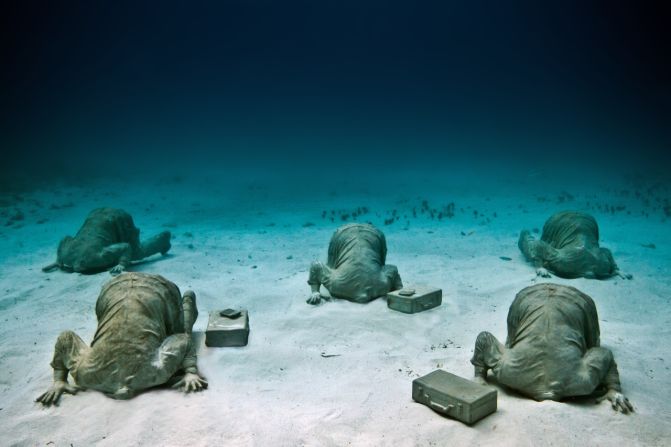
Even in Mexico the artist doesn't shy away from a strong metaphor, such as the installation shown above where figures have their heads literally buried in sand: "This was a piece referencing climate change and global warming, and how we tend to be living in denial at the moment, forgetting the future for short term gain," he said..
Courtesy Jason deCaires Taylor
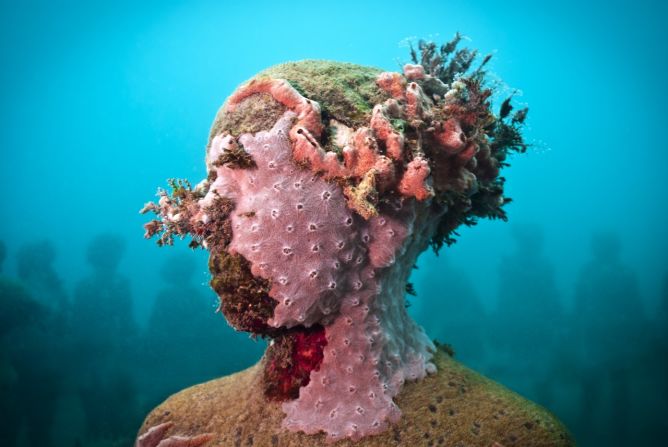
In Cancun, Taylor planted coral on figures, but said he never disturbs natural settings, instead using those grown in nurseries or damaged by tourists.
Courtesy Jason deCaires Taylor
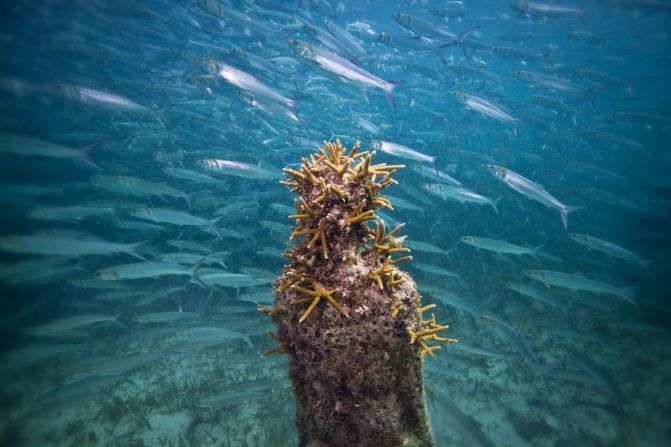
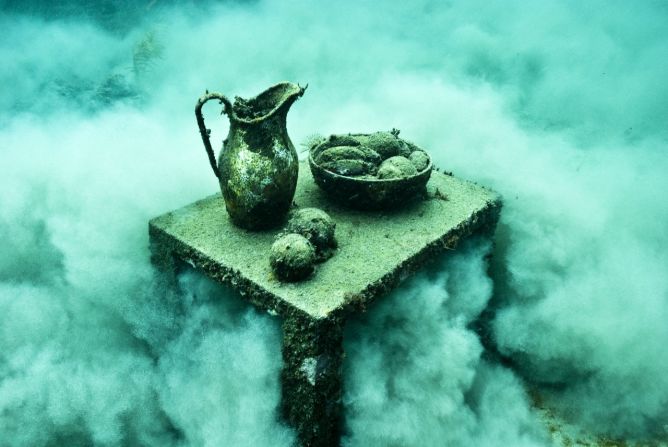
His sculptures are made of pH neutral cement, and over time sponges and coral encrust the surfaces in myriad of colorful and unexpected patterns.
Courtesy Jason deCaires Taylor
Apart from encouraging the growth of the area's marine life, Taylor is also keen to highlight the identity of the region which hosts his works: "I don't want it to be just myself bringing my ideas to a place, I want it to represent local culture," he explains.
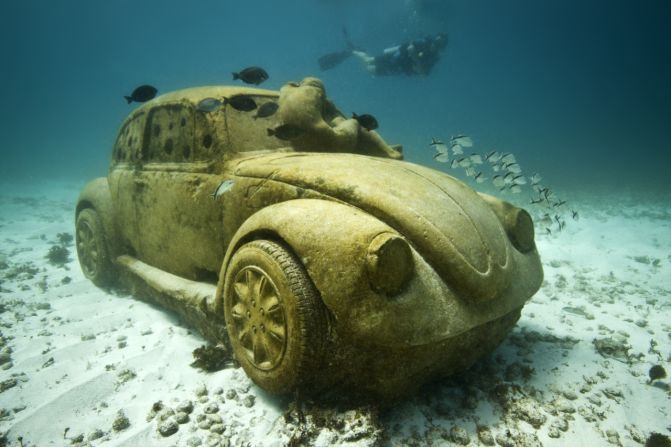
That idea was behind his decision to submerge a VW Beetle in Mexico, a car that has an iconic status in the country, but which also presented an ideal refuge for marine life.
Courtesy Jason deCaires Taylor
Taylor is also working a new underwater botanical garden in the Canary Islands.
!["I think it is a very powerful image having a suited businessman-slash-politician waist-high in rising water, in denial, ambivalent to the current situation," Taylor says. "The riders symbolize our desire to control natural forces, but [being] positioned in a vast body of moving water aims to highlight our fragility."<br /><br />Taylor leaped at the opportunity to create an installation in London, where he received his art education. But the location resonated for deeper reasons.](https://media.cnn.com/api/v1/images/stellar/prod/150904111213-jason-decaires-taylor-rising-tide-3.jpg?q=w_3657,h_2438,x_0,y_0,c_fill/h_447)
!["The location is fundamental to the work," Taylor says. "Not only does it provide a disturbing metaphor for rising sea levels, demonstrating how little time we have to act, but crucially it offers hope for the future as it resets itself each day," he said.<br /><br />"With both the houses of Parliament and the Shell headquarters in close proximity, I hope [<em>Rising Tide</em>] offers a stark reminder that fossil fuels clearly are not the future and we should be investing in a sustainable future, not looking into fracking or oil exploration in Antarctica," Taylor says.](https://media.cnn.com/api/v1/images/stellar/prod/150904124259-jason-decaires-taylor-rising-tide-5.jpg?q=w_2478,h_1652,x_0,y_0,c_fill/h_447)
!["[Water] dissolves the barriers we have between our physical and imaginary worlds," Taylor says.](https://media.cnn.com/api/v1/images/stellar/prod/150907120213-underwater-museum-15.jpg?q=w_5010,h_3306,x_0,y_0,c_fill/h_447)