Your effort and contribution in providing this feedback is much
appreciated.
Close
Ad Feedback
The true colors of ancient statues
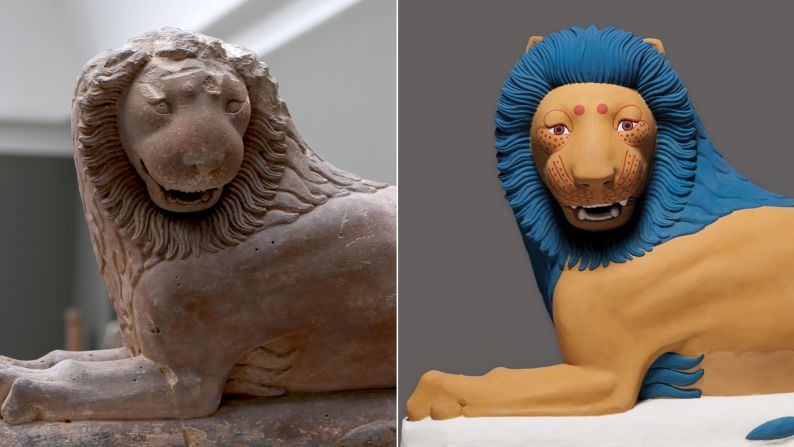
Reconstruction of a lion, 2005/2012. Original: Loutraki, ca. 550 BC —
The "Gods in Color" exhibition has been showing what ancient statues really looked like for over a decade, using modern techniques to analyze the surface of antiquities and determine original colors. Pictured here is a Greek lion statue from Loutraki, Greece, circa 550 BC, and its reconstruction.
FOST/Alamy Stock Photo/Courtesy Fine Arts Museum of San Francisco
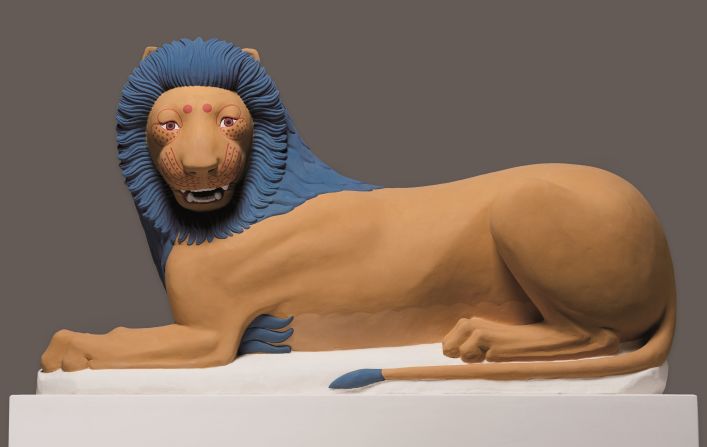
Reconstruction of a lion, 2005/2012. Original: Loutraki, Greece c. 550 BC —
The full view of the reconstruction, made from a plaster cast with natural pigments in egg tempera.
Fine Arts Museum of San Francisco
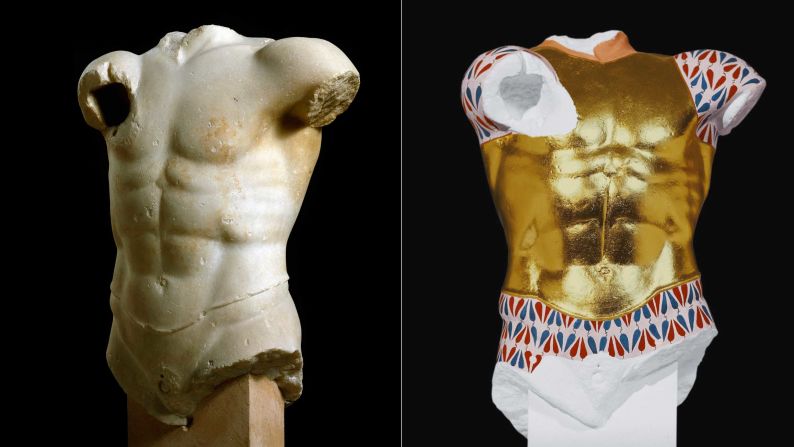
Reconstruction of a cuirassed torso from the Akropolis in Athens, 2005. Original: Athens, c. 470 BC —
This statue, known as the "Cuirassed Torso," was uncovered in 1886. A cuirass was a breastplate shaped in metal or leather to fit the torso of a warrior. No pigments were left on the marble, but ultraviolet and raking light analysis revealed traces of a variety of colors that were used for the reconstruction.
Luisa Ricciarini/Leemage/UIG via Getty/Courtesy Fine Arts Museum of San Francisco
The pigments used for the reconstruction are Egyptian blue, red ocher, calcite, madder and gold leaf.
Fine Arts Museum of San Francisco
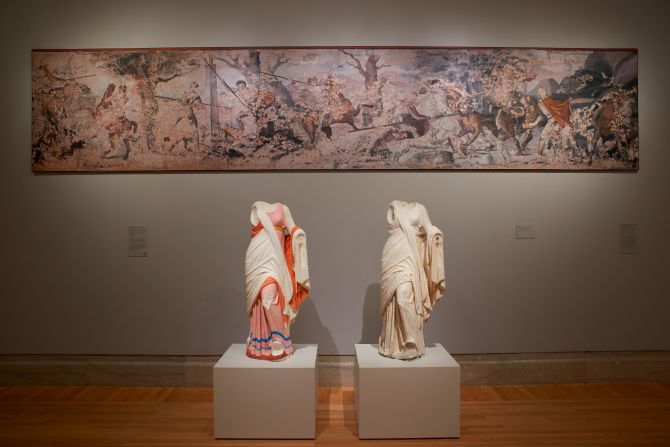
Reconstruction of Thalia, 2016. Original: Delos, Greece, 2nd century BC. —
This marble figure from the second century BC retained various traces of its original colors, some even apparent to the naked eye. Egyptian blue and pink madder were found in abundance around the garment near the right foot. These were used as guideline to create the reconstruction, shown on the left next to the original.
Fine Arts Museum of San Francisco
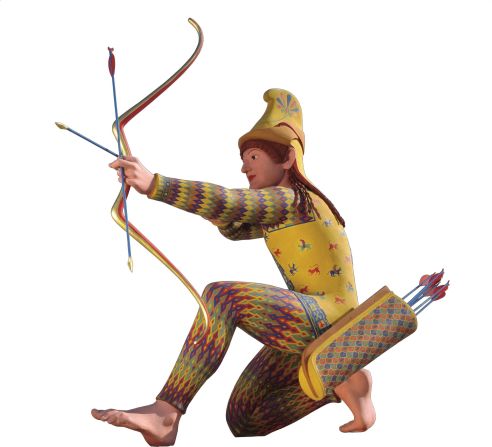
Reconstruction of a Trojan archer, 2005. Original: Aegina, Greece, c. 480 BC —
This reconstruction is a synthetic marble cast with natural pigments in egg tempera, lead, and wood. Raking light analysis on the original statues revealed the complex patters of the garments on the archer, including leggings with at least five colors.
Fine Arts Museum of San Francisco
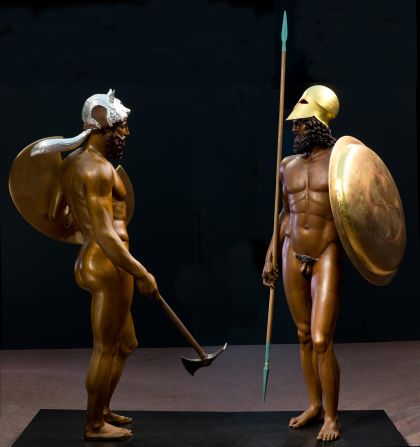
Reconstructions of the Riace Warriors (A and B), 2015-2016. Original: Greece, c. 460 —
These reconstructions of the Riace Warriors are made with bronze cast, copper, colored stones, silver, and Japan lacquer. Found in 1972 off the southern coast of Italy, these life-size statues from Greece had extraordinary details, including eyes made from assembled stones of different colors.
Fine Arts Museum of San Francisco
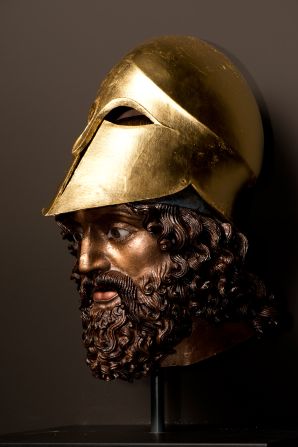
Reconstruction of the head of the Riace warrior (A), 2013. Original: Greece, c. 460 BC. —
Asphalt and patination were originally used for coloring and to create a possible distinction between the skin tones and hair colors of the two warriors.
Fine Arts Museum of San Francisco
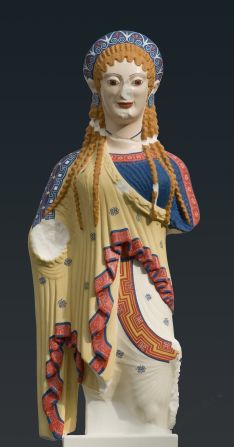
Reconstruction of the Chios kore from the Akropolis in Athens, 2012. Original: Athens, c. 500 BC. —
This reconstruction of the so-called Chios kore from the Akropolis in Athens is made of crystalline acrylic glass, with applied pigments in tempera. Traces of color on the skin and blue and red on the clothes were recorded at the time of discovery in the 1880s.
Fine Arts Museum of San Francisco
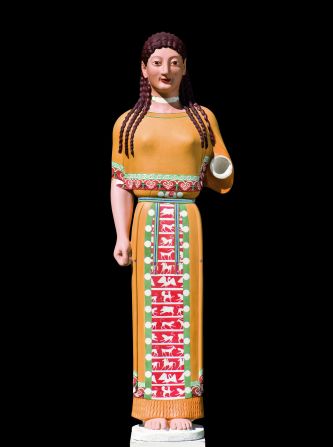
Reconstruction of the Peplos Kore, 2005. Original: Athens, c. 530 BC —
This reconstruction of the Peplos kore is made of plaster cast with natural pigments in egg tempera. Residues of red, blue, green and yellow paint were found on the figure's hair, eyes, belt and garments.
Fine Arts Museum of San Francisco
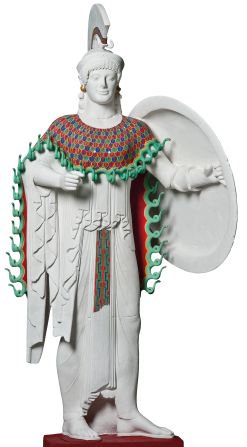
Reconstruction B of Athena, 2005. Original: Aegina, Greece, c. 480 BC —
This plaster cast reconstruction is made with natural pigments in egg tempera. The original aegis, the cape worn by the statue, was lavishly detailed and adorned with more than a thousand snake scales.
Fine Arts Museum of San Francisco
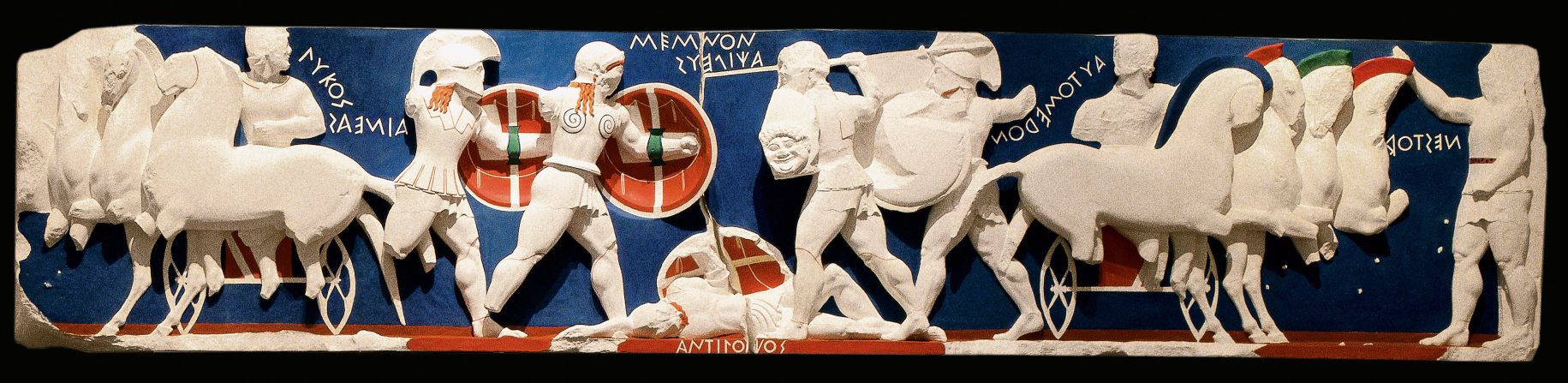
Reconstruction of the east frieze of the Siphnian Treasurtm 2006/2012 —
The original, from Delphi in Greece, dates back to 520 BC. This reconstruction was carried out exclusively on the basis of surviving traces of paint.
Fine Arts Museum of San Francisco
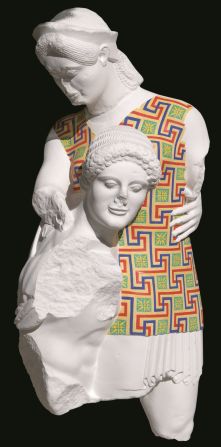
Reconstruction of Antiope and Theseus, 2005 —
On the original statue, which dates back to 490 BC, no traces of pigment had survived. The color combination is based on the most commonly used pigments of the era.