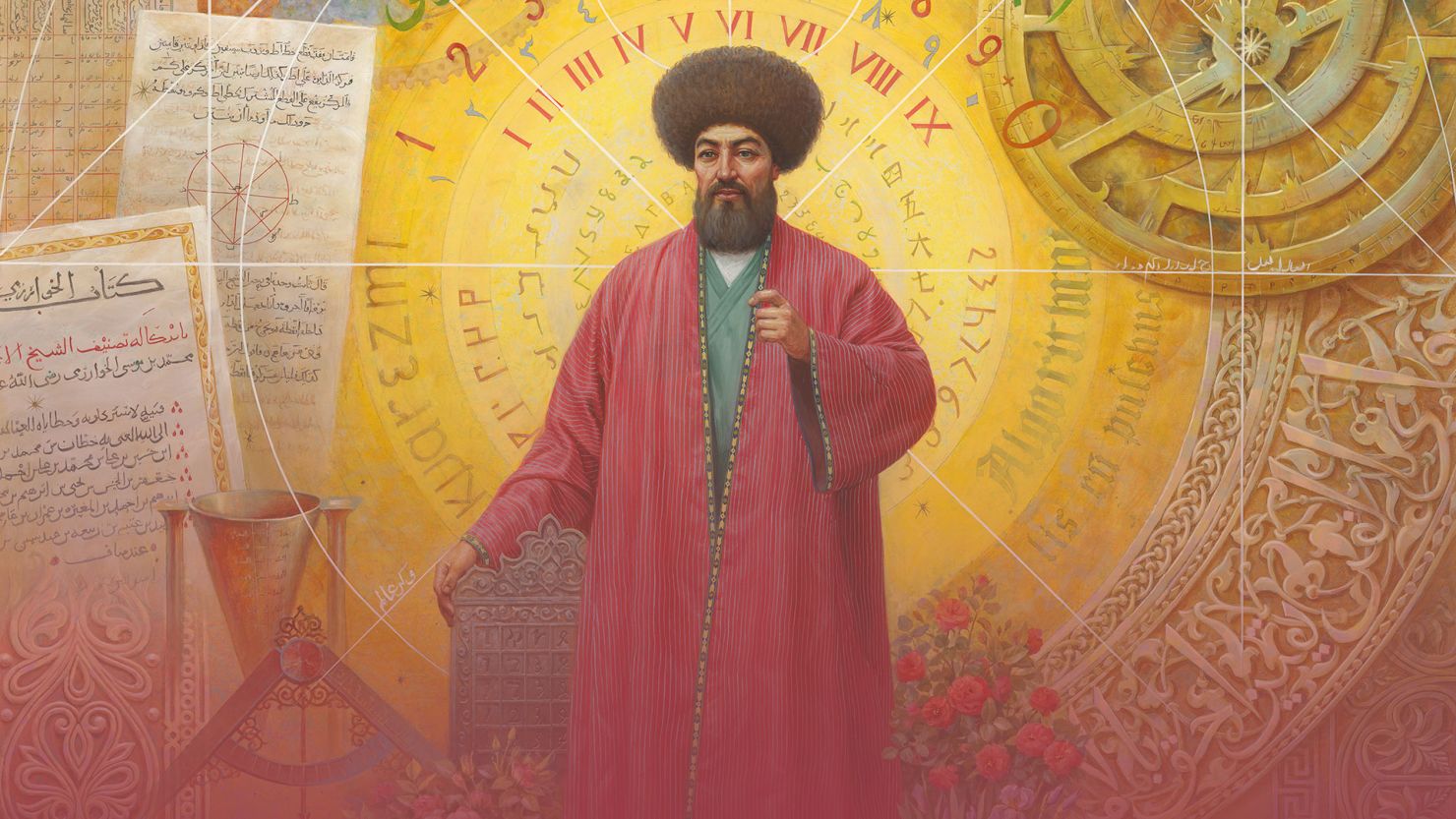

Every time we use our smartphones or computers, we encounter the legacy of Muhammad ibn Musa al-Khwarizmi. This remarkable Uzbek scholar laid the foundations for modern technology to thrive—from the digit “0” to the algorithms that power everything from social media to Artificial Intelligence (AI).
Al-Khwarizmi was born around 780 CE in Khwarazm (modern-day Khiva, Uzbekistan), which, from the 9th to the 12th centuries, was a hub of great discoveries during the Islamic Golden Age of science and culture.
His academic contributions around this time did not go unnoticed, securing him an invite to Baghdad, where he headed the famous “House of Wisdom” (Bayt al-Hikma). There, he studied ancient Greek and Indian works and opened a new realm of knowledge.

The sum of all parts
The word “algorithm” originates from the name of Al-Khwarizmi, owing to his methodical approach to problem-solving, which changed the course of science. Centuries later, we continue to use his namesake, demonstrating a long course of intellectual exchange that has inspired our use of modern technology and computation—from search engines and social networks, to navigation systems and healthcare diagnostics.
It was also Al-Khwarizmi who refined the Indian numeral system and introduced mathematics to the use of the number “0”. Before this, Europe relied on cumbersome Roman numerals, which complicated calculations, and the positional system was unknown. His innovation did not just simplify mathematics, it provided the basis for the binary system at the heart of all modern computers.
His mathematical accomplishments extend to his contributions to algebra. This Uzbek scholar was the first to present it as an independent science, focusing on general methods for solving and classifying linear and quadratic equations. His book, ‘The Compendious Book on Calculation by Completion and Balancing’, set a precedent for algebra. This work gained immense popularity in the medieval West and served as a classic mathematical text for European university students for 700 years. Without it, modern mathematics as we know it would be unimaginable.
Mapping the world
In 827 CE, in the Khwarazmian desert, Al-Khwarizmi participated in measuring the length of a degree of the Earth’s meridian arc (the curve between two points on the Earth’s surface that share the same longitude). He created accurate maps and tables that helped determine the size of the Earth and the coordinates of cities. His reliable model of the Earth, developed centuries ago, served as a precursor to the modern globe and foreshadowed contemporary GPS technology.
Using mathematical computations, Al-Khwarizmi also precisely calculated the positions of the Sun, Moon, and planets during solar eclipses. His contributions were pivotal in advancing the understanding of celestial phenomena.

Reigning significance
Muhammad ibn Musa Al-Khwarizmi is not just an Uzbek scholar from the past; he is a titan whose ideas and discoveries formed the foundation of technologies indispensable to modern life. Our use of mobile phones and computers has been made possible by his genius, through which, he made science globally accessible.
His achievements demonstrate that science knows no boundaries and that the ideas of one individual can change the world.
Today, in Uzbekistan, thanks to the initiatives of President Shavkat Mirziyoyev, the legacy of great scholars, like Al-Khwarizmi, is being actively studied and widely promoted to inspire new generations of researchers.
The Center of Islamic Civilization in Uzbekistan is a grand building in the heart of Tashkent, designed to exhibit the stories of these Uzbek intellects and preserve the heritage of their transformative works for years to come.
Learn more about the cultural and academic heritage of Uzbekistan here.