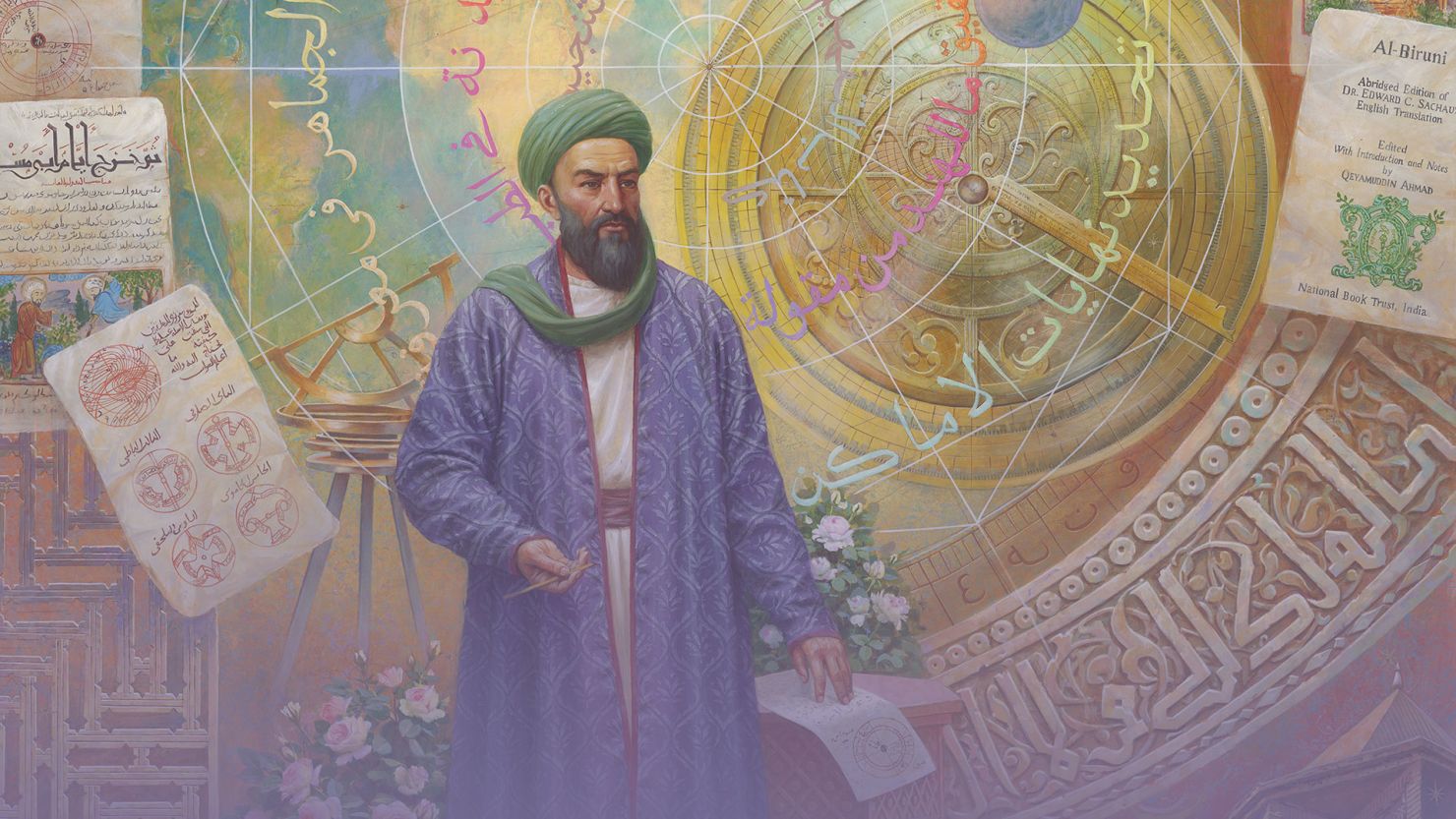

At a time when Europe had entered into the Dark Ages, the Muslim world was in a golden age of intellectual discovery.
One of the key figures of this era was Abu Rayhan Biruni (973–1048), an outstanding scholar whose achievements laid the foundation for many modern sciences. From his hypothesis on the Earth’s rotation to his measurements of the Earth’s diameter, his works became a bridge between the legacy of antiquity and future innovations—including those that would later emerge in Renaissance Europe.
Born in Khwarezm, in the northwest of present-day Uzbekistan, Al-Biruni was a man of such vast knowledge and scholarship that a modern city now bears his name—Beruniy.

Being a polyglot, Al-Biruni mastered Arabic, Greek, Persian, and Sanskrit. This linguistic prowess granted him access to the ancient knowledge of these remarkable civilizations. His intellectual pursuits were nearly boundless, encompassing alchemy and astronomy. He was an encyclopedist and historian, a geographer and geologist, an Islamic philosopher and theologian. His contributions to these fields of study were profound and enduring, and his works continue to inspire and remain relevant today.
The early ages of cosmic discoveries
One of the first to make a significant contribution to the study of space was the great scholar Al-Biruni. His passion for astronomy is showcased in 95 out of his 146 works.
Al-Biruni not only calculated the Earth’s radius and rotation but also devised an improvised quadrant to measure the height of the Sun and developed a method to determine the density of substances through the ratio of mass to volume. His discoveries became the foundation upon which geniuses like Galileo Galilei and Isaac Newton built their work centuries later.
The works of Al-Biruni also inspired astronomer Richard Dunthorne, who relied on studies of the Moon’s phases, the timing of equinoxes, and eclipse data to determine the Moon’s acceleration. This remarkable contribution became a starting point for future generations of researchers and cemented his name in history as one of the greatest minds of his era.

Founder of Indology
Al-Biruni became the astrologer at the court of Mahmud of Ghazni, the Sultan of the Ghaznavid Empire. He accompanied the Sultan on expeditions to India, where he recorded his observations of this uncharted and enigmatic land. The quality of his works earned Al-Biruni worldwide recognition, and he was celebrated as an anthropologist, ethnographer, and historian of Indian science.
His travels and research led to the creation of the book ‘Explanatory Treatise on the Teachings of the Indians, Whether Acceptable to Reason or Rejected.’ Al-Biruni considered it his most important encyclopedic work. Ranking second is ‘Chronology of Ancient Nations,’ described as a universal anthropological account of various cultures and a testament to his deeply rooted interest in the people and places around him.
Legacy of scientific innovation
Today, under the initiative of the President of the Republic of Uzbekistan, Shavkat Mirziyoyev, the legacy of such remarkable figures as Abu Rayhan Al-Biruni is being actively studied and promoted at the Center for Islamic Civilization in Uzbekistan. The center is a majestic building in the heart of Tashkent, created to tell the stories of these Uzbek intellectuals and preserve their transformative works for many years to come.
The name of Al-Biruni remains synonymous with wisdom, the pursuit of knowledge, and inspiration, continuing to motivate future generations to seek truth and make new scientific discoveries.
He has been a source of inspiration for scientists and mathematicians for over a millennium, and his influence is still felt today. In addition to a city named in his honor, he now also has an award dedicated to his legacy.
At the 220th session of the UNESCO Executive Board in October 2024, it was announced that the UNESCO-Uzbekistan International Prize would bear the name of Al-Biruni in recognition of his scientific achievements.
The prize, which will be awarded every two years, honors outstanding projects that advance ethics, inclusivity, and development in the field of Artificial Intelligence (AI). It also highlights Uzbekistan’s commitment to preserving and fostering a legacy of research and innovation that began over ten centuries ago with Al-Biruni.
The first award ceremony is scheduled for November 2025 in Samarkand during the 43rd session of the UNESCO General Conference.
Learn more about the cultural and academic heritage of Uzbekistan here.