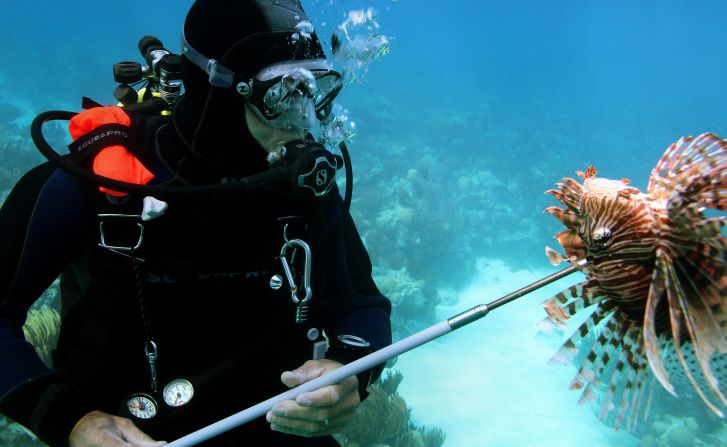
A lionfish between two electrodes during tests of a prototype of a robot designed to cull the invasive species.
ocean support foundation
Voracious appetite —
Invasive lionfish are not recognized as a threat by native fish, allowing them to gorge to the point of obesity.
Lionfish eat everything from shrimp and squid to molluscs and lobster, and have decimated native species populations.
ocean support foundation
Unwelcome guest —
Studies have shown lionfish wiping out 80-90% of reef biodiversity within weeks of arrival, including species that maintain the reef itself.
ocean support foundation
Local solution —
Methods to control lionfish populations have had mixed results.
Spear-fishing derbies have reduced their numbers in localized areas, but have not impacted the wider spread.
ocean support foundation
New delicacy —
A man eats in a private restaurant in Havana where the lionfish is served.
There are increasing efforts to reduce the lionfish population by marketing them as food, with conservation group REEF producing a dedicated cookbook.
YAMIL LAGE/AFP/AFP/Getty Images
Power tool —
Design drawing of the robot, from Robots in Service of the Environment (RISE). The machine combines a remote-operated vehicle with a bespoke electrocution device. It will be equipped with recognition software to ensure the wrong fish are not killed.
RISE
Older brother —
RISE was launched by Colin Angle, CEO of iRobot, and the technology was based on the company's previous creation - the Roomba vacuum cleaner.
The new company hopes the new robot can also be cheap and easy to operate in order to appeal to casual users.
Breathing space —
RISE do not expect to eliminate the invasive lionfish, but hope to reduce their numbers sufficiently to allow the ecosystems to recover.