Your effort and contribution in providing this feedback is much
appreciated.
Close
Ad Feedback
Blaxicans of L.A.
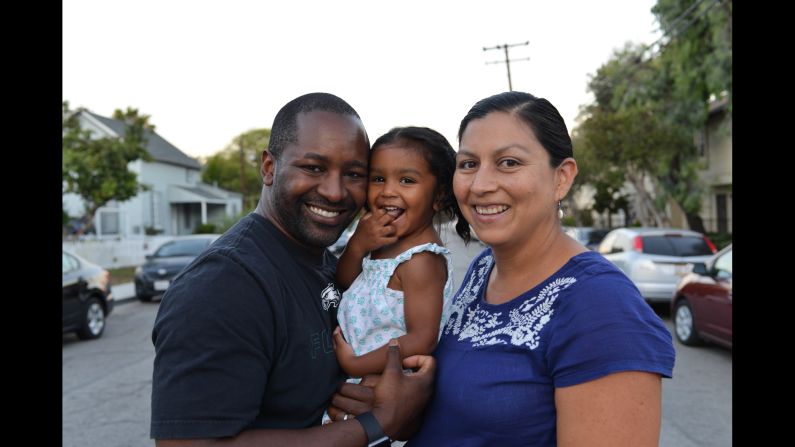
Blaxicans of L.A. is an Instagram account that grew into a show at Los Angeles' Avenue 50 Studio during Black History Month. The exhibit includes portraits with captions detailing personal histories and experiences with colorism and self-identity. Ken and Alejandra, pictured here, say they tell their daughter she is black and Mexican. "We will explicitly teach her to be proud of the fact that she is Mexican and to be proud of the fact that she is black," Alejandra said.
Courtesy Walter Thompson Hernandez
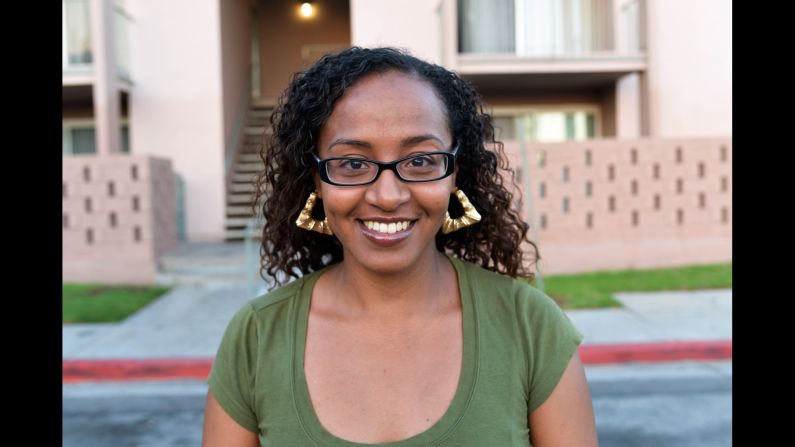
Maria says she identifies as Afro-Mexicana. Her portrait is accompanied by a photo of her parents.
Courtesy Walter Thompson Hernandez
"My dad was an MTA bus driver. My mom would always catch the bus at one of his stops, and slowly but surely, they began to talk. My dad learned some Spanish phrases just so that he could communicate with her during his bus route. They eventually got together and had me," Maria said of her parents.
Courtesy Walter Thompson Hernandez
Richard says he ethnically identifies as Afro-Mexican, but racially, "I embrace my blackness as here in L.A., that is typically how I am read." Identifying as Afro-Mexican acknowledges his African roots as well as his hometown of Los Angeles, which indigenous Mexicans occupied until American colonization. "My mom has always spoken about our family proudly in these terms. It's what I'd like to continue to promote."
Courtesy Walter Thompson Hernandez
Richard traces his Afro-Mexican on both sides of his family to Nogales, a city on the U.S.-Mexico border that's home to Afro-Mexicans descended from the Buffalo Soldiers of the 10th Calvary Regiment. The community was so tight that many of them stayed in touch after moving away. "When my grandmothers moved west to Los Angeles, they built their families around each other. It was no surprise when my mother, Alva, and father, Pancho, found each other. In fact, it may have been the intention of my grandmas from the start."
Courtesy Walter Thompson Hernandez
Maggie says she grew believing she was full Mexican, until she was 13. That's when she found her father, a black man. "As soon as I found out I was mixed, it opened up my mind, and I guess I was finally able to be me," she said.
Courtesy Walter Thompson Hernandez
Growing up as "the little dark Mexican" in her family, Maggie says, she struggled to prove that she was Hispanic. "But once my mom told me I was black, I started to hang out with more black people, and I stopped chasing the idea of proving to everyone that I was Hispanic."
Courtesy Walter Thompson Hernandez
The exhibit features subjects with varied heritage. As the descendant of black slaves from the rural southern United States and indigenous farmers from El Salvador, "I'm proud of the fact that both of my cultures come from circumstances that people don't often live through," Antonio said. "They rose above it, and they are still trying to make sense of who they are. I'm just proud to envelop both cultures and feel everything flowing through me."
Courtesy Walter Thompson Hernandez
Antonio says his parents split when he was 4 years old. Growing up, he felt as though they were "trying to root for me to succeed because they couldn't succeed as parents." The family reunited for his high school graduation. "But during this photo, for one moment, any grudge, bitterness, it all went away, and that's something that I will cherish forever."