Your effort and contribution in providing this feedback is much
appreciated.
Close
Ad Feedback
Forgotten ally? China and the United States in World War II
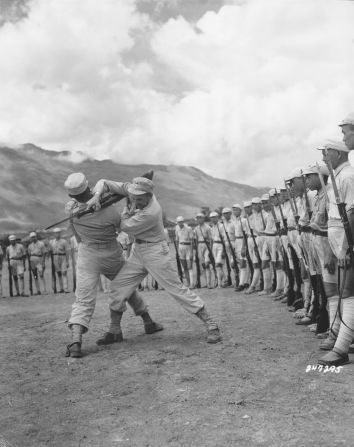
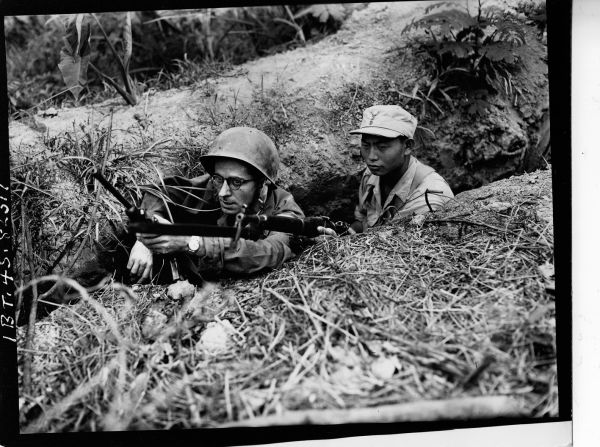
The United States and China were allies during World War II and more than 250,000 Americans served in what was known as the "China-Burma-India" theater. Here, a U.S. sergeant and a lieutenant, both members of the Y-Force Operations Staff, demonstrate methods of disarming the enemy with a bayonet to Chinese soldiers.
U.S. National Archives and Records Administration
September 30, 1945 —
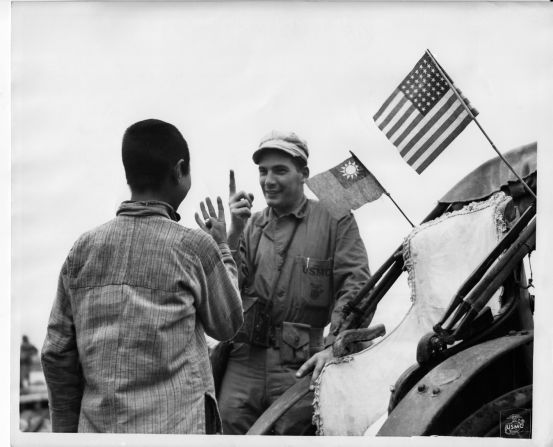
Marine Corporal Richard W. Miller bargains with a Chinese man for a lift in his rickshaw on September 30, 1945. This image was among 23,000 discovered by Chinese historian Zhang Dongpan in 2006 in the U.S. National Archives and Records Office.
Official U.S. Marine Corps photo/Corp A.J. Gloss
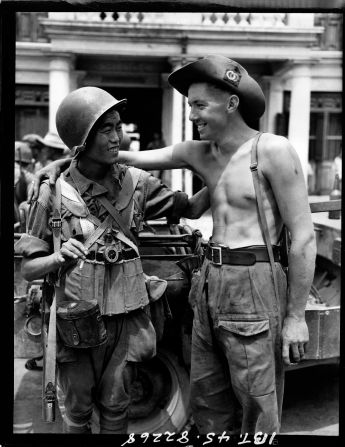
Zhang used the images for an exhibition that tells the often forgotten role of U.S. and Chinese cooperation in World War II. Here, a British and Chinese soldier exchange greetings when the Chinese and British troops met on the Mandalay Road, Burma on 30 March 1945.
U.S. National Archives and Records Administration
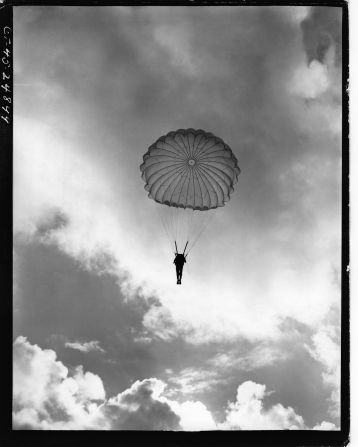
Zhang worked with Retired Army Col. John Easterbrook to bring the photo exhibition to the United States, where many Americans were surprised to learn of of the U.S. effort against Japan in China, Easterbrook says. Here, a Chinese commando being trained as a paratrooper by American officers makes his first jump in Kunming, southwest China.
T/4 Paczkowski/ U.S. National Archives and Records Administration
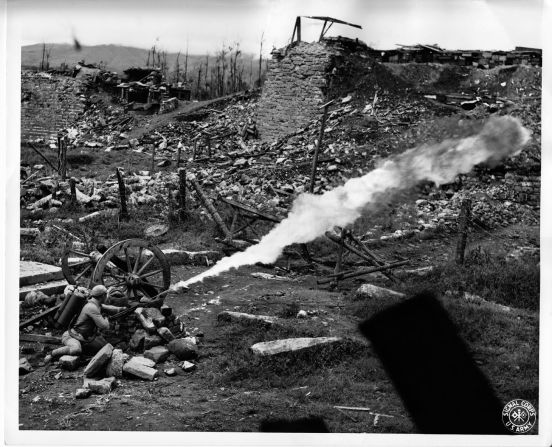
Chinese soldiers were trained by U.S. officers to use incendiary devices called "flamethrowers" seen here during the three-month siege of the ancient walled city of Tengchung, a Japanese stronghold. The American effort is often forgotten in China too. Following the end of the war, civil war broke out, and with the victory of the Communists all mention of American cooperation was stricken from the record.
U.S. National Archives and Records Administration
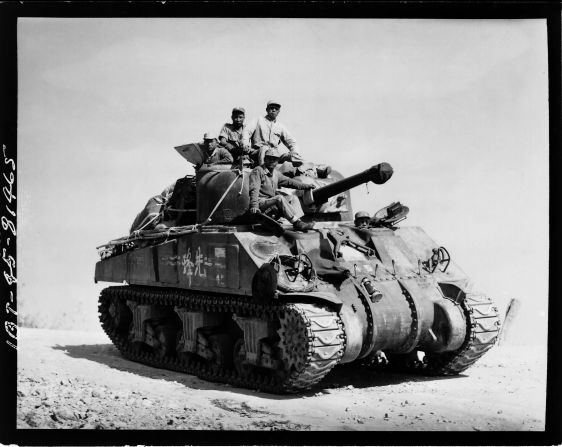
China was the first country to enter what would become World War II. On July 7, 1937, a clash between Chinese and Japanese troops at the Marco Polo Bridge, just outside Beijing, led to all-out war. Here, a Chinese manned tank moves south along the Burma Road toward Lashio, Burma on February 24, 1945
U.S. National Archives and Records Administration
March 5, 1945 —
Some 14 million Chinese died and up to 100 million became refugees during the eight years of conflict with Japan from 1937 to 1945.
U.S. National Archives and Records Administration
September 13, 1943 —
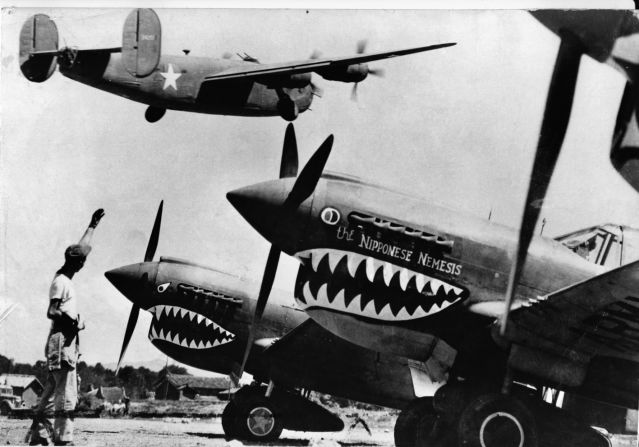
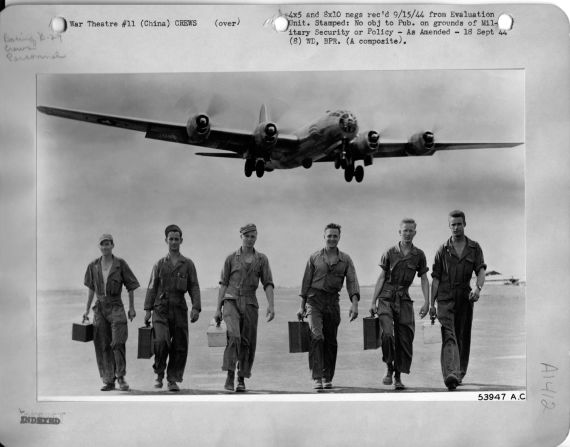
An American soldier waves good luck to a U.S. Army Air Force Liberator bomber as it crosses the shark-nosed bows of U.S. P-40 fighter planes at an advanced U.S. base in China.
U.S. National Archives and Records Administration
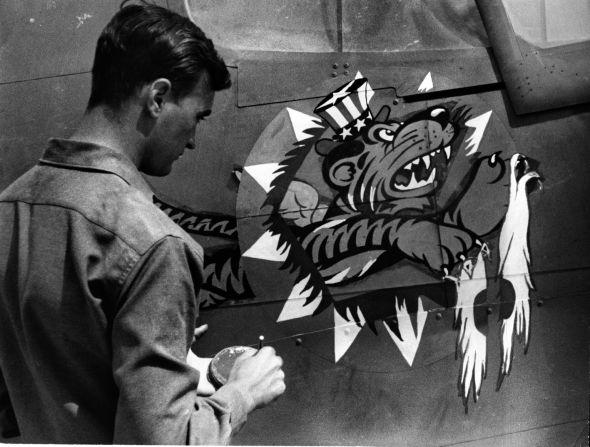
An artist of the China Air Task Force Fighter Command of the United States Army Air Force puts the finishing touches on the insignia of a U.S. plane. The pilots were known as "Flying Tigers."
U.S. National Archives and Records Administration
March 1, 1945 —
Historian Rana Mitter says that China could not have won the war on its own but held down huge numbers of Japanese troops on its territory. He says the defeat of Japan was dependent on western, and in particular American finance, military support and supplies.
U.S. National Archives and Records Administration
March 2, 1945 —
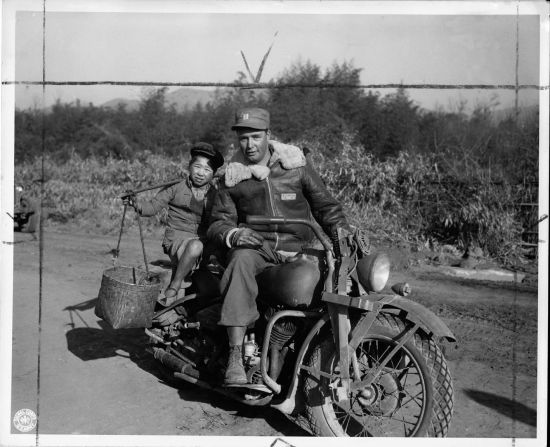
But acknowledging these realities does not mean denying that China's contributions were also very important to the war effort, Mitter adds. Here, a convoy rider gives a Chinese child a ride in the Tengchun Cutoff, China.
U.S. National Archives and Records Administration
Cairo, Egypt, 1943 —
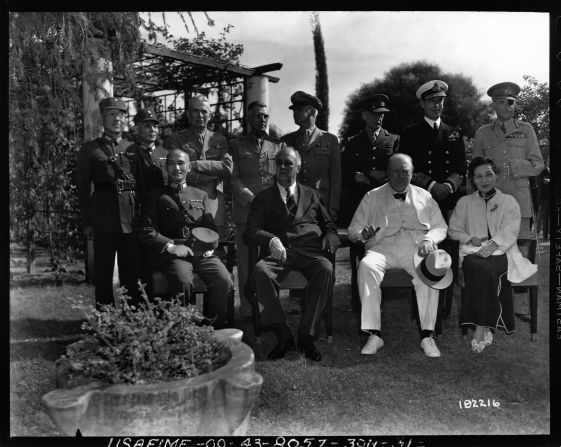
American President Franklin Delano Roosevelt, British Prime Minister Winston Churchill and Chinese leader Chiang Kai-shek meet with other military leaders at the Cairo Conference. The conference addressed issues related to Allied policy against Japan during World War II, and made decisions about the future of Asia.
U.S. National Archives and Records Administration
August 22, 1945 —
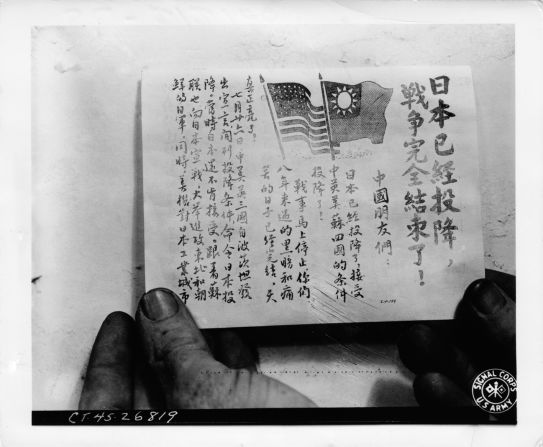
A photo of the leaflets declaring the Japanese surrender that were air dropped over occupied areas of China.
U.S. National Archives and Records Administration
China is embracing much of its war history that remained taboo during the Cold War. During that time, few wished to remember the regime of Chiang Kai-shek, which had been driven onto Taiwan or their American backers.
U.S. National Archives and Records Administration
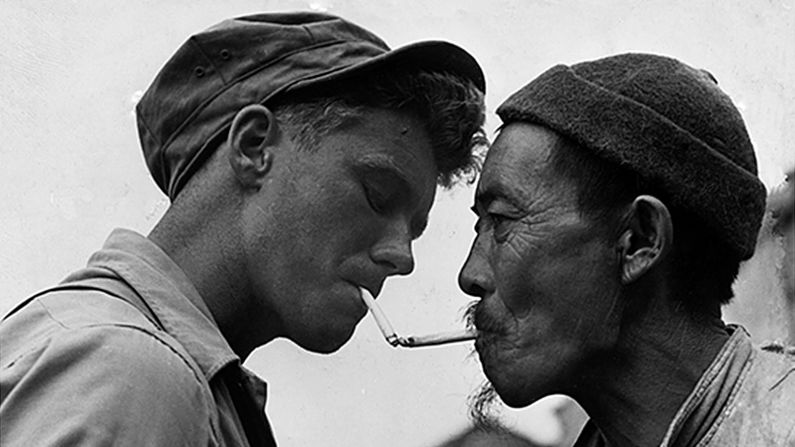
Pausing on a street in bomb-shattered Tengchung, an aged Chinese civilian obtains a light for his cigarette from a U.S. Army sergeant October 14, 1944, who helped drive the Japanese from the ancient city.