Your effort and contribution in providing this feedback is much
appreciated.
Close
Ad Feedback
Ad Feedback
Planet of the robotic apes?
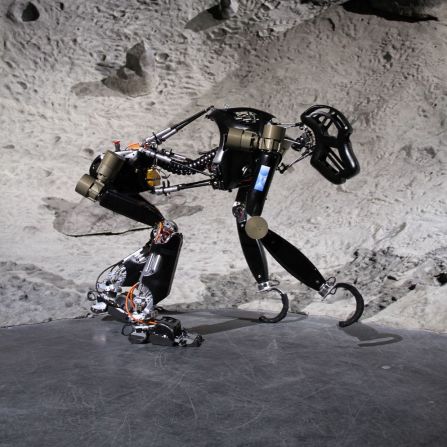
This robot, nicknamed Charlie, could be our best bet at a future unmanned Moon mission.
courtesy dfki
The robot capitalizes on the inherent stability of the ape's quadrupedal stance without losing the chimp's versatility in climbing, grasping and moving over all types of terrain.
Courtesy of DFKI GmbH
"(Chimps) have quite good quadrupedal walking abilities but they can also perform stand- up motion and walk on two legs -- their ability to do this is greater than other animals," says researcher Daniel Kuhn.
Courtesy of DFKI
"They can choose -- if the environment won't let you move in a stable fashion on two legs they can choose four. When the environment improves, two legs allows you to get a better view over the field," Kuhn says.
Courtesy of DKFI
The robochimp's sensors include a pressure sensor array of 43 individual force sensing resistor (FSR) sensors. It also has six additional FSR-sensors used for collision detection.
Courtesy of DFKI GmbH
The research team are studying how to transfer from four-legged to two-legged motion patterns. They say this system gives us hints as to how humans evolved to walk on two legs.
Courtesy of DFKI GmbH
The research agency is also looking at other types of space rovers. The locomotion of the scorpion and the mantis is being studied to create robots that have the stability of four legs but with the ability to manipulate material with their forelegs.
Courtesy of DFKI GmbH
A space climber - a free-climbing robot designed to scale the inclines of craters - is put through its paces at the Bremen center's lunar habitat.