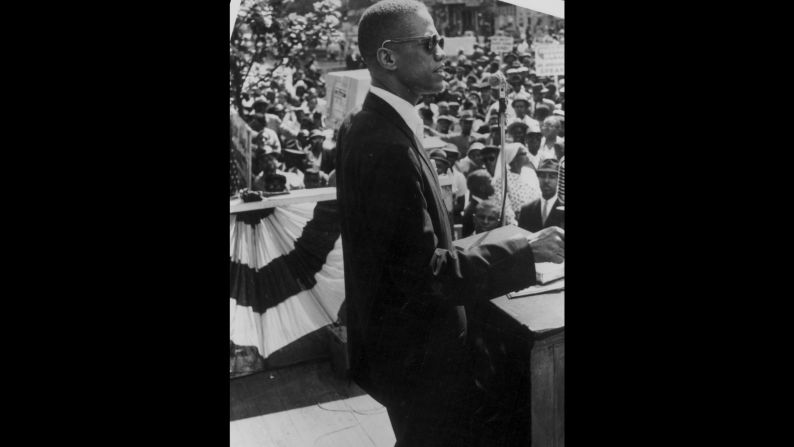
As a spokesman for the Nation of Islam in the 50s and 60s, civil rights activist Malcolm X grew in popularity. He was a highly sought-after speaker. Here, he is seen on the PBS program "Open Mind" in 1963.
Pictorial Parade/Archive Photos/Getty Images
Malcolm X was never afraid to speak out against injustices he said black Americans were facing. In this photo, taken outside a New York courthouse, he offers his support during a police brutality case.
Lloyd Yearwood/Three Lions/Getty Images
Fidel Castro and Malcolm X meet in Harlem in 1960. The Cuban leader was visiting New York to address the United Nations.
Universal History Archive/UIG/Getty Images
Nation of Islam leader Elijah Muhammad, seated in the hat, listens as Malcolm X speaks at a Nation of Islam convention in Chicago in February 1961. It was Malcolm X who bestowed the title "Honorable" to Muhammad.
Frank Scherschel/The LIFE Picture Collection/Getty Images
Malcolm X would frequently speak on street corners in Harlem and preach to crowds.
Three Lions/Hulton Archive/Getty Images
Malcolm X with his daughters Qubilah, left, and Attilah in 1963.
Robert L. Haggins/Getty Images
Malcolm X preaches in Harlem in August 1963. He rose quickly within the Nation of Islam. Those who followed him said he was one of the most dynamic speakers they had ever heard.
Richard Saunders/Pictorial Parade/Archive Photos/Getty Images
Malcolm X was also Muhammad Ali's mentor and spiritual guide.
John Peodincuk/NY Daily News Archive/Getty Images
Malcolm X holds cash during a speech in Washington in 1963.
Richard Saunders/Hulton Archive/Getty Images
Malcolm X talks to a woman inside a Halal restaurant patronized by black Muslims in Harlem.
Richard Saunders/Hulton Archive/Getty Images
In 1964, Malcolm X made a trip to Mecca after he split with the Nation of Islam. He is seen here with Saudi Prince Faisal, who would later become king.
Pictorial Parade/Getty Images
Malcolm X meets with Martin Luther King Jr. in March 1964.
Universal History Archive/Getty Images
In December 1964, Malcolm X meets with students before the Oxford Union Debates in Oxford, England. He would be assassinated less than two months later.
Keystone/Hulton Archive/Getty Images
On February 21, 1965, Malcolm X was shot before he was about to deliver a speech about his new organization called the Organization of Afro-American Unity.
Underwood Archives/Getty Images
Reporters inspect the scene of the assassination, inside the Audobon Ballroom in New York.
NY Daily News Archive/Getty Images
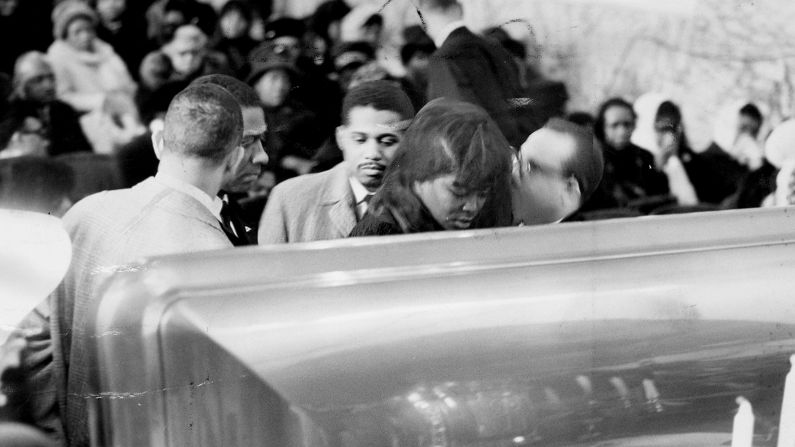
Malcolm X's widow, Betty Shabazz, stands by her husband's casket at his funeral.