Countering the counterfeiters: The art of making money
Notable notes —
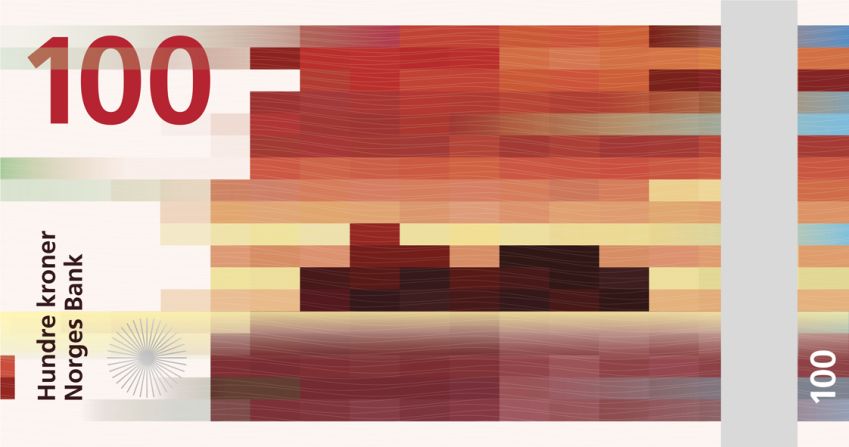
One of the winning designs for what will be the newest Norwegian 100 Krone ($15) note. Norges Bank, the Norwegian central bank, recently held a competition to design its latest banknotes.
Courtesy Norges Bank
Norwegian 100 Krone —
Among the reasons given for the designs selected as winners was their compatibility with the latest security and anti-counterfeiting measures.
Courtesy Norges Bank
Canadian dollars —
High-tech security efforts are now a common feature of new currencies. When combined with detailed artworks or designs they can make the job of forgers more difficult. Canada's newest bank notes, for example, contain holographic features alongside expert calligraphy, metallic illustrations, and raised text.
Courtey BANK OF canada
Kazakhstani tenge —
This paper note from Kazakhstan's national bank contains an array of important national symbols mixed with advanced holographic strips that complement the design.
courtesy The National Bank of the Republic of Kazakhstan
Australian dollars —
A number of countries have shunned paper money, however, and turned to polymer plastics as a way of defeating counterfeiters. Australia became the first nation to manufacture all of its notes from polymer -- a thin, flexible polypropylene film.
WILLIAM WEST/AFP/Getty Images
Mexican pesos —
Mexico (pictured), Mozambique, Northern Ireland, Costa Rica and Lebanon are just a few of the nations to introduce polymer banknotes. Part of the polymer film is often left clear to give a transparent window in the banknote, making forgeries more difficult. Additional security features can be embedded into the polymer note.
ALFREDO ESTRELLA/afp/getty images
New British notes —
The Bank of England announced earlier this year that it would introduce new polymer £5 and £10 notes by 2016, featuring former prime minister Winston Churchill and author Jane Austen respectively. According to Bank of England governor Mark Carney, polymer notes are "the next step in the evolution of banknote design."
DYLAN MARTINEZ/AFP/GETTY IMAGES
British £50 —
But currency expert Thomas Hockenhull, of the British Museum, says the latest in paper money technology, such as the newest UK £50 note, can be more difficult to forge than polymer notes. The £50 note includes raised ink, a metallic thread embedded in the paper, and a number "50" that appears in red and green under ultraviolet light.
courtesy bank of england
U.S. $100 —
Hockenhull also highlights the U.S. $100 bill, as being a particularly advanced paper note in terms of its security features. These include an image of a color-changing bell inside a copper-colored inkwell. Tilting the note makes the bell seem to appear and disappear inside the inkwell.
BRENDAN SMIALOWSKI/AFP/Getty Image
Zimbabwean $100 trillion —
Not all paper money needs a funky design or futuristic security hologram to stand out or get noticed, however. This $100,000,000,000,000 (100 trillion) note from Zimbabwe is bound to grab anyone's attention.