Mousetronauts, fireballs and a real-life R2D2: Life on the Space Station | CNN Business
Thank You!
Your effort and contribution in providing this feedback is much
appreciated.
Close
Ad Feedback
Mousetronauts, fireballs and a real-life R2D2: Life on the Space Station
A real-life R2D2 —
He's the only permanent resident of the International Space Station. Robonaut 2 or R2, pictured here with ESA astronaut Paolo Nespoli, was designed by NASA and General Motors as a humanoid robotic assistant to perform maintenance tasks and free up the astronauts' time.
Could astronauts journey to another planet and 3D print their own houses? While that scenario is a long way off, scientists are investigating if zero gravity affects the tech, which could be used in the future for in-space manufacturing. Here, a 3D printer is tested in the Microgravity Science Glovebox Engineering Unit at Marshall Space Flight Center, Alabama, prior to being taken to the ISS.
Brightly colored "Synchronized Position Hold, Engage, Reorient, Experimental Satellites" or "SPHERES" float around the Destiny laboratory module. Stephanie Buskirk Dudley explains: "The "SPHERES" are little bowling ball or soccer ball-sized robots basically. [These] satellites can fly inside the space station, propelled by little thrusters. We can hook up all kinds of equipment to the "SPHERES" and you can do all types of things with them." The results could help "satellite servicing, vehicle assembly and formation flying spacecraft configurations," according to NASA.
NASA
Protecting the planet —
The gold box in the bottom left corner of this image is the Hyperspectral Imager for Coastal Oceans (HICO) which provides valuable information about the environment to scientists back on Earth.
NASA
Pioneering science 240 miles above Earth —
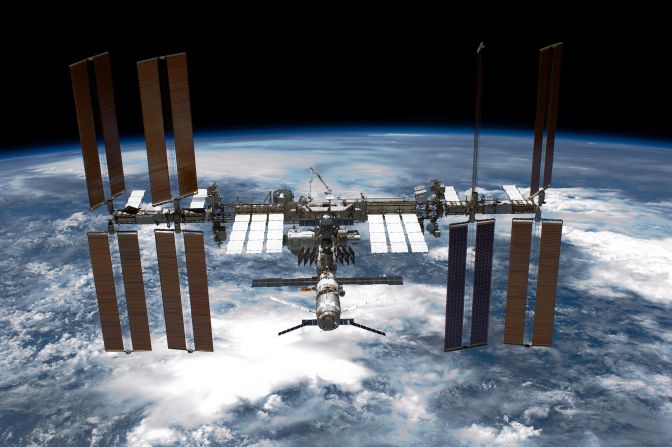
ISS research is conducted 24 hours a day, 365 days a year thanks to an internationally-coordinated effort by five control centers in Germany, Japan, Russia and two in the United States. Payload operations directors plan all experiments down to five-minute increments and often experiments are decided upon a year in advance.
Earthbound operators —
Inside the Payload Operations Integration Center at NASA's Marshall Space Flight Center in Huntsville, Alabama.