Secrets of the ‘God particle’ | CNN Business

CNN values your feedback

1. How relevant is this ad to you?
2. Did you encounter any technical issues?
Thank You!
Your effort and contribution in providing this feedback is much appreciated.
Close
Ad Feedback
Business
Markets
Tech
Media
Calculators
Videos
Markets Tech Media Calculators Videos
Watch Listen Live TV
My Account
  • Settings
  • Newsletters
  • Topics you follow
  • Sign out
Your CNN account Sign in to your CNN account

My Account
  • Settings
  • Newsletters
  • Topics you follow
  • Sign out
Your CNN account Sign in to your CNN account

Live TV Listen Watch
Edition
US
International
Arabic
Español
Edition
  • US
  • International
  • Arabic
  • Español

Markets
Tech
Media
Calculators
Videos

Follow CNN
Download the CNN App

  • World
    • Africa
    • Americas
    • Asia
    • Australia
    • China
    • Europe
    • India
    • Middle East
    • United Kingdom
  • US Politics
    • Elections 2026
    • Trump
    • Facts First
    • CNN Polls
    • Redistricting Tracker
    • Epstein Files
  • Business
    • Tech
    • Media
    • Calculators
    • Videos
  • Markets
    • Pre-markets
    • After-Hours
    • Fear & Greed
    • Investing
  • Health
    • Life, But Better
    • Fitness
    • Food
    • Sleep
    • Mindfulness
    • Relationships
  • Entertainment
    • Movies
    • Television
    • Celebrity
  • Tech
    • Innovate
  • Style
    • Arts
    • Design
    • Fashion
    • Architecture
    • Luxury
    • Beauty
    • Video
  • Travel
    • Destinations
    • Food & Drink
    • Stay
    • News
    • Videos
  • Sports
    • Football
    • Tennis
    • Golf
    • Motorsport
    • US Sports
    • Olympics
  • Science
    • Space
    • Life
    • Unearthed
  • Climate
    • Solutions
    • Weather
  • Weather
    • Video
    • Climate
  • Ukraine-Russia War
  • Israel-Hamas War
  • Features
    • As Equals
    • Call to Earth
    • Freedom Project
    • Impact Your World
    • Inside Africa
    • CNN Heroes
  • Watch
    • Live TV
    • Featured
    • CNN Fast
    • Shows A-Z
    • CNN 10
    • CNN TV Schedule
  • Listen
    • All There Is with Anderson Cooper
    • Chasing Life with Dr. Sanjay Gupta
    • The Assignment with Audie Cornish
    • Terms of Service with Clare Duffy
    • CNN 5 Things
    • All CNN Podcasts
  • Games
    • Daily Crossword
    • Jumble Crossword
    • Photo Shuffle
    • Sudoblock
    • Sudoku
    • 5 Things Quiz
  • About CNN
    • Photos
    • Investigations
    • CNN Profiles
    • CNN Leadership
    • CNN Newsletters
    • Work for CNN

Download the CNN App
Pioneers
Pioneers
Ad Feedback

Photos: Secrets of the ‘God particle’

Updated 4:20 PM EDT, Fri October 2, 2015
Link Copied!
Three years ago, scientists in Geneva, Switzerland, announced they had proved the existence of the so-called "God particle" known as Higgs boson -- a never-before-seen subatomic particle long thought to be a fundamental building block of the universe. This year, researchers from two different teams combined their measurements of the particle, providing an unprecedented picture of Higgs boson's production, decay and interaction with other particles. Click through the gallery for more.
Studying the 'God particle' —
Three years ago, scientists in Geneva, Switzerland, announced they had proved the existence of the so-called "God particle" known as Higgs boson -- a never-before-seen subatomic particle long thought to be a fundamental building block of the universe. This year, researchers from two different teams combined their measurements of the particle, providing an unprecedented picture of Higgs boson's production, decay and interaction with other particles. Click through the gallery for more.
CERN
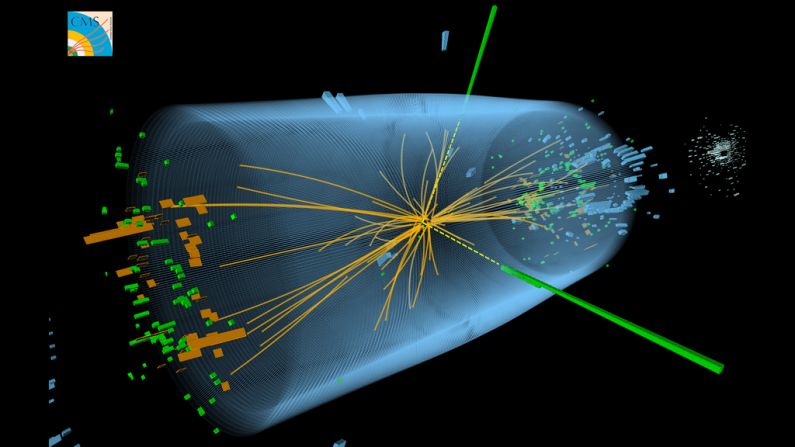
This graphic shows traces of the collision of particles from an experiment at the Compact Muon Solenoid (CMS) -- a large particle detector in Geneva.  The Standard Model of particle physics lays out the basics of how elementary particles and forces interact in the universe. But the theory crucially fails to explain how particles actually get their mass. Particles, or bits of matter, range in size and can be larger or smaller than atoms. Electrons, protons and neutrons, for instance, are the subatomic particles that make up an atom. Scientists believe that the Higgs boson is the particle that gives all matter its mass.
This graphic shows traces of the collision of particles from an experiment at the Compact Muon Solenoid (CMS) -- a large particle detector in Geneva. The Standard Model of particle physics lays out the basics of how elementary particles and forces interact in the universe. But the theory crucially fails to explain how particles actually get their mass. Particles, or bits of matter, range in size and can be larger or smaller than atoms. Electrons, protons and neutrons, for instance, are the subatomic particles that make up an atom. Scientists believe that the Higgs boson is the particle that gives all matter its mass.
AFP/Getty Images
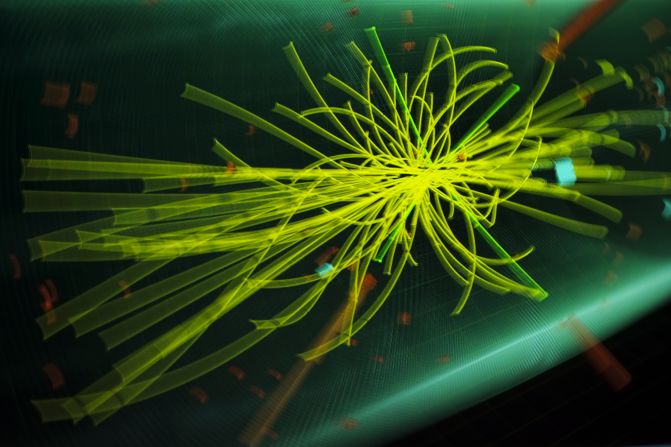
An image of the Compact Muon Solenoid (CMS) experiment. "The Higgs boson is the last missing piece of our current understanding of the most fundamental nature of the universe," Martin Archer, a physicist at Imperial College in London, told CNN. "Only now with the LHC [Large Hadron Collider] are we able to really tick that box off and say 'This is how the universe works, or at least we think it does'."
Ben Brumfield/CNN
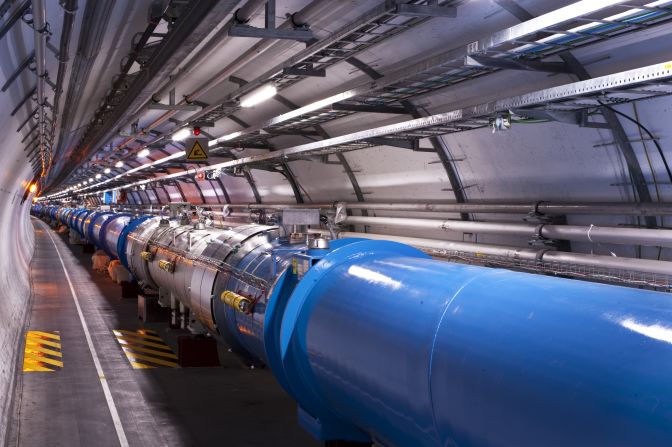
Higgs boson research takes place at the Large Hadron Collider -- a circular tunnel located 100 meters (328 feet) underground. It uses a particle accelerator to collide protons at extreme speeds. By combining their data, researchers found that there are different ways to produce a Higgs boson, and different ways for a Higgs boson to decay to other particles.

Studying the 'God particle' —
Higgs boson research takes place at the Large Hadron Collider -- a circular tunnel located 100 meters (328 feet) underground. It uses a particle accelerator to collide protons at extreme speeds. By combining their data, researchers found that there are different ways to produce a Higgs boson, and different ways for a Higgs boson to decay to other particles.
CERN
British physicist Peter Higgs, right, speaks with Belgian physicist Francois Englert at a press conference at Geneva's CERN facility in 2012. Higgs and Englert shared the 2013 Nobel Prize in Physics for describing an explanation for why particles have mass. They independently published papers on this topic in 1964.
Studying the 'God particle' —
British physicist Peter Higgs, right, speaks with Belgian physicist Francois Englert at a press conference at Geneva's CERN facility in 2012. Higgs and Englert shared the 2013 Nobel Prize in Physics for describing an explanation for why particles have mass. They independently published papers on this topic in 1964.
FABRICE COFFRINI/AFP/Getty Images/File
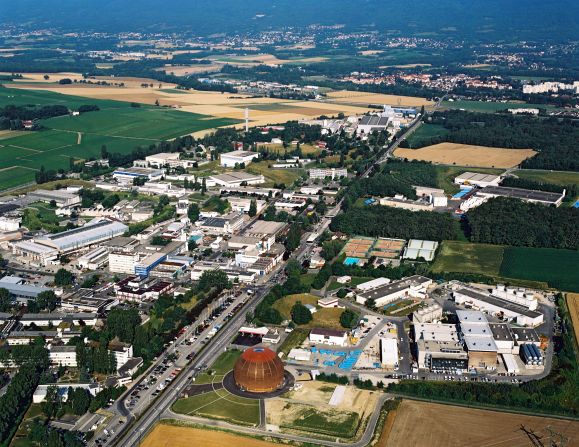
CERN's Globe of Science and Innovation exhibition center and surface buildings, which provide access to the Large Hadron Collider, can be seen near Geneva, Switzerland. CERN Director General Rolf Heuer said, "There is much benefit in combining the results of large experiments to reach the high precision needed for the next breakthrough in our field. By doing so, we achieve what for a single experiment would have meant running for at least 2 more years."
Studying the 'God particle' —
CERN's Globe of Science and Innovation exhibition center and surface buildings, which provide access to the Large Hadron Collider, can be seen near Geneva, Switzerland. CERN Director General Rolf Heuer said, "There is much benefit in combining the results of large experiments to reach the high precision needed for the next breakthrough in our field. By doing so, we achieve what for a single experiment would have meant running for at least 2 more years."
CERN
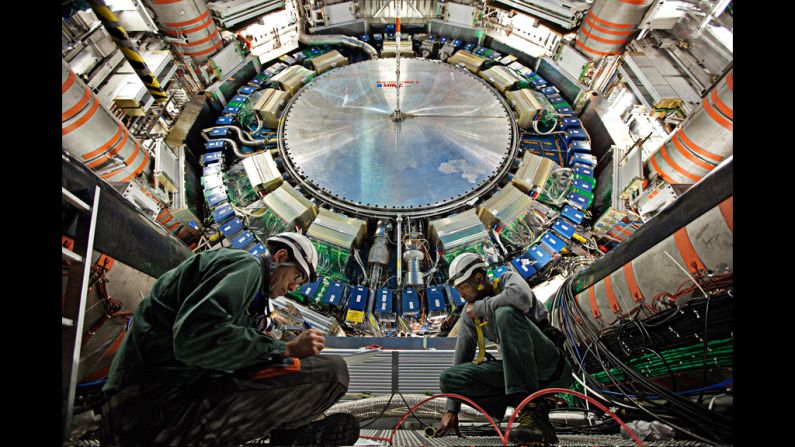
Teams from ATLAS and CMS Collaborations combined their research to obtain their results. "Combining results from two large experiments was a real challenge as such analysis involves over 4,200 parameters that represent systematic uncertainties," said CMS Spokesperson Tiziano Camporesi. "With such a result and the flow of new data at the new energy level at the LHC, we are in a good position to look at the Higgs boson from every possible angle."
Studying the 'God particle' —
Teams from ATLAS and CMS Collaborations combined their research to obtain their results. "Combining results from two large experiments was a real challenge as such analysis involves over 4,200 parameters that represent systematic uncertainties," said CMS Spokesperson Tiziano Camporesi. "With such a result and the flow of new data at the new energy level at the LHC, we are in a good position to look at the Higgs boson from every possible angle."
CERN
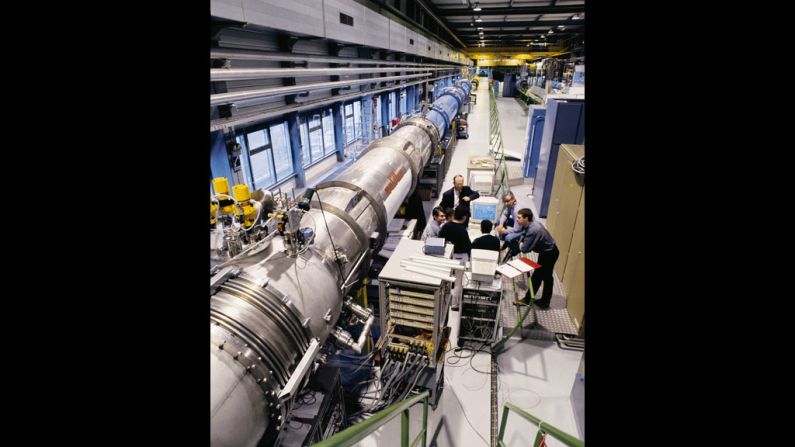
The particle accelerator magnets of the LHC are shown at the underground test facility at CERN near Geneva. Many scientists dislike the term "God particle," even though it's become popular in the media. The nickname came from the title of a book by Leon Lederman, who reportedly wanted to call it the "Goddamn Particle" since it was so hard to find.
Studying the 'God particle' —
The particle accelerator magnets of the LHC are shown at the underground test facility at CERN near Geneva. Many scientists dislike the term "God particle," even though it's become popular in the media. The nickname came from the title of a book by Leon Lederman, who reportedly wanted to call it the "Goddamn Particle" since it was so hard to find.
Barcrfot Media /Landov
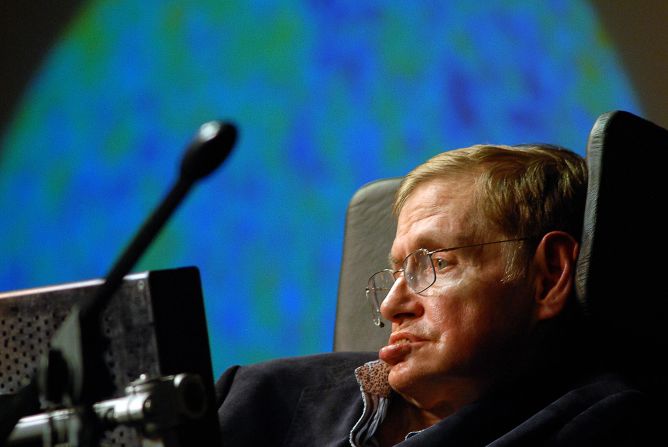
In the preface to a 2014 book, astrophysicist Stephen Hawking wrote he was worried that Higgs boson might turn unstable and lead to the end of everything. The "universe could undergo catastrophic vacuum decay, with a bubble of the true vacuum expanding at the speed of light," Hawking wrote. "This could happen at any time and we wouldn't see it coming." Not to worry too much. Hawking added that such a scenario would require a "particle accelerator that ... would be larger than Earth, and is unlikely to be funded in the present economic climate."

Studying the 'God particle' —
In the preface to a 2014 book, astrophysicist Stephen Hawking wrote he was worried that Higgs boson might turn unstable and lead to the end of everything. The "universe could undergo catastrophic vacuum decay, with a bubble of the true vacuum expanding at the speed of light," Hawking wrote. "This could happen at any time and we wouldn't see it coming." Not to worry too much. Hawking added that such a scenario would require a "particle accelerator that ... would be larger than Earth, and is unlikely to be funded in the present economic climate."

RODGER BOSCH/AFP/Getty Images

My Account
  • Settings
  • Newsletters
  • Topics you follow
  • Sign out
Your CNN account Sign in to your CNN account

Live TV Listen Watch
  • World
    • Africa
    • Americas
    • Asia
    • Australia
    • China
    • Europe
    • India
    • Middle East
    • United Kingdom
  • US Politics
    • Trump
    • Facts First
    • CNN Polls
    • Elections 2026
    • Redistricting Tracker
    • Epstein Files
  • Business
    • Tech
    • Media
    • Calculators
    • Videos
  • Markets
    • Pre-markets
    • After-Hours
    • Fear & Greed
    • Investing
  • Health
    • Life, But Better
    • Fitness
    • Food
    • Sleep
    • Mindfulness
    • Relationships
  • Entertainment
    • Movies
    • Television
    • Celebrity
  • Tech
    • Innovate
  • Style
    • Arts
    • Design
    • Fashion
    • Architecture
    • Luxury
    • Beauty
    • Video
  • Travel
    • Destinations
    • Food & Drink
    • Stay
    • News
    • Videos
  • Sports
    • Football
    • Tennis
    • Golf
    • Motorsport
    • US Sports
    • Olympics
  • Science
    • Space
    • Life
    • Unearthed
  • Climate
    • Solutions
    • Weather
  • Weather
    • Video
    • Climate
  • Ukraine-Russia War
  • Israel-Hamas War
  • Features
    • As Equals
    • Call to Earth
    • Freedom Project
    • Impact Your World
    • Inside Africa
    • CNN Heroes
  • Watch
    • Live TV
    • Featured
    • CNN Headlines
    • Shows A-Z
    • CNN 10
    • CNN TV Schedule
  • Listen
    • All There Is with Anderson Cooper
    • Chasing Life with Dr. Sanjay Gupta
    • The Assignment with Audie Cornish
    • Terms of Service with Clare Duffy
    • CNN 5 Things
    • All CNN Podcasts
  • Games
    • Daily Crossword
    • Jumble Crossword
    • Photo Shuffle
    • Sudoblock
    • Sudoku
    • 5 Things Quiz
  • About CNN
    • Photos
    • Investigations
    • CNN Profiles
    • CNN Leadership
    • CNN Newsletters
    • Work for CNN

Business
Watch Listen Live TV
My Account
  • Settings
  • Newsletters
  • Topics you follow
  • Sign out
Your CNN account Sign in to your CNN account
Follow CNN

Download the CNN app

Most stock quote data provided by BATS. US market indices are shown in real time, except for the S&P 500 which is refreshed every two minutes. All times are ET. Factset: FactSet Research Systems Inc. All rights reserved. Chicago Mercantile: Certain market data is the property of Chicago Mercantile Exchange Inc. and its licensors. All rights reserved. Dow Jones: The Dow Jones branded indices are proprietary to and are calculated, distributed and marketed by DJI Opco, a subsidiary of S&P Dow Jones Indices LLC and have been licensed for use to S&P Opco, LLC and CNN. Standard & Poor’s and S&P are registered trademarks of Standard & Poor’s Financial Services LLC and Dow Jones is a registered trademark of Dow Jones Trademark Holdings LLC. All content of the Dow Jones branded indices Copyright S&P Dow Jones Indices LLC and/or its affiliates. Fair value provided by IndexArb.com. Market holidays and trading hours provided by Copp Clark Limited.

Terms of Use Privacy Policy Ad Choices Accessibility & CC About Newsletters Transcripts Sitemap

© 2026 Cable News Network. A Warner Bros. Discovery Company. All Rights Reserved.
CNN Sans ™ & © 2016 Cable News Network.

Download the CNN app

Scan the QR code to download the CNN app on Google Play.

Scan the QR code to download the CNN app from Google Play.

Download the CNN app

Scan the QR code to download the CNN app from the Apple Store.

Scan the QR code to download the CNN app from the Apple Store.