Winning images from Environmental Photography Award show why we need to preserve nature
The winners have been announced in this year's Prince Albert II of Monaco Foundation's Environmental Photography Award. A photo of a scared elephant that had been struck by a freight train in the Lopé National Park in Gabon won the grand prize, highlighting the increasing problem of human-wildlife conflict. Explore the gallery to see more photos from this year's awards.
Jasper Doest
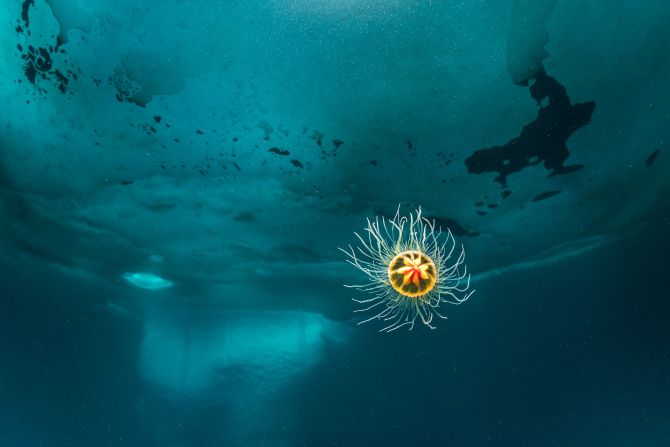
The award aims to promote conservation and environmental awareness through powerful photography. In this photo, which achieved first place in the "Polar Wonders" category, a tiny benthic hydromedusa with a bell measuring less than a centimeter is pictured. The image spotlights the little-known gelatinous organism that lives in deep or polar waters.
Franco Banfi
This image of a windswept Arctic fox photographed in Svalbard, Norway, was highly commended. In order to find food in all seasons, the fox has to cope with the Arctic's extreme conditions, but its small size and thick fur, which is as insulating as a bear's, enable it to withstand the extreme Arctic cold.
KnutM Selmer
A photograph of a man and a boy in a flooded living room in Java, Indonesia, caught the jury's attention. It is part of a long-term project by photographer Giacomo d'Orlando to document rising sea levels and how people adapt to survive the impacts of climate change.
Giacomo d'Orlando
A dog team is pictured racing through pools of water that have formed on top of melting sea ice during an evening run outside of Iqaluit, Nunavut, Canada, in June 2022. Typically, from late December until June, much of the water in this area is frozen. But as temperatures rise, the snow covering the ice melts, creating large pools of water that reveal the turquoise-blue ice beneath it.
Dustin Patar
A female short-finned pilot whale is pictured carrying her dead calf in Tenerife, Spain. Photographer Franco Banfi says that it was "really sad to witness her pain," but that it was touching that she was surrounded and consoled by other members of the pod.
Franco Banfi
A photograph taken in a village in Maharashtra, India, shows people crowding around a 20,000-liter water tanker as they fill their buckets. Water is a precious resource, and climate change is bringing more extreme weather such as droughts.
Pratick Chorge
A flock of Grandala birds perform a murmuration at an altitude of more than 4,000 meters in the Himalayas, as a snowstorm whirls behind. The photograph won first place in the competition's "Into the forest" category.
Kallol Mukherjee
Fish are pictured swimming among inactive oil rigs in Kuwaiti waters, east of Qaruh Island. The rigs have become an important artificial reef, attracting divers and fishers alike.
Suliman Alatiqi
The deccan banded gecko, an endemic species of the Western Ghats, in India, is photographed in the Amboli rainforest.
Soumya Ranjan Bhattacharyya
A jaguar in Brazil holds a caiman by the neck. Jaguars are becoming increasingly rare due to deforestation and hunting, but in the northern Pantanal plain, a UNESCO World Heritage site, they can still be spotted in their natural habitat.
Clement Fontaine
Here, elephants are sedated and lifted into lorries using cranes, before being transported from Liwonde National Park to Kasungu National Park in Malawi. The photograph, which won first place in the "Change makers: reasons for hope" category, highlights a conservation initiative designed to maintain healthy habitats in the parks and establish stable and resilient elephant populations.
Marcus Westberg
In another unusual photograph, forensic students are seen at a fake poaching crime scene at the Wildlife Forensics Academy in Buffelsfontein, South Africa. The Academy was set up in 2022 to equip rangers and other environmental law enforcement officers with the skills needed to collect the vital forensic evidence required to convict poachers in court.
Tommy Trenchard
A turtle is pictured swimming in an artificial dome-shaped reef (known as an "igloo") which was built and placed in the sea more than 20 years ago. After corals were transplanted to the igloo, others established themselves naturally, attracting many species of fish and other marine animals.
Tom Shlesinger
First place in the "Ocean Worlds" category was a picture of California sea lions in Espiritu Santo National Park in Mexico. Here, the species enjoys protected status and a no-fishing zone provides them with a safe environment.
Simon Biddie
High school students in Monaco -- where the foundation that runs the awards is based -- were also invited to vote for their favorite photograph. They chose a surreal image of Iceland's Mýrdalsjökull glacier, the fourth largest ice cap in the country.