What we covered here
• Tankers seized: The US has seized two oil tankers linked to Venezuela, including a Russian-flagged vessel. President Donald Trump is “not afraid” to continue seizing sanctioned oil tankers despite concerns that it could ratchet up tensions with Russia and China, the White House said. Sigue nuestra cobertura en español.
• Venezuela death toll rises: Venezuela’s interior minister said at least 100 people were killed in the US attack to seize President Nicolás Maduro. Cuba previously said 32 of its citizens were killed in the attack.
• Spotlight on Greenland: The US is discussing the potential purchase of the Arctic island, the White House said, and Secretary of State Marco Rubio is scheduled to meet with Danish leaders next week.
Our live coverage has ended for the day. Get the latest here.
Former US Vice President Mike Pence pushes for acquisition of Greenland through financial, not military, means

Former Vice President Mike Pence on Wednesday pushed for a financial agreement for a US acquisition of Greenland rather than military assault, following mounting speculation from the White House about the future of the Arctic island.
“There ought to be some long-term financial arrangement that would allow us to acquire that land, just like the Louisiana purchase, just like Alaska and beyond,” Pence told CNN’s Kaitlan Collins on “The Source.”
The White House has signaled that President Donald Trump is “discussing a range of options” to acquire Greenland, and that using the US military is not off the table.
Trump has repeatedly stated that he wants to annex Greenland – a huge, resource-rich island in the Atlantic and self-governing territory of Denmark – claiming that this is needed for American security purposes.
Pence noted in the event of a military attack on Greenland, “every NATO ally would be called upon to either drop out of NATO or come to the defense of that country” but said he fully supports the notion of finding a way forward with Denmark.
At least 100 people were killed during US raid, Venezuela's interior minister says

The US attack on Venezuela to seize the country’s President Nicolas Maduro killed at least 100 people, according to the country’s interior minister.
The Cuban government said on Sunday that 32 of its citizens were killed during the operation “in combat actions,” performing missions on behalf of the Cuban Armed Forces and interior ministry. Cabello did not specify whether this was part of the 100 reported dead.
US President Donald Trump previously said no US service members were killed, though some were injured when a helicopter was hit during the attack.
This post was updated with more details on the toll.
Colombia's president says call with Trump helped ease tensions

Colombian President Gustavo Petro said on Wednesday he spoke with his US counterpart Donald Trump, in a phone call that had helped ease tensions between the two governments.
Petro said the call was his first with Trump since the US president returned to office and that it lasted about an hour.
Petro said the two leaders agreed to restore direct communication channels between their governments, including between foreign ministries and presidential offices.
Petro reiterated to his supporters that he believes the US operation in Venezuela that seized President Nicolás Maduro was “illegal” and said he raised concerns about US rhetoric toward Venezuela, warning that threats related to oil and other natural resources risk fueling regional instability.
On Saturday, during a press conference held hours after the capture of Maduro, Trump reiterated his claims that Petro was connected to drug trafficking, and warned him to “watch himself.”
On social media on Wednesday, Trump said that he “appreciated” the call he had with Petro, and had invited the Colombia president for a meeting at the White House in the “near future.”
Venezuela's Rodriguez insists country is "not at war" and welcomes mutually beneficial energy ties
Acting President Delcy Rodriguez today emphasized Venezuela’s readiness to pursue energy partnerships and noted the history of economic and commercial relations with the United States.
Rodriguez was sworn in Monday after President Nicolás Maduro was seized by US forces and brought to trial in New York on drug and weapons charges.
She dismissed allegations of Venezuela’s involvement in drug trafficking as well as criticism of democracy and human rights in the country. She labeled them “falsehoods” which served as excuses for foreign interests in the country’s oil.
Rodríguez insisted on criticizing the operation carried out by the United States, which she described as “a stain” on the bilateral relationship, but assured that Venezuela “is not at war.”
On the issue of oil, Rodriguez said it “must be delivered to the global North,” reiterating Venezuela’s position that “Venezuela is open to energy relations where all parties benefit.”
Here's a roundup of diplomatic news related to Venezuela today
There have been some diplomacy developments around Venezuela and oil in the last few hours.
Here’s what to know:
Conversations between leaders:
- US President Donald Trump spoke on the phone with British Prime Minister Keir Starmer about the two oil tankers that the US seized today as well as developments in Venezuela.
- Trump also spoke to Colombian President Gustavo Petro. And in stark contrast to his critical remarks Sunday about the South American leader, Trump said on social media that he “appreciated” the call and invited Petro for a meeting at the White House in the “near future.”
- US Secretary of State Marco Rubio spoke with G7 foreign ministers yesterday about the US operation in Venezuela, according to a State Department readout.
On trade:
- Energy Secretary Chris Wright told CNN he is getting “barraged” with interest from US oil CEOs who want to help develop Venezuelan oil infrastructure, after meeting with industry executives in Miami today.
- Trump said in a separate social media post today that Venezuela will be purchasing “ONLY American Made Products” with the proceeds coming from the oil deal between the two countries, without providing additional information on the mechanisms for that.
Other news:
- Trump said in another social media post that he will propose the 2027 defense budget be $1.5 trillion, an increase of 50% over this year’s budget.
- GOP Sen. Lindsey Graham said that Trump has given the greenlight on a long-awaited bill to impose stiff sanctions on countries purchasing Russia oil — and the bill could come up in the Senate next week.
- The Justice Department’s Office of Legal Counsel wrote a new memo that provided legal justification for the US capturing Venezuelan leader Nicolás Maduro, sources say. The details of the memo are not immediately clear. And while Attorney General Pam Bondi told lawmakers today she would provide them with copies of the memo soon, one source told CNN the memo is likely to remain classified.
No sense in "negotiating with people at gunpoint,” Danish politician says of Greenland dispute

A Danish member of the European parliament has told CNN that Denmark will not negotiate a sale of Greenland to the United States.
In an interview with CNN’s Jim Sciutto, Anders Vistisen responded to Secretary of State Marco Rubio’s statements about President Donald Trump’s plans to buy the Arctic island, firmly rejecting any notion that the territory could be sold.
His comments come after the White House on Tuesday declined to rule out the use of the military to gain control of Greenland, a self-governing territory of Denmark.
When asked if US pressure to force Denmark to give up Greenland could effectively end the alliance between the two countries, the Danish lawmaker warned of serious consequences.
“To be honest, Denmark, from left to right on the political spectrum, has been quite positive toward the US. That is changing. And that is not just coming back, even if this issue is resolved.”
Vistisen said both Denmark and Greenland were firm on the matter. “If the US wants to take Greenland, it has to be by military power. We are not going to negotiate in this way.”
The Danish politician’s remarks echoed those of his country’s leaders. Danish Prime Minister Mette Frederiksen reiterated on Monday that “Greenland has repeatedly said that it does not want to be part of the United States.”
Vistisen also warned recent US rhetoric had caused a breakdown in international public trust in America.
“The communication from the US has pushed many European allies toward China. When you’re asking who is the greatest adversary, people don’t necessarily put (the) US far behind China or Russia,” he said.
Graham says Trump has “greenlit” bipartisan Russia sanctions bill

GOP Sen. Lindsey Graham said that President Donald Trump has given the greenlight on a long-awaited bill to impose stiff sanctions on countries purchasing Russia oil — and the bill could come up in the Senate next week.
Graham said in a post on X that he had a “very productive” meeting on Wednesday with the president “on a variety of issues,” and he said that Trump “greenlit the bipartisan Russia sanctions bill.”
A White House official told CNN that the president supports the legislation.
Despite having more than 80 cosponsors from across the political spectrum, the bill has languished without a vote as Senate GOP leadership has indicated they were working with the Trump administration to sort out when it could be brought to the floor. Senate Majority Leader John Thune repeatedly told reporters that they wanted to work in unison with the administration on the government’s policy on Russia, and they’d need President Trump’s approval to schedule a vote.
The announcement by Graham that Trump has “greenlit” the legislation comes as Trump’s foreign policy has been in the spotlight, following the US capture of then-Venezuelan President Nicolás Maduro. The US on Wednesday also seized two oil tankers linked to Venezuela, including a Russian-flagged vessel. President Donald Trump is “not afraid” to continue seizing sanctioned oil tankers despite concerns that it could ratchet up tensions with Russia and China, the White House said.
Graham and Democratic Sen. Richard Blumenthal have been pushing for a floor vote on their sanctions legislation for months, arguing that the way to break Putin’s war machine in Ukraine is through Russia’s reliance on oil markets.
The bill would allow the president to impose harsh sanctions on nations that purchase oil, natural gas and uranium from Russia, with exceptions for countries who have made contributions to Ukraine’s war effort.
US attorney general told lawmakers DOJ's legal justification for capturing Maduro will be shared, sources say

The Justice Department’s Office of Legal Counsel wrote a new memo that provided legal justification for the US military operation that captured then Venezuelan President Nicolás Maduro on Saturday, according to three sources familiar with the matter.
The details of the memo are not immediately clear.
Attorney General Pam Bondi told lawmakers on Wednesday she would provide them with copies of the memo soon, though one source told CNN the memo is likely to remain classified.
Background: Maduro’s capture was met with immediate bipartisan criticism over whether the United States had the authority to conduct the arrest of a foreign president abroad without congressional approval. Some legal scholars — and Maduro’s attorneys — have suggested it may have violated federal law.
Inside the Justice Department, officials have also been citing a separate memo from 1989, which claimed that a president had “inherent constitutional authority” to order the FBI to take people into custody in foreign countries, even if it violated international law to do so.
Trump and British prime minister discussed seized tankers, Greenland and Venezuela during call, Starmer says
In a call tonight, US President Donald Trump and British Prime Minister Keir Starmer spoke about the two oil tankers that the US seized today as well as developments in Venezuela.
Trump says he “appreciated” Petro’s call and invited him for a meeting at the White House in the "near future"

President Donald Trump said on social media Wednesday that he “appreciated” the call he had with Colombian President Gustavo Petro on Wednesday and invited Petro for a meeting at the White House in the “near future.”
In a statement, the Colombian government said it “welcomes the constructive tone of the exchange and notes that, through established diplomatic channels, arrangements are being advanced for a meeting between the two Presidents in Washington, D.C.”
“Colombia remains committed to open dialogue and constructive engagement with the United States, guided by mutual respect and understanding and a shared interest in regional stability,” the statement said.
Trump’s comments today marked a stark contrast to his remarks Sunday when he described Petro as “a sick man who likes making cocaine and selling it to the United States, and he’s not going to be doing it very long.”
A White House official previously told CNN that both Venezuela and drug labs were part of the conversation between the two leaders.
This post was updated with the Colombian government statement.
Diosdado Cabello: the powerful Venezuelan minister who may be in jeopardy next

In the wee hours of Saturday, shortly after Venezuelan President Nicolás Maduro was captured, blindfolded and taken to the United States, video emerged of Interior Minister Diosdado Cabello surrounded by a group of armed men in Caracas.
Maduro’s abduction “was a criminal, terrorist attack against our people,” said Cabello, clad in a bulletproof vest and helmet. The sky was still dark, and the buzz of drones could be heard overhead.
“I ask people to stay calm,” Cabello continued. “Trust our leadership. Trust in our military and political leaders during the situation we’re facing.”
That morning, US Attorney General Pam Bondi released the unsealed US indictment against Maduro, accusing him of drug trafficking, among other offenses. Cabello’s name was the second on the indictment, just below Maduro’s. With Maduro in US custody, Cabello is arguably the most powerful Venezuelan official named in the superseding indictment.
"We are not a colony but a sovereign country." Colombians protest as tensions increase between Petro and Trump
Colombians took to the streets today to protest against the United States and its President Donald Trump.
The demonstration comes as tension escalates between Trump and Colombian President Gustavo Petro in the aftermath of US capturing and removing Venezuelan leader Nicolás Maduro from power over the weekend.
Some context: Trump had harsh words for Petro on Sunday, describing him as “a sick man who likes making cocaine and selling it to the United States, and he’s not going to be doing it very long.”
When pressed by a reporter on whether those comments meant there could be an “operation” in Colombia in the future, Trump responded, “Sounds good to me.”
Americans are closely divided on US military action to remove Maduro, poll shows

Americans are closely divided on the US military action in Venezuela that captured Nicolás Maduro and removed him from power, according to a CBS News/YouGov poll released today, with 48% approving and 52% disapproving.
That echoes the findings of earlier Washington Post and Reuters/Ipsos polls, both of which also showed the public closely divided.
The CBS poll, conducted Monday through Wednesday, puts Trump’s approval rating for handling the situation with Venezuela at 43%, similar to his 41% job approval rating overall in the survey.
A 62% majority of Americans say that they would oppose further US military action in Venezuela if the Venezuelan government does not cooperate with the US, with 67% saying they’d oppose the US taking military action against other countries in the region that do not cooperate with US interests.
The CBS News/YouGov poll was conducted January 5-7, and surveyed 2,325 U.S. adults using a nationally representative online panel. Results among the full sample have a margin of sampling error of +/- 2.4 percentage points.
Take a look at Venezuela's oil infrastructure
The largest oil reserves of any country on the planet, more than 300 billion barrels, are estimated to lie beneath the ground in Venezuela. US President Donald Trump is now laying claim to these vast deposits after his capture of the country’s president Nicolás Maduro.
See how the country’s oil infrastructure is mapped out below:
Here's how some lawmakers are reacting to the White House plans for Venezuela, Greenland and the seized tankers
US lawmakers had a lot to say today as the Trump administration outlined its strategy for Venezuela in the aftermath of the capture this weekend of President Nicolás Maduro and his wife in Caracas.
They also weighed in on the US seizure of oil tankers linked to Venezuela and the White House remarks about acquiring the Danish territory of Greenland.
Here’s some of the reaction:
Republican Sen. Eric Schmitt of Missouri told reporters he thought the administration outlined a clear plan during a briefing today.
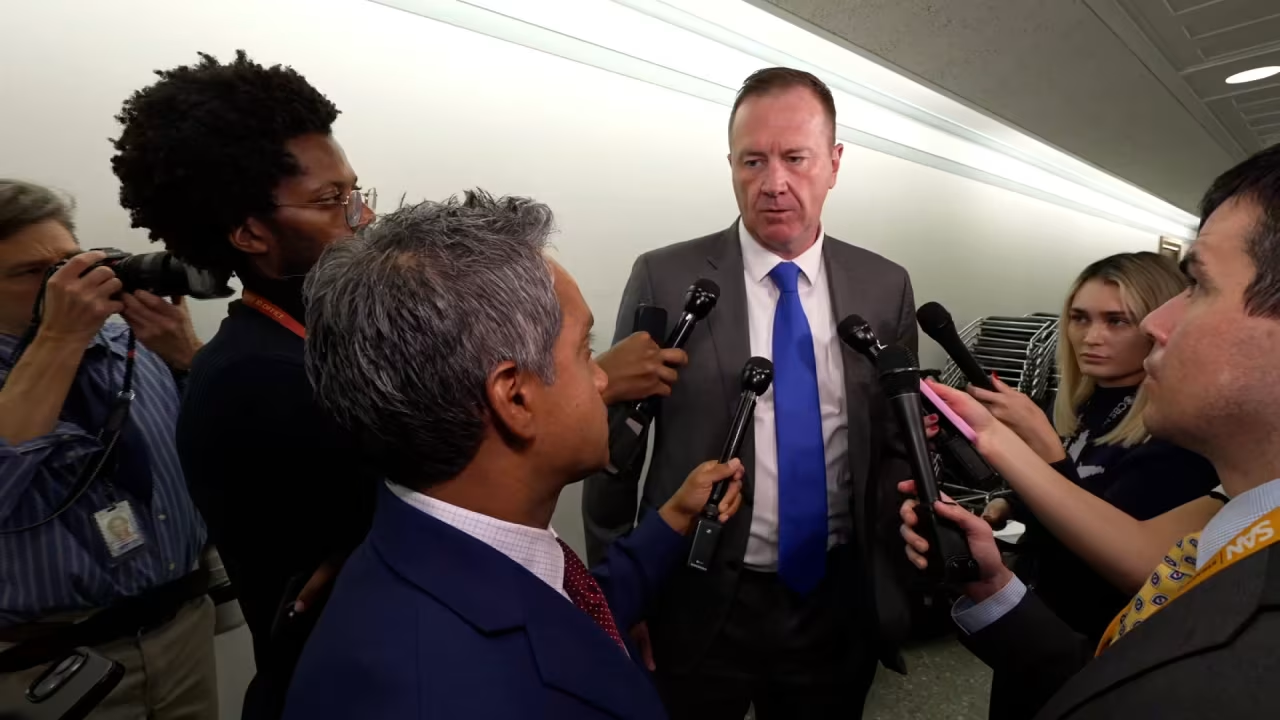
GOP Sen. Kevin Cramer of North Dakota said the administration’s briefing was like a good “movie script” and the operational details they heard were very interesting. He said he’s not upset his Senate Armed Services Committee was not briefed ahead of time because it had to be closely held.
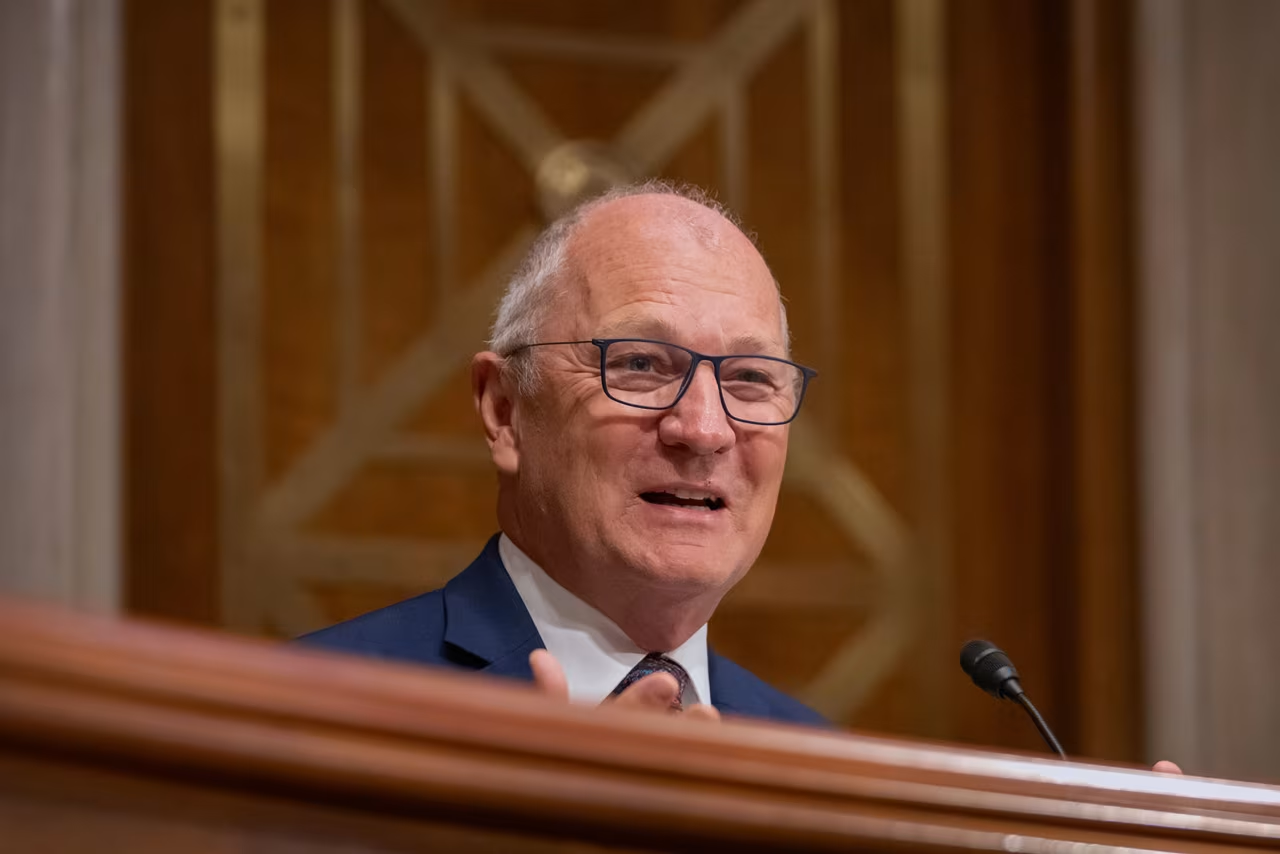
Rep. Adam Smith, the top Democrat on the House Armed Services Committee, told CNN he believes the administration’s plan right now is to “sort of force the current regime to cooperate,” noting that it is “basically the Maduro regime without Maduro” and concerns remain about links to drug cartels.

Democratic Sen. Ruben Gallego of Arizona said each of the briefers — which included Secretary of Defense Pete Hegseth and Secretary of State Marco Rubio — spoke for roughly 15 minutes, with very little time for substantive back-and-forth with members.

Democratic Sen. Chris Murphy of Connecticut accused Trump officials of lacking a cohesive strategy, saying

Democratic Sen. Ben Ray Lujan of New Mexico demanded public hearings and the declassification of some Venezuela operation information:

As for Greenland:
GOP Sen. John Kennedy of Louisiana warned against using the US military:

And on the US seizure of a Russian-flagged oil tanker linked to Venezuela, Democratic Sen. John Fetterman of Pennsylvania praised the US:
CNN’s Alison Main, Manu Raju, Logan Schiciano, Ted Barrett, Sarah Ferris and Camila DeChalus contributed to this post.
There's been so much news today about Venezuela, Greenland, Russia and oil markets. Here's what to know
An all-senators classified briefing ended this afternoon and US lawmakers and Trump officials have talked about US plans for Venezuela’s oil, acquiring Greenland and more.
Here’s what to know:
The US has planned phases for Venezuela: Below is what US Secretary of State Marco Rubio said about the three phases: stabilization, recovery and transition:
- Stabilization will include the oil deal announced by President Donald Trump yesterday. The administration expected to soon be able to sell millions of barrels of Venezuelan oil and generate revenue that the US will disperse “in a way that benefits the Venezuelan people.”
- Recovery will ensure that American and other companies have fair access to Venezuelan market, and the opposition forces can be released from exile, hiding or prison so civil society can rebuild.
- Transition will cede the transformation of the country to its people.
House Speaker Mike Johnson after the briefing said he does not expect the US to send troops to Venezuela. Senate Minority Leader Chuck Schumer said he was dissatisfied with some responses the administration.
On the ground in Venezuela:
- The people of Venezuela go about their daily lives during the day, but the streets empty out and bars and restaurants close as the sun sets. Crackdowns on the Venezuelan population would not be consistent with the Trump administration’s priorities, White House press secretary Karoline Leavitt said in a briefing today.
- Venezuela’s newly installed acting president Delcy Rodríguez placed trusted officials in key positions as she tries to shape the government to her liking. At a televised event yesterday afternoon, she outlined a series of growth targets for Venezuela’s economy and made no mention of deposed President Nicolás Maduro.
Developments on oil:
- There was a partisan split among senators on the feasibility of Trump administration’s plan for controlling oil in Venezuela.
- Venezuela’s state-owned oil company, Petróleos de Venezuela, SA (PDVSA), said today it is in negotiations with the US “for the sale of oil volumes.”
- Press secretary Leavitt said significant private sector interest is emerging around the oil industry.
- Russia’s foreign ministry demanded the US return the Russian citizens aboard today’s seized oil tanker “to their homeland,” according to the Russian state news agency TASS. The agency also reported Russian lawmaker Leonid Slutsky calling the US seizure of the tanker an act of “21st-century piracy.” Ukraine welcomed the US seizure.
- Trump is “not afraid” to continue seizing sanctioned oil tankers and “enforcing the embargo against all dark fleet vessels that are illegally transporting oil,” Leavitt said during her press briefing.
Persistent interest in Greenland:
- Some GOP lawmakers are defending Trump’s interests while others are warning against military action to acquire Greenland. Speaker Johnson broke with the White House in suggesting that such an option is not on the table.
- Administration is “actively” discussing the potential purchase of Greenland, Leavitt said. US top diplomat Rubio said that he will meet with Danish officials next week.
- The European Council president issued a statement in support of Denmark, Greenland and the people. “Europe will remain a firm and unwavering champion of international law and multilateralism,” Antonio Costa said in a speech today.
- Meanwhile, GOP Sen. Thom Tillis suggested that a senior White House adviser’s job should be at risk for his recent comments on Greenland. “Look either Stephen Miller needs to get into a lane where he knows what he’s talking about or get out of this job,” Tillis told CNN’s Jake Tapper.
Energy secretary says he is getting "barraged" with interest from oil CEOs on Venezuela

Energy Secretary Chris Wright told CNN he is getting “barraged” with interest from US oil CEOs who want to help develop Venezuelan oil infrastructure, after meeting with industry executives in Miami Wednesday.
“I’m getting barraged with inbounds,” Wright told CNN’s Jake Tapper on “The Lead,” describing the communications from companies as, “‘We’re interested. How can we get involved?’” CNN has previously reported there has been skepticism within the oil industry about getting Venezuela safe and stable enough to allow companies to set up infrastructure there.
Wright said the Trump administration “won’t be twisting or convincing anyone’s arms” but will work to get Venezuela’s political stability on a surer footing and acknowledged that process would take time.
“Of course, to make the very big, long-term investments, we’ve got to get the government in a better place where they’ve got secure rule of law, national security, and that’s a process,” Wright said.
After saying Wednesday morning that Venezuelan oil money will be controlled by the US, Wright suggested the process of getting US accounts up and running to deposit that money was still being set up.
“We’re still working out the logistics of that, and there’s some legal things that are involved in that,” he said. “But whichever account this ends out in – I’ll know in 24 hours – is going to be controlled by the United States government.”
“We’re going to sell that crude, we’re going to put it in accounts, and we’re going to distribute that funds to the interim authorities in Venezuela and align that with incentives to improve their behavior, end the criminality, reduce the risk to America and the risk to their own citizens, and work with us to construct more confidence in that,” Wright said.
Trump says that Venezuela will be purchasing "ONLY American Made Products” with oil deal proceeds
President Donald Trump said in a social media post Wednesday that Venezuela will be purchasing “ONLY American Made Products” with the proceeds coming from the oil deal between the two countries, without providing additional information on the mechanisms for that.
“I have just been informed that Venezuela is going to be purchasing ONLY American Made Products, with the money they receive from our new Oil Deal. These purchases will include, among other things, American Agricultural Products, and American Made Medicines, Medical Devices, and Equipment to improve Venezuela’s Electric Grid and Energy Facilities,” the president wrote on Truth Social.
“In other words, Venezuela is committing to doing business with the United States of America as their principal partner,” he added.
Trump’s latest remarks come after he announced on Tuesday that Venezuela will turn over 30 million to 50 million barrels of oil to the United States, to be sold at market value and with the proceeds controlled by the US.
CNN has reached out to Venezuela’s Ministry of Communication and Information for comment.
Navy SEALs helped seize Russian-flagged tanker
US Navy SEALs were among the US forces that boarded and seized the Bella 1 tanker on Wednesday morning in the north Atlantic, according to two people briefed on the operation.
The SEALs were transported to the tanker by the US Army’s 160th Special Operations Aviation Regiment, also known as the “night stalkers,” the people said.
The Pentagon declined to comment, saying it does not confirm or comment on Special Operations Forces assets.
The US last used Special Operations Forces and assets to help interdict a sanctioned tanker on December 11, when it supported a US Coast Guard operation near the coast of Venezuela to seize the Skipper, a very large crude carrier that was falsely flying Guyana’s flag.