Final sprint to Election Day
• Democratic hopes on midterm eve: A series of New York Times/Siena polls show Democrats leading in five of seven key battleground states that could decide Senate control. Michigan Democratic nominee Abdul El-Sayed leads Rogers by 11 points and Texas Democrat James Talarico leads Ken Paxton by seven.
• Haley Stevens talks to CNN: The Michigan Democrat struggled at times to defend flipping her endorsement from the state’s Senate nominee Abdul El-Sayed to Mike Rogers, telling Anderson Cooper her backing of the Republican is “rock solid,” but refusing to explain her switch.
• Trump interview: Meanwhile, President Donald Trump reiterated that he plans to exert his executive authority to veto Democratic-led legislation if they win back power in Congress. The president closes the midterm campaign with telerallies and a speech at the Lincoln Memorial Reflecting Pool today.
Sign up for breaking news email alerts to get the most important election updates in your inbox.
Updates
(20)"I'd love to run again if I had the chance," Trump says

President Donald Trump said that he’d love to run for president again if the Constitution allowed it.
“I’d love to run again if I had the chance, but the language is very exacting,” Trump told Miranda Devine on New York Post’s “Pod Force One.”
Trump has previously mused about running for a third term but has also referred to the clear restriction written in the 22nd Amendment, which bars a person from being elected “to the office of President more than twice.”
At a rally in Iowa last month, Trump said he believed he has “the right to run again because they cheated,” referring once again to his false claims of election fraud in the 2020 election.
“I think the law said — I’m not 100% sure — but I think the law says that I’m not allowed to run again. I’ve studied that phrase,” Trump said at the time.
Trump says he'll become "Mr. Veto," if Democrats win back power of Congress

President Donald Trump reiterated that he plans to exert his executive authority to veto Democratic-led legislation if they win back power in Congress.
The interview, which was taped on Friday, was released this morning. It comes as new polls suggest Democrats are within striking distance of Senate control.
Asked if he’ll be able to continue what he’s doing as president and work with Democrats if they win, Trump said: “Well, if that happens, I guess I’ll become Mr. Veto.”
“Then at some point, we’ll probably make deals. That’s what’s happened. I mean, this wouldn’t be the first time,” he said.
“They’ll be sending stuff up. You veto it, and eventually, after a month or two of getting all vetoed, they just waste — they come over, and you make a deal,” Trump added. “Hopefully, we don’t have to worry about that.”
Trump made similar comments to reporters in late October that while he believes “Republicans are going to win,” his plan is to veto Democratic-led legislation to force the other party into a negotiating position with Republicans.
Haley Stevens' mother says she's "very proud" of daughter

The mother of Michigan’s Democratic Rep. Haley Stevens told Reuters she is “very proud” of her daughter following Stevens’ endorsement of the Republican Senate nominee Mike Rogers.
“I am proud of Haley for standing up for her values, for standing up for the Democratic Party, even though it feels like, ‘oh my gosh, you’ve done something bad,’” Maria Marcotte told Reuters.
“But you know, I think history will say she’s done something good for the party in that, take a look at yourselves, and look at what the values are. And take a look at standing for values and standing for the people of Michigan and for all the citizens of Michigan. I’m proud of her. I’m very proud of her.”
Stevens has been heavily criticized by members of her own party for the surprise endorsement of the Republican candidate in her state.
Marcotte, a retired advertising executive, told CNN in a statement yesterday that her daughter’s fiancé had nothing to do with the change of heart and that Marcotte herself had also voted for Rogers.
Mortgage rates have climbed since the Iran war began. A look at Trump's housing agenda


America’s housing market is paralyzed, with buyers pulling back and builders growing more pessimistic ahead of the midterms.
Adding to the strain: Mortgage rates have surged back above 7% in recent weeks, hitting a three-year high of 7.4% last month. The average 30-year fixed rate eased slightly to 7.24% last week, according to Freddie Mac.
President Donald Trump won the 2024 election amid growing frustration over the cost of living. Two years later, affordability remains a defining issue heading into the midterm elections.
But while the White House has taken some steps aimed at housing affordability during Trump’s second term, the issue has featured relatively little in the administration’s public messaging over the last two years.
Trump said on the 2024 campaign trail that his plan for tackling the cost of housing would primarily rely on lowering interest rates.
“We’re going to make it easier to buy. We’re going to get interest rates down,” Trump said at the start of this year.
For a brief moment, mortgage rates appeared poised to fall. In January, Trump directed Fannie Mae and Freddie Mac, the government-sponsored enterprises that underpin much of the US mortgage market, to buy $200 billion in mortgage-backed securities in an effort to push rates lower.
But the reprieve was short-lived. Mortgage rates climbed once again after the US began its war with Iran, and have remained elevated since.
Read more here on Trump’s housing agenda.
Trump is rounding out his midterms campaigning today. Here's what's on the schedule

President Donald Trump will be rounding up his midterms campaigning today, with appearances expected at several telerallies in a final push before Election Day tomorrow.
The president will also be holding an event at the Reflecting Pool “just to show how beautiful it is,” he told reporters yesterday. He is expected to talk about his DC projects and reopening the pool, but also make a broader “closing argument” about the midterms, people familiar with the matter told CNN.
Here’s some of the other events taking place today:
- In Michigan, Republican Senate nominee Mike Rogers will hold a rally, a day after Democrat Haley Stevens announced she was breaking with her party to endorse Rogers over his Democratic opponent Abdul El-Sayed.
- El-Sayed will also be appearing at several rallies across the state, joined by officials including Massachusetts Sen. Elizabeth Warren and Michigan Sen. Elissa Slotkin.
- In Texas, Democratic Senate candidate James Talarico will be holding his final rally before Election Day in Austin.
- His opponent, Republican Attorney General Ken Paxton will hold at least two events in the state, joined at one by Texas GOP Sen. Ted Cruz and another by former basketball player Enes Kanter Freedom.
We’ll bring you news from these events as we get them, as well as any other significant developments today.
CNN’s Molly English, Alayna Treene and Kevin Liptak contributed to this reporting.
The positions in the House and Senate up for election in this year's midterms

Voters have been casting their ballots in the midterm elections, but exactly what they are choosing depends on where they are based in the country.
Members of the US House of Representatives, as well as a third of Senate members, are elected in the midterms, while states can also add local races to their voters’ ballots.
Here’s a closer look at representatives, senators and governors, some of the key positions up for grabs in midterms races.
Representatives
A total of 435 representatives, or congressmen and congresswomen, make up the House of Representatives, also known as the House.
The House, alongside the Senate, makes up the US Congress, which has the sole authority to enact legislation and declare war, according to the White House. Both major US political parties want control of Congress.
Voted in every two years, representatives are able to introduce bills and resolutions, offer amendments and impeach federal officers, among other duties.
The number of representatives per state is proportionate to its population. There are currently 218 Republican representatives, 214 Democrat representatives, and one Independent representative in the House, according to the House Press Gallery.
Senators
In this year’s elections, 35 out of a total 100 Senate seats will be up for grabs. Each US state has two senators, whose terms last a total of six years. Roughly a third of Senate seats are on the ballot in any given election.
Currently, 53 Senators are Republican, 45 are Democrat and two are Independent.
The Senate is the only power able to confirm presidential appointments and ratify treaties, according to the White House, though there are two exceptions to this: when a vice president is appointed or when treaties involve foreign trade. Then, the House of Representatives must also approve.
The Senate also tries impeachment cases for federal officials.
Governors
Voters will be electing governors in 36 states on November 3.
The National Governors Association (NGA) describes governors as the “chief executive officers” of the country’s states, as well as US territories.
Governors are often responsible for implementing state laws and policies, appointing state officials, approving state budgets and handling local emergencies and disasters, according to the NGA. They also liaise with the federal government on behalf of their state.
Notably, the amount of power a governor can wield varies by state, the NGA says, depending on state constitutions, legislations, and tradition.
The term of a governor is typically four years, except in New Hampshire and Vermont, where gubernatorial terms last two years.
Election officials bracing for Trump's possible voting-day disruptions



Election officials have spent months preparing to run the 2026 vote — and bracing for what could disrupt it. They’re training workers, tightening security and readying legal challenges for threats that could stretch well beyond Election Day.
Planning for trouble is part of running elections. But this year’s preparations by state and local officials come amid a ramped-up campaign by President Donald Trump and his allies to undermine confidence in voting integrity and assert greater federal control over elections.
Officials have spent months considering what that might look like: a last-minute executive order, ballot seizures, federal agents at the polls or efforts to undermine trust in the results.
Trump and his allies continue to allege widespread noncitizen voting and election fraud, including in midterm voting already underway. They have threatened to prosecute election officials who fail to secure the vote or allow noncitizens to cast ballots and have filed lawsuits to restrict the counting of disputed ballots in California and the certification of results in Alaska.
Some election leaders have prepared for the administration to potentially take even more drastic steps on or after Election Day, like disrupting polling places, confiscating ballots or election equipment, challenging the results or going after election administrators.
So far, Trump’s attempts to interfere have mostly played out in the courts and with letters demanding that election officials set aside certain ballots so that those who cast them could be investigated — requests administrators have been rebuffing. Early in-person voting has been underway in states across the country — in some states, for weeks — and there have been no reports of major disruptions involving the federal government.
But officials are prepared in case that changes.
The 11 Senate seats most likely to flip


1. North Carolina
North Carolina is the Senate seat most likely to flip, with Democrats appearing on track to win their first Senate race in the state since 2008. Democrat Roy Cooper was leading GOP Senate nominee Michael Whatley by 14 points among likely voters in a final poll from High Point University/YouGov.
2. Ohio
The CNN Poll of Polls average shows former Sen. Sherrod Brown leading GOP Sen. Jon Husted by 5 points, 50% to 45%.
3. Texas
A pair of polls released in the last few days – including one from the New York Times/Siena and another from CNN – show Democratic Senate candidate James Talarico performing ahead of GOP Ken Paxton, outside the margin of error.
4. Maine
A CNN Poll of Polls average shows Democratic Troy Jackson leading GOP Sen. Susan Collins by 4 points – 50% to 46%.
5. Alaska
A NYT/Siena poll released Sunday showed no clear leader in the contest between Democratic former Rep. Mary Peltola and Sen. Dan Sullivan – 48% to 46%.
6. Kansas
GOP Sen. Roger Marshall appears on shaky ground against Democratic Adam Hamilton, who is hoping to be the first Kansas Democrat elected to the US Senate since 1994.
A NYT/Siena poll released Sunday showed Hamilton leading Rogers 49% to 44%, while a recent CNN poll conducted by SSRS found no clear leader in the contest.
7. Iowa
CNN’s Poll of Polls average shows no clear leader in the contest between Democratic Josh Turek and GOP Rep. Ashley Hinson who sit at 46% and 45%, respectively.
8. Michigan
New signs suggest Democrat Abdul El-Sayed may have an upper hand over GOP former Rep. Mike Rogers. CNN’s Poll of Polls average shows El-Sayed leading Rogers in Michigan – 50 to 45%. That includes a NYT/Siena poll, which found El-Sayed with an 11-point advantage.
9. New Hampshire
A University of New Hampshire Survey Center poll found Democratic Rep. Chris Pappas up 12 points over GOP former Sen. Sununu among likely voters in the state.
10. South Carolina
A New York Times/Siena poll released last week showed a tied race between appointed GOP Sen. Darline Graham and Democratic Annie Andrews, a physician.
11. Georgia
Democratic Sen. Jon Ossoff has outpolled GOP Rep. Mike Collins throughout the contest.
What we heard from candidates over the past several months on the trail
Candidates in the country’s most pivotal midterm races sat down for revealing interviews with CNN’s Manu Raju in the months leading up to the November elections.
Here’s a collection of some of the most notable moments:

Candidates in the country's most pivotal midterm races sat down for revealing interviews with CNN's Manu Raju in the months leading up to the November elections.

Newsom says DOJ pressure campaign is intended to sow doubt
California Gov. Gavin Newsom addresses the DOJ’s election pressure campaign in his state and others. CNN’s Elex Michaelson reports.

California Gov. Gavin Newsom addresses the DOJ's attempts at intervening in the 2026 midterm elections. CNN's Elex Michaelson reports.

The economy looks good on paper. Here's why voters aren't feeling it

Every incumbent on the ballot this fall, Republican or Democrat, is running on a set of numbers. Unemployment at 4.2%. Record household income. Inflation “cooling.”
But over six months of meeting with voters across the country, I heard directly from Americans why those numbers aren’t landing. Why do people feel this bad about an economy that, on paper, is this good?
Here are the five things that more than four dozen interviews taught me:
- When Washington says inflation is cooling, it means prices are rising more slowly. It doesn’t mean anything got cheaper. That distinction sounds like economist hair-splitting. At the kitchen table, it’s everything.
- No single catastrophe wiped out the people I met. It was the grind: housing, insurance, food, childcare, electricity — all of it climbing, none of it optional. That left them one surprise away from crisis: a $70 tire, a $400 vet bill, an $1,100 utility bill due Monday, a dead battery in a snowstorm.
- When a system breaks quietly enough, the people it breaks blame themselves. But self-blame doesn’t stay self-blame forever. More than three-quarters of Americans say they’re dissatisfied or angry about the direction of the country, and 37% call themselves flat-out angry.
- The anxiety I heard wasn’t only about this month’s bills. It was about who gets to stay. First-time buyers are getting older and buying less frequently. Voters under 35 are among the most pessimistic in the country: 84% rate the economy poorly. It isn’t a mood. It’s math about their own futures.
- The people most consumed by the cost of living are the least sure their vote changes anything. Many Americans feel that policymakers aren’t listening, or don’t understand, when it comes to their financial situation.
Read Phil Mattingly’s full report on voters’ economic sentiments here.
Judge throws out attempt to delay Alaska Senate race
The Department of Justice sought to delay the Senate race in Alaska over alleged “spoiler candidate” Daniel J. Sullivan, who shares a name with the incumbent, Republican Daniel S. Sullivan. CNN’s Gabe Cohen reports.

The Department of Justice sought to delay the Senate race in Alaska over alleged "spoiler candidate" Daniel J. Sullivan, who shares a name with the incumbent, Republican Daniel S. Sullivan. CNN's Gabe Cohen reports.

Trump to make "closing argument" about midterms at Reflecting Pool


President Donald Trump said he’s holding an event at the Reflecting Pool on Monday “just to show how beautiful it is.”
Trump is expected to talk about his DC projects and reopening the pool, but also make a broader “closing argument” about the midterms, people familiar with the matter previously told CNN.
Several of Trump’s advisers have urged him not to focus on his Washington construction projects in the lead-up to the midterm elections.
Trump vowed to restore the Reflecting Pool as part of his executive order to make the nation’s capital “safe and beautiful.” However, the renovation project was plagued with issues from the start.
Could Stevens’ switch shift the Michigan Senate race?
After Democrat Haley Stevens endorsed GOP Senate nominee Mike Rogers in Michigan, CNN’s David Chalian asks: Could her public decision shift the results away from Democratic nominee Abdul El-Sayed?

After Democratic Rep. Haley Stevens endorsed GOP nominee Mike Rogers in Michigan, CNN's David Chalian asks the question, "Could her public decision shift the results away from Democratic nominee Abdul El-Sayed?"

Michigan Democrats slam Stevens’ endorsement shift as a betrayal
Michigan Rep. Haley Stevens’ 11th-hour endorsement for Republican Senate candidate Mike Rogers over Abdul El-Sayed has sparked outrage from her Democratic colleagues, with some framing the shift as a betrayal to her colleagues and constituents.
After Stevens’ tense interview with CNN’s Anderson Cooper on Sunday, fellow Democratic Rep. Debbie Dingell said: “That was one of the most painful interviews I have ever watched.”


Dingell also said she thought Stevens’ reversal was “backfiring.”
“Abdul has raised more money today, more than $1 million,” she said.
Michigan Democratic Party Chair Curtis Hertel, too, said Stevens’ shift has actually “energized” the Democratic base.
“She lied to me, she lied to her colleagues, she lied to Jim Clyburn. But what’s more important, she lied to her constituents,” Hertel said. “She’s endorsing somebody who she has said she does not share the values of in any way, shape or form.”
Democrats have also expressed concern about how Stevens’ endorsement shift will resonate with Black voters in Michigan, a critical constituency for the party whose support could prove decisive.
“African American voters have a history in this country of being incredibly pragmatic. Very rarely is there the perfect candidate that comes along who everybody runs to go support,” CNN political commentator Jamal Simmons, a Democrat and Detroit native, told Dean.
After Stevens shifted her endorsement, Eli Savit, the Democratic nominee for Michigan attorney general, said he is “proud to vote for my friend Abdul El-Sayed” and that he is part of the “most diverse ticket in Michigan’s history.”
“We won’t be distracted by those who seek to divide us. The issues Michiganders face are too important,” he said on X.
Trump wrapped his rally blitz Sunday. Here's what else happened on the campaign trail

President Donald Trump kicked off his final midterms rally in Kansas tonight after a day that in which attention was largely monopolized by Democrat Haley Stevens’ shock endorsement of Michigan Republican Senate candidate Mike Rogers.
You can catch up on Stevens’ flip and the fallout here. Here’s what else you may have missed today:
- POTUS’ last rallies: The president said he’s “closing it down tonight” after a campaign blitz for Republican candidates in over a dozen states. “I could have been home watching television or some crappy thing. I’d rather be with you,” Trump told a crowd in Salina, Kansas, where he was stumping for Sen. Roger Marshall. Earlier in Dubuque, Iowa, he told rally goers higher gas prices are “a small price to pay” for national security as the war in Iran deepens cost-of-living concerns.

President Donald Trump took to the stage and made jokes in Kansas for his 30th rally to help boost support for Sen. Roger Marshall.

- Dems lead Senate polls: Democratic candidates hold leads in five of the seven critical races polled by The New York Times and Siena University. Democrats are leading in Michigan, Texas, Maine, Ohio and Kansas, with Alaska and Iowa deadlocked, according to the poll.
- In court: A federal judge threw out a DOJ lawsuit that sought to potentially delay the certification of Alaska’s Senate race. The legal battle stems from an alleged Democratic scheme to confuse voters by recruiting a spoiler candidate in the race between Mary Peltola and Republican Dan Sullivan. Trump stood by the lawsuit today, saying it was “most meritful” and that the ballot controversy was “voter fraud at the highest level.” CNN also spoke to voters in Big Lake, Alaska, who expressed confidence in the electoral process despite the ballot drama.
The Department of Justice sought to delay the Senate race in Alaska over alleged "spoiler candidate" Daniel J. Sullivan, who shares a name with the incumbent, Republican Daniel S. Sullivan. CNN's Gabe Cohen reports.
- Elsewhere on the trail: Republican Ken Paxton and Democrat James Talarico offered their differing visions for Texas in dueling rallies. In Maine, Democratic nominee Troy Jackson teamed up with Massachusetts progressive Sen. Ed Markey in the final stages of his race against battle-tested incumbent Sen. Susan Collins.
CNN’s Piper Hudspeth Blackburn, Logan Schiciano, Jennifer Agiesta, Matt Meyer, Maureen Chowdhury, Danya Gainor and Molly English contributed reporting.
"I didn't want to take a chance": Trump wraps midterm campaign blitz in Kansas

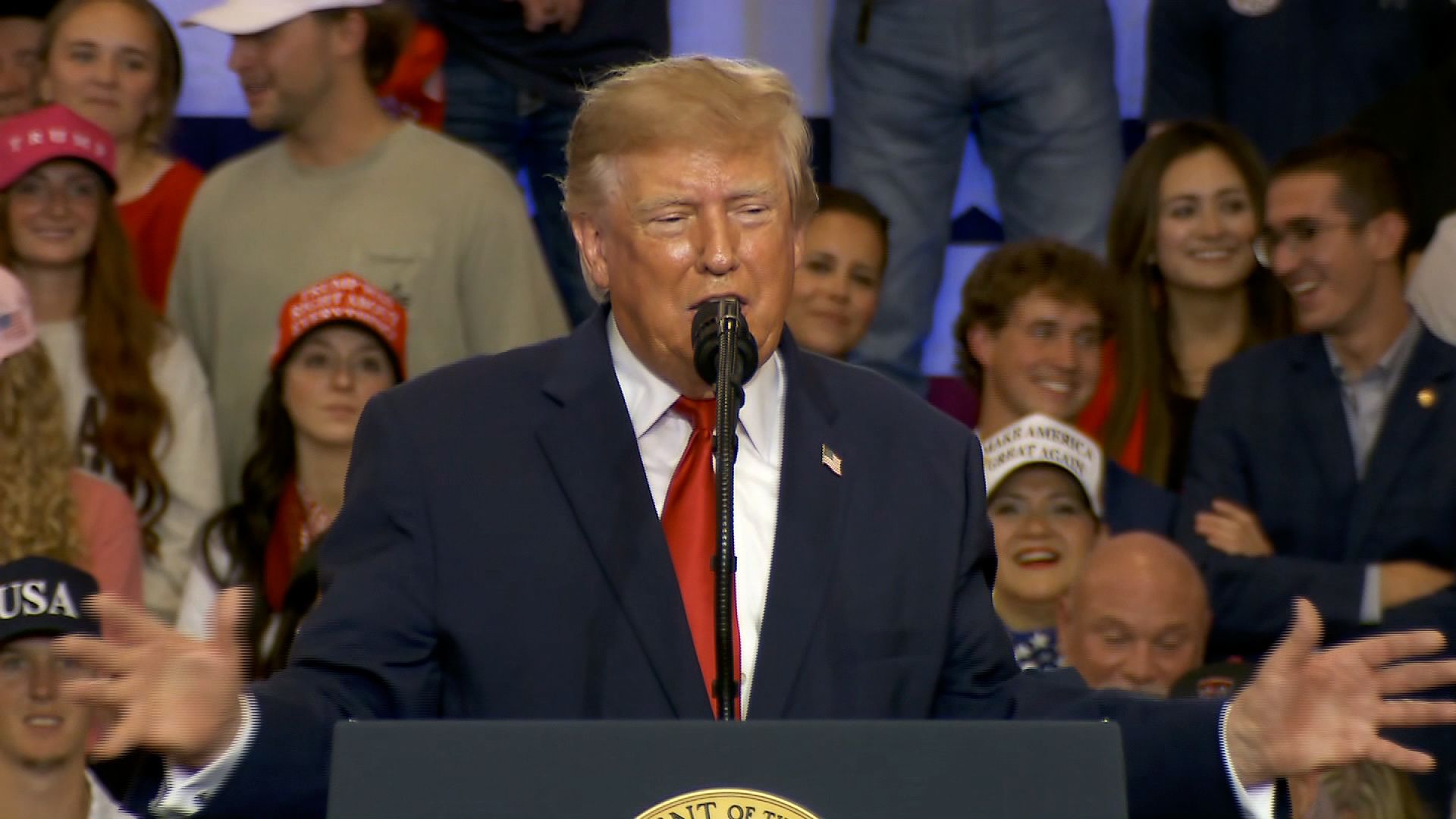
As President Donald Trump took the stage in Kansas for his 30th rally, he wanted to be clear: No one could say he didn’t do everything possible to salvage the midterms for Republicans.
In an hour-plus speech that was by turns dark, wistful, agitated and celebratory, Trump boasted about his administration’s various political victories — and warned that Democrats would take it all away if they got control of Congress on Tuesday.
He repeatedly pleaded with his supporters to turn out to vote for Marshall and down-ballot Republicans, urging them to “pretend I’m on the ballot” and do this last favor for him.
But for as much as he praised Marshall and touted his candidacy, it was clear the crowd was here — as always — for Trump.
And, as always, the president obliged.
“I’m very good at teleprompters, but when I read every single word on the teleprompter, you would be so bored,” he said at one point, as he embarked on another signature off-the-cuff riff.
Still, as Trump stretched well beyond the hour mark, even his devotees began to get restless. After he joked about wrapping up abruptly, big portions of the crowd took it as their cue. As Trump launched into the next part of his speech, rallygoers began streaming out the back of the venue.
Democrats leading in 5 critical Senate races: New York Times/Siena polls


Democrats hold leads in five of the seven critical Senate races polled by The New York Times and Siena University as the 2026 midterm campaign comes to a close, with no clear leader in the other two races.
Democrat Abdul El-Sayed leads Republican Mike Rogers by a wide 53% to 42% among likely voters in Michigan. Democrat James Talarico tops Republican Ken Paxton by 50% to 43% among likely voters in Texas. Democrat Troy Jackson runs ahead of incumbent Republican Susan Collins by 51% to 45% among likely voters in Maine.
Democratic former Sen. Sherrod Brown tops Republican Sen. Jon Husted among likely voters in Ohio 49% to 44%. And in Kansas, Democrat Adam Hamilton leads incumbent Sen. Roger Marshall among likely voters by 49% to 44%.
The surveys find no clear leader races in Alaska, where Democrat Mary Peltola holds 48% support to Republican incumbent Sen. Dan Sullivan’s 46%, and in Iowa, where Democrat Josh Turek holds 48% to Republican Ashley Hinson’s 47%.
The polls, which largely fielded through the last few days, align with other recent public polling in several of these states, but the Michigan results suggest a far wider race than other polling. A CNN poll conducted by SSRS and released last week found El-Sayed topping Rogers by 7 points, and the CNN Poll of Polls on the race suggests a 5-point margin in El-Sayed’s favor.
Should the results of these polls match the results in Tuesday’s election, Democratic victories in the four Republican-held states where they lead outside the margin of sampling error would be enough to flip control of the Senate, if Democrats were also to hold all of their currently held seats.
Even in these late-fielding polls, though, there is still room for movement. With the exception of Michigan, each of these surveys finds the Democratic candidate holding roughly 50% support, suggesting there is room for the roughly 5% of likely voters who haven’t committed to one of the two major candidates to shift or tighten the margins.
The New York Times/Siena University polls were conducted between October 23 and November 1 among likely voters in each states. Margins of sampling error for results from the full sample stand at +/-4.8 percentage points in Alaska, +/-4.4% points in Iowa, +/-4.1% points in Kansas, +/-4.3% points in Maine, +/-3.6% points in Michigan, +/-4.2% points in Ohio and +/-3.3% points in Texas.
What happened before Stevens’ surprise endorsement of Rogers



As recently as Saturday night, the prospect of Democrat Haley Stevens endorsing Republican Mike Rogers in Michigan’s Senate race had seemed implausible.
Stevens issued a statement praising Democratic candidate Abdul El-Sayed for saying he disagreed with a controversial advertisement that blamed the high cost of living in Michigan on the United States’ aid to Israel. Despite a week of speculation about her withdrawing an endorsement for El-Sayed, her primary rival, she repeatedly said that she would do no such thing.
When staffers reached out last week to urge her not to endorse Rogers, Stevens replied in a text message, according to a person who saw the message:
She told several Democrats she intended to appear with El-Sayed at church on Sunday. As recently as midnight Saturday, she told a key ally that she was sticking with El-Sayed.
Then on Sunday morning, things changed.
She appeared at a Black church in Detroit with Rogers and then announced her change of heart to reporters gathered outside and on social media.
Her move stunned the political world — including Stevens’ friends, colleagues and even her own congressional staffers, most of whom found out about her decision on social media and promptly quit, according to a statement from her chief of staff and people familiar with the matter.
Stevens says her choice to back a Republican is “rock solid.” Here's what she told CNN
Democratic Rep. Haley Stevens spoke to CNN’s Anderson Cooper last night about her last-minute choice to revoke her support from Democratic Michigan Senate hopeful Abdul El-Sayed and back GOP candidate Mike Rogers in the consequential race.
Stevens said she was endorsing Rogers after appearing with the GOP candidate at a church in Detroit on Sunday morning, following recent tensions between her and El-Sayed, her former opponent in the Democratic primary.


Here are the top lines from her interview with Cooper:
- On what changed: Stevens said “nothing with me changed” despite her choice to reverse her endorsement less than 48 hours from Election Day. “I would just say that, you know, I had some time to, you know, think,” Stevens told Cooper. “I woke up this morning clear-eyed, fresh and focused on what was in my heart, and that’s that.”
- On staff exodus: The Michigan Democrat said she is under “transition” when asked about the resignation of her congressional chief of staff and others following her Rogers endorsement. “These are great individuals who, you know, I care a lot about,” she said, adding “they’re free to share their views on this.” Stevens’ former chief of staff, Justin German, said earlier her congressional team was “shocked and heartbroken” by the endorsement.

Speaking to CNN’s Anderson Cooper, Rep. Haley Stevens (D-MI) said her team is free to share their views after her endorsement of GOP Senate nominee Mike Rogers. Her chief of staff said in an earlier statement that many members of her team have resigned.

- On whether she’ll change her mind: Stevens said she hasn’t yet cast her ballot — but she’s “rock solid” in her choice to back Rogers. “I’m an independent woman, I made my decision,” she said, adding “I still love my party a whole lot.”
- On why she reversed course: Stevens refused to articulate what inspired her endorsement reversal. “I changed my mind. (El-Sayed) said, ‘Hey, I don’t need your endorsement.’ That’s fine. Why the anger? Why the frustration?” she said, sidestepping questions about what prompted the sudden about-face. “I hope to see more kindness in the Democratic Party and for all of us to just accept when somebody has a disagreement,” she added.
CNN’s Danya Gainor and Piper Hudspeth Blackburn contributed to this report.