Here's the latest
• Spectacular show: A total solar eclipse will put on a captivating show today for millions of people in prime viewing locations across Iceland, Spain and a small corner of Portugal.
• How to watch: If you’re planning on viewing today’s spectacular event, wear certified eclipse glasses or use a handheld solar viewer.
• When will it happen again? The next total solar eclipse will pass over southern Spain, North Africa, Saudi Arabia and Yemen on August 2, 2027, according to NASA. The contiguous US must wait until August 22, 2044, when totality will only occur over North Dakota and Montana.
How to capture the eclipse with your smartphone



While gazing up at the total solar eclipse today with proper eye protection, you might want to snap a photo to remember the moment. You don’t need fancy camera equipment, either.
Here are some tips from NASA on using a smartphone to photograph the eclipse:
- Manually adjust the focus and exposure. Use your finger to tap on your screen to bring the moon into focus and then slide up and down to fix the exposure.
- Consider putting your phone’s camera on a delay. Setting a timer could help ensure your phone doesn’t shake or vibrate when you take the photo.
- It might be difficult to get a clear image if you zoom in. Try focusing your photos on what is going on around you and capture the scenery and landscape as well.
Even the pros say your smartphone camera can get the job done: “I used one on the past eclipses, just on the automatic settings, and it actually seemed to work OK,” professional photographer Stan Honda said. “Just leave it on the standard wide-angle setting — if you start to zoom in on the sun to try to make it bigger, it throws off the automatic exposure.”
If the eclipse graces the sky near you, we’d love to see your photos! Send images and a few details about your eclipse experience to sciencenewsletter@cnn.com, and we may include them in our eclipse coverage.*
*Any materials sent are subject to the following terms. I agree that CNN can use my photos/video (“Material”) on all CNN media, worldwide in perpetuity along with affiliate distribution. I also confirm that I am the exclusive owner and rights holder of the Material, did not create the Material using AI, and have all the necessary rights to authorize use of this Material.
China created an extremely detailed map of the moon

Just in time for today’s eclipse, China recently released one of the most detailed maps of the moon ever created — logging about 13,000 impact craters, 81 basins, as well as various geological structures and rocks.
“The map also incorporates higher-resolution data showing the distribution of key minerals on the lunar surface,” according to an English-language news release from state-run media.
Tracking resources on the moon will be vital for both the United States and China, as both nations plan to build sprawling research bases near the moon’s south pole, where people could live and work.
“The new map provides scientific support for the construction of China’s future lunar research station, landing site selection and deep-space exploration,” the news release says, quoting Yang Zhiming, director of Chian’s Institute of Geology, Chinese Academy of Geological Science.
Eclipse watchers across parts of Europe gear up for rare total solar eclipse
Sky-gazers across parts of Europe are preparing for the first total solar eclipse visible from the region in more than 20 years.
See how eclipse watchers in Iceland, London and Spain are preparing for the rare celestial event.
Iceland


London


Spain


People outside of the eclipse path will see the moon "bite" the sun


For those living outside of the path of totality, the main event will be a crescent-shaped partial eclipse — in which the moon appears to take a bite out of the sun — rather than a total eclipse.
The amount of exposed sunlight depends on how close viewers live to the path of totality. For example, people in the United States will only see a small part of the sun covered by the moon, while Europe and northwestern Africa will experience a more dramatic cloaking of much of the sun, according to NASA.
“New York will see a 10% eclipse, so you know a very small slice of the sun missing,” said Dr. Ryan French, solar astrophysicist at the Laboratory for Atmospheric and Space Physics in Boulder, Colorado. “But if you’re in Europe, obviously that slice is much larger. In the United Kingdom, which won’t actually experience a total solar eclipse until the year 2090, they’re actually getting a 95% eclipse for this event.”
The partial eclipse will occur in the morning for those in Alaska and northern Canada, in the afternoon for the northern United States and eastern Canada, and in the evening for viewers in the United Kingdom, Ireland, Africa and mainland Europe, where the sunset eclipse phenomenon will occur.
What people in the eclipse's path will see, including a rare sunset event
The excitement kicks off in a remote part of northern Russia where totality occurs midday local time. Sky-gazers in Iceland will experience the longest duration of totality — about two minutes and 15 seconds — in the late afternoon and early evening.
But Spain and the northestern tip of Portugal will experience a special spectacle as totality, which will last just under two minutes in those locations, occurs right before sunset. In León, totality will begin at 8:28 p.m. local time and end at 8:30 p.m.
The partial eclipse phase that lingers after totality won’t conclude until 9:22 p.m. local time in León.
“For pretty much the entirety of Spain, by the time the sun sets sort of over the horizon, the total eclipse will have happened, but the sun will set in a partial eclipse, a beautiful sight seeing the sun set as a crescent sun,” said Dr. Ryan French, solar astrophysicist at the Laboratory for Atmospheric and Space Physics in Boulder, Colorado.

Some along Wednesday’s eclipse path could witness the sun low on the horizon, creating a rare eclipse-at-sunset experience.

Solar eclipses can disrupt the atmosphere. Here's how
When a rare total solar eclipse sweeps through parts of Europe, its effects will extend beyond the spectacular sight in the sky.
CNN Senior Science Reporter Kasha Patel breaks down four ways a solar eclipse can affect the air and weather, including eclipse wind and tweaking GPS signals.

CNN Senior Science Reporter Kasha Patel explains four ways a solar eclipse affects the air and weather, from eclipse wind to tweaking GPS signals.

UK households are urged to use less electricity during the eclipse


The dip in sunlight because of the eclipse will affect solar panels, according to Octopus Energy, a UK electricity supplier.
The eclipse would “briefly knock out a chunk of Britain’s solar power just as millions of people are getting home and electricity demand is climbing,” it said in a news release.
It urged customers to cut back the use of electrical appliances such as washing machines and dishwashers between 6 p.m. and 8 p.m. local time (1 p.m. to 3 p.m. ET)
If enough households delay using electricity for a short time, it could reduce the need to fire up extra gas power stations to plug the gap, Octopus added. Solar panels generated a record 14.4% of Britain’s electricity last month.
Britain will experience a partial solar eclipse, with around 90% of sun expected to be obscured by the moon. This will reduce the sun to a “very thin” crescent, according to Mike Lockwood, a professor at the University of Reading.
Eclipse Explained: I live in the US. Will I be able to see at least a partial eclipse?

If you live in the United States, you may be able to see a partial solar eclipse today. Specifically, some parts of the eastern US — like New York, Philadelphia, Boston and parts of Maine — will see a sliver taken out of the sun as the moon appears, according to NASA.
A large part of the United States experienced a total solar eclipse in 2024.
To check when the eclipse will occur in your area, and what it will look like, check Time and Date’s website.
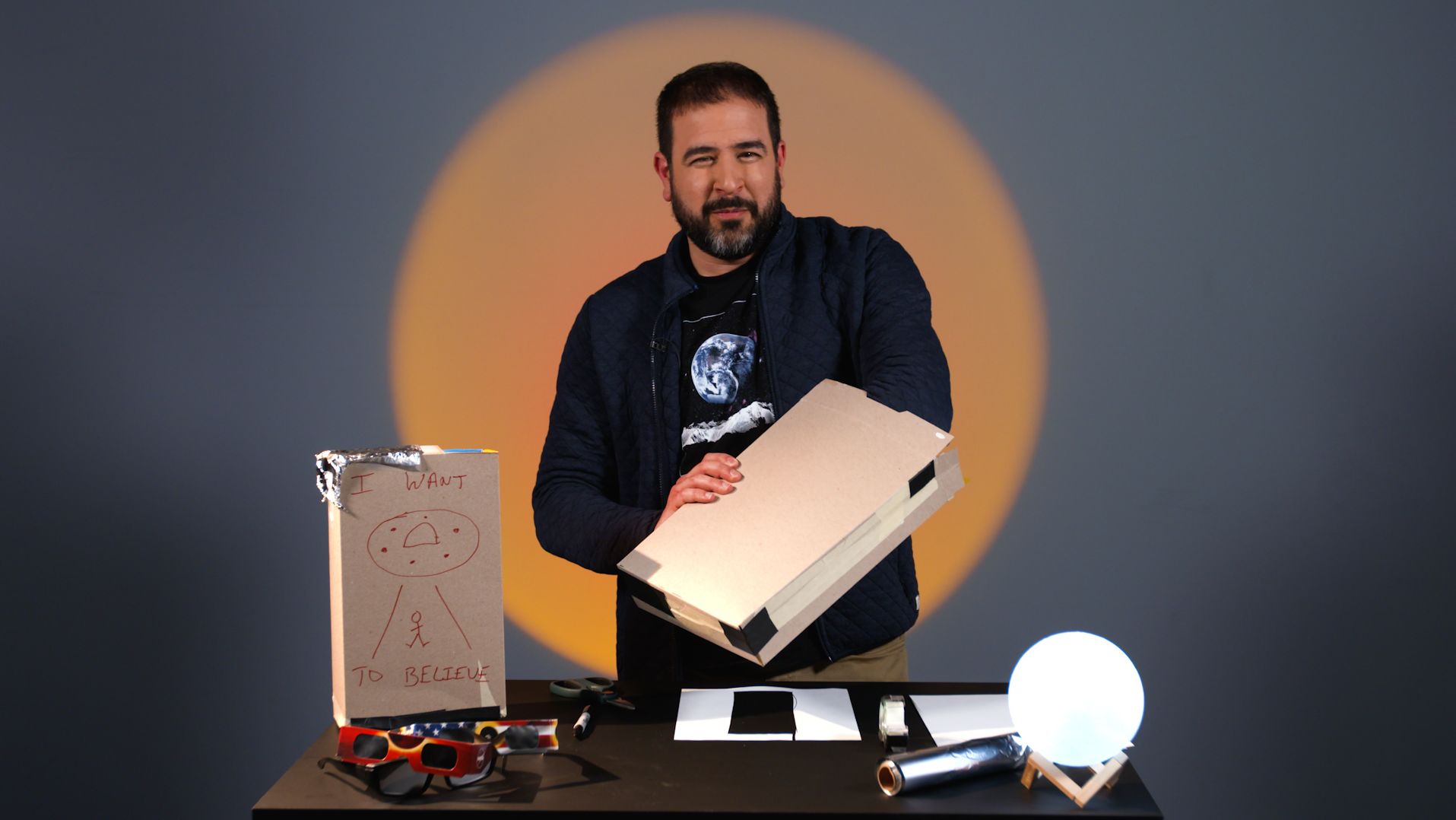
Eclipse Explained: Can I make my own eclipse viewer?
Yes! You can make your own pinhole projector with things you probably have around your house.
Here’s what you’ll need:
- A cardboard box (cereal, cracker and small shipping boxes all work)
- White printer paper
- Scissors or a box cutter
- Tape
- Aluminum foil
- A thumbtack, nail, needle or anything else that can punch a pinhole
Here’s what to do:
- Cut a strip of white paper the size of the end of your box and tape it inside.
- Cut two tabs at the top of the box. Use foil to cover and tape one side.
- Poke one small hole in the foil opposite the white paper.
Watch this step-by-step guide on how to make it:

Eclipse Explained: When should I go outside to see the eclipse?
The path of totality for today’s solar eclipse will start over the Arctic coastline at around 1 p.m. ET and end near the Balearic Islands at around 2:30 p.m. ET.
Use this chart to make sure you are outside — with your eclipse glasses on — at the right time:
No eclipse glasses? Here's how you can still watch today's event

People in the UK have been struggling to find certified eclipse glasses with many retailers sold out.
However, if you don’t have any on hand, you can still view the eclipse indirectly using a pinhole projector, such as a hole punched through an index card.
This method works when you stand with your back to the sun and hold up the card. The pinhole projects an image of the crescent or ring-shaped sun on the ground or other surfaces.
Just remember: Never face the sun and look directly at it through the pinhole.
Other pinhole projectors you may already have lying around include colanders, straw hats or anything with small holes in it. Or you can simply hold up your hands, space out your fingers and cross them over each other to create a waffle pattern. The small space between them will reflect the sun’s crescent during a partial eclipse or a ring during an annular eclipse.
Standing by a leafy tree? The small spaces between leaves will dapple patterns of the eclipse phase on the ground.
Millions will witness a rare sunset total solar eclipse today

The grand stellar spectacle of the year has arrived. A total solar eclipse will be easily visible over parts of Europe on Wednesday.
A total solar eclipse occurs when the moon moves between the sun and Earth, casting a shadow on our planet that completely blocks the sun’s light from some areas of the world, according to NASA.
Major viewing locations in parts of Iceland, northern Spain and a small corner of northeastern Portugal will be in the path of totality, when the skies go momentarily dark as the sun completely disappears from view — creating a rare sunset eclipse for some, especially observers in Spain.
Meanwhile, a partial eclipse, in which only some of the sun’s light is blocked from view, will pass over the northern US, Canada, much of Europe and northwestern Africa. Check Time and Date to see when it will occur in your area.
Spain hasn't had a total eclipse in 120 years. Now it's getting a series

The last time a total solar eclipse was visible from Spain’s mainland was in 1905, making today’s show a long-awaited spectacle.
But it won’t be the last.
Spain is in for a treat as not one, not two — but three eclipses are expected to pass over the Iberian Peninsula between now and January 2028, including a second total eclipse next August. (Notably, that 2027 eclipse will be one of the longest of the century.) The trio of celestial spectacles will conclude with an annular “ring of fire” solar eclipse in January 2028.
“Many institutions and organisations from all over Spain will cooperate to ensure the success of this event,” which is being referred to as “Trío de Eclipses,” according to an official government website.
Bill Nye explains solar eclipses
Famed science communicator Bill Nye took a moment to explain why solar eclipses happen during an interview with CNN for a new documentary “Eclipsing Power: Musk, Bezos and The New Space Race.”