Our live coverage has ended
• Follow the latest updates on the war with Iran here.
What we know so far
• Opening the strait: The UN Security Council is set to vote Friday on a Bahraini proposal that would authorize countries to use “all defensive means necessary” to secure the Strait of Hormuz. More than 40 countries attended a virtual meeting to discuss reopening the waterway Thursday, as US President Donald Trump railed against allies over their handling of the issue.
• Iran’s capabilities: US intelligence assessments have found that Iran maintains significant missile launching capability despite more than a month of heavy US-Israeli bombardment, sources told CNN. Tehran remains poised to “wreak absolute havoc” throughout the region, one of the sources said.
• Impact on markets: Asian equities rebounded on Friday, tracking gains on Wall Street amid hopes for an end to the conflict despite surging oil prices. Meanwhile, Asian airlines have hiked ticket prices and cut flights as carriers face pressure amid rising jet fuel costs.
Aircraft carrier USS Gerald R. Ford back at sea after fire repairs completed


The aircraft carrier USS Gerald R. Ford, the US Navy’s newest and largest carrier, is back at sea and mission-capable after undergoing repairs for a fire in its laundry spaces, a statement from the 6th Fleet said Thursday.
“Gerald R. Ford remains poised for full mission tasking in support of national objectives in any area of operation,” said the statement released after the ship left Split, Croatia, on Thursday.
The Ford was in the Red Sea operating as part of Operation Epic Fury against Iran when the fire broke out on March 12.
Speaking to a defense forum in Washington on Tuesday, Chief of Naval Operations Adm. Daryl Caudle praised the Ford’s crew for their firefighting and getting the ship back into action two days after the blaze.
“They fought that, put it out, and started flying sorties two days after that, so I’m very proud of that crew,” he said.
But the ship was pulled from action against Iran just over a week after the fire and sent to Greece for repairs to berthing spaces that were damaged.
After repair work was done at a US base at Souda Bay on the island of Crete, the Ford went to the Croatian port for five days of rest and relaxation.
Caudle told the defense forum that the Ford’s deployment, which began when it left its Norfolk, Virgina, homeport late last June, would extend into a “record-breaking” 11th month.
New satellite images show destroyed US plane and other unsheltered aircraft at Saudi base

New satellite imagery provided to CNN by Airbus shows the remains of a destroyed US E-3 Sentry airborne warning and control (AWACS) aircraft after an Iranian strike on Prince Sultan Air Base in Saudi Arabia on March 27.
The image taken on March 29 shows large portions of the center fuselage of the aircraft destroyed by the strike while its distinct rotating radar dome, normally affixed to the top of the aircraft, can be seen on the ground. Several vehicles can be seen surrounding the damaged aircraft.
In the same image, two other E-3 Sentry planes can be seen sitting out in the open at the air base, indicating they had not been moved to shelters for at least two days following the attack. One of those E-3s was located less than 1,300 meters from the destroyed E-3.

Several other aircraft including refueling tankers and E-2 Hawkeye surveillance planes can also be seen exposed in the satellite image.
CNN has reached out to CENTCOM for comment.

The AWACS enables airborne monitoring of up to 120,000 square miles of battlespace from the ground to the stratosphere, and it has been a vital component of US fighting forces for decades.
Asian stocks rebound on Wall Street gains


Asian equities rebounded on Friday, tracking gains on Wall Street amid hopes for an end to the Iran conflict despite surging oil prices.
Japan’s benchmark index Nikkei 225 rose 1.4% at 10:24 am local time, while South Korea’s Kospi surged 3%. Hong Kong’s market is closed for a public holiday on Friday.
Analysts, however, expect volatility in both stock and oil markets to persist in the absence of a clear off-ramp to the Middle East war. President Donald Trump reiterated in his Wednesday address to the nation that he would strike Iran “extremely hard” in the next two to three weeks, while offering no details on his exit strategy.
140,000 homes, commercial units damaged in Iran since war began, Red Crescent says

Nearly 140,000 residential and commercial units have been damaged in airstrikes on Iran since the war began, according to a Thursday tally by the Iranian Red Crescent.
At least 316 health, medical and EMS facilities, 763 schools and 18 Red Crescent centers have also been damaged by US-Israel attacks, the Red Crescent said.
Sniffer dogs have participated in 693 search and rescue missions since the war began, and they have found wounded people and bodies beneath the rubble in some of the operations, the Red Crescent added.
CNN cannot independently verify these figures.
Missile and drone attacks from Iran have also caused damage to airports, energy facilities and residential homes across the Gulf.


Iran war jet fuel shock hits Asia’s airlines


Before the conflict, an economy class ticket on Cathay Pacific from Sydney to London would cost about $1,370.
It now costs more than $2,000 thanks to yet another fuel surcharge – and on some days, it’s over $3,500.
Before the US-Israeli war with Iran started, the global airline industry had forecast record profits of $41 billion for 2026.
But with the price of jet fuel more than doubling, carriers are under pressure and scrambling to cope.
Carriers ranging from Air New Zealand to Vietnam Airlines have started cutting flights.
Korean Air is shifting to “emergency management mode” to deal with the supply crunch.
And the Philippines’ President Ferdinand Marcos has said grounding planes is a “distinct possibility.”
To secure its own supply, China has banned exports of jet fuel.
China’s airlines are also finding opportunity during the crisis, adding thousands of flights to Europe thanks to the country’s ability to bypass the Middle East and access Russian airspace.
Nevertheless, China’s carriers remain exposed to the Iran energy shock.
Earlier this week, local carrier Colorful Guizhou Airlines disclosed a plan to hike fuel surcharges by five times for domestic routes starting April 5.
China’s three biggest state-owned carriers – Air China, China Eastern and China Southern Airlines – are all reporting cautious outlooks for the year.
In its annual report on Monday, China Eastern Airlines said: “The impact of geopolitical conflicts will persist and the overall momentum of global economic growth will remain insufficient.”
According to HSBC, fuel made up 35–38% of the operating expenses for the three Chinese airlines in the first half of the year.
As Iran has effectively closed the Strait of Hormuz, Asia is vulnerable as the region relies more heavily on oil and gas that transit the strait than other parts of the world.
So while Iran maintains its iron grip on the strait, expect higher fuel costs around the world from Asia to the US, and expect airlines to pass that on to consumers.
UN Security Council is set to vote tomorrow on a Strait of Hormuz proposal. Here’s what to know



The UN Security Council is set to vote Friday on a Bahraini proposal that would authorize countries to use “all defensive means necessary” to secure transit passage through the Strait of Hormuz.
We’re tracking news as it unfolds. Catch up on the latest headlines:
- More on the proposal: Bahrain’s foreign minister said ongoing discussions at the United Nations over the Security Council draft resolution are aimed at safeguarding global trade and preventing disruption to one of the world’s most critical maritime routes. A Gulf official told CNN that Saudi Arabia’s Crown Prince Mohammed bin Salman had spoken with Russian President Vladimir Putin and that there was an expectation Russia would not block the resolution. The official added the crown prince was expected to speak with “relevant” officials in China, with the expectation Beijing would also not block it.
- More strikes: A US-Israeli strike on a major bridge just outside Tehran killed at least eight people and injured 95 others, according to local media. And Iran’s Islamic Revolutionary Guard Corps (IRGC) said Thursday it had attacked an Amazon cloud computing center in Bahrain in retaliation for recent “assassinations.” Also, Iran-backed Houthi militants said Thursday they had launched a ballistic missile attack targeting “vital objectives” in Israel’s Jaffa area.
- Satellite information: A critical American radar was damaged in an Iranian attack on Saudi Arabia’s Prince Sultan Air Base on March 1, a new satellite image revealed.
- Expulsion order: Argentina ordered the Iranian Embassy’s chargé d’affaires to leave the country. The expulsion order comes after Tehran criticized Argentina for designating the IRGC as a terrorist organization.
- Oil prices: US Trade Representative Jamieson Greer sought to tamp down concern over rising oil prices after President Donald Trump’s address to the nation, telling CNN the surge is “a temporary disruption.”
CNN’s Thomas Bordeaux, Allegra Goodwin, Mohammed Tawfeeq, Donald Judd, Adam Pourahmadi, Sana Noor Haq, Becky Anderson, Lauren Izso, Nic Robertson and Gonzalo Zegarra contributed to this report.
Sources: Iran still has significant missile capabilities, according to US intelligence




Roughly half of Iran’s missile launchers are still intact and thousands of one-way attack drones remain in Iran’s arsenal despite the daily pounding by US and Israeli strikes against military targets over the past five weeks, according to recent US intelligence assessments, three sources familiar with the intel told CNN.

Roughly half of Iran's missile launchers are still intact and thousands of one-way attack drones remain in Iran's arsenal despite US and Israeli strikes against military targets, according to recent US intelligence assessments, sources say. CNN's Jim Scuitto reports.

The US intelligence assessment total may include launchers that are currently inaccessible, such as those buried underground by strikes but not destroyed.
Thousands of Iranian drones still exist — roughly 50% of the country’s drone capabilities — two of the sources said the intelligence indicated. The intelligence, compiled in recent days, also showed a large percentage of Iran’s coastal defense cruise missiles were intact, the sources said, consistent with the US not focusing its air campaign on coastal military assets though they have been hitting ships.

Those missiles serve as a key capability allowing Iran to threaten shipping traffic in the Strait of Hormuz.
The intelligence offers a more nuanced picture of Iran’s continuing capabilities compared to sweeping assessments of military victory offered publicly by President Donald Trump and administration officials.
Bahrain condemns Iranian strike on infrastructure site said to host Amazon cloud facility



Bahrain has condemned an Iranian strike on an infrastructure facility earlier this week that, according to the Islamic Revolutionary Guard Corps, targeted an Amazon data center.
A Bahraini official said the strike hit the headquarters of Bahrain telecoms company Batelco in Hamala, calling it a “grave and deliberate aggression against the sovereign territory and civilian economic interests of the Kingdom of Bahrain.”
CNN has approached Amazon for comment but the company has not said whether it has a data center at the site. However, the IRGC said earlier today that it had attacked an Amazon cloud computing center in Bahrain two days ago in retaliation for recent US “assassinations.”
The Bahraini official rejected Tehran’s claims that the strike was aimed at US military installations, saying the facility targeted was a Bahraini national telecommunications center hosting commercial cloud services.
The affected infrastructure supports regional businesses, financial institutions and digital services used by citizens throughout the Gulf, making the strike a threat to wider economic connectivity, the official said.
The official accused Iran of attempting to intimidate Gulf states and disrupt regional prosperity, particularly countries maintaining partnerships with international technology firms.
“We call upon the international community to recognize that these escalating violations against civilian infrastructure threaten not only Gulf stability but the very foundations of global digital interdependence,” the official added.
France-Japan ties grow as Trump hits allies over Strait of Hormuz
French President Emmanuel Macron wrapped up a two-day visit to Tokyo, where he and Japanese Prime Minister Sanae Takaichi made calls to reopen the Strait of Hormuz.
CNN’s Hanako Montgomery reports:

French President Emmanuel Macron wrapped a two-day Tokyo visit, boosting cultural and diplomatic ties with Japan. He and Prime Minister Sanae Takaichi also called to reopen the Strait of Hormuz, as President Donald Trump ramps up pressure on allies to protect the key waterway. CNN’s Hanako Montgomery reports.

Remember: President Donald Trump has ramped up pressure on allies to protect the key waterway, urging US allies in his address last night they should “go to the Strait and just take it.”
Macron rejected Trump’s demand Thursday, saying the “idea of forcibly liberating the Strait of Hormuz through a military operation,” was “unrealistic.” On the broader campaign, Macron reiterated France would not participate in the conflict against Iran.
CNN’s Joseph Ataman and Elina Baudier Kim contributed to this report.
Bahrain’s UNSC proposal would authorize naval action to defend ships in Strait of Hormuz

A draft UN Security Council resolution proposed by Bahrain would authorize countries to use “all defensive means necessary” to secure transit passage through the Strait of Hormuz, if adopted.
A Gulf official told CNN that the Security Council is expected to vote on Bahrain’s proposed resolution on Friday.
The official said Saudi Arabia’s Crown Prince Mohammed bin Salman had spoken with Russian President Vladimir Putin and that there was an expectation Russia would not block the resolution. The official added the crown prince was expected to speak with “relevant” officials in China, with the expectation Beijing would also not block it.
The draft resolution, which CNN has obtained a copy of, deplores Iran’s actions as violations of international law and warns of adverse impacts on international trade, energy security, supply chains and the global economy.
It stresses that ships and aircraft enjoy a right of transit passage through the Strait of Hormuz that “shall not be impeded.”
The draft resolution would authorize member states, acting individually or through voluntary multinational naval partnerships that notify the Security Council in advance, to use defensive measures in the strait and adjacent waters – including within the territorial waters of littoral states bordering the strait – to secure transit passage and deter attempts to close or obstruct navigation.
The authorization would last at least six months from adoption and would require quarterly reporting by participating states.
The draft calls on participating states to coordinate their actions and ensure operations comply with international humanitarian law and applicable international human rights law, while respecting third states’ navigation rights.
It also stresses the authorization would apply only to the Strait of Hormuz and would not establish customary international law.
Houthis target Israel with ballistic missile attack

Iran-backed Houthi militants said Thursday they had launched a ballistic missile attack targeting “vital objectives” in Israel’s Jaffa area.
The Houthis said the operation was carried out “in partnership” with forces in Iran and Hezbollah in Lebanon and claimed – without providing evidence – to have achieved their objectives.
The Israel Defense Forces said in a brief statement that a missile launched from Yemen was “successfully intercepted.”
Some context: After nearly a month of not directly entering the conflict, the Houthis launched their first missile attack of the war toward Israel on Saturday. The group cited US-Israeli strikes on infrastructure and what it called “crimes and massacres” against people in Lebanon, Iran, Iraq and the Palestinian territories as its reason for entering the conflict.
Satellite image confirms US radar was damaged at base in Saudi Arabia


A critical American radar was damaged in an Iranian attack on Saudi Arabia’s Prince Sultan Air Base on March 1, a new satellite image has revealed. The radar, an AN/TPY-2, is a crucial piece of equipment for the US’ high-end THAAD missile interception system.
Since then, the base has suffered multiple Iranian attacks, including on March 27, when an E-3 radar aircraft and a refueling tanker were struck. That attack wounded at least 10 US service members.
The strike was part of a pattern of attacks by Iran seemingly intended to degrade the US’ ability to detect incoming missiles and drones by striking radars. Iranian strikes also destroyed another American AN/TPY-2 radar in Jordan, targeted military communications infrastructure, and damaged a Qatari early warning radar that cost over $1 billion to build.
CNN previously reported that a tent which had housed the radar at Prince Sultan was struck but could not confirm if the radar was present at the time of the attack, or if it had been damaged. The radar, which is split between multiple movable trailers, appears to have since been removed from the tent and is out in the open. Its antenna is marked with charring and is missing a large chunk. The US Missile Defense Agency, which is responsible for the THAAD program, listed the cost of an AN/TPY-2 antenna as $136 million in its 2025 budget.
The March 1 attack on the radar fatally wounded a US service member who served under the Army’s Space and Missile Defense Command, according to a US Army statement. The US military announced that the soldier, Sgt. Benjamin N. Pennington of Kentucky, would be posthumously promoted to Staff Sergeant.
A Pentagon spokesperson previously declined to comment on the targeting of radars, citing operational security. CNN has reached out to US Central Command regarding the damage to the radar at Prince Sultan.
Tehran claims it attacked Amazon cloud data center in Bahrain
Iran’s Islamic Revolutionary Guard Corps (IRGC) said Thursday it attacked an Amazon cloud computing center in Bahrain in retaliation for recent “assassinations.”
“The cloud computing center of Amazon company in Bahrain was attacked and destroyed,” the IRGC said, without providing evidence.
A Gulf official told CNN that the attack happened two days ago.
In a later statement, the IRGC also said it targeted an Oracle data center in Dubai. CNN has reached out to the United Arab Emirates for comment.

On Wednesday, Kamal Kharazi, a senior adviser to Iran’s supreme leader, was seriously injured and his wife was killed in what Iranian officials described as a US-Israeli attack in Tehran.
The IRGC warned this week that if assassinations continue, it would target what it called American information technology and artificial intelligence companies, which it alleged are involved in tracking and directing assassination operations.
Apple, Microsoft, Google, Meta, IBM, HP, Intel, Tesla, Boeing and JP Morgan are among the 17 companies the IRGC threatened to target earlier this week.
CNN cannot independently verify the IRGC’s claims. CNN has reached out to Amazon, which owns cloud computing arm Amazon Web Services (AWS), for comment.
Amazon said in a statement last week it was working “closely with local authorities and prioritizing the safety of our personnel throughout our recovery efforts.” It added: “As this situation evolves, and as we have advised before, we request those with workloads in the affected regions continue to migrate to other locations.”
Trump’s trade representative calls oil price surge “a temporary disruption”


US Trade Representative Jamieson Greer sought to tamp down concern over rising oil prices after President Donald Trump’s address to the nation, telling CNN the surge is “a temporary disruption.”
“We have a lot of energy independence, which is a big — puts us in a very different spot than we would’ve been, you know, 20 years ago,” Greer told CNN’s Kaitlan Collins at the White House on Thursday.
“We, of course, look at the energy prices globally, we have a lot of partners around the world, we’re watching them, we’re staying in contact with them, to see what’s happening,” he said.
And Greer said President Donald Trump is not putting a timeline on achieving his objectives. “The president and his national security team are focused on dealing with the objectives of this war as soon as they can. They’re not going to put an artificial deadline on it, but the fundamentals of the global energy market are OK,” he added.
In remarks from the White House Wednesday, Trump said the bombing campaign over Iran could intensify while suggesting other countries should be responsible for reopening the critical Strait of Hormuz.
Pressed on comments from French President Emmanuel Macron that taking the strait by force was not realistic, Greer deferred to the White House national security team.
US-Israeli attack on key bridge kills eight and injures 95, Iranian media say

A US-Israeli strike on a major bridge just outside Tehran killed at least eight people and injured 95 others, according to local media.
Several strikes hit the B1 bridge about 40 kilometers (25 miles) west of the Iranian capital on Thursday, severing a key new route under construction between the Iranian capital and the city of Karaj, the semi-official Fars News Agency reported, citing a local security official.
Those killed included “residents of Bilqan village, passing travelers and families who were in the area for Nature Day,” the final day of the Nowruz holidays, a local official said, according to a later Fars report.
Many families spend Nature Day outdoors, often having picnics near rivers and natural beauty spots.

The crossing was “the tallest bridge in the Middle East,” the judiciary-affiliated news agency Mizan claimed. It was designed to cut down the one-hour travel time between Tehran and Karaj to 10 minutes and was seen as a “point of pride for Iranian engineers,” according to local media.
CNN has reached out to US Central Command for comment. The Israeli military told CNN it was “not aware” of an Israeli strike on the bridge.
CNN’s Lauren Izso and Issy Ronald contributed to this post, which has been updated with additional information.
Countries meet about Strait of Hormuz as uncertainty surrounds US war plans. What to know

More than 40 countries came together Thursday for a virtual meeting to discuss “every possible” measure to free up Iran’s chokehold on the Strait of Hormuz.
The meeting, hosted by the UK, had no formal conclusions. It came amid an increasingly tense — and at times personal — exchange between France’s President Emmanuel Macron and his US counterpart, Donald Trump, who has put the onus on allies to reopen the strait by any means necessary.
Iran’s effective closure of the strait has left nearly 2,000 vessels trapped inside the Persian Gulf, according to the International Maritime Organization. But the strait remains open to Russia, an aide to President Vladimir Putin said today.
Catch up on more of today’s headlines here:
- More than 2,000 people have been killed in Iran since joint US-Israeli strikes began a month ago, the Iranian Red Crescent said Thursday.
- Israeli strikes in Lebanon have caused significant civilian casualties and the displacement of more than 1 million people, according to the nonprofit Project HOPE. As Israel ramps up its offensive against Hezbollah, migrant workers in Lebanon are being displaced for a second time — and resources are running thin, the International Organization for Migration warns.
- A strike hit a kindergarten in northern Israel on Thursday, causing part of its roof to cave in and scattering debris across the yard.
- Iran is drafting a protocol with Oman to facilitate safe passage of maritime traffic through the Strait of Hormuz, a senior Iranian official said.
- US-Israeli bombing has “completely halted” services at one of the largest steel plants in Iran, according to state media, depleting key infrastructure and putting employees out of work.
- Iran’s Islamic Revolutionary Guard Corps said it attacked an Amazon cloud computing center in Bahrain in retaliation for recent “assassinations.”
CNN’s Lauren Kent, Adam Pourahmadi, Sana Noor Haq, Issy Ronald, Mustafa Qadri, Lauren Izso, Nina Subkhanberdina, Hira Humayun and Mohammed Tawfeeq contributed to this report.
Israel slams opponents of its controversial death penalty bill

Israel’s national security minister is slamming the Muslim-majority countries that have denounced its controversial bill to effectively expand the death penalty for Palestinians convicted of terrorism and nationalistic murders.
“Your preaching of morality and concern for the ‘rights’ of bloodthirsty human animals are a display of hypocrisy that arouses laughter among every Israeli citizen,” said Israeli National Security Minister Itamar Ben Gvir.
“The time has come for whoever murders an Israeli citizen to understand that this is the last step he will take in his life,” he said.
The Israeli parliament has finalized the bill, which stipulates that residents in the West Bank who kill an Israeli “with the intent to negate the existence of the State of Israel” will be sentenced to death.
The bill drew swift condemnation from rights groups and Muslim-majority countries including Pakistan, Turkey, Egypt, Indonesia, Jordan, Qatar, Saudi Arabia and the United Arab Emirates. The countries called the Israeli move a “dangerous escalation, particularly given its discriminatory application against Palestinian prisoners.”
Prior to the vote, Germany, France, Italy and Britain urged Israeli lawmakers to abandon the legislation.
Bahrain pushes for UN resolution to protect Strait of Hormuz


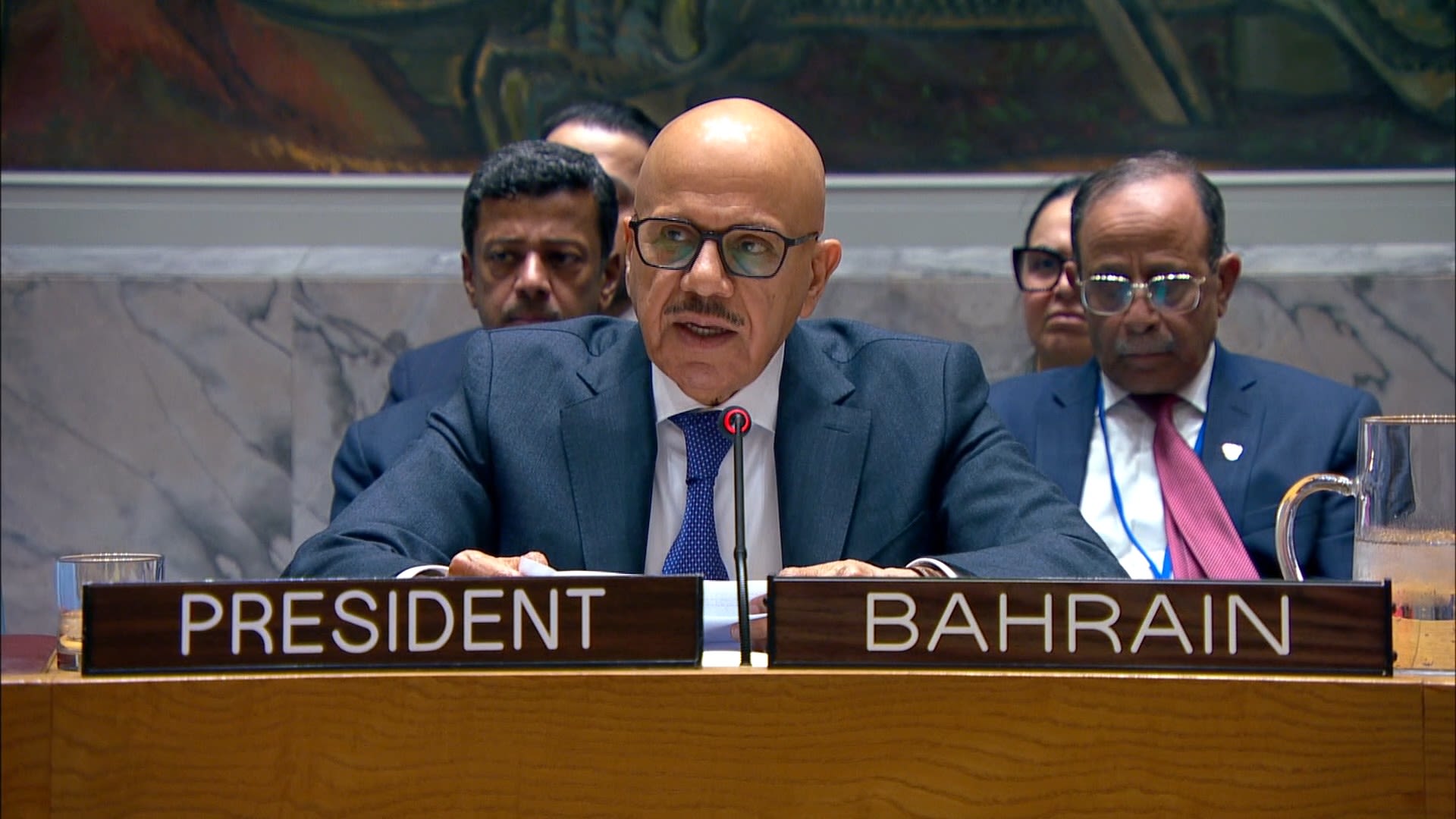
Bahrain’s foreign minister said ongoing discussions at the United Nations over a draft Security Council resolution on the Strait of Hormuz are aimed at safeguarding global trade and preventing disruption to one of the world’s most critical maritime routes.
Foreign Minister Abdullatif bin Rashid al-Zayani, said in a statement Thursday that the draft resolution, submitted by the Kingdom of Bahrain to the UN Security Council, reflects “collective responsibility to protect international security and stability and to safeguard freedom of maritime navigation.”
Iran has effectively closed the Strait, sending global energy markets into turmoil and forcing countries far beyond the Persian Gulf to take emergency measures to secure fuel supplies.
It has suggested, that after the war it would impose tolls on ships passing through the strait
Bahrain described Iran’s plans as “illegal and reckless” and warned it would amount to holding the global economy hostage.
UN Security Council Resolution 2817 (2026), adopted on March 11, called on Iran to immediately refrain from actions or threats aimed at closing or obstructing navigation through the strait. The minster said Iran had not complied with the resolution.
Al-Zayani stressed that no single country can address the threat posed by Iran alone, adding that maintaining safe and uninterrupted maritime passage through the Strait of Hormuz requires a coordinated international response through legitimate global frameworks.
He warned that continued disruption to shipping in the Strait of Hormuz would carry serious humanitarian and economic consequences worldwide.
Strait of Hormuz is open to Russia, Kremlin aide says


The Strait of Hormuz is open to Russia, an aide to President Vladimir Putin has said.
While the strait is effectively shut to most ships, Russian state media reported Kremlin aide Yuri Ushakov as saying on Thursday that it was “open for us.”
Nearly 2,000 vessels are currently trapped inside the Persian Gulf, according to the International Marine Organization. However, some vessels with ties to Iran, China, India and Pakistan have made it through the strait.
Ushakov’s comments came as the Iranian and Russian foreign ministers discussed the strait during a phone call. Russia’s Foreign Ministry said the two leaders “exchanged views on the progress of discussions in the UN Security Council regarding ways to ensure the safety of navigation in the Strait of Hormuz.”