August 26, 2025: Israel-Hamas war, Gaza hostage deal protests, Nasser Hospital attack | CNN

August 26, 2025 – Hostage families protest in Israel as global outrage deepens over Gaza hospital attack

Israeli Protest THUMB THREE.jpg
Protests halt Tel Aviv traffic amid nationwide day of action
0:23 • Source: CNN
Israeli Protest THUMB THREE.jpg
0:23

What we covered today

Strikes on hospital: Israel is facing global condemnation after an attack on a Gaza hospital killed 20 people, including five journalists and medical workers. The Israel Defense Forces claimed “six of the individuals killed” in the strikes were terrorists and said an initial inquiry showed the intended target was a camera positioned by Hamas to capture Israeli military activity.

Protests in Israel: Israelis held a nationwide day of protest on Tuesday, blocking highways and burning tires as they called for a Gaza ceasefire deal that would secure the release of hostages.

Media under attack: In a letter to senior Israeli officials, AP and Reuters executives have demanded accountability. Israel does not allow international journalists to enter the Gaza Strip to report independently.

33 Posts

Our live coverage of the latest developments in Israel and Gaza has wrapped up for the day. Please scroll through the posts below to learn about today’s developments.

Organizers estimate hundreds of thousands attended Tel Aviv rally

Organizers in Israel estimated that hundreds of thousands attended their rally in Tel Aviv as a nationwide “day of struggle” for a hostage deal and ceasefire ended on Tuesday.

Images from Tel Aviv showed the streets packed with flag-waving demonstrators.

“The people of Israel are voting with their feet,” said Noam Peri, whose father was killed in captivity in Gaza, according to the organizer’s statement. “The nation wants this war to end and the hostages brought home.”

Tuesday’s protests came the same day as a meeting of Israeli Prime Minister Bejamin Netanyahu’s security cabinet. Sources told CNN that the meeting ended without major decisions or any review of the current ceasefire deal. Another meeting on Sunday will review the government’s plan to occupy Gaza City.

“Occupying Gaza is the opposite of the right decision,” said Nira Sharabi, whose husband died a hostage in Gaza, according to the organizer’s statement. “It’s the opposite of reunification, it’s the opposite of an opportunity to end this terrible and long nightmare.”

Macron pushes back against Netanyahu's claim that recognizing a Palestinian state fuels antisemitism

French President Emmanuel Macron in London on July 10.

French President Emmanuel Macron has pushed back against Israeli Prime Minister Benjamin Netanyahu’s accusation that he was fueling antisemitism in France by pledging to recognize a Palestinian state.

In a letter addressed to Netanyahu and made public on Tuesday, Macron listed many of the actions he has taken to fight antisemitism, saying allegations of inaction were “unacceptable and offend the whole of France.”

Macron was responding to a letter that Netanyahu sent him earlier this month, which read in part: “Your call for a Palestinian state pours fuel on this antisemitic fire. It is not diplomacy, it is appeasement. It rewards Hamas terror, hardens Hamas’ refusal to free the hostages, emboldens those who menace French Jews and encourages the Jew-hatred now stalking your streets.”

Macron rejected the notion that recognizing a Palestinian state would allow groups like Hamas to threaten Israel. Instead, he argued, the move would pave the way to peace between Israelis and Palestinians.

Macron also criticized Israel’s imminent takeover and occupation of Gaza City, as well as other actions Netanyahu’s government is taking against Palestinians.

The president concluded his letter by urging Netanyahu to abandon what he called a “deadly and illegal headlong rush into a permanent war in Gaza.”

Macron said he made his letter public because Netanyahu had done the same with his own letter.

Red Cross delegation calls hospital strikes "unacceptable"

The International Committee of the Red Cross (ICRC)’s delegation in Israel and the occupied territories has called the strikes at Gaza’s Nasser Hospital “unacceptable” in a statement on X.

“It is crucial to guarantee its continued operation and accessibility for both medical personnel and patients,” the statement added.

The ICRC’s statement adds to a growing chorus of international voices condemning Israel’s back-to-back strikes on the hospital. The attacks killed at least 20 people, including journalists, medical workers and first responders.

Israeli Prime Minister Benjamin Netanyahu called the deaths of reporters and medical staff a “tragic mishap” in a post on Monday and promised a thorough investigation.

The IDF claimed Tuesday that its initial inquiry into the strikes found that it targeted a camera operated by Hamas. It said further investigations would examine the decision-making behind the attacks.

Protesters in Israel are confident despite a 'disconnected' government

Protesters in Israel agitating for a ceasefire and hostage deal told CNN that they remain confident that they can pressure the Israeli government to end the war.

“If we didn’t believe we could make a difference, we wouldn’t be here,” Yael Adar told CNN in downtown Tel Aviv. “We are the water drops that wear down the stone, and something will eventually happen because we’re fighting for our future.”

Adar’s son Tamir Adar died on October 7, with his body taken into Gaza.

“All the deals that have been reached until now, and the hostages who have already returned, came back because of public pressure, not because of military pressure, which only killed hostages,” said Zamir Haimi. Like Adar, Haimi’s cousin, Tal Haimi, was killed on October 7, and his remains are being held in Gaza.

“Today we know that over 80 percent of Israelis support us and - we are asking the remaining part to join us,” Haimi continued. “True, we have a disconnected government and a disconnected cabinet, but together we can do this.”

Israeli security cabinet meeting ends with no major decisions, sources say

An Israeli security cabinet meeting on Tuesday ended after two hours with no major decisions, according to two Israeli sources familiar with the discussions.

The security cabinet was expected to discuss the imminent Israeli takeover and occupation of Gaza City, but instead held a regional security review. There were no plans to consider the latest ceasefire proposal currently on the table.

Several key ministers were absent from the meeting, including the far-right Minister of National Security Itamar Ben Gvir, and the far-right Finance Minister Bezalel Smotrich, according to the sources. Foreign Minister Gideon Sa’ar was also absent, as he is on his first official trip to the United States.

The government is now scheduled to discuss the upcoming offensive on Gaza City at Sunday’s security cabinet meeting, the source said.

Israel’s Opposition Leader Yair Lapid said in a statement that the fact that the Cabinet convened and did not discuss the hostage deal “is yet another moral stain on the government of October 7.”

“I say clearly and unequivocally to the Israeli public,” Lapid wrote. “There is a deal on the table, it is possible to bring the hostages home and to end the war”.

Protester in Tel Aviv says Netanyahu’s cabinet motivated by "messianic fantasies about conquering Gaza"

still_21897597_397507.678_still.jpg

Haim Weiss, a protester who traveled to downtown Tel Aviv from Beer Sheva in Israel’s south, told CNN’s Oren Liebermann that he believes Israeli Prime Minister Benjamin Netanyahu’s cabinet is more interested in “conquering Gaza” than in securing a hostage deal and ceasefire.

“It’s unbelievable what the government is doing not to bring the hostages back,” Weiss, who protests three times a week, told CNN.

“This government should be dealing with one and only (one) thing: ending this war and bringing back the hostages,” Weiss said.

Weiss believes rebuilding Israeli settlements in Gaza, an idea promoted by some members of Netanyahu’s cabinet, would bring “total war” to the Middle East.

“It would bring total war, endless war to the region,” Weiss said. “We would not let it happen.”

IDF outlines further inquiries into "several gaps" related to Nasser strike

The Israel Defense Forces (IDF) said it would “examine several gaps” related to its “double-tap” attack on Nasser Hospital, including an “examination of the authorization process prior to the strike” and an “an examination of the decision making process in the field.”

The IDF claimed Tuesday that an initial inquiry into the strike, which killed at least 20 people, including journalists and medical staff, showed that the intended target was a camera positioned by Hamas to capture Israeli military activity. Israel did not provide evidence for the claim.

“The Chief of the General Staff emphasized that the IDF directs its activities solely toward military targets,” the statement concluded.

An Israeli security official previously told CNN that the forces involved in the strike were authorized to strike the camera with a drone, but fired two tank shells: the first at the camera and the second at rescue forces.

IDF claims six "terrorists" were killed in Nasser Hospital strike

The Nasser Medical Complex building in Khan Younis is seen after strikes by Israeli forces on Monday.

The Israel Defense Forces (IDF) claimed in a statement that “six of the individuals killed” in its strikes on Nasser Hospital were terrorists.

“Six of the individuals killed were terrorists, one of whom took part in the infiltration into Israeli territory on October 7th,” said the statement, which announced the conclusion of the initial inquiry into the incident. “At the same time, the Chief of the General Staff regrets any harm caused to civilians.”

A security source told CNN that none of the journalists killed on Monday were targets of the strike.

Israel has faced global condemnation after the attack on the Gaza hospital killed at least 20 people, including five journalists and medical workers who had rushed to the scene after the initial attack.

IDF's initial inquiry into Gaza hospital strike claims troops identified Hamas camera

The Israel Defense Forces (IDF) claimed Tuesday that the “double-tap” strike on Nasser Hospital, which killed at least 20 people, was aimed at a camera positioned by Hamas.

Israel did not provide evidence for the claim.

“In light of this,” the statement continued. “The troops operated to remove the threat by striking and dismantling the camera and the inquiry showed that the troops operated to remove the threat.”

The back-to-back strikes on Monday killed health workers, journalists and emergency workers. Israeli Prime Minister Benjamin Netanyahu later called their deaths a “tragic mishap” in a statement on social media.

More than 190 journalists have died in Gaza since the start of the war in the enclave, according to the Committee to Protect Journalists (CPJ). Last year, the war accounted for more than 70% of all reporter fatalities in the deadliest year for journalists since CPJ began keeping records in 1992.

Israeli police say nationwide protests have largely proceeded without major incidents

Protesters demonstrate in Tel Aviv on Tuesday.

Police in Israel said the bulk of the protests across the country have proceeded without “unusual incidents,” as thousands of citizens have called for a ceasefire deal in Gaza that would secure the release of the hostages held there.

Protesters throughout Tuesday, blocked several interchanges by burning tires on the main highway between Tel Aviv and Jerusalem. Israeli police said that any roads that were temporarily closed have been “reopened quickly,” with officers deployed across all major routes.

Police said they thwarted several attempts to block roads by locating more stockpiles of tires that protesters were planning to burn.

Protesters fill a street in Tel Aviv on Tuesday evening.

“Lighting fires in public areas or on roads is not a form of protest, but a dangerous and criminal act that could endanger human life,” police said.

Although Israeli police said any disruptions have been intermittent, the widespread nature of the protests have caused traffic to build up across the country, in what protesters have called the “day of struggle.”

Protest leader demands ceasefire and says Netanyahu is trying to keep himself in office

Ami Dror speaks to CNN on Tuesday, August 26.

A leader of the nationwide “day of struggle” protests, and former bodyguard to Israel’s prime minister, says Benjamin Netanyahu is waging a “political war,” and demanded an immediate end of hostilities and the release of all the hostages.

“The main goal of this war is to keep Netanyahu in his office,” Ami Dror said in an interview with CNN’s Becky Anderson. “He needs to care about the country Israel more than he cares about himself.”

Dror described widespread support for the protests across the Israeli public.

Calling out the mounting starvation in Gaza affecting Palestinian civilians as well as hostages, he added: “It’s a Jewish value to make sure that children in Gaza have food to eat. Enough of this war. No more war. We want to live in a decent place. Hamas are monsters, and we have all the ways in the world to fight the terrorists like we do with many other cases, but the highest priority is our starving, dying hostages … Enough is enough.”

Protests begin in Israel as UN calls for accountability after Gaza hospital strike. Catch up here

Black smoke rises from burning tires on Highway 2 in Tel Aviv on Tuesday.

Demonstrations have taken place across Israel, coming one day after a deadly Israeli double strike on a hospital in southern Gaza, which has prompted global condemnation.

If you’re just joining our coverage today, here’s a round up of some of the main developments.

National “day of struggle”: Protesters blocked key routes, including the main highway in Tel Aviv, calling for the release of the hostages held by Hamas in Gaza and a negotiated end to the war.

Hospital strike condemned: The UN human rights office called for “justice and accountability” after an Israeli “double-tap” attack on Nasser Hospital killed at least 20 people, including five journalists.

Security cabinet meeting: Israel’s security cabinet was meeting today to discuss an imminent assault on Gaza City, according to a source familiar with the plans.

Ceasefire proposal: Israel has yet to provide a response to a ceasefire proposal currently on offer, according to Qatar’s foreign ministry spokesperson.

Palestinian statehood recognition: German Chancellor Friedrich Merz has said his country would not join Western nations in recognizing Palestinian statehood at the United Nations General Assembly next month. Israeli Foreign Minister Gideon Sa’ar has warned that Western recognition of Palestinian statehood would be an “act of suicide” for Israel.

Pictures show aftermath of Israel's back-to-back strikes on Gaza's Nasser Hospital

On Monday morning, Hussam Al-Masri, a cameraman who worked for Reuters, was positioned on an external stairwell of the Nasser Hospital in southern Gaza, providing a live feed showing fighting in the distance elsewhere in the enclave.

Al-Masri was killed in an Israeli strike on the hospital.

Some minutes later, after people had rushed to treat those wounded in the strike – and other journalists arrived to cover the attack – a second Israeli strike hit the hospital.

At least 20 people were killed in the “double tap” strike, including five journalists. Israel called the attack a “tragic mishap” and said it is launching an investigation.

The pictures below show the aftermath of the attack.

People gather outside Nasser Hospital in Khan Younis, Gaza, on Monday following Israeli strikes.
People recover the body of journalist Hussam al-Masri, who was a contractor for Reuters, on Monday.
People inspect the damage at Nasser Hospital.
Hussam al-Masri's equipment lies at the site where he was killed at Nasser Hospital.
Dust fills the air as people inspect the damage following airstrike.
An injured man is taken inside Nasser Hospital after the strikes.
People mourn over the bodies of journalist Moaz Abu Taha, left, and photojournalist Hussam al-Masri, right, ahead of their funeral on Monday.
A camera with blood on it is shown after the strikes.
In this photo provided by a family member, Riyad Dagga, surrounded by relatives and friends, prays over the body of his daughter and freelance journalist Mariam Dagga during her funeral on Monday. Dagga was killed in the Israeli strikes on Nasser Hospital.
In this photo provided by a family member, relatives and friends caress the face of Mariam Dagga during her funeral on Monday.

Israel faces global outrage over “double-tap” strike on Gaza hospital

Medics assist an injured man at Nasser Hospital in Khan Younis, Gaza, after Israeli strikes on Monday.

Israel is facing a global outcry after it launched a deadly strike on a hospital in southern Gaza.

Yesterday’s attack was a “double-tap” strike. After the initial blast at the Nasser Hospital, people gathered around the site to tend to the casualties, while journalists arrived to report. Then, Israel fired again.

At least 20 people were killed in the attacks, including five journalists. Israeli Prime Minister Benjamin Netanyahu said the incident was a “tragic mishap.”

Here’s how the world has reacted:

• United Nations: The UN human rights office called for “justice and accountability” after the strike. At least 247 Palestinian journalists have been killed since October 7, 2023, spokesperson Thameen Al-Kheetan said Tuesday at a press briefing, a figure he said should “shock the world.”

• European Union: An EU spokesperson said Israel’s strike was “completely unacceptable.” It urged Israel to “ensure that these attacks are investigated,” since “there have been too many fatalities in this conflict.”

• United Kingdom: Downing Street on Tuesday condemned Israel’s “indefensible strike.” On Monday, Foreign Minister David Lammy said he was “horrified” by the Israeli attack and called for an immediate ceasefire.

• United States: When asked for his reaction, President Donald Trump yesterday said he had not heard about the strike, but that he was “not happy about it.” “We have to end that whole nightmare,” he said.

• Germany: Chancellor Friedrich Merz, however, said he did not believe that Israel’s attack targeted journalists, Reuters reported today. Merz said he would like to wait for the results of Israel’s investigation “before making a final judgment.”

• Spain: The foreign ministry said Israel’s strike was a “flagrant and unacceptable violation of international humanitarian law, which must be investigated.” It said journalists must be given “special protection” and not be targeted.

• France: President Emmanuel Macron said Israel’s strike on the hospital was “intolerable” and stressed that “civilians and journalists must be protected in all circumstances.”

• Canada: The foreign ministry condemned “all violence directed against journalists and media workers” and called once again for “an immediate and permanent ceasefire.”

Qatar says Israel has yet to respond to Gaza ceasefire proposal

Demonstrators on the streets of Israel today are demanding a negotiated end to the war in Gaza and the release of all hostages.

Israel itself has yet to provide a response to the ceasefire proposal currently on offer, Qatar’s foreign ministry spokesperson Majed al-Ansari said earlier.

He added that the deal on the table is in line with what Israel previously demanded.

“There is an offer on the table, there is agreement from Hamas about the phrasing,” he said, adding that the current framework “is very compatible with the previous Israeli demand.”

“The ball is now in Israel’s court,” al-Ansari told reporters, adding that Israel should clearly explain its reservations about the deal.

Al-Ansari said that Qatar does not see “any positive trajectory coming out of this escalation on the ground,” referring to Israel’s plan to take over Gaza City.

“Instead of getting an answer to the proposal on the table, the only thing we have seen is threatening to occupy the city of Gaza, attacking civilians as they wait for aid, and the purposeful targeting of your colleagues and my colleagues, journalists in Gaza,” he said.

For context: Along with Egypt and the United States, Qatar has been a mediator between Hamas and Israel throughout the war.

But nearly a week after Hamas accepted the latest Gaza ceasefire proposal from Qatari and Egyptian mediators, Israel has yet to respond – even as Prime Minister Benjamin Netanyahu claims he is “immediately” starting negotiations to release all the hostages and end the war.

After 18 months of agreeing only to partial, phased ceasefire deals, Netanyahu is now demanding a comprehensive agreement that would secure the release of all hostages and end the war entirely – on Israel’s terms.

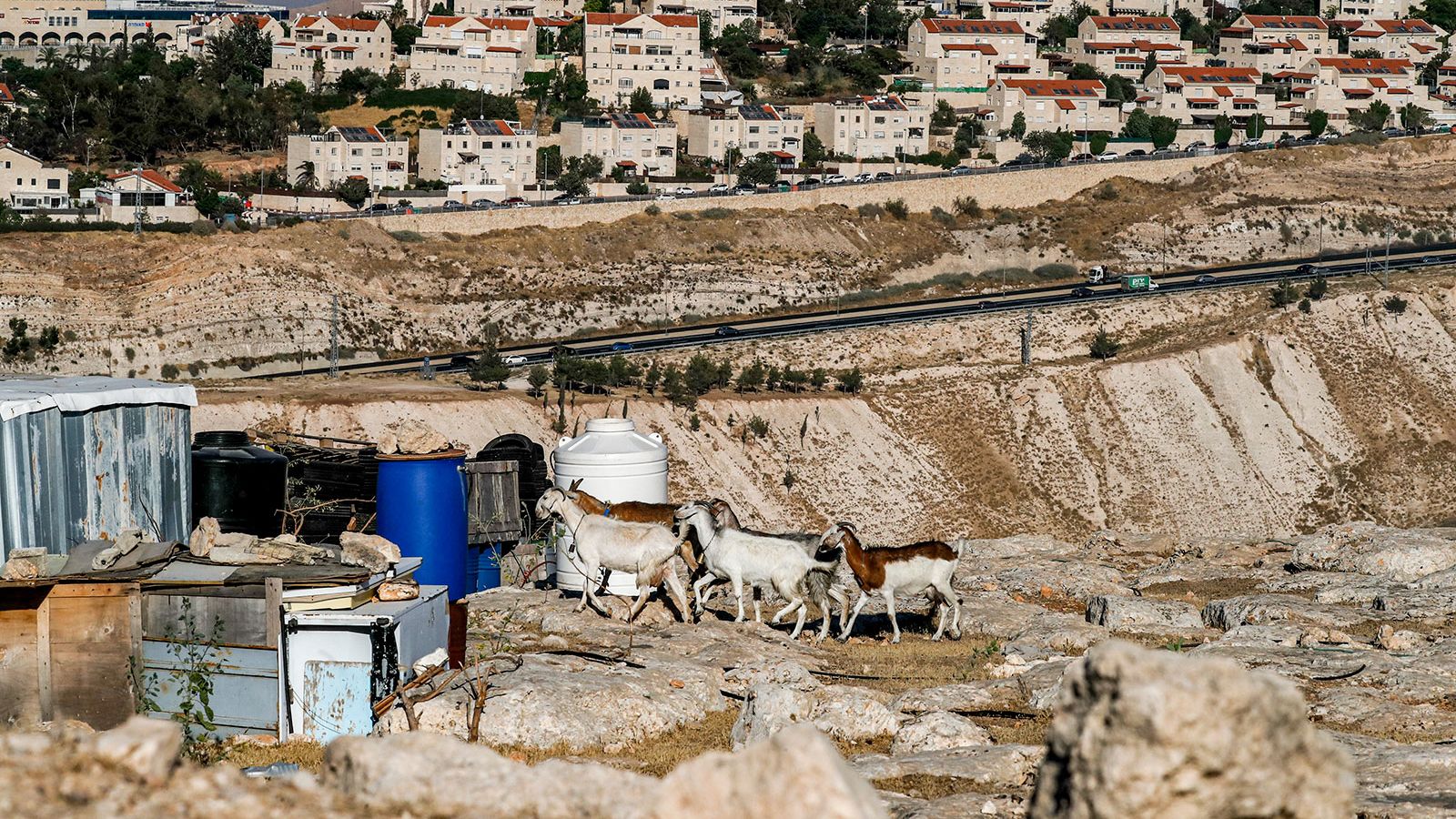
The hill where hopes for a Palestinian state may die

This picture taken on June 30, 2020 shows a view of the bedouin encampment of Jabal al-Baba, near the Israeli settlement of Maale Adumim in the occupied West Bank on the outskirts of Jerusalem, with the settlement appearing in the background. (Photo by AHMAD GHARABLI / AFP) (Photo by AHMAD GHARABLI/AFP via Getty Images)
Condemnation for Israel's plan for new settlements in the West Bank
4:18 • Source: CNN
This picture taken on June 30, 2020 shows a view of the bedouin encampment of Jabal al-Baba, near the Israeli settlement of Maale Adumim in the occupied West Bank on the outskirts of Jerusalem, with the settlement appearing in the background. (Photo by AHMAD GHARABLI / AFP) (Photo by AHMAD GHARABLI/AFP via Getty Images)
4:18

Atop a Palestinian village overlooking Jerusalem, Atallah Mazara’a ruminates about his long-held dream. His Bedouin village of Jabal al-Baba sits near the geographical center of the occupied West Bank, balanced between the north and south of what a future Palestinian state would be made up of.

But with each passing day, that dream seems to fade into the horizon, farther than ever before.

Far-right Israeli Finance Minister Bezalel Smotrich last week announced the final approval of thousands of new housing units to expand Israel’s Ma’ale Adumim settlement, that would effectively cut the West Bank in two – a plan known as E1.

Smotrich made it clear that his goal was to kill prospects of a Palestinian state, saying, “The Palestinian state is being erased from the table not with slogans, but with actions.”

Read the full story here.

Watch as tires are set alight in central Israel during "day of struggle" protests

<p>Demonstrators set tires alight in central Israel on Monday as part of protests calling for the release of the remaining hostages in Gaza. Demonstrations are taking place across the country in what protesters have called a 'Day of Disruption.' </p>
Demonstrators set tires alight in Israel in protests calling for hostage release
0:05 • Source: CNN
<p>Demonstrators set tires alight in central Israel on Monday as part of protests calling for the release of the remaining hostages in Gaza. Demonstrations are taking place across the country in what protesters have called a 'Day of Disruption.' </p>
0:05

As we’ve been reporting today, protesters have been setting tires alight and blocking highways across Israel as part of a nationwide ‘Day of Struggle,’ calling for a ceasefire deal securing the release of the remaining hostages in Gaza.

The video above, obtained by CNN and filmed in Kfar Hayarok, central Israel, shows several flaming tires piled up on a roadway.

Which countries have recognized Palestinian statehood?

More than 140 nations have joined the call for international recognition of a Palestinian state. That’s about three quarters of all United Nations members – and growing.

The majority of those countries recognized Palestinian statehood in the 1980s, following the Palestine National Council’s (PNC) declaration of the state. But the issue has risen in prominence since the Israel-Hamas war began in 2023.

Today, most of the Arab world recognizes a Palestinian state. But some of Israel’s closest Western allies are soon set to join them.

Spurred by global alarm at the suffering of Palestinians in Gaza, France, the United Kingdom, Canada and Australia have announced plans to recognize a Palestinian state next month.

Israeli foreign minister says “left-wing” Western governments trying to “impose” Palestinian state on Israel

Israeli Foreign Minister Gideon Saar at UN headquarters in New York City on August 5.

Israeli Foreign Minister Gideon Sa’ar has warned that Western recognition of Palestinian statehood would be an “act of suicide” for Israel.

We’ve reported today on comments from German Chancellor Friedrich Merz. He says his country will not be joining other Western nations in recognizing Palestinian statehood when they gather at the UN General Assembly next month.

In recent weeks, France, the United Kingdom, Canada and Australia have announced plans to recognize a Palestinian state in September, a growing consensus among Western governments to promote a two-state solution to the Israeli-Palestinian conflict.

Sa’ar, who belongs to Prime Minister Benjamin Netanyahu’s right-wing Likud party, said Israel was in a “better strategic position than we were two years ago,” referring to Israel’s assaults against Hamas in Gaza, Hezbollah in Lebanon, and Iran.

“This so-called ‘solution’ is suicidal from Israel’s perspective. Israel cannot agree to it,” he added.

Download the CNN app

Scan the QR code to download the CNN app on Google Play.

Scan the QR code to download the CNN app from Google Play.

Download the CNN app

Scan the QR code to download the CNN app from the Apple Store.

Scan the QR code to download the CNN app from the Apple Store.