Our live coverage has ended
Follow the latest updates on the war with Iran here.
Updates
(72)Here’s what we covered
• US-Iran negotiations: US President Donald Trump said that Vice President JD Vance and Secretary of State Marco Rubio are leading negotiations with Iran, expressing optimism that a deal is in sight. An Iranian source told CNN that Tehran is willing to listen to “sustainable” proposals to end the war.
• Philippines declares emergency: The Philippines has declared a state of national emergency due to the Iran war. The leader of the country, a US ally, warned there was an “imminent danger” to the “availability and stability of the country’s energy supply.”
• Bolstering US firepower: Around 1,000 US soldiers with the Army’s 82nd Airborne Division are expecting to deploy in coming days to the Middle East, sources told CNN.
• Congressional vote: Meanwhile, Republicans again rejected a resolution requiring Trump to seek congressional approval for future US military action against Iran.
Trump expresses optimism that an Iran deal is in sight. Catch up on the latest

US President Donald Trump indicated Tuesday that a deal on ending the war could be in sight, while an Iranian source told CNN that Tehran is willing to listen to “sustainable” proposals.
At the same time, sources said that 1,000 US soldiers with the Army’s 82nd Airborne Division are expecting to deploy in coming days to the Middle East.
Catch up on other headlines here:
- On negotiations: Iranian representatives have let the Trump administration know it does not want to re-enter negotiations with special envoy Steve Witkoff and President Donald Trump’s son-in-law Jared Kushner and would prefer to engage with Vice President JD Vance, two regional sources said. Trump said today that Vance, Secretary of State Marco Rubio and others are leading the negotiations, expressing optimism that a deal is in sight.
- Rejected resolution: Republicans again rejected a resolution aimed at requiring Trump to seek congressional approval for future US military action against Iran.
- More attacks: Drones hit a fuel tank at Kuwait International Airport, causing a fire at the site, the country’s civil aviation authority said. Separately, videos geolocated by CNN showed fire and smoke rising from a residential building in Erbil, Iraq. Local authorities said it was caused by a drone strike.
- State of emergency: Philippines President Ferdinand Marcos Jr. declared a state of national energy emergency, warning that there was an “imminent danger” to the “availability and stability of the country’s energy supply.”
Meanwhile, CNN’s Nick Paton Walsh reports from southern Lebanon, where some villages are being entirely emptied as civilians seek safety from Israel strikes aimed at Hezbollah targets.


Kylie Atwood, Morgan Rimmer, Helen Regan, Michael Rios and Dalia Abdelwahab contributed reporting.
Philippines declares state of national emergency as Iran war threatens energy supplies


Philippines President Ferdinand Marcos Jr. declared a state of national energy emergency on Tuesday, warning that there was an “imminent danger” to the “availability and stability of the country’s energy supply.”
Marcos said a committee had been formed to ensure the availability and distribution of fuel, food, medicines, agricultural products and other basic goods.
Measures include enforcing energy conservation measures, introducing fuel subsidies and other initiatives to reduce transport costs, taking action against hoarding, profiteering and manipulation of the supply of petroleum products.
Marcos also said the government was rolling out 5,000 pesos ($83) to motorcycle taxi drivers and transport workers to help with rising fuel costs. Welfare programs have also been announced for farmers, fishermen, and other workers.
Senate Republicans again reject effort to rein in Trump over Iran war

Republicans again rejected a resolution aimed at requiring President Donald Trump to seek congressional approval for future US military action against Iran.
The Senate voted 47 to 53 to put down the measure, with GOP Sen. Rand Paul joining with Democrats in voting to advance it, and Democratic Sen. John Fetterman voting with Republicans to block it.
This is the third time since the current conflict between the US and Iran started that Democrats have forced an unsuccessful vote over Iran war powers.
Democrats have pledged to keep forcing votes until Secretary of State Marco Rubio and Secretary of Defense Pete Hegseth publicly testify about Iran on Capitol Hill. To date, the GOP-led Congress has not held any open oversight hearings on the conflict, although there have been classified sessions for members.
Even if the measure had advanced, it faced an uphill battle on Capitol Hill, as it would have needed to withstand a full amendment process in the Senate before moving to the House, and then a likely presidential veto that requires a two-thirds vote to override.
Drones strike fuel tank at Kuwait International Airport, causing fire
Drones have hit a fuel tank at Kuwait International Airport, causing a fire at the site, the country’s civil aviation authority said.
The attack resulted in material damage but so far there are no reports of casualties, according to Abdullah Al-Rajhi, the spokesperson for Kuwait’s Directorate General of Civil Aviation.
Emergency teams have been deployed to the scene to put out the flames, he added.
Iranian-linked drones have repeatedly attacked the country’s main international airport during the US-Israeli war with Iran, leaving several people injured and causing damage to the passenger terminal, according to the aviation authority.
Iran has expressed a preference for negotiating with Vance, sources say

Iranian representatives have let the Trump administration know it does not want to re-enter negotiations with special envoy Steve Witkoff and President Donald Trump’s son-in-law Jared Kushner and would prefer to engage with Vice President JD Vance, two regional sources said.
The message, which was passed through back channels to the US, signals Iran believes discussions involving Witkoff and Kushner wouldn’t be productive given the deficit of trust following the breakdown of negotiations prior to Israel and the US launching military action.
Vance — in contrast to Witkoff, Kushner and even Secretary of State Marco Rubio — is viewed as more sympathetic to wanting to end the war, the sources said.
Though regional players also recognize that it could be risky for Vance to enter into negotiations as it won’t be easy to negotiate an end to the conflict.
Witkoff, in particular remains heavily involved in the portfolio from the US side and the sources said that the Iranians will likely have no option but to engage with whoever the Trump administration sends to negotiate.
“Who the administration decides to send, the Iranians will have to deal with, but it doesn’t mean they don’t have a preference,” the second source said.
Earlier on Tuesday, Trump said all the key members of his diplomatic team were involved in negotiations.
White House press secretary Karoline Leavitt told CNN that it’s Trump’s call who negotiates for the US.
“President Trump and only President Trump determines who negotiates on behalf of the United States. As the President stated today, Vice President Vance, Secretary Rubio, Special Envoy Witkoff, and Mr. Kushner will all be involved,” Leavitt said.
Another White House official said the regional sources were trying to undermine Trump.
“This obvious op sourced entirely to ‘regional sources’ is clearly a coordinated foreign propaganda campaign meant to undermine the president,” the White House official said.
For now, a meeting between the US and Iran later this week in Islamabad remains a possibility — but even those advocating for it to take place are skeptical that it will actually happen, sources said.
This post has been updated with additional details.
A recap on US-Iran talks and the ongoing fighting in the Middle East



US President Donald Trump expressed optimism that a deal with Tehran is in sight, with Vice President JD Vance, Secretary of State Marco Rubio and others leading negotiations. There had been “outreach” between the Washington and Tehran, an Iranian source told CNN, adding that Iran is willing to listen to “sustainable” proposals to end the war.
Trump alluded to an “oil and gas related” goodwill gesture from the Iranians that he described as a “present” helped with diplomatic efforts to end the war.
Get CNN’s detailed look here at talks between the US and Iran.
In the meantime, here is all the other news from the region:
Impacts of Strait of Hormuz closure:
- The effective closure of the vital waterway by Iran is “economic terrorism against every nation,” said Sultan Ahmed Al Jaber, CEO of state-owned energy giant ADNOC (the Abu Dhabi National Oil Company).
- Here are some of the measures some countries are taking as the closure has sent energy prices rising around the world. An end to the Iran war will bring immediate relief to oil and natural gas markets, but it could take months before prices fall back to the levels they stood at before the conflict started.
In Iran:
- Iran appointed Mohammad Bagher Zolqadr, an Islamic Revolutionary Guard Corps (IRGC) veteran, to lead its national security after Ali Larijani was killed in an Israeli strike last week.
- The IRGC has warned that it will target the Israeli military in Gaza and northern Israel if the “crimes against civilians in Lebanon and Palestine continue.”
In the region:
- The conflict between Israel and Lebanon could have been avoided if Israel had withdrawn from southern areas as outlined in the 2024 ceasefire deal made between Israeli forces and Hezbollah, Lebanese President Joseph Aoun said. Israel’s targeting of infrastructure, including bridges, along the Litani River “aims to isolate villages and towns south of the Litani River from the rest of Lebanon,” he added.
- Israel is set to approve a major increase in the number of reserve soldiers it can mobilize – setting a new limit of 400,000, up from 280,000.
- Iraq ordered a response to recent military attacks targeting Iraqi security forces, following deadly strikes in western Iraq on Iran-backed Popular Mobilization Forces (PMF) earlier on Tuesday. The PMF has repeatedly accused the US and Israel of being behind deadly strikes in recent weeks that killed dozens of its fighters.
- At least six Kurdish Peshmerga fighters were killed and 30 others were wounded in an Iranian missile attack on a base north of Erbil in Iraqi Kurdistan, local officials said early Tuesday, in the first direct Iranian attack on Peshmerga forces in Iraq.
- Nearly 350 children are among the thousands killed so far in the conflict, according to a CNN tally of regional figures.
- Saudi Arabia wants Tehran’s missile capabilities degraded “as much as possible,” but does not want Iran’s civilian infrastructure harmed, a source told CNN. Revisit what each country involved in the conflict wants.
CNN’s Mohammed Tawfeeq, Betsy Klein, Aqeel Najim, Tal Shalev, Donald Judd, Catherine Nicholls, Eyad Kourdi, Charlotte Reck, Nechirvan Mando and Christian Edwards, Frederik Pleitgen, Becky Anderson, Mostafa Salem, Hanna Ziady and Olesya Dmitracova contributed to this report.
Iran speaker has been talked about as potential interlocutor with US. Learn more about him
The speaker of the Iranian parliament has been talked of as a potential interlocutor with the Trump administration.
CNN’s Fred Pleitgen has more on Speaker Mohammad Bagher Ghalibaf:

President Trump claims the US is speaking to Iran, but one of Iran’s highest-ranking surviving officials, parliamentary speaker Mohammad Bagher Ghalibaf, has denied any negotiations have taken place. Ghalibaf is emerging as one of the strongmen in the country and is known for being a political hardliner and well-respected by the IRGC.

Iran says projectile hits grounds of Bushehr nuclear plant, accuses US and Israel


The Atomic Energy Organization of Iran said a projectile struck the grounds of the Bushehr Nuclear Power Plant on Tuesday night, local time, describing the incident as a “renewed attack,” by what it called the “American–Israeli enemy.”
CNN has reached out to the US Department of Defense and the Israeli military for comment.
In a statement, the AEOI said initial reports indicated the strike caused no financial, technical or human damage and that no part of the facility was affected.
The agency said it followed an incident earlier this month, when a another projectile hit the facility’s grounds — an event it said also ended without casualties or damage.
The AEOI said attacks on “peaceful nuclear facilities” violate international regulations and commitments that protect such sites from military action, warning such incidents could have “dangerous and irreversible consequences” for regional safety and security, particularly for countries along the Persian Gulf.
9 people injured after Iranian missiles fired toward central Israel, rescue workers say



At least nine people, including six children, were wounded after an Iranian missile launch struck a city in central Israel, emergency officials reported Tuesday.
A 23-year-old man, an 80-year-old woman and a 7-year-old boy were among those injured by shrapnel and glass fragments in the city of Bnei Brak, immediately east of Tel Aviv, according to Israel’s emergency services Magen David Adom.
Video from the scene showed upturned cars and damaged buildings. In one photo, the internal wall of what appears to be a safe room has been badly damaged, with masonry strewn across the floor and a bed.

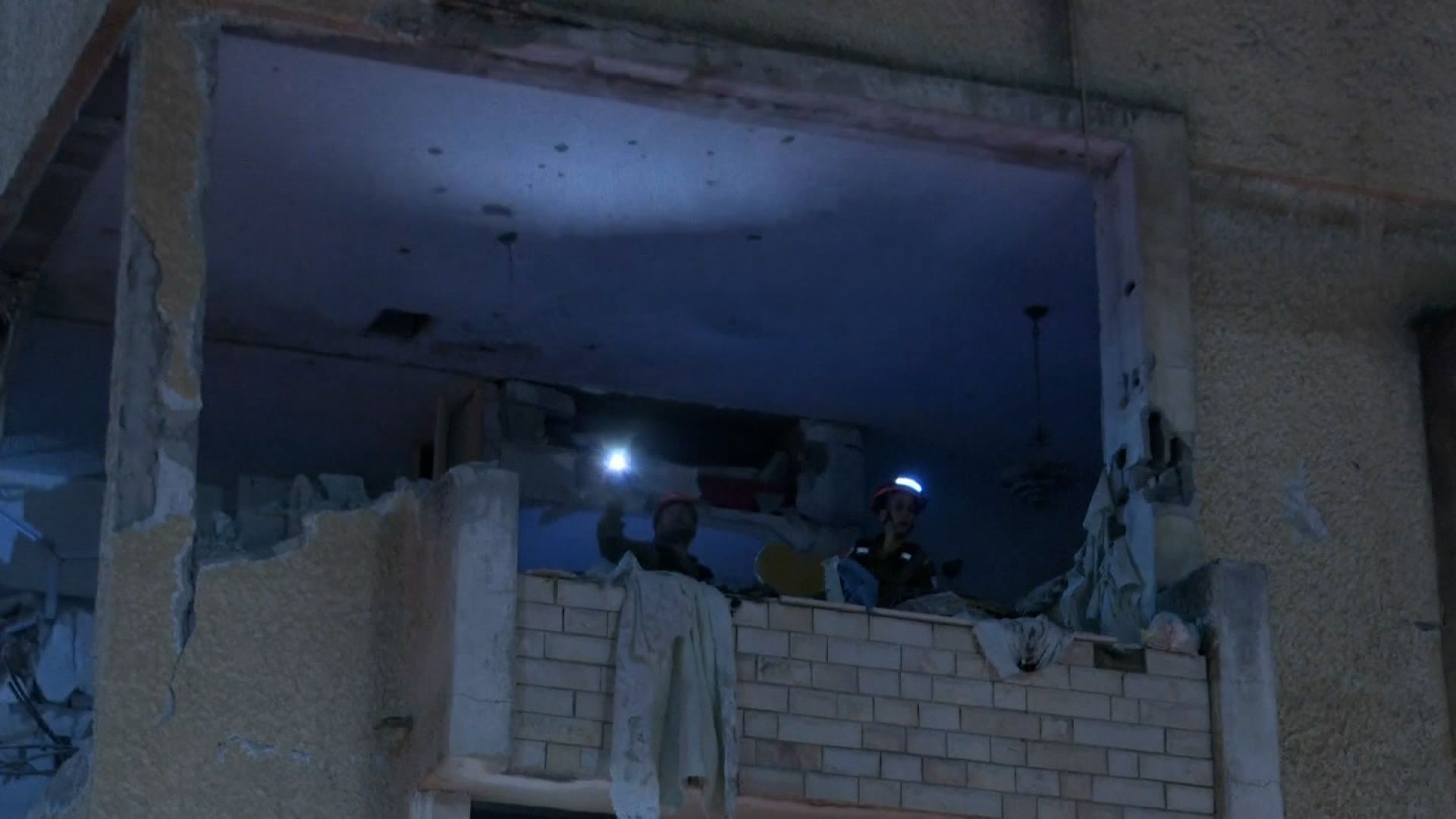
A CNN team about 5 kilometers away witnessed the incoming strike, observing more than a dozen orange lights moving through the sky, suggesting a possible cluster munitions attack.
In total, 17 Israeli civilians have been killed by Iranian missile strikes since Israel and the US went to war with Iran on February 28. Four Palestinian women in the occupied West Bank, including a 32-year-old expectant mother who was six months pregnant, were also killed, after rocket fragments struck a hair salon near the city of Hebron last week.
At least 16 attacks reported on vessels near Iran since the war started, UK agency says
More than a dozen vessels have been attacked near Iran since the war started four weeks ago.
According to UK Maritime Trade Operations, there have been at least 16 reported attacks on ships in the Persian Gulf and near the Strait of Hormuz since February 28.
Approximately 290 US troops injured thus far in Iran war, Central Command says

Approximately 290 US service members have been injured during combat operations targeting Iran as of Tuesday, ticking up from approximately 200 last week, according to a spokesperson for US Central Command.
A US official previously told CNN that the service members considered seriously wounded include significant cases where death is possible or imminent. Thirteen US service members have been killed in action to date.
Previously Chairman of the Joint Chiefs of Staff Gen. Dan Caine had said the majority of the injuries to US military personnel were the result of Iranian drone attacks.
It’s not unusual for the number of injuries to fluctuate or increase over time, as service members may not seek care immediately after an incident depending on its severity.
UC Irvine professor warns of “corpse” of Iran in bleak post on X
Touraj Daryaee, an Iranian Iranologist at the University of California, Irvine, warned on Tuesday about what he described as a catastrophic future for Iran amid its war with the US and Israel.
“At best, we will take delivery of the corpse of our Iran, which will be torn to pieces and without water and electricity and gas and breathable air,” Daryaee, who’s professor of history and director of the Dr. Samuel M. Jordan Center for Persian Studies and Culture wrote on X.
Daryaee, a prominent Iranian-born historian, invoked a scenario in which he said US President Donald Trump “will make peace,” while Iran’s Supreme Leader Ayatollah Ali Khamenei would “silence every voice other than his own.”
Daryaee also appeared to criticize Iran’s exiled royalist opposition, writing that “the Prince will, every week from his safe house in Washington, deliver the message of the ‘final battle.’”
Iraq orders response to US-Israeli attacks on Iran-backed forces
Iraq’s Ministerial Council for National Security has ordered a response to recent military attacks targeting Iraqi security forces, following deadly strikes in western Iraq on the Iran-backed Popular Mobilization Forces (PMF) earlier on Tuesday.
The PMF has repeatedly accused the US and Israel of being behind deadly strikes in recent weeks that killed dozens of its fighters.
The council said in a statement Tuesday that Iraq’s security institutions, including the PMF, are carrying out their duties under the constitution and the law to maintain stability across the country. It described the PMF Commission as “one of the pillars” of Iraq’s national security system, while stressing that its members must operate strictly within the legal framework.
The meeting came amid what the government called “unjustified attacks and serious violations of Iraqi sovereignty,” including strikes targeting official security headquarters.
The council ordered Iraqi forces to confront and repel “attacks carried out through warplanes and drones” targeting PMF headquarters and other armed forces formations, “by all possible means,” citing the right to respond and self-defense.
The council failed to address the recent attack on Kurdish forces in northern Iraq earlier today, which authorities there say was carried out by several ballistic missiles fired from Iran.
A senior Iraqi security official who spoke to CNN on condition of anonymity due to security concerns, said the order to retaliate could drag Iraq into a wider confrontation and further undermine stability in the region.
See how Israeli strikes target bridges and affect families in Lebanon
Israeli strikes have killed at least 1,000 people, including more than 100 children, since the bombing campaign began earlier this month.
Here’s a look at the impact on people in a town in southern Lebanon.

A series of evacuation orders and air strikes by Israel are emptying southern Lebanon of its civilian population as fears grow about when they can expect to return. CNN Chief International Security Correspondent Nick Paton Walsh reports.

Trump says Hegseth and Caine were "disappointed" by prospect of ceasefire with Iran

President Donald Trump said Tuesday that Defense Secretary Pete Hegseth was “quite disappointed” by the prospect of the US negotiating a ceasefire with Iran.
Trump, who has insisted repeatedly that the US is making progress in discussions with Iranian leaders, praised Hegseth and Caine for their reluctance, calling it a “good attitude.”
“They were not interested in settlement,” he said. “They were interested in just winning this thing.”
Amid ongoing Iran and Lebanon campaigns, Israeli government to expand mobilization powers
The Israeli government is set to approve a major increase in the number of reserve soldiers it can mobilize – setting a new limit of 400,000, up from 280,000.
In a statement, the government said the move was a result of the Israel Defense Forces’ “operational activity across several areas, and in particular the framework of Operation Roaring Lion” – the name given to Israel’s war, launched with the US, against Iran.
The expanded authorization – which is a temporary measure in place until the end of May – sets the legal ceiling for call-ups but does not necessarily mean the military will mobilize the full 400,000 reservists.
The current limit of 280,000 was set in January this year and represented the lowest figure since the Hamas attacks of October 7, 2023.
“The IDF is currently engaged on several fronts, and reservists are being mobilized as required by operational needs closely tied to the broader war effort,” the government added in its statement.
Trump says “war has been won” with Iran

President Donald Trump again claimed victory in the war with Iran, while leaving the door open to continued strikes against the country’s energy infrastructure if ongoing negotiations to end the conflict fall through.
“You know, I don’t like to say this — we’ve won this, because this war has been won, the only one that likes to keep it going is the fake news,” Trump said in the Oval Office today, blasting media coverage of the spiraling conflict.
“We’re not winning a war where they have no navy and they have no air force and they have no nothing, and we literally have planes flying over Tehran and other parts of their country,” the president continued. “They can’t do a thing about it. For instance, if I want to take down that power plant, that very big, powerful power plant, they can’t do a thing about it.”
Trump’s rhetoric about the end of the war has repeatedly shifted. On March 9, for example, the president told a reporter that the 10-day-old war was “very complete, pretty much.” Hours later, the president signaled there was still more to do: “We’ve already won in many ways, but we haven’t won enough.”
Trump said over the weekend that the US would “obliterate” Iran’s power plants if the Strait of Hormuz was not reopened by Monday evening.
But on Monday morning he reversed course, saying that the US and Iran have held “productive conversations” and that he would hold off on striking Iranian energy sites for five days.
Selection of Iran's new top security official points to more aggressive Iran posture, says analyst

Iran’s decision to install Mohammad Bagher Zolghadr – a loyalist of Supreme Leader Ayatollah Mojtaba Khamenei – as the country’s new security chief, signals Khamenei is tightening his grip on power, an analyst says.
“Zolghadr is Mojtaba’s man, and the selection shows that Mojtaba is in charge,” Vali Nasr, a professor at the Johns Hopkins University School of Advanced International Studies, said in a post on X Tuesday.
Nasr also wrote that Iranian parliament Speaker Mohammad Bagher Ghalibaf “may be the hot ticket for the White House, but Zolghadr is the reality on the ground.” His comment came after reports suggested Ghalibaf was in talks with US President Donald Trump — a claim Ghalibaf denied within hours, saying there were no negotiations between Tehran and Washington.
Nasr argued the selection points to a shift of influence toward the most hardline elements of the Iran’s Islamic Revolutionary Guard Corps (IRGC), saying it “confirms that all Israel’s decapitation has achieved is to transfer power in Tehran to the most hawkish part of IRGC.” He described Zolqadr as coming from that wing.
Nasr alleged Zolghadr had a hand in suppressing protests in 1999 and 2009.
Looking ahead, Nasr said Zolghadr’s elevation does not suggest a diplomatic opening with Washington. “His selection to replace (Ali) Larijani does not suggest there will be talks with US but rather a much more aggressive Iranian posture,” he wrote.
Trump suggests "present" from the Iranians might pave the way for diplomacy

President Donald Trump alluded to a goodwill gesture from the Iranians that he described as a mystery “present,” suggesting that the gift has helped with diplomatic efforts to end the war.
“They gave us a present, and the present arrived today. It was a very big present, worth a tremendous amount of money, and I’m not going to tell you what the present is, but it was a very significant prize,” Trump told reporters in the Oval Office on Tuesday.
The present, Trump said, was “oil and gas related.”
“It was related to the flow, to the Strait,” the president said, referring to the Strait of Hormuz, a critical oil thoroughfare that’s been effectively shut down.
He said the gift indicated that the Iranian negotiators talking with his administration were willing to follow through on their promises.
“They gave it to us, and they said they were going to give it, so that meant one thing to me: we’re dealing with the right people,” Trump said, later adding, “They’re the only ones that could have done it.”
And he described what’s happened in Iran as “regime change” for the country.
“We have, really, regime change. You know, this is a change in the regime, because the leaders are all very different than the ones that we started off with that created all those problems,” he said.