Our live coverage has ended
• Follow the latest updates on the war with Iran here.
Updates
(80)What we know so far
• War timeline: US President Donald Trump said on social media Friday the US is considering “winding down” military efforts in the Middle East. But officials said thousands more US troops are heading there. And a senior Iranian source told CNN that Tehran doesn’t believe Trump’s claim.
• Berating allies: Trump also called NATO allies “cowards” for not helping the US secure the Strait of Hormuz. He downplayed prospects of a ceasefire.
• Oil market: US temporarily lifted sanctions on 140 million barrels of Iranian oil as the price of Brent crude settled at $112.19 a barrel Friday, its highest so far in the war. Goldman Sachs suggested that higher prices could last through 2027.
• Town hall: US Ambassador to the UN Mike Waltz, speaking at a CNN town hall Friday night, defended the lifting of sanctions on some Iranian oil, describing the move as “very temporary.”
Key lines from Ambassador Mike Waltz and other headlines from the war with Iran


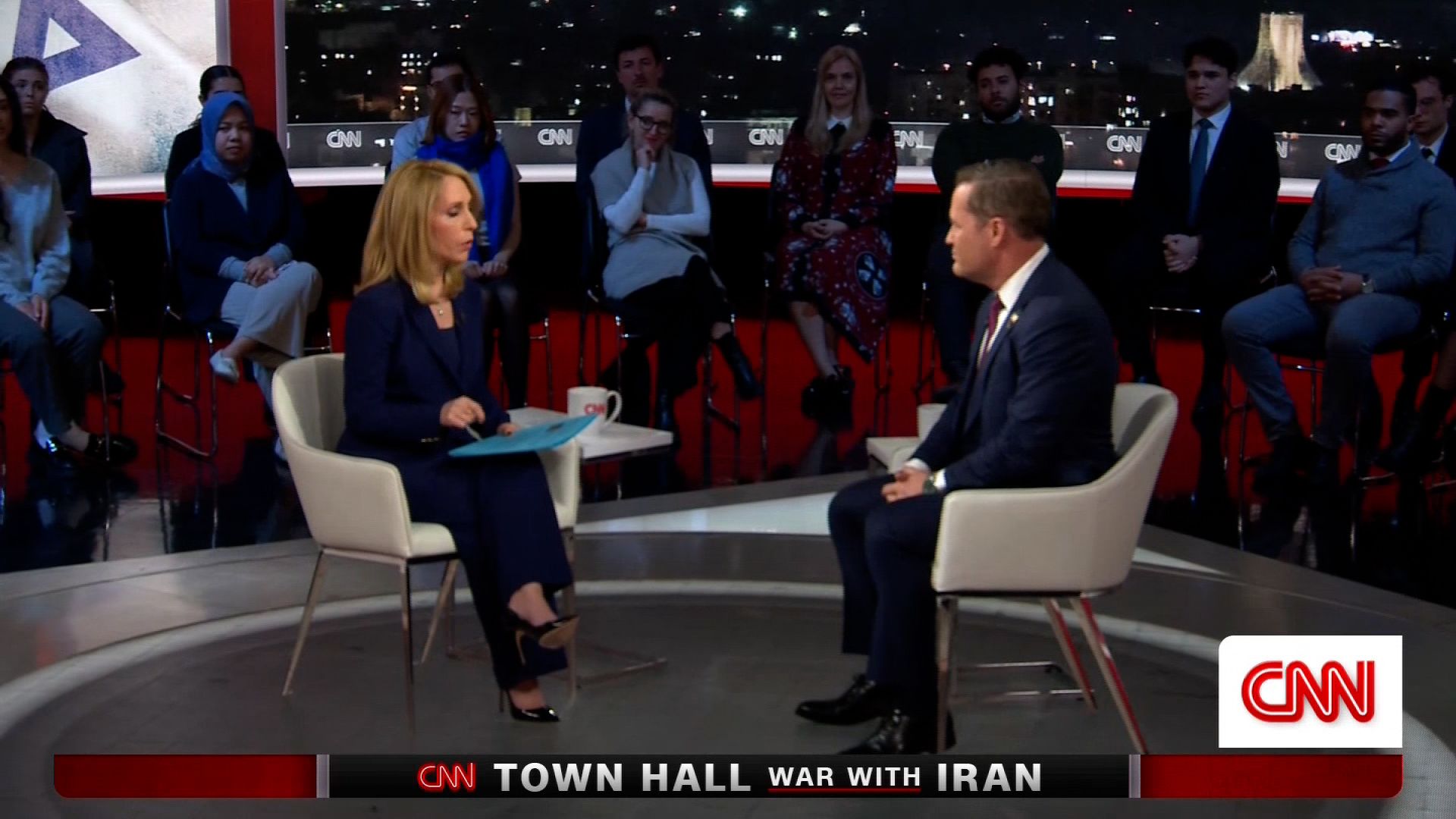
US Ambassador to the UN Mike Waltz took questions Friday night from CNN’s Dana Bash and a studio audience in New York about the administration’s war with Iran.
He defended President Donald Trump and, at times, seemed to struggle to respond to some concerns.
Here are some of the key headlines from the CNN town hall:
- The war against Iran still comports with the “America First” platform Trump used to successfully run for office, Waltz said. He said the president is “seeking to end wars all over the world. In this case, this is the ultimate endless war in the sense that it’s been going on for 47 years.”
- Waltz argued Trump gave diplomacy a chance before deciding “enough was enough” and resorting to military action against Iran.
- Trump has “all options” at his disposal in the conflict, including US forces deploying inside Iran, Waltz said. Degrading the country’s nuclear facilities from the air or sea remains the “preferred option,” he said.
- The administration’s decision Friday to lift sanctions on millions of barrels of Iranian oil is “very temporary” and necessary to “defeat the Iranian strategy of driving energy prices so high,” Waltz said.
- A college student who also works as a waiter asked Waltz how the war, funded by his taxes, is helping him. The ambassador highlighted other Trump policies on housing and taxes, saying the president has to “make tough decisions” when it comes to a “genocidal, terroristic regime.”
Other key things to know:
- Iran launched intermediate-range ballistic missiles at Diego Garcia, a joint US-UK military base, Friday morning local time, according to a US official.
- US actions meant to lower the price of oil may take too long to have any immediate effect, Beth Sanner, a former deputy director of national intelligence, said at the town hall.
- Earlier today, the US removed sanctions on 140 million barrels of Iranian oil as Trump seeks to lower gas prices.
CNN’s Zachary Cohen and Adam Cancryn contributed reporting to this post.
Source: Iran unsuccessfully targets US-UK base in Indian Ocean with ballistic missiles

Iran launched intermediate-range ballistic missiles at Diego Garcia, a joint US-UK military base, Friday morning local time, according to a US official.
Iran fired two missiles at the facility located in the Indian Ocean around 2,370 miles (3,810 kilometers) from Iran’s coast, but neither of them struck the base, the official said.
Diego Garcia - a key airfield for the US’ heavy bomber fleet - has long served as a crucial overseas US military staging post for operations far from home.
CNN has reached out for comment from the White House, Pentagon and the UK Ministry of Defense, as well as US Indo-Pacific Command, which counts the base at Diego Garcia among its areas of responsibilities.
The Wall Street Journal first reported Iran’s attempt to strike Diego Garcia.
This post has been updated with additional information.
Why a delayed Xi-Trump summit could give China a stronger hand

US President Donald Trump’s request to delay a high-stakes summit with China’s leader Xi Jinping could work in Beijing’s favor, according to several Chinese sources familiar with the matter, potentially allowing both parties to sidestep complications related to the US’ war with Iran – China’s most important strategic partner in the Middle East.
And if Trump loses his grip on the conflict that’s already threatening oil supplies and global economic growth, it could strengthen China’s hand in talks – if they go ahead at all –– according to experts.
Beijing never formally confirmed the highly anticipated visit, and has yet to provide an official response to the proposed “5-to-6 week” delay. Trump said this week that “China is fine with” delaying the meeting that, according to the White House, had previously been scheduled for March 31 to April 2.
Beijing has remained vague on the delay – possibly giving itself more room to maneuver – but its tone remains positive, with Chinese Foreign Ministry spokesperson Lin Jian saying Wednesday that leaders’ summits play an “irreplaceable” role in guiding the bilateral relationship.
Behind the scenes, however, there remains caution. The summit may still “not necessarily happen as planned,” with the possibility either China or the US decides to pull out of talks, according to two Chinese sources familiar with the matter.
“If the war in Iran causes major casualties of Chinese citizens, or major damage of Chinese assets in the region, then Trump would not be able to come,” said a source, describing one of Beijing’s apparent red lines.
US action so far not enough to significantly curb oil price, national security expert says

A national security expert said during a CNN town hall tonight that US actions meant to lower the price of oil may take too long to have any immediate effect.
Beth Sanner, a former deputy director of national intelligence and CNN national security analyst, said the administration is trying to do “little, tiny things that make it seem like they’re doing something” to bring prices down, including by waiving the Jones Act and easing sanctions on Russian and Iranian oil.
Regarding the lifting of some sanctions, Sanner said: “That is not going to increase the number of barrels, really, on the market.”
“And so it won’t significantly lower the price, and it’s not enough,” she added. “Just like the release of the strategic petroleum reserves — it takes too long, over too much of a period of time, and it’s just not enough.”
Read more about why the Trump administration is easing some sanctions on Iranian oil.
Waltz struggles to explain cost of Iran war to student who works as a waiter
During tonight’s CNN town hall, a college student who also works as a waiter asked Mike Waltz how the Iran War, funded by his taxes, is helping him. The US ambassador to the United Nations struggled to answer.
“How is a war in a country half a world away, funded by the taxes pulled from my check, helping me in any way?” Santiago Porras Ruiz asked.
Watch Waltz’s answer:


Here's what US victory in Iran would look like, according to Ambassador Waltz
US Ambassador to the UN Mike Waltz just laid out what the administration would consider victory in the war with Iran.
Hear his full answer:


Waltz defends administration's decision to lift sanctions on some Iranian oil

The Trump administration’s decision Friday to lift sanctions on millions of barrels of Iranian oil is “very temporary,” US Ambassador to the UN Mike Waltz said.
The ambassador said it is necessary to “defeat the Iranian strategy of driving energy prices so high.” Iran has effectively closed the Strait of Hormuz.
“So we’re going to allow it to go in a temporary basis to some of our allies like India, Japan and others so that this strategy from Iran, the Iranian regime, doesn’t work,” he said.
Oil prices have continued to rise as the strait remains closed, with average gas prices in the US steadily ticking higher. Roughly 20% of the world’s oil travels through it, and the administration has struggled with solutions to make up for the dwindling supply.
Trump decided "enough is enough" after failed diplomacy with Iran, Waltz says
US Ambassador to the UN Mike Waltz argued that President Donald Trump gave diplomacy a chance before deciding “enough was enough” and resorting to military action against Iran.
Michael Gianino, a constituent liaison for a New York City councilmember, asked the ambassador during the CNN town hall how the US involvement in Iran corresponds with Trump’s previous commitments to prioritize American interests.
Watch his answer:


Will the US have boots on the ground in Iran? Trump has "all options," Waltz says

“All options” are available in regard to US forces deploying inside Iran, US ambassador to the UN Mike Waltz said tonight, adding that degrading the country’s nuclear facilities from the air or sea remains the “preferred option.”
“I don’t think anybody should expect this to look anything like we saw in back in 2003, two decades ago, with a massive invasion,” the ambassador said at a CNN town hall.
But US special forces have the ability to go into Iran and take possession of components that could be used to build a nuclear weapon “in a very targeted way,” said Waltz, who is himself a former special forces operator.
“If we can do this and degrade those capabilities from the air and from the sea, that would be the preferred option,” Waltz said, though adding that Trump as commander-in-chief has “all options” at his disposal.
Waltz: Iran war aligns with Trump “America First” agenda, calls it “ultimate endless war”

US ambassador to the United Nations Mike Waltz said the United States’ war against Iran still comports with the “America First” platform that President Donald Trump used to successfully run for office.
Responding to a question during a CNN town hall, Waltz called the war with Iran “the ultimate forever war” — referring to the years in which Iranian proxies have fought for decades against US forces in the Middle East.
“One of the things that we should be very clear on is how consistent President Trump has been in terms of Iran never having a nuclear weapon,” Waltz said.
“He is a president of peace,” Waltz said of Trump. “He is seeking to end wars all over the world. In this case, this is the ultimate endless war in the sense that it’s been going on for 47 years.”
Waltz later added: “The Iranian regime has been at war with the United States for nearly 50 years, and I’m thankful that he is no longer going to kick the can.”
NOW: The CNN town hall on the Iran war has begun

US Ambassador to the United Nations Mike Waltz and a panel of experts are answering questions from CNN’s Dana Bash and a live audience about the war against Iran.
CNN Global Affairs Analyst Brett McGurk, CNN National Security Analyst Beth Sanner and CNN Military Analyst Lt. General Mark Schwartz are on the expert panel.
How to tune in: A CNN Town Hall: War with Iran is streaming for CNN’s streaming subscribers and pay TV subscribers via CNN.com, CNN connected TV and mobile apps.
Why the Trump administration is easing sanctions on certain Iranian oil stockpiles

Trump administration officials are making a desperate push to secure every available barrel of oil amid a worsening energy crisis — even if it means lifting sanctions on the very country that they’re fighting against.
But three weeks into war with Iran, the administration is running out of options to contain the skyrocketing price of oil and gas.
Trump officials now privately estimate that the higher prices triggered by the war could linger for months, especially as fighting in the Middle East intensifies and passage through the Strait of Hormuz remains nearly impossible, three people familiar with the internal discussions said.
The US has already exhausted all of its go-to policy levers for alleviating the supply shock rippling through the global economy, those people said.
The Trump administration has already agreed to release hundreds of millions of barrels from its strategic reserves, eased some sanctions on Russian oil and taken steps domestically to accelerate crude flows throughout the US. Yet those actions have done little to slow the surge in prices around the world.
Officials are now going even further by temporarily removing sanctions on barrels of Iranian oil that are currently at sea, a move that will allow allies badly in need of supply to purchase them.
The optics of such a move are discomfiting: As the US tries to decimate the Iranian regime militarily, it will simultaneously be allowing the regime to benefit financially. It’s a tacit acknowledgement of the intense economic and political pressure that Iran has put on the US by closing the Strait of Hormuz.
Top headlines: US troops head to Middle East as Trump considers "winding down" operations
President Donald Trump said today that the US is “very close to meeting our objectives” in its war with Iran, even as thousands of service members are being deployed to the Middle East.
Here’s the latest:
- The US is considering “winding down” military efforts in the Middle East, Trump said in a social media post today. However, a senior Iranian source told CNN there has not been a “reduction in military activity” in the region.
- Trump told reporters earlier that he believes the US has “won” its war with Iran. But thousands more US Marines and sailors are heading towards the Middle East.
- Iran claims it has targeted the United States Embassy’s logistics base in Baghdad three times today, according to state broadcaster IRIB. The embassy has faced multiple rocket and drone attacks since the war began.
- Tehran has also issued a warning to the United Arab Emirates that it will strike the port city Ras al-Khaimah if Iranian islands in the Gulf continue to come under attack.
- Bahrain has joined EU nations as well as Japan and Canada in expressing readiness to support efforts to reopen the Strait of Hormuz, its state media reported. Yesterday, several European nations and Japan issued a joint statement condemning Iran’s attacks on commercial vessels in the Gulf and the effective closure of the waterway.
- US stocks and bonds fell, oil prices rose and gold had its worst week in four decades as the Iran war continues to ripple through financial markets. The US removed sanctions on 140 million barrels of Iranian oil as Trump seeks to lower gas prices.
- Georgia Gov. Brian Kemp signed legislation into law suspending the state’s 33.3 cents per gallon tax on gas and 37.3 cents per gallon levy on diesel fuel for two months.
- Coming up: US Ambassador to the UN Mike Waltz and a panel of experts will answer questions from CNN’s Dana Bash and a live studio audience about what may come next in the war during a town hall at 9 p.m. ET.
Meanwhile, CNN’s Zachary Cohen reports on the thousands of US Marines and sailors heading to the Middle East.

Thousands more US Marines and sailors are heading towards the Middle East as the war with Iran is about to enter its fourth week. CNN's Zachary Cohen reports on the details.

CNN’s Tami Luhby, John Towfighi, Samantha Waldenberg, Sophie Tanno, Caitlin Danaher, Frederik Pleitgen, David Goldman and Eyad Kourdi contributed reporting to this post.
US removes sanctions on 140 million barrels of Iranian oil as Trump seeks to lower gas prices

The Trump administration Friday night granted a temporary license for Iran to sell oil that has been sitting afloat on tankers.
That’s a lot of crude: 140 million barrels worth, which is enough to satisfy the entire world’s oil demand for about one-and-a-half days, according to the US Energy Information Administration.
The United States has sanctioned Iranian oil on and off for decades, and the Trump administration has blocked sales of the country’s crude since it abandoned the Iran nuclear agreement in 2018.
The optics of the temporary, one-month waiver on sanctions could be difficult. The United States is at war with Iran, and the license allows Iran to sell its sanctioned oil to help finance its war against the United States and its allies.
But Iran was selling its oil anyway. China is Iran’s biggest customer, and Iran was allowing its tankers through the otherwise blocked Strait of Hormuz. Meanwhile, global oil prices have surged over the course of the war to around $110 a barrel. The administration is trying to find any lever it can pull to keep oil prices in check while it wages its war – including desanctioning hundreds of millions of barrels of Russian oil last week.
The sale of Iranian oil probably would have been accomplished anyway – and this way, it can open up the sales to Western countries instead of going exclusively to China. And because of existing sanctions on Iran’s finances, the country may be unable to obtain the oil proceeds, noted Treasury Secretary Scott Bessent in a statement on Friday.
“Iran will have difficulty accessing any revenue generated and the United States will continue to maintain maximum pressure on Iran and its ability to access the international financial system,” Bessent said.
The move received praise from David Malpass, former World Bank president and Treasury official during Trump’s first term, who called the decision “a strong economic step.”
This post has been updated with additional information.
Here's how rising gas prices are impacting the average US household
Gas prices have climbed swiftly since the start of the war three weeks ago, fueled by the effective closing of the Strait of Hormuz that cut off 20% of the world’s oil supply. Prices hit a nationwide average of $3.91 per gallon today, according to AAA, the highest average price for a gallon of regular gas since October 13, 2022.
Collectively, the figures are staggering. Drivers have pumped nearly $4.5 billion more into their gas tanks since the US and Israel first attacked Iran, estimated Patrick De Haan, head of petroleum analysis at GasBuddy, an online price tracker.
A household with two cars is spending an average of $20 to $40 a week more on gas than prior to the conflict, De Haan said.
It’s unknown when the war – and attacks on the Middle East’s energy hubs – will end. If gas prices top $4 a gallon and remain there for six months, the typical household will spend about $600 more on fuel during that period, said Scott Hoyt, senior director at Moody’s Analytics. In total, its spending will increase by $750 because higher gas prices will cause other items to become more expensive.
And the spike will hit lower-income Americans even harder because they tend to spend a larger share of their household budgets on energy, he said.
Read more about how rising gas prices are impacting Americans here.
CNN’s Tami Luhby contributed to this report.
Iranian official says no sign Trump is winding down military operation

Tehran doesn’t believe Trump’s claim that the US is considering “winding down” its military operation, a senior Iranian source has told CNN.
“Contrary to Trump’s claims of a reduction in military activity in the region, Iran has no such estimate and concludes that the enemy’s military posture in the region hasn’t changed significantly,” the official said.
It comes after US President Donald Trump made the claim in a social media post Friday – and even as officials said thousands more US troops are heading to the region.
But the Iranian official dismissed the president’s comments as “Trump’s psychological operations to control the markets,” following continued chaos caused by the closure of the Strait of Hormuz.
Oil prices rose further on Friday to $112 a barrel, as the vital waterway supplying 20% of the world’s oil remains largely closed. Goldman Sachs has even suggested that higher prices could last all the way through 2027.
“Tehran has concluded that it should not teach Trump a lesson or a temporary response; it should teach him a historical lesson,” the official said.
US Embassy in Baghdad's logistics base targeted three times on Friday, Iran says

Iran claims it has targeted the United States Embassy’s logistic base in Baghdad three times on Friday, according to state broadcaster IRIB.
CNN has reached out to the US Embassy for comment on the latest reports of an attack.
The US Embassy in Baghdad issued a security notice yesterday urging US citizens to leave the country immediately. “Iran-aligned terrorist militias have encouraged and conducted widespread attacks on U.S. citizens and targets associated with the United States throughout Iraq,” the notice said.
Remember: The US Embassy in Baghdad has faced multiple rocket and drone attacks since the war with Iran began nearly three weeks ago, with Iran-backed militias claiming responsibility.
Bahrain joins multi-national effort to reopen Strait of Hormuz, state media reports

Bahrain has joined EU nations as well as Japan and Canada in expressing readiness to support efforts to reopen the Strait of Hormuz, the Gulf nation’s state media reported Friday.
It marks the first regional country to publicly express willingness to help secure the key waterway.
“The Kingdom of Bahrain joined the joint statement…regarding the Strait of Hormuz,” the state-run Bahrain News Agency (BNA) reported. “The statement noted that the countries strongly condemned Iran’s recent attacks on unarmed commercial vessels in the Gulf, the attacks on civilian infrastructure including oil and gas facilities, and the effective closure of the Strait of Hormuz by Iranian forces.”
Remember: On Thursday, several largely European nations issued a joint statement condemning Iran’s attacks on commercial vessels in the Gulf and the effective closure of the Strait of Hormuz, which has choked off roughly 20% of the world’s oil supply and caused its price to dramatically increase.
The countries added that they are ready to contribute to “appropriate efforts to ensure safe passage through the Strait.”
Iran warns of "heavy strikes" on UAE's Ras al-Khaimah if Iranian Gulf islands attacked
Iran has issued a warning to the United Arab Emirates that it will strike the port city Ras al-Khaimah if its islands in the Gulf continue to come under attack.
CNN has reached out to the UAE for comment.