What we covered
• Aircraft lost: An American refueling plane went down in Iraq, according to the US military, which said the aircraft was not hit by hostile or friendly fire. It’s not clear if service members were hurt or killed.
• First purported message: A message attributed to new Supreme Leader Mojtaba Khamenei was read on Iranian state media. His purported statement called for the Strait of Hormuz to remain closed as a “tool of pressure,” as the global oil market faces historic levels of disruption.
• Oil shock: The Islamic Revolutionary Guard Corps has threatened to set the region’s oil and gas infrastructure “on fire” if Iranian energy sites are attacked.
• Soldier dies: A French soldier was killed and several others were wounded in an attack in Iraqi Kurdistan. A drone attack had targeted a base hosting Kurdish forces and international coalition troops in northern Iraq.
Updates
(109)Dozens wounded, buildings damaged in missile strike in northern Israel
A missile strike has wounded dozens of people and damaged buildings in northern Israel early Friday, authorities said, as Iran announced a fresh wave of missiles launched toward Israeli territory.
Fire crews were responding to a “direct hit by a missile on a structure” in the Arab town of Zarzir, in northern Israel, that damaged several houses and caused a fire that was later extinguished, Israel Fire and Rescue said.
Israel’s emergency response service said paramedics treated 58 people, most with mild injuries.
Among the wounded is a 34-year-old woman in moderate condition who sustained a shrapnel wound to the back, and a 17-year-old girl injured by broken glass, Israel’s emergency service Magen David Adom said, adding they were transferred to hospital.
Photos and video from Israel Fire and Rescue show a badly damaged building, a mangled car, and debris strewn in the street.
The incident came after sirens sounded in northern Israel and the Israeli military said it had detected missiles fired from Iran.
Earlier, Iran said it was firing another wave of missiles toward Israel and that Hezbollah had launched a simultaneous attack from southern Lebanon, state broadcaster IRIB reported.
Both Iran and Iran-backed Hezbollah militants based in Lebanon have fired projectiles at Israel in recent days.
This post has been updated with new information about the number of people wounded.
Explosions heard in Dubai as projectile intercepted
Video geolocated by CNN shows a thick plume of smoke rising over skyscrapers in Dubai’s central finance district following reports of an explosion being heard on Friday morning local time.
Dubai Media Office said “debris from a successful interception caused a minor incident on the façade of a building in central Dubai,” in a post on X shortly before 8 a.m. local time.
No injuries were reported, the media office said.
Trump administration temporarily lifting sanctions on Russian oil stranded at sea
The Trump administration on Thursday issued a new license allowing countries to temporarily purchase certain Russian oil products, the same day Brent crude prices settled above $100 per barrel for the first time since August 2022 as the war with Iran drags on.
Temporarily lifting the sanctions on oil from Russia, a major exporter, comes despite previous US pressure on Russian oil companies as part of a bid to stem the flow of cash funding Moscow’s war in Ukraine.
“To increase the global reach of existing supply, @USTreasury is providing a temporary authorization to permit countries to purchase Russian oil currently stranded at sea,” Treasury Secretary Scott Bessent wrote on social media. “This narrowly tailored, short-term measure applies only to oil already in transit and will not provide significant financial benefit to the Russian government, which derives the majority of its energy revenue from taxes assessed at the point of extraction.”
The license, posted to the US Treasury site, only applies to Russian crude or petroleum products loaded on vessels as of March 12. The license authorizes those shipments through April 11.
Some background: CNN previously reported that the US has granted Indian refiners a 30-day waiver to buy Russian oil currently stranded at sea. Bessent, at the time, said the move was “to enable oil to keep flowing into the global market.”
The war, now in its second week, has seen the Strait of Hormuz, through which one-fifth of the world’s oil travels, effectively closed to tanker travel. Oil prices have jumped, and analysts, economists and traders have warned that even a rapid end to the war won’t necessarily mean a quick re-opening of the strait.
This post has been updated with additional details.
It's two weeks into the Iran war. Here's the latest

As the Iran war enters day 14, airstrikes in the region continue while the widening conflict roils the global economy.
Here are the latest headlines from the Middle East:
Fresh attacks: Dozens were wounded and buildings damaged in northern Israel, authorities said, as Iran announced a fresh wave of missiles launched toward Israeli territory. And in Iran, an attack on a major freeway wounded three Red Crescent workers.
French soldier dies: A French soldier was killed and several others were wounded in an attack in Iraqi Kurdistan, President Emmanuel Macron said. A drone attack had targeted a base hosting Kurdish forces and international coalition troops in northern Iraq, the governor of Erbil earlier said.
Asian markets down: Stocks opened lower Friday morning, tracking falls in global markets overnight.
License for Russian oil : The Trump administration issued a new license allowing countries to temporarily purchase certain Russian oil products.
Strait of Hormuz: The Pentagon and National Security Council significantly underestimated Iran’s willingness to close the Strait of Hormuz in response to US military strikes while planning the ongoing operation, according to multiple sources familiar with the matter.
Ship fire: A fire in the main laundry area in the USS Gerald R Ford injured two sailors, the latest issue to plague the $13-billion aircraft carrier. The fire was not combat-related and the carrier remains fully operational, the Navy’s 5th Fleet said.
Missile caused "extensive destruction" in northern Israel town, fire official says

An Israel Fire and Rescue commander said the missile strike that damaged buildings in the northern town of Zarzir caused “extensive destruction.”
“We arrived at the site of a missile impact in Zarzir. There was extensive destruction at the scene and considerable commotion,” fire officer Shay David said in video from the Israel Fire and Rescue.
The missile hit a complex of four houses, David said. Fire crews rescued people trapped in their homes and extinguished several fires in the impact area, he added.
Earlier, Israel’s emergency response service said paramedics treated 58 people, most with mild injuries.
Australia releases more than 750 million liters of oil reserves to feed fuel demand

Australia is releasing 762 million liters of petrol and diesel from its reserves to ease supply shortages for farmers in rural areas.
It comes a day after the country temporarily relaxed fuel quality standards to allow unleaded petrol with higher sulfur levels to be mixed with local supplies. The “dirtier” fuel is normally sent offshore.
Like elsewhere, Australia is gripped with oil supply fears, but Environment Minister Chris Bowen has repeatedly insisted the country has enough fuel – for now.
“We continue to see expected ships arrive in our ports. However, a huge spike in demand has led to local shortages in many parts of regional Australia, and imports will come under further pressure should the conflict in the Middle East continue,” Bowen said in a statement Friday.
In rural Australia, residents rely on independent retailers who buy diesel on spot markets that are under pressure from surging demand.
Earlier this week, the only service station in Batlow, a small town west of the capital Canberra, ran out fuel, according to CNN affiliate 9 News.
Local lawmaker Joe McGirr said the owner had shuttered his petrol station rather than sell fuel to locals at “exorbitant prices.”
Communities are hoping some relief comes soon.
This week the International Energy Agency announced plans to release 400 million barrels of oil – the largest release of emergency stockpiles.
Australia’s petrol and diesel release will make up about 5 million barrels of that total, the government statement added.
3 Iranian Red Crescent workers wounded in attack on Tehran freeway

Iran’s Red Crescent Society said three of its aid workers were wounded in an attack at the Tehran-Qom toll station early Friday.
The toll station is a major freeway exit point from the capital leading to the city of Qom.
The attack damaged one of the organization’s relief posts, and the three wounded aid workers were transferred to hospital, the Red Crescent said.
One of the wounded told Iranian state media that he heard jets overhead and felt two strikes that hit simultaneously.
“We came to the side and I was thrown off the ground by the third wave,” he said, according to semi-official Iranian news agency Mehr News.
Heavy explosions reported in several parts of Tehran
Heavy explosions were felt in several parts of the Iranian capital Tehran on Friday morning, Iranian state media said.
Airstrikes were reported at about 5:15 a.m. local time in two of the city’s eastern districts. The “intensity of the explosions was such that residents of these areas reported their houses shaking,” the semi-official Fars News Agency said.
State-affiliated Tasnim News reported more intense explosions were also felt in southern Tehran.
South Korea caps oil prices for first time in decades

South Korea on Friday implemented a price cap on fuel for the first time in almost 30 years to ease cost burdens as global oil prices surge.
As of midnight, the price for regular gasoline was capped at 1,724 KRW (about $1.17) per litre, diesel at 1,713 KRW ($1.15) per litre, and kerosene at 1,320 KRW ($0.89) per litre, according to the country’s Ministry of Trade, Industry and Energy.
The price caps target the wholesale prices supplied by oil refiners to gas stations, rather than the retail prices at the pumps. For fuel supplied to island regions where maritime transport is essential, the caps will be set slightly higher, the ministry said.
The caps will be recalculated every two weeks to reflect the international oil market.
President Lee Jae Myung, via a social media post, urged people to report gas stations that were price gouging.
Energy prices have surged since the widening Middle East conflict choked the Strait of Hormuz, a critical shipping pathway. Brent crude, the global oil benchmark, climbed 9% to trade just above $100 a barrel Thursday.
South Korea, on Thursday, said it would release 22.46 million barrels of oil from its strategic reserves in line with an agreement among International Energy Agency (IEA) members to make 400 million barrels of oil from its reserves available to the market.
Asian markets open lower as US, Iran leaders strike defiant tones over conflict


Asian stocks opened lower on Friday, tracking falls in global markets overnight after Iran’s new supreme leader and US President Donald Trump both struck defiant tones over the ongoing conflict.
Japan’s Nikkei 225 was down about 1.59% when it opened on Friday morning. South Korea’s KOSPI index fell 3.06%. Taiwan’s TAIEX opened 1.09% lower while Hong Kong’s Hang Seng index was slightly down 0.52%.
In his first purported public comments since his appointment, Iran’s new supreme leader Mojtaba Khamenei vowed to keep blocking the Strait of Hormuz, the vital channel through which 20% of the world’s oil normally flows.
On Truth Social, Trump said keeping Iran from having nuclear weapons is “of far greater interest and importance to me” than the cost of crude.
Iran is also warning of more attacks.
Since fighting began, at least 16 oil and cargo ships have been struck in the region.
Iran has warned the world to get ready for oil at $200 a barrel.
U.S. Energy Secretary Chris Wright says it’s unlikely to hit that price. On CNN News Central, Wright said the Strait of Hormuz “needs to be and will be reopened.”
One French soldier killed, several wounded in Iraq, Macron says

One French soldier was killed and several others were wounded in an attack in Iraqi Kurdistan, President Emmanuel Macron said Thursday.
“Warrant Officer Arnaud Frion of the 7th Alpine Chasseurs Battalion in Varces died for France during an attack in the Erbil region of Iraq,” Macron said in a post on X, extending “the nation’s deepest sympathy and solidarity.”
Several French soldiers were also wounded in the attack, he said.
“This attack against our forces, engaged in the fight against ISIS since 2015, is unacceptable,” he added.
“Their presence in Iraq is strictly within the framework of the fight against terrorism. The war in Iran cannot justify such attacks.”
Fire in laundry area injures two on US Navy's largest aircraft carrier, deployed in Red Sea


A fire in the main laundry area of the US Navy’s newest and largest aircraft carrier, the USS Gerald R Ford, has left two sailors injured, the Navy’s 5th Fleet said in a statement Thursday.
The fire is contained and not combat-related, and the 100,000-ton carrier remains fully operational, the statement said.
The injured sailors are in stable condition and being treated for non-life-threatening injuries, the Navy said.
The laundry area fire is the latest issue to plague the $13-billion carrier and its crew of some 4,500 during its current deployment, which began last June when it left its homeport of Norfolk, Virginia.
Earlier this year, NPR reported longstanding problems with the ship’s toilets, with dozens of calls for outside plumbing help over the past few years, and at least a dozen were made during its recent deployment to the Caribbean.
Thursday’s report on the laundry fire said the Ford was in the Red Sea, moving south from the Mediterranean since the US strikes on Iran began.
The Ford’s current deployment has seen the ship go from Norfolk across the Atlantic to the Mediterranean, back across the Atlantic to the Caribbean to support operations in Venezuela, and now back to the Middle East.
A second US aircraft carrier, the USS Abraham Lincoln, is also deployed to the Middle East.
Pentagon and National Security Council underestimated war’s impact on Strait of Hormuz





The Pentagon and National Security Council significantly underestimated Iran’s willingness to close the Strait of Hormuz in response to US military strikes while planning the ongoing operation, according to multiple sources familiar with the matter.
President Donald Trump’s national security team failed to fully account for the potential consequences of what some officials have described as a worst-case scenario now facing the administration, the sources said.
While key officials from the Departments of Energy and Treasury were present for some of the official planning meetings about the operation before it started, sources said, the agency analysis and forecasts that would be integral elements of the decision-making process in past administrations were secondary considerations.
Treasury Secretary Scott Bessent and Energy Secretary Chris Wright have been key players throughout the planning and execution stages of the conflict, the sources acknowledged. But Trump’s preference of leaning on a tight circle of close advisers in his national security decision making had the effect of sidelining interagency debate over the potential economic fallout if Iran were to respond to US-Israeli strikes by closing the strait.
And now it may be weeks before the administration’s efforts to alleviate the intensifying economic fallout take hold, officials said Thursday, including high-risk naval escorts of oil tankers through the strait that the Pentagon believes are currently too dangerous to conduct. The president, meanwhile, has continued to downplay the tumult in energy markets.
Israel unleashes fresh strikes on Beirut. Catch up on what you should know


As the war in the Middle East rages on, Iran believes that it can tolerate the pain of a longer war better than the United States and its allies, according to Richard Haass, president emeritus of the Council on Foreign Relations.
Here’s what else you should know:
More strikes: Israel says it is now expanding operations targeting the Iranian-backed paramilitary group Hezbollah in Lebanon, with fresh strikes in Beirut’s suburbs. And Hezbollah fired rockets that damaged homes in central Israel overnight Wednesday into Thursday.
Rising death and injury toll: Six French soldiers were wounded in a drone attack targeting a base hosting Kurdish forces and international coalition troops in northern Iraq, according to the governor of Erbil. Also, two academics were killed by an Israeli airstrike at a university south of Lebanon’s capital Beirut, Lebanese officials said Thursday. And according to Iraq’s Popular Mobilization Forces (PMF), a state-affiliated paramilitary umbrella group that includes several Iranian-backed factions, US airstrikes targeting its headquarters in multiple Iraqi provinces have killed at least 27 fighters and wounded dozens of others since March 1.
Threat from Iran: Iran’s Islamic Revolutionary Guard Corps (IRGC) warned today that it will set the region’s oil and gas “on fire” if Iran energy infrastructure and ports are attacked.
Israel warns Khamenei: Israeli Prime Minister Benjamin Netanyahu said Thursday that Iran’s new supreme leader, Ayatollah Mojtaba Khamenei, “cannot show his face in public.” The warning comes hours after Tehran released what was purportedly his first public statement.
Strait of Hormuz: Iran will not close the Strait of Hormuz, the Iranian ambassador to the UN said Thursday, hours after supreme leader Khamenei purportedly said the waterway will remain closed as a “tool of pressure”.
Downed aircraft: A US KC-135 Stratotanker, a refueling aircraft, went down in western Iraq on Thursday, the US military said, though the incident was “not due to hostile fire or friendly fire.” The statement did not specify whether any US service members were hurt or killed.
US refueling aircraft lost over western Iraq, US military says

A US KC-135 Stratotanker, a refueling aircraft, went down in western Iraq on Thursday, the US military said, though the incident was “not due to hostile fire or friendly fire.” The statement did not specify whether any US service members were hurt or killed.
“The incident occurred in friendly airspace during Operation Epic Fury, and rescue efforts are ongoing,” a release from US Central Command said, using the operation name the Pentagon has given to US operations against Iran. “Two aircraft were involved in the incident. One of the aircraft went down in western Iraq, and the second landed safely. This was not due to hostile fire or friendly fire.”
At least five crew members were aboard the tanker that went down, a US official told CNN.
The second aircraft that landed safely was also a KC-135, the official said.
The release said more information would become available as “the situation develops” and asked for patience as more details were gathered “to provide clarity for the families of service members.”
A KC-135 flight crew typically includes three to four service members, according to the Air Force: a pilot, co-pilot, and boom operator, which is the person who refuels other aircraft mid-air from the KC-135. Some missions require navigators in the crew as well, an Air Force fact sheet said.
Last week, three F-15E Strike Eagle fighter jets were shot down over Kuwait in a mistaken friendly fire incident; all six crew members ejected safely.
This post has been updated with additional details.
Six French soldiers injured in drone attack on coalition base in Iraq, Erbil governor says

Six French soldiers were wounded in a drone attack targeting a base hosting Kurdish forces and international coalition troops in northern Iraq, according to the governor of Erbil.
Omed Khoshnaw, governor of Erbil, said the attack struck a base used by the Peshmerga that also houses members of the international coalition forces.
Khoshnaw said at least six soldiers from France were wounded in the drone strike.
The French armed forces confirmed to CNN that six French soldiers “engaged in counter-terrorism training with Iraqi partners” were hurt in the attack. It said they were immediately taken to the nearest medical center.
The base is near Makhmour, southwest of Erbil, where coalition forces operate alongside Kurdish security forces as part of ongoing efforts against extremist groups such as ISIS.
There was no immediate claim of responsibility for the attack, and officials did not provide further details about the condition of the wounded soldiers.
However, in a statement issued after the attack, an Iran-backed militia in Iraq, Ashab al-Kahf, threatened to target French interests in Iraq and the wider region.
“From tonight, all French interests in Iraq and the region will be under fire and targeted,” the group said, without directly claiming responsibility for this incident.
CNN has not independently verified the authenticity of the statement. Iraqi officials did not immediately respond to requests for comment.
CNN reports from damaged Israeli home after Hezbollah strikes
Hezbollah fired rockets that damaged homes in central Israel overnight Wednesday into Thursday. Israel says it is now expanding operations targeting the Iranian-backed paramilitary group in Lebanon, with fresh strikes in Beirut’s suburbs.
CNN’s Jeremy Diamond reports from a damaged Israeli home:

Rockets fired overnight by Hezbollah reached central Israel, damaging homes like this one in the village of Haniel. CNN's Jeremy Diamond visited the site of the strike where a large crater is visible. In response Israel continues to target Iran-backed Hezbollah in Lebanon, where hundreds have been killed and hundreds of thousands displaced in renewed fighting.

Lebanese hospital worries about how it'll function if conflict goes on


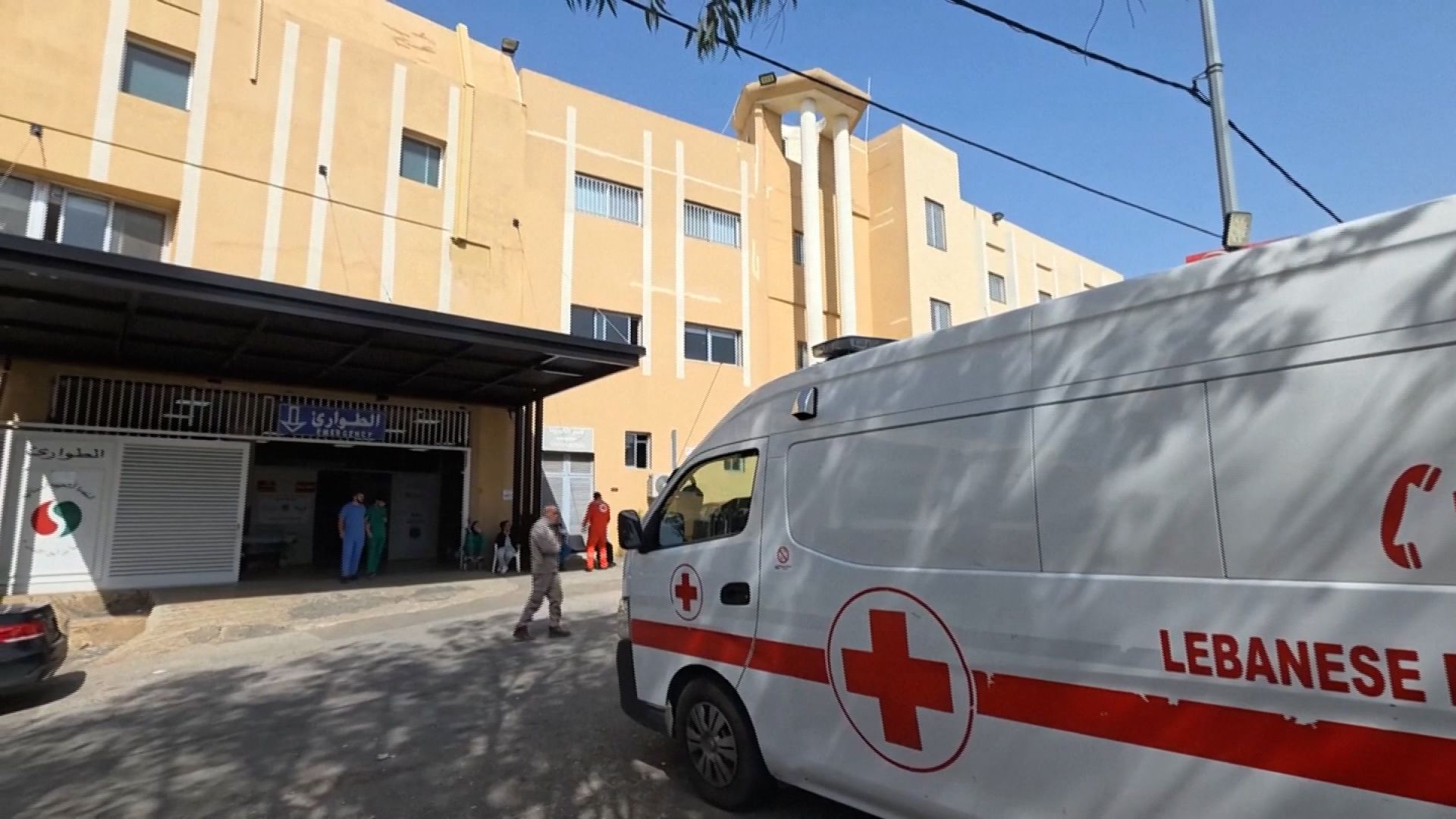
Southern Lebanon’s Al-Najda Al-Chaabia hospital is treating people injured in Israel’s repeated strikes, but officials wonder how much longer they can sustain operations.
The hospital is in Nabatiyeh, southern Lebanon, where Israel says it is striking facilities belonging to Iran-backed militant group Hezbollah.
“I was lying on the sofa, and suddenly a missile came, shaking the building and the house,” recalls Intissar Yassine. “It hit on our neighbours. The glass, stones and everything fell,” she told Reuters in a video.
Hospital Director Mona Abou Zeid said the hospital is receiving more injured civilians now than during the 2024 Israel-Hezbollah war.
She said that while the hospital is prepared, its suplies are not indefinite.
Abou Zeid said the hospital is trying to buy food supplies from the southern coastal city of Sidon.
“But (if) bridges were hit, roads were closed, we will be besieged.”
Iran won’t close Strait of Hormuz, UN envoy says

Iran will not close the Strait of Hormuz, the Iranian ambassador to the UN said Thursday, hours after the new supreme leader purportedly said the waterway will remain closed as a “tool of pressure”.
“We are not going to close the Strait of Hormuz, but it is our inherent right to preserve the peace and security in this waterway,” Amir Saeid Iravani told reporters at the UN.
He insisted that Iran remains committed to freedom of navigation, and blamed the US for the current situation in the strait.
“The current situation in the region, including in the Strait of Hormuz, is not the result of Iran’s lawful exercise of its right of self-defense. Rather, it is the direct consequence of the destabilizing actions of the United States in launching aggression against Iran and undermining regional security,” he added.