What we're watching
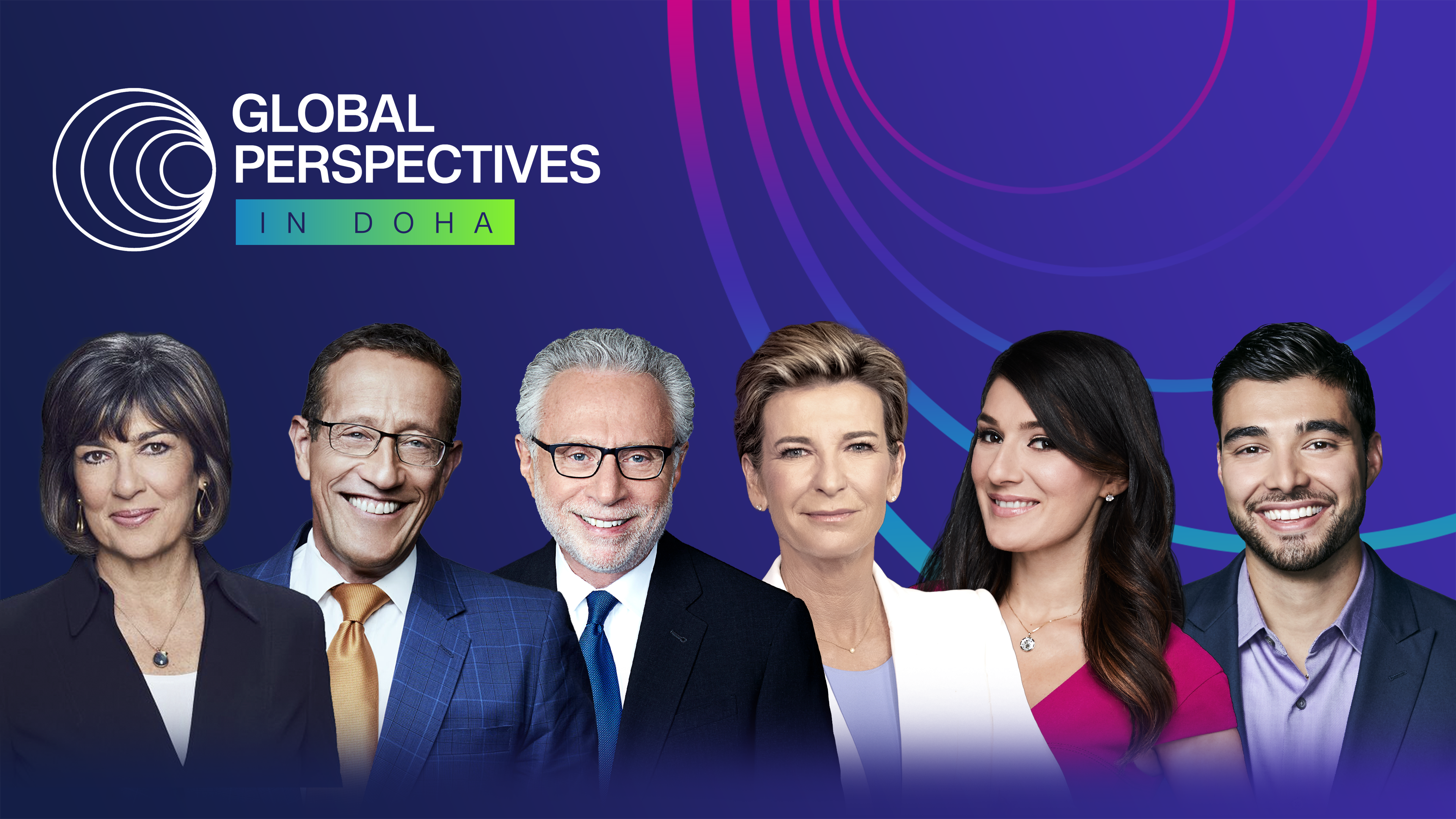
• A first for the region: Global Perspectives: In Doha will be exploring “The Invisible World” — the forces quietly reshaping how we live, and the businesses driving that change. This is the first time CNN’s live events series has come to the Middle East, and we’ve chosen the Qatari capital as a meeting point for leaders from the region and beyond to share their insights.
• Dialogue spotlighted: Qatar’s Prime Minister Sheikh Mohammed bin Abdulrahman Al Thani said considering different perspectives “has never been more important,” because building understanding is essential in times of disagreements.
• Support: Patrice Motsepe, president of the Confederation of African Football, showed his support for FIFA President Gianni Infantino, describing him as “a very loyal friend.”
• Speakers: Executives from TikTok, Orbitworks and Crescent Petroleum will be joining CNN throughout the day. Other speakers include Ari Emanuel, executive director of TKO Group Holdings, and former US Secretary of State John Kerry.
Updates
(20)The Olympian, Mutaz Barshim, who shared gold, now wants ‘everything’
Mutaz Barshim’s name is forever etched in sporting history as the embodiment of selflessness, but as the high jumper weighs whether to make one final attempt at the Olympics, he wants to make one thing very clear: he is greedy.
The Qatari athlete made global headlines at the Tokyo 2020 Olympics, held in August 2021, when he delighted in sharing the gold medal with Italy’s Gianmarco Tamberi, joining his rival in embodying the spirit of the games by forgoing a jump-off to determine the winner.
While the 35-year-old did not confirm whether he will be in Los Angeles competing at his fifth and likely final Olympics in two years time, he admitted to CNN’s Bijan Hosseini that, when it comes to his legacy, he has great ambition.
“I’m very greedy when it comes to how I want to be remembered. I want everything,” he said.
“That’s why today if you come to my house, you’re not gonna see anything. I have no trophies, no medals, nothing, because I don’t want to feel the satisfaction. I want to keep going as much as possible.”
With four Olympic medals and three World Championship victories, Barshim is among the most decorated high jumpers of all time but success has not come without sacrifice. He clinched silver at the London 2012 Games despite suffering a stress fracture in his back mere months prior, a determination that Barshim believes epitomizes what it means to be a champion.
“A lot of people want to go to the targets, but they don’t want to sacrifice as much. They don’t want to be patient. They want fast results,” he said.
“You see the top of the iceberg, but there is so much going on. There’s so much blood, sweat, and tears every single day, to this day.”
Ari Emanuel says live event TV is "more crucial than it’s ever been"

CNN’s Richard Quest held a lively virtual interview with Ari Emanuel, the executive chairman of TKO Group Holdings Inc., which owns sports brands including the WWE and the UFC.
Emanuel made the case that live sporting events are only becoming a more valuable asset in media companies’ portfolios, describing sports as “the ultimate reality show: we don’t know the ending.”
“Live is more crucial than it’s ever been … that is an unbelievable asset in this global ecosystem,” he added.
Pressed on the high costs for sports being paid by networks and streamers, Emanuel said, “I don’t think the cost of sports is stratospheric when you look at the economics the streamers are valued on — meaning audience and engagement.”
Emanuel was also bullish about how AI-proof this area of media is.
“Live sports can’t be disintermediated by AI,” he said, “that’s why we think we’re in a great position.”
‘When you’re not at the table, you’re the menu’: Why Arab filmmaking is more important than ever
Ensuring Arab stories make it to the big screen is more critical now than ever, explained Palestinian filmmaker Annemarie Jacir.
Her 2025 film “Palestine 36,” which recounts the events of the Arab revolt against British colonial rule between 1936 and 1939, marked the fourth consecutive movie she has directed to be selected as the Palestinian Oscar submission for Best International Feature Film, and she believes authentic stories from Middle Eastern perspectives must continue to be dramatized and — crucially — distributed.
“Palestinians have never been at the table [and] … when you’re not at the table, you’re the menu,” she told CNN’s Eleni Giokos.
“When our voices are not there, and we are not there to tell our own story, we are actually really being eaten up … Cinema is not for people far away. It’s not for something that’s not ours. It is ours.”
Indian film producer Siddharth Roy Kapur, founder of Roy Kapur Films, added that it was time for the Global South to start making its presence felt on the global film stage and spoke of the “undeniable talent” in Middle Eastern filmmaking circles.
“We’ve traded goods over so many years, we can trade stories now,” he said.
“It’s time for the Global South to get together and tell our stories to the world rather than the world telling our own stories back to us.”
Why Qatar is going all in on boosting its film industry clout


To know where the film industry is heading next, you don’t follow the money, per se. You follow the tax credits and rebates.
Countries are locked in an arms race to offer the best deal to get productions shooting on their patch. In the past that might have translated into location shoots with gorgeous vistas and local culture. Today, that also includes studios and soundstages.
What’s also true is that amid the rise of streamers, increased availability of international cinema, and a global box office influencing commissioning, world cinema is rising.
Qatar has put itself in the mix in an effort spearheaded by Hassan Al Thawadi, the man who delivered Qatar the 2022 FIFA World Cup and is now chairman of the Film Committee at Media City Qatar.
He told CNN’s Becky Anderson that boosting the country’s film industry clout will follow the same roadmap as the World Cup: first Qatar, then the region, then the world.
Why? “Film touches on people’s emotions,” Al Thawadi said, “but at the same time, film, and by extension the creative industries, is a vibrant, very strong contributor to economies.”

To date, regional filmmakers have been underrepresented, he argued: “Today, we’re not present in the global audience; not present in the global consciousness when it comes to our storytelling.”
“There’s a missing formula that has not allowed for Arabic content to travel in the way it deserves around the world,” he added.
Tax rebates may be the answer, with generous rates in Qatar of up to 50% on productions.
“The simple message is this,” Al Thawadi said: “If you want to come to the region, you don’t have to think about where to go. You set up shop in Qatar, you get access to the region, and you get access to the best that the Arab world has to offer.”
As for homegrown talent, Al Thawadi shared that last year he met Daniel Katz, CEO of US studio A24. “Daniel only sees the next Martin Scorsese coming from this region,” he said. “Everyone recognizes the opportunity available.”
Qatari official says singer Dana Al Meer can be "the next Adele"

Hassan Al Thawadi, managing director of Qatar’s Supreme Committee for Delivery and Legacy for the 2022 FIFA World Cup, said that singer Dana Al Meer is “on the track to be the next Adele… or more than that.” Al Thawadi was speaking to CNN’s Becky Anderson, just after the 38-year-old Qatari singer performed on stage at CNN’s Global Perspectives event.
“She’s a phenomenal performer,” he said.
The singer, composer, and cultural ambassador is known for performing at the 2022 FIFA World Cup and 2023 AFC Asian Cup ceremonies.
One of the songs she sings was composed at the age of just 19, she said, adding that coming from “a very conservative and religious family,” performing on stage was a major decision for her. She said some people considered it “a no-no,” — “but I had a different belief.”
Tech entrepreneur says he can make an AI version of CNN’s Richard Quest in one week


An AI entrepreneur working in the film industry told CNN’s Richard Quest that he can generate an AI version of the news anchor in just one week.
“Can you create an AI version of me?” Quest asked Jo Plaete, co-founder and Chief Technology Officer of BRAHMA AI, a company which helps entertainment businesses create AI-generated content.
“100%,” Plaete said, “as long as it’s with your consent and with your kind of governance.”
It would take “about a week,” he added.
This is just one example of what some experts say is an unfolding AI revolution that will change, but benefit, humanity.
AI “could be the last, or it could be the first one that gets us better and better,” Elie Habib, co-founder and CEO of Anghami, a music streaming giant in the Middle East that uses AI to enhance its services.
“I see bright days ahead if we know how to use things,” he said.
Beyond cinema and music, AI is also transforming the frontiers of what we can see in space.
Dr. Hamdullah Mohib, CEO of Marlan Space and founder of Orbitworks, showcased how AI can give real-time warnings about major environmental catastrophes, including oil spills, by enhancing how satellite imagery works.
“So, if you were looking at an oil spill, you would know it immediately rather than waiting for six hours or 24 hours before it has spread,” he said.
"Of course a machine can be creative" argues AI artist

Ferdi Alıcı, the founder and director of Ouchhh Studio, which mixes AI and art, discussed whether an algorithm can truly be creative. “We’re living a digital renaissance with AI,” he told CNN’s Bijan Hosseini
He then put his argument to the test — using CNN as his medium.
Alıcı had put 300 AI agents to work “watching” a CNN International broadcast in real time. The agents tracked faces, voices and text on screen, digested them and reconstituted the information into a work of art. The result is a sometimes fluid, sometimes glitchy glob of colors moving around a three-dimensional void.
Behind the millions of pixels lies an existential debate. As AI aims to supersede human brainpower and robotics seeks to approximate our physical capabilities, our species’ ability to be creative is seen as one thing that sets us apart. If technology can do that too, what’s left for us?
“Right now, AI is a collaborative friend,” said Alıcı.
When pushed on whether a machine can be creative without a human, he said, “of course,” adding, “if you can feed it with creative people’s knowledge.”
“We will not lose the human decision ever, I think,” he suggested. “It’s a kind of symbiotic relationship, always, between human and machine.”
Why culture is a "form of resistance"


Culture is “a form of resistance and resilience” amid challenging times, said Sheikha Al Mayassa bint Hamad Al Thani, the woman driving Qatar’s multibillion-dollar art strategy.
Asked by CNN’s Christiane Amanpour about the impact of the Iran war on her work, Al Thani – who serves as chairperson for Qatar Museums and the Doha Film Institute – acknowledged that artists had been affected by the conflict but believes delaying or cancelling events in aftermath of missile strikes earlier this year the would have been like “a sign of defeat.”
“What I can control is the agenda and we’re going through the agenda because the people who need it the most, need it now more than ever.”
Al Thani, who is the sister of the Qatari Emir, Sheikh Tamim bin Hamad Al Thani, described her role as a “facilitator” when asked about progressing the arts in a society with conservative sectors.
“I’m an empowerer,” she said. “I’m never in a position where I’m imposing on somebody to do what they don’t want.”
“We create spaces for creativity because I really believe culture transcends ignorance, arrogance, and we need more empathy in the world … But we’re also very respectful of our cultural tradition and our tribal system, and that doesn’t change.”
Experts speak to CNN about "never-seen" energy crisis amid Iran war


Majid Jafar, CEO of Crescent Petroleum — one of the region’s oldest oil and gas companies — told CNN’s Eleni Giokos that the industry has “never seen such a global energy crisis.”
“We’ve never seen a war that encompassed every single country in the Middle East,” he said, referring to the ongoing US-Iran conflict and the mass disruption of shipping through the Strait of Hormuz — a key waterway through which around 20% of the world’s crude oil and liquefied natural gas traveled.
Hing Chao, Chairman of the Hong Kong-based maritime company Wah Kwong Maritime Transport, said that while recently there has been occasional movement of oil and gas through the waterway, it is “not enough.” He added that “In order to find a more permanent solution, something deeper needs to happen.”
Ester Baiget, president and CEO of the global biotechnology company Novonesis, said that bio-solutions are one of the many answers to today’s energy problem, adding that biofuels are already alleviating pressure on a strained oil market.
The Strait of Hormuz was effectively shuttered at the height of the US-Iran war early this year, driving oil prices up. Oil prices remain high, partly due to the threat of possible Iranian attacks.
Why when it comes to robots, "boring is good"


Dr. Yifan “David” Li wants to make robots boring again.
The CEO and co-founder of Hesai Technology and co-founder of Sharpa is a strong believer that when it comes to creating robots, “boring is good. If you’re boring, you’re dealing with the tasks and solving the problems that happen every day in people’s lives.”
“The ugly truth today is that robots around the world … they barely produce any productivity at all,” Li added. So he wants to find them boring jobs.
While speaking to CNN’s Richard Quest, video showed footage of one of Li’s robots serving ice cream. Engineering and programming hands, Li said, is the hardest part to figure out when creating humanoid robots.
Quest pointed out that, innovative though it might be, one robot’s newfound utility is a potential job lost.
Quest pushed Li on whether an army of robots is possible in the future. “I only see that in the movies,” Li quipped, thought he couldn’t rule it out. “There’s always a chance technology like this can be abused in the wrong hands and cause damages,” he said, “… and that does warrant regulation. I’m all for that.”
As with all things AI and robotics, Li suggested we’re going to have to learn to live among them. “We can’t put the genie back in the bottle.”
"A huge impact on what Trump can do": Blitzer on upcoming US midterms


Wolf Blitzer, the co-anchor of CNN’s “The Situation Room,” joined Becky Anderson just days ahead of US midterm elections that are expected to deliver a blow to Republicans.
“If the Democrats take control of the House of Representatives and maybe even the Senate, that would have a huge impact on what Trump can do,” said Blitzer.
Election forecasters are predicting that Democrats will take the House of Representatives. The races that will decide if Republicans retain control of the Senate are mostly much closer.
Many Americans angry about high prices for everything from groceries to gasoline — which have been driven up by the war in Iran.
Still, only time will tell if next week’s elections will bring political change to the US.
“The American people we know from the last decade do surprise us sometimes,” Blitzer said. “But the data and more importantly, my travels, tell me something big is coming.”
Here's what experts are telling Christiane Amanpour about negotiations



On US-Iran tensions:
Asked about reports that US Vice President JD Vance had written to the head of Iran’s National Security Agency, a powerful Iranian hardliner, seeking to revive peace talks, CNN Global Affairs Analyst Brett McGurk described it as “extraordinary” and “a good move.”
“You have to do everything you possibly can diplomatically to try to find an off-ramp,” he said.
He also said there remains a role for the US to play in the region “militarily, diplomatically, economically.”
“Otherwise, as we pull back too much, we’re drawn back in a very deeper way,” he added.
On the Israeli election:


Hiba Qasas, executive director of Principles for Peace Foundation, said that while it is still uncertain which parties will govern Israel, the election has implications that reverberate through the Middle East. All eyes are watching to see if the opposition party led by Gadi Eisenkot will work with Arab parties but “it’s yet to be seen,” she said.
She added that “whether we will see a change in course in Israel choosing a path of integration rather than isolation in the region, today is not very clear.”
On Africa:


Wamkele Mene, Secretary-General of AfCFTA Secretariat, which promotes stronger intra-African trade, said this period under the Trump administration has presented “the most difficult challenge to the multilateral system since the end of the Second World War.”
But amid challenges including global tariffs, he said he believed Africa will emerge stronger.
“We believe that in this crisis, there is an opportunity to build a domestic market on the African continent, a negotiated domestic market amongst 55 countries to move from a fragmented market to a single market that is globally competitive, that has seamless movement of goods and services within it, very similar to the European Union,” he said.
"A good friend": Patrice Motsepe on support for embattled FIFA president


Patrice Motsepe, the President of the Confederation of African Football, showed his support for FIFA President Gianni Infantino, who has faced pressure to step down over a failed plan to sell off commercial and operational rights to the World Cup.
“Gianni is a very good friend, a very loyal friend,” said Motsepe, a South African billionaire businessman who has built an investment portfolio spanning from mining and renewable energy to banking and technology.
“We’ve said very clearly we support Gianni,” he added.
“Governance for us, transparency, ethics, from an African perspective, are critically, critically important,” he said, when pressed by CNN’s Eleni Giokos on why he supports the FIFA boss.
“There have been allegations of lack of governance, and it’s a very simple process. If anybody is accused of having either violated governance or behaved in a manner that’s contrary to the rules and regulations, take him to the ethics committee. Let a hearing take place and let judgment be made whether there’s been a violation or not.”
Infantino will face re-election in March at the FIFA Congress in Morocco. Several national football associations have pulled support for Infantino. But he has secured support from Africa’s 54 member associations, to which he has promised additional resources, according to Reuters.
A spirited debate on the power of the "middle powers"


Several guests joined CNN’s Richard Quest to discuss how “middle powers” can help shape the global economic order.
Earlier this year, Canada’s Prime Minister Mark Carney called for middle powers, like Canada, to work together as the world’s largest economies compete for influence.
“The middle powers must act together, because if we’re not at the table, we’re on the menu,” Carney said at the World Economic Forum’s annual meeting in January.
Alliances is what take “middle powers” to the next level, said Egypt’s Minister of Investment and Foreign Trade, Dr. Mohamed Farid Saleh. “Middle power is about collaborations with other countries, economically before politically.”
Deemah AlYahya, Secretary-General of the Digital Cooperation Organization, suggested looking inward, at local content and national champions, to push these economic collaborations cross-borders, to stay “resilient and self-sufficient.”
US still leads world of innovation, head of Qatar Investment Authority says


The US remains the global leader in innovation, the head of the Qatar Investment Authority (QIA) said.
Mohammed Saif Al-Sowaidi, CEO of QIA, offered his take when asked by CNN’s Becky Anderson whether changes to the policy environment in Washington may affect the authority’s appetite to invest in the US.
“If policies become more constraining, … or a constraint to foreign investors like ourselves, we’ll definitely have adjustments. But so far, if you look into the best markets with the deepest capital markets and more investor-friendly and focused jurisdictions, the US is on top of it. If you look into the innovation space, the US also has the greatest level of innovation,” he said.
QIA is part of the consortium that made a significant investment into Skydance, which owns CNN after the merger between Paramount and Warner Bros. Discovery.
Saif Al-Sowaidi said he has “a high level of conviction” for the move, adding “we’re very proud to be part of the consortium.”
Qatar "provides a foundation for a better future" says chairman and editor-in-chief of CNN Worldwide

Ahead of the first session of the day, chairman and editor-in-chief of CNN Worldwide, Sir Mark Thompson, thanked the city of Qatar and sponsor Media City Qatar before doubling down on the importance of the country in building a globally prosperous future.
The region, he said, might have not always been in the news recently for “positive reasons,” citing conflicts and the geopolitical tensions. But Global Perspectives, he says, is an opportunity to remind the public that Qatar “stands for growth, for innovation, and for trying to nurture and build human potential.”
He added that Qatar “has kept alive the path of diplomacy and dialogue in quite dark times, not just to end conflict, but to provide a foundation for a better, more prosperous, more collaborative future.”
Bringing Middle Eastern voices to the world


Sheikh Dr. Abdulla bin Ali Al Thani, the Chairman of Media City Qatar, host partner for today’s event, welcomed guests with comments about the role the media hub has in shaping perception of the region.
“Our responsibility is to help regional voices reach global audiences and support a fuller understanding of the Middle East,” he said. “We believe proximity changes perspective.”
CNN’s Global Perspectives event in Qatar “creates an opportunity to listen to the people of this region and engage directly with the ideas shaping its future,” he said.
“My hope is that we leave today with a deeper understanding of this region and a greater willingness to question our assumptions about the world,” he added.
Understanding different perspectives has "never been more important," Qatar's Prime Minister says


Qatar’s Prime Minister and Minister of Foreign Affairs Sheikh Mohammed bin Abdulrahman Al Thani told CNN’s Global Perspectives that building understanding is essential in times of disagreements.
“Gatherings such as this offer a valuable opportunity to bring together people from different backgrounds, industries, and experiences, and to exchange ideas on subjects that increasingly touch all our lives, at a time of profound global change,” he said during his welcoming speech.
“Understanding different perspectives has never been more important.”
“The challenges we face are increasingly interconnected, and no single perspective can offer all the answers,” he continued, adding that Qatar has “always believed in dialogue.”
Today’s big theme
What do we mean by “The Invisible World”? We’re talking about the hidden forces quietly reshaping how the world works. From AI to supply chains, media, money and influence, power is moving in new and often invisible ways — and it’s already impacting your lives profoundly, whether you realize it or not.
The Gulf is increasingly at the center of this conversation, so it makes sense to discuss it all here.
How to keep ahead in a world in flux? How to capitalize on constant change? How to shape what comes next?
CNN’s first Middle East edition of Global Perspectives, held at Rosewood Doha, will put the big questions to leaders from the region and beyond.
Welcome to our live coverage
Greetings! Welcome to CNN International’s third Global Perspectives event, this time in Doha.
Following Global Perspectives in Bangkok earlier this month, our live event series travels to the Middle East for the first time. In the heart of the Qatari capital, CNN journalists will lead conversations with a roster of regional powerbrokers and international industry leaders under the theme “The Invisible World” (more on that later).
Here we’ll bring you highlights, breaking news and a peek behind the scenes.