What we covered here
• Major opinion: The Supreme Court ruled against Colorado’s “conversion therapy” ban for gay and transgender youth on Tuesday.
• Law remains: The decision technically does not strike down the law, which remains in place at the moment. Justice Neil Gorsuch, a conservative justice, wrote the opinion for an 8-1 court.
• Sole dissenter: Liberal Justice Ketanji Brown Jackson took the rare step of dissenting from the bench, saying the decision “opens a dangerous can of worms” by undermining states’ rights to regulate medical care.
Our live coverage has ended for the day. Read takeaways from the Supreme Court’s decision here.
"You are valued": Colorado attorney general sends message to LGBTQ youth after ruling


Colorado Attorney General Phil Weiser described today’s Supreme Court decision as a “setback” and directly addressed LGBTQ youth.
Weiser added that he disagrees “with the court’s reasoning” and is “carefully reviewing the decision to assess its full impact on Colorado law and on our responsibility to protect consumers and patients.”
Conservative groups celebrate ruling as a win for free speech

Conservative groups celebrated the Supreme Court’s ruling on conversation therapy, describing it as a win for First Amendment rights.
The chief legal counsel for Alliance Defending Freedom said, “Kids deserve real help affirming that their bodies are not a mistake and that they are wonderfully made.”
Alliance Defending Freedom represented Kaley Chiles, the licensed counselor who challenged Colorado’s ban on First Amendment grounds, at the Supreme Court.
Similarly, Adèle Keim, senior counsel at the religious legal organization Becket, said in a statement, “Kids who want help accepting their bodies should be able to get it. We’re glad the Court protected the right of counselors to help them.”
CNN’s John Fritze contributed to this post.
What’s next for the conversion therapy law

The Supreme Court’s decision is heavy on language about how Colorado’s law likely runs afoul of the First Amendment but the court’s ruling technically doesn’t strike down the law.
Instead, it sends the case back to a lower court that will almost certainly do so.
At issue are the “levels of scrutiny” courts apply when determining if a law is unconstitutional. In the Colorado case, a lower court applied the lowest level of scrutiny — known as “rational basis” — and upheld the law on that basis.
But in its 8-1 decision today, the Supreme Court said that the lower court should have applied what’s known as “strict scrutiny,” the highest level of scrutiny.
Under strict scrutiny, a government must have a “compelling interest” to enact a law infringing on the First Amendment — such as the safety of minor patients — and it must “narrowly tailor” that law to make sure it doesn’t apply to more people than the government intended.
Laws that infringe on the First Amendment rarely satisfy strict scrutiny. And so the court’s ruling Tuesday is likely a death sentence for the law but that sentence will ultimately be carried about another court.
“A tragic step backward": LGBTQ advocacy groups denounce court’s ruling


Four major LGBTQ organizations criticized the Supreme Court’s decision, stressing that conversation therapy puts children at risk.
The Trevor Project, a nonprofit suicide prevention and crisis intervention organization that supports LGBTQ youth, said the ruling is “a tragic step backward for our country that will put young lives at risk.”
“LGBTQ+ youth subjected to conversion therapy are more than twice as likely to attempt suicide compared to their peers,” Black added. “That’s why protections have been enacted in more than 20 states, and are supported by every major medical and mental health association in the country.”
The president of Human Rights Campaign, a leading LGBTQ civil rights organization, slammed the high court’s ruling as “reckless” and warned it “means more American kids will suffer.”
Similarly, Carl Charles, a counsel for Lambda Legal, shared in a statement his own experience with conversation therapy, adding, “LGBTQ+ youth do not need to be changed.”
Meanwhile, Polly Crozier, director of family advocacy at GLAD Law, which submitted an amicus brief in the case, said in a statement, “Today’s decision does not change the science, and it does not change the fact that conversion therapists who harm patients will still face legal consequences, and that family advocates, mental health practitioners, and all of us who care about the wellbeing of youth will continue working to shield LGBTQ+ young people and their families from this dangerous practice.”
This post has been updated with additional information.
Religious legal group praises Supreme Court’s decision
First Liberty Institute, a group that has brought several successful religious appeals to the Supreme Court in recent years, applauded the court’s decision against Colorado’s “conversion therapy” ban.
“Americans should never have their professional speech censored simply because the government disfavors that speech,” said Kelly Shackelford, the group’s president and CEO.
In this case, the Supreme Court sent a clear message to state governments that the Constitution actually means what it says when it protects the free speech of its citizens.
Decision came on Transgender Day of Visibility

The court’s ruling landed on a key day for transgender Americans: Tuesday is Transgender Day of Visibility.
The day, which aims to celebrate the achievements of trans rights activists and increase awareness about ongoing challenges that transgender and gender-nonconforming people face, is observed annually on March 31.
The day has taken on new significance in recent years as GOP-led states have plowed ahead with enacting legislation targeting members of the community and President Donald Trump moved quickly after returning to office last year to reverse recent gains made on the federal level by transgender Americans.
The Supreme Court is expected to release another key ruling dealing with transgender rights in coming months. That case deals with whether states can ban transgender athletes from joining teams that align with their gender identity.
“This Transgender Day of Visibility comes at a time when hateful politicians are trying to divide us by targeting the trans community. But the truth is, the American people are far more united than extremists will admit. We believe in fairness. We believe in dignity. And we believe in treating people equally under the law,” Kelley Robinson, the president of the Human Rights Campaign, said in a statement.
Gorsuch brushes off Jackson dissent as inconsistent with the First Amendment
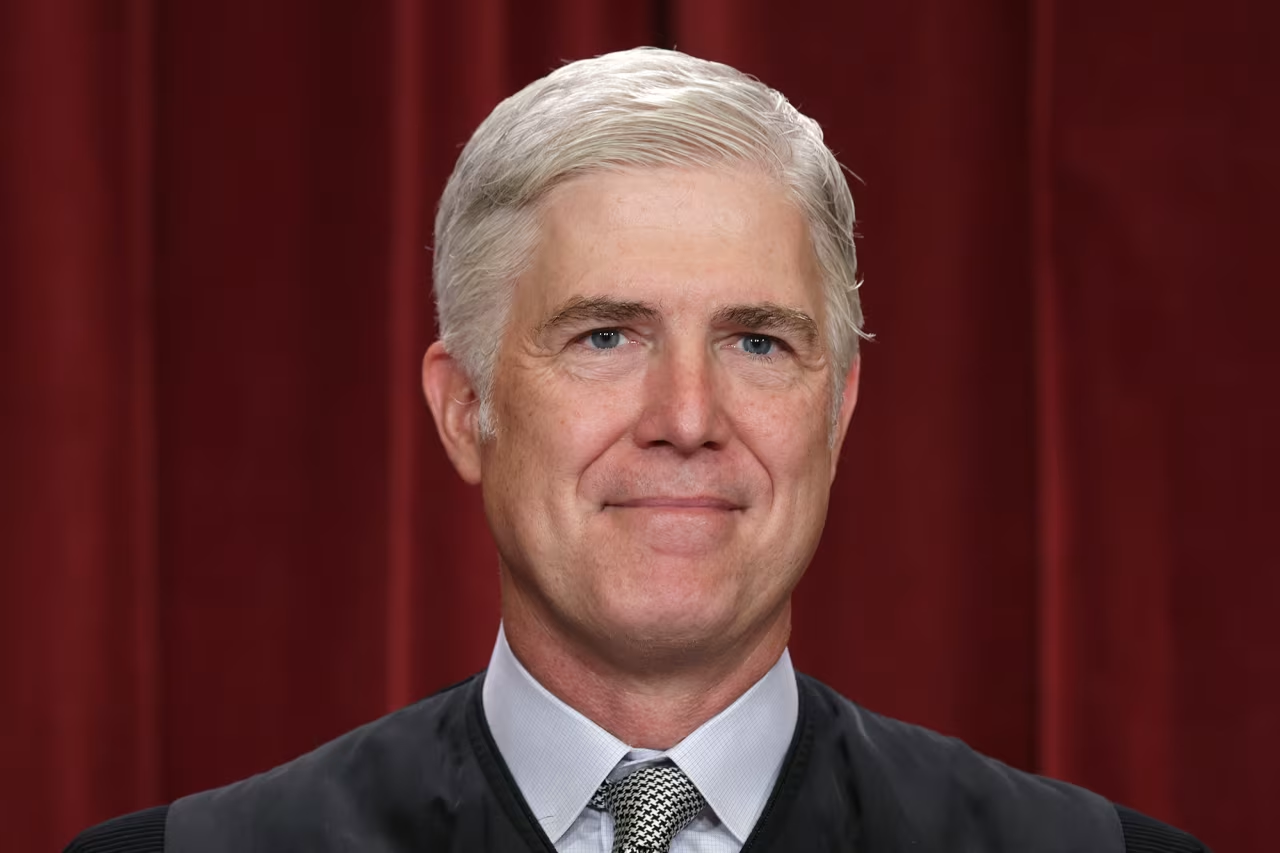
Justice Neil Gorsuch, who wrote the court’s majority opinion, fired back at Justice Ketanji Brown Jackson’s dissent arguing that the court should have given the state more room to regulate the speech of counselors under the First Amendment.
Jackson’s basic point is that therapists are acting like health care professionals more than speakers and so governments should have more leeway to regulate them.
Gorsuch brushed that argument aside.
The dissent, he wrote, “may believe that state-imposed orthodoxies in speech pose few dangers and many benefits in this field (and who knows what others). But their policy is not the First Amendment’s.”
Jackson warns of "catastrophic" result from court’s ruling

Justice Ketanji Brown Jackson held no punches in her fiery, scorched earth dissent, warning that her colleagues hadn’t considered “the potential long-term and disastrous implications” of their decision.
“Ultimately, because the majority plays with fire in this case, I fear that the people of this country will get burned,” she wrote.
“We are on a slippery slope now: For the first time, the Supreme Court has interpreted the First Amendment to bless a risk of therapeutic harm to children by limiting the State’s ability to regulate medical providers who treat patients with speech,” Jackson wrote.
She continued: “What’s next? In the worst-case scenario, our medical system unravels as various licensed healthcare professionals – talk therapists, psychiatrists, and presumably anyone else who claims to utilize speech when administering treatments to patients – start broadly wielding their newfound constitutional right to provide substandard medical care.”
Kagan and Sotomayor joined the conservatives. Here's why.

Justice Elena Kagan, joined by Justice Sonia Sotomayor, wrote a concurring opinion that stressed their belief the court’s ruling Tuesday is a narrow one.
That likely explains why both of those justices, who are members of the liberal wing, joined the court’s majority.
The problem with Colorado’s law, Kagan wrote, was it was “content-based” in its explicit focus on anti-trans therapy. A law that was neutral in its viewpoint “would raise a different and more difficult question.”
“Fuller consideration of that question, though, can wait for another day. We need not here decide how to assess viewpoint-neutral laws regulating health providers’ expression because, as the Court holds, Colorado’s is not one,” Kagan said.
“Consider a hypothetical law that is the mirror image of Colorado’s. Instead of barring talk therapy designed to change a minor’s sexual orientation or gender identity, this law bars therapy affirming those things,” Kagan wrote, concluding that such a law should be subject to similarly harsh scrutiny.
“One of the real clues to both the significance and limits of today’s ruling comes from Justice Kagan’s short concurring opinion,” said Steve Vladeck, CNN Supreme Court analyst and professor at Georgetown University Law Center.
“As Kagan explains, the problem with Colorado’s law isn’t that it is based on the content of therapists’ speech, but that it isn’t neutral as to the viewpoint they’re expressing. In other words, at least some of the justices aren’t averse to states regulating the speech of medical professionals; they just have to do it in a way that doesn’t prefer one viewpoint over another.”
Jackson reads dissent from the bench, saying the ruling "risks grave harm to Americans’ health"
Justice Ketanji Brown Jackson, the sole dissenter in Tuesday’s case, said that she thought her colleagues’ decision “opens a dangerous can of worms” by undermining states’ rights to regulate medical care.
Underscoring her displeasure with the court’s decision, Jackson took the rare step of reading excerpts of her dissent from the bench.
The court’s decision, she wrote in her 35-page opinion, “ultimately risks grave harm to Americans’ health and wellbeing.”
Read the Supreme Court's opinion on "conversion therapy"
Here is the Supreme Court’s opinion Chiles v. Salazar, backing a challenge to Colorado’s “conversion therapy” ban.
Gorsuch: First Amendment is a "shield" against government
Justice Neil Gorsuch, the conservative who wrote the opinion for the court, said the Colorado law required a far more rigorous review under the First Amendment.
“Colorado may regard its policy as essential to public health and safety,” Gorsuch wrote. “Certainly, censorious governments throughout history have believed the same. But the First Amendment stands as a shield against any effort to enforce orthodoxy in thought or speech in this country.”
Supreme Court backs challenge to Colorado’s "conversion therapy" ban for gay and transgender youth

The Supreme Court on Tuesday endorsed a religious counselor’s challenge to Colorado’s ban on “conversion therapy” for gay and transgender minors, another legal setback for the LGBTQ community that will reverberate in nearly half the country.
The decision technically does not strike down the law, which remains in place at the moment, but means lower courts will now review it again by applying the highest form of judicial scrutiny – an outcome that puts the prohibition on exceedingly thin ice.
Justice Neil Gorsuch wrote the opinion for an 8-1 court. Justice Ketanji Jackson, a liberal, dissented.
"How many boxes?"

“How many boxes?”
That’s one of the first questions that comes up on Supreme Court opinion days. See, the court tells us when opinions will come, but not how many or in which cases.
So it starts with the court staff putting out boxes of printouts in the press room. One box usually equals one to two opinions — the first indication of what the justices will announce.
In the courtroom, the justices convene. Chief Justice John Roberts announces the case and the justice who wrote the opinion. He or she then reads the opinion (or its highlights) in court. The paper is distributed to reporters and the opinion goes online.
Rinse and repeat on opinion days until the end of the session, which usually comes at the end of June.
How the conversion therapy case got to the Supreme Court
The decision comes at a moment of upheaval for transgender Americans, who are facing legal and political headwinds during President Donald Trump’s second term. The president ran for reelection in part on a campaign of ending what he described as “transgender lunacy” and both his administration and several conservative states have taken steps to roll back gains made by LGBTQ advocates in recent years.
Colorado enacted its law in 2019 to protect gay and transgender youth subjected to the scientifically discredited practice of attempting to “convert” their sexual orientation or gender identity. Research shows the practice can increase a person’s risk of suicide and cause other long-term health problems, such as depression, anxiety and high blood pressure.

Kaley Chiles, a licensed counselor in Colorado, challenged the law on First Amendment grounds. She said she would engage in her “faith-informed counseling” only when clients sought it out. And she disavowed especially controversial practices, such as the use of electric shock therapy or drug-induced nausea. Chiles described her work as helping clients who “have a goal to become comfortable and at peace” with their body.
Advocacy groups say roughly half of US states have banned the therapy for minors.
Chiles was represented at the Supreme Court by Alliance Defending Freedom, a religious law group that has had considerable success in recent years.
At the oral arguments in October, a majority of the court signaled it was prepared to rule against Colorado. Several justices appeared to reject the idea that a state could regulate “talk therapy” in the same way it regulates a medical procedure, suggesting First Amendment protections applied to speech even in the otherwise highly regulated space of a therapist’s office.
Several of the justices also suggested that the answer for potentially harmful therapy was a malpractice lawsuit, not a preventative law.