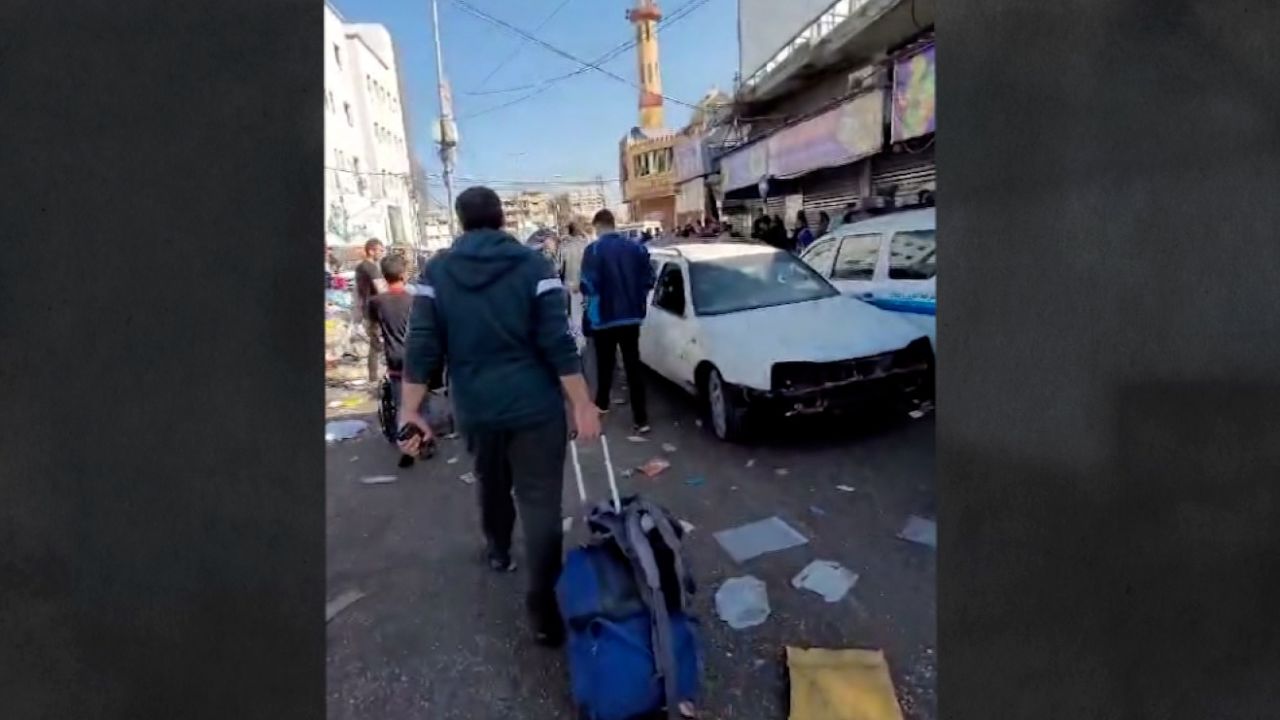
Man films family's journey after being forced from Gaza City
05:54
What we covered
Video shows dozens of bodies, including women and children, after a blast rocked a UN school that was used as a shelter in northern Gaza. A UN agency confirmed the school was hit Saturday but did not have further details.
Our live coverage of the Israel-Hamas war has moved here.
Link Copied!
CNN speaks to Palestinian families fleeing northern Gaza
From CNN's Abeer Salman, Eyad Kourdi, and Jo Shelley
CNN spoke to some of the hundreds of Palestinians fleeing northern Gaza for the south on Saturday.
Crowds of people — women, children, the elderly and wounded — made their way down Salah al-Din street, carrying bags, food and water. Most were on foot. A few moved by donkey and cart.
Some said their journey would be more than 5 kilometers (3.1 miles) long.
Israeli tanks could be seen at the side of the road and at times the sound of gunfire sent people running, with parents separated from their children amid the chaos.
At one point, the evacuees put cardboard over blankets that appeared to cover bodies on the street.
Among the evacuees were those who had sought refuge at Al-Shifa hospital, including Gaza health ministry spokesperson Ashraf Al-Qidra and journalist Ibrahim Shaqoura.
“The Israeli soldiers bombed the intensive care unit at Al-Shifa hospital, and they threatened us to bomb the lower floor, so we decided to leave,” Shaqoura told CNN.
A woman who was carrying her child recalled the moment when the school they were sheltering in, in Jabalya, collapsed.
“Three [other] girls and three women also lost their lives. I managed to pull this child out from under the rubble. All my children are barefoot. I grabbed them and we just ran away.”
Um Muhammad Hamada, a mother from Sheikh Radwan, sat by the roadside with her three children and two bird cages.
The crack of gunfire made her flinch and her daughter cover her ears.
“These birds mean a lot to me. They are like spirits that God saved, just like we were saved,” she said.
“I couldn’t leave them behind.”
Link Copied!
WHO leads 'very high risk' UN mission to Gaza’s Al-Shifa hospital
From CNN’s Jo Shelley
A satellite image provided by Maxar Technologies shows Al-Shifa hospital and surroundings in Gaza City on November 11.
A group of United Nations humanitarian workers visited the Al-Shifa hospital in northern Gaza on Saturday, the World Health Organisation (WHO) said in a post on X.
The group spent one hour inside the hospital during which time there was heavy fighting in close proximity to the facility, the WHO said.
UN staff described the hospital as a “death zone” where “signs of shelling and gunfire” were evident.
The WHO said that several patients had died over the past two to three days due to the lack of medical services.
“There are 25 health workers and 291 patients remaining in Al-Shifa, with several patient deaths having occurred over the previous two to three days due to the shutting down of medical services,” it said.
It added: “Patients include 32 babies in extremely critical condition, two people in intensive care without ventilation, and 22 dialysis patients whose access to life-saving treatment has been severely compromised.”
Staff and patients who spoke to UN workers were “terrified for their safety and health,” WHO said, adding that they “pleaded for evacuation.”
The WHO says it is “urgently developing plans” to evacuate staff and patients to two hospitals in southern Gaza.
“The vast majority of patients are victims of war trauma, including many with complex fractures and amputations, head injuries, burns, chest and abdominal trauma, and 29 patients with serious spinal injuries who are unable to move without medical assistance,” WHO said.
Some context: Israel launched a “targeted” operation against Hamas early Wednesday morning inside Gaza’s largest hospital, where thousands of displaced Palestinians had been sheltering alongside patients and medical staff.
Israel claims Hamas is using the hospital complex for military purposes and has built a command center under the facility – allegations repeatedly rejected by both Hamas and hospital officials. CNN has not verified the claims of either Israel or Hamas.
The intervening days have seen the hospital turn from civilian sanctuary to battlefield with heavy fighting taking place in and around the complex, amid an already rapidly deteriorating humanitarian situation.
Israel is facing mounting international pressure to prove its claims about Hamas’ infiltration of the hospital, in order to justify some of its military decisions, which could otherwise constitute a possible serious violation of international humanitarian law.
Link Copied!
Another blast at a UN school in Gaza leaves dozens dead, video shows. Here’s what you should know
From CNN staff
Many women and children were among those killed when a blast rocked a United Nations school in northern Gaza on Saturday, a UN relief agency confirmed. Video from the scene shows bloodied bodies in a series of rooms on two floors of the building, which had been used as a shelter for displaced Palestinians.
Saturday’s incident was the second time in 24 hours that a school run by the UN Relief and Works Agency for Palestine Refugees had been hit, the agency said. It did not have any further details about what caused the explosion or who was responsible.
Here are other headlines you should know:
No deal on hostages: Israeli Prime Minister Benjamin Netanyahu says there is still no deal to release some of the hostages captured by Hamas during the militant group’s October 7 attacks. Netanyahu denied what he called false reports that Israel was considering a proposal for the release of at least 50 abductees. The Israel Defense Forces said Friday that the military’s official estimate of hostages being held in Gaza is 237.
Biden rejects ceasefire: US President Joe Biden has rejected the mounting calls for a ceasefire in Gaza, saying in an op-ed published Saturday that it would not achieve peace, because it would allow Hamas to regroup and continue its attacks. Biden called for Israel to respect humanitarian law and minimize the loss of civilian life. The US leader also used the piece to condemn extremist violence against Palestinians in the West Bank — which has been a concern among officials — saying the US is prepared to issue visa bans against the perpetrators.
Fuel in, evacuees out of Gaza: Six hundred seventy-four foreign nationals and nine injured Palestinians, along with 11 companions, have left Gaza for Egypt through the Rafah crossing Saturday, according to a statement by the Rafah crossing administration. Meanwhile, 50 trucks made their way into Gaza, including fuel trucks delivering 127,000 liters of fuel designated for UN relief workers, the statement added. The delivery is part of a new Israeli commitment to daily fuel shipments for Gaza, which has proven controversial domestically.
Al-Shifa evacuations: Several doctors from Al-Shifa told Al Jazeera on Saturday morning they had left the hospital after the Israel Defense Forces ordered them to evacuate – a claim the IDF denies. Dr. Munir Al-Bursh said the hospital director had received the order over a phone call, when he was told to evacuate the entire hospital and instruct those leaving to wave white flags or handkerchiefs. Six doctors will stay behind to take care of 120 patients who cannot move due to poor health conditions, the head of plastic surgery, Ahmed El Mokhallalati, wrote on X (formerly Twitter) Saturday. Meanwhile, the UN has called for access to the hospital so it can investigate Israel’s claims that Hamas is using the medical center for combat purposes. Hamas and Gaza medical officials deny that claim.
Link Copied!
Netanyahu says Palestinian Authority is "not competent" to govern Gaza in current form
From CNN's Michael Rios and Tamar Michaelis
Israeli Prime Minister Benjamin Netanyahu said the Palestinian Authority is “not competent” in its current form to lead Gaza at a news conference Saturday.
Netanyahu accused Palestinian Authority President Mahmoud Abbas of not condemning Hamas’ October 7 attack on Israel and said some of Abbas’ senior ministers celebrated the attack.
“After fighting and pulling this whole thing, we’d give it to them?” Netanyahu said.
“You know full well how they educate their children,” he added. “If this doesn’t change, what have we done?”
The prime minister’s comments come after US President Joe Biden said in an op-ed published Saturday that Gaza and the West Bank should ultimately be reunited under “a revitalized” Palestinian Authority after the Israel-Hamas war.
Remember: The Palestinian Authority is a government body with limited self-rule in the West Bank. It is a political rival to Hamas, which controls Gaza and is at war with Israel.
The Palestinian Authority was established in the 1993 Oslo Accords, a peace pact between Israel and the Palestine Liberation Organization that saw the PLO give up armed resistance against Israel in return for promises of an independent Palestinian state.
Hamas — which is designated as a terrorist organization by the US, European Union and other countries — presents itself as an alternative to the Palestinian Authority, which has recognized Israel and has engaged in multiple failed peace initiatives with it.
CNN’s Abbas Al Lawati and Nadeen Ebrahim contributed reporting to this post.
Link Copied!
Video shows dozens of bodies after blast at UN school in Gaza
From CNN's Jo Shelley, Andrew Carey and Eyad Kourdi
A still from video that first aired on Al Jazeera shows the aftermath at a UN school that was struck on Saturday. Al Jazeera did not report how they obtained the video.
Al Jazeera
The United Nations confirmed one of its schools in northern Gaza, which was being used as a shelter, was hit on Saturday.
Video from the scene shows bloodied bodies in a series of rooms on two floors of the two-story building. Many women and children are among the dead.
One room appears to contain about a dozen bodies lying on the floor covered in dust. Desks are strewn and smashed up, and a huge hole can be seen in one of the room’s walls. In the courtyard of the building, a canopy roof across a metal structure appears to have been torn off, and there is debris on the ground as well.
A spokesperson for the main UN relief agency in Gaza, which runs the schools in Palestinian refugee camps, confirmed the building as the al-Fakhoura School in Jabalya.
The spokesperson, Juliette Touma, said the relief agency – the UN Relief and Works Agency for Palestine Refugees in the Near East (UNRWA) – was not able to confirm the number of casualties as information was still coming in.
UNRWA chief Philippe Lazzarini, who called the images “horrifying” on X, formerly known as Twitter, said that thousands of displaced people had been sheltering there at the time of the incident.
Touma said the UN did not know what caused the incident, nor who was responsible.
The Israeli military told CNN it was aware of the incident and that it was under review but had no further comment to make.
Egypt and Qatar have already blamed Israel. The Egyptian foreign ministry called it a “bombing,” and said it was the latest in a series of Israeli violations against civilians in Gaza.
Qatar said independent investigators from the UN needed to go to Gaza to examine what it said was the “ongoing targeting of schools and hospitals.” The UN has already called for independent access to Al-Shifa Hospital in Gaza City.
Another school hit: Saturday’s incident was the second time in 24 hours an UNRWA school in northern Gaza had been hit, the agency said.
A school in Zaitoun — which was being used by 4,000 people as a shelter — had been struck multiple times on Friday, Touma told CNN. She said ambulances had reportedly been unable to get to the school, which she said was most likely due to the fighting and the communications blackout.
Lazzarini posted that dozens of people were believed to have been killed in the Friday incident.
Link Copied!
Biden rejects ceasefire calls and condemns West Bank violence in op-ed
From CNN's Aileen Graef and Priscilla Alvarez
US President Joe Biden speaks at a press conference in Woodside, California, on November 15.
Brendan Smialowski/AFP/Getty Images
US President Joe Biden has rejected the mounting calls for a ceasefire in Gaza, saying in an op-ed published Saturday that it would not achieve peace.
Biden also called for Israel to respect humanitarian law and minimize the loss of civilian life, saying he counseled Israeli officials during his trip to Tel Aviv “against letting their hurt and rage mislead them into making mistakes we ourselves have made in the past.”
Biden said a two-state solution is the only solution to the enduring conflict in the region, and that, in the meantime, there should be governance under the Palestinian Authority.
Eyes on the West Bank: Biden also took aim at extremist violence against Palestinians in the West Bank — which has been a concern among officials — saying the US is prepared to issue visa bans against the perpetrators.
“I have been emphatic with Israel’s leaders that extremist violence against Palestinians in the West Bank must stop and that those committing the violence must be held accountable,” the president wrote.
The warning came amid concerns over Israel violating the Visa Waiver Program — which allows eligible travelers to apply to enter the US without a visa, and went into effect in late October.
More background: Biden’s op-ed is the latest example of efforts from the White House to remind Americans that conflicts abroad also affect US national security, as the administration’s supplemental funding request remains stalled.
Last month, the Biden administration requested more than $105 billion from Congress as part of a package it said will provide security assistance for the conflicts in Ukraine and Israel. At the time, Biden made his own impassioned plea for the funding in a primetime Oval Office address to the nation, calling the moment “an inflection point” in American history.
The president closed with condemning the rising antisemitism and Islamophobia since the conflict between Israel and Hamas began.
Link Copied!
There is no deal on release of hostages, Netanyahu says
From CNN’s Michael Rios
People look at photographs of hostages captured by Hamas posted on a wall in Tel Aviv, Israel, on November 13.
Mostafa Alkharouf/Anadolu/Getty Images
Israeli Prime Minister Benjamin Netanyahu says there is still no deal to release some of the hostages captured by Hamas during the militant group’s October 7 attacks.
Netanyahu denied what he called false reports that Israel was considering a proposal for the release of at least 50 abductees. When the government has something to say, authorities will report it, he said.
The Israel Defense Forces said Friday that the military’s official estimate of hostages being held in Gaza is 237.
Netanyahu said he has invited the representatives of the hostages’ families to a meeting with Israel’s war cabinet later this week.
On fuel tankers: The prime minister also defended the war cabinet’s decision to allow two fuel tankers to enter Gaza daily after several Israeli officials criticized the move.
He said the tankers will supply a minimal emergency amount of fuel to operate water and sewage pumps in Gaza. He also denied that the move was a change of policy, saying instead that it was a specific and limited solution to prevent diseases.
Link Copied!
Hundreds of foreign nationals exit Gaza through the Rafah crossing, administration says
From CNN’s Ibrahim Dahman and Eyad Kourdi
Six hundred seventy-four foreign nationals and nine injured Palestinians, along with 11 companions, have left Gaza for Egypt through the Rafah crossing Saturday, according to a statement by the Rafah crossing administration.
In addition, 50 trucks made their way into Gaza, including fuel trucks delivering 127,000 liters of fuel designated for the United Nations Relief and Works Agency for Palestine Refugees in the Near East, the statement added.
Remember: Rafah is the only crossing in and out of Gaza that is not controlled by Israel, making it the sole option for foreigners trying to leave the besieged enclave.
Waves of foreign nationals have begun to escape the war-torn territory, alongside a limited number of wounded Palestinians, after spending weeks stuck in Gaza.
Link Copied!
Israeli Prime Minister Benjamin Netanyahu faces battles on all fronts after 6 weeks of war
From CNN's Tara John
Israeli prime minister Benjamin Netanyahu attends a press conference in Tel Aviv, Israel, on October 28.
Abir Sultan/Pool/Reuters
Winds have been shifting against Israeli Prime Minister Benjamin Netanyahu as Israel’s war in Gaza drags past its sixth week.
Multiple opinion polls suggest national favor toward Netanyahu and his governing coalition is collapsing, despite continued overwhelming support in Israel for the war on Hamas, the militant Palestinian group that controls Gaza.
Opposition parties initially rallied behind Israel’s war effort, with National Unity Party leader Benny Gantz joining the wartime government – but cracks have begun to emerge.
On Wednesday, the country’s opposition leader Yair Lapid said it was time for the six-term prime minister to resign, and called for Netanyahu’s Likud party to oust him. But Lapid did not go as far as to call for new elections, saying instead that Likud should put forward an alternative leader.
Hostage negotiations drag on: Israel, Hamas and the United States, with the Gulf state of Qatar acting as mediator, have been struggling to reach an agreement on a number of sticking points over a pause to allow for hostages to be released.
Sticking points include how many days a potential pause in fighting would last, the number of hostages that would be released, and Hamas’ demand that Israel stop flying surveillance drones over Gaza, according to several sources familiar with the talks.
Gestures to relieve pressure on the besieged enclave’s civilian population have already drawn the ire of Netanyahu’s unruly governing cabinet — which is the most right-wing in Israel’s history.
Some families have demanded that the government should consider an “everyone for everyone deal,” which was floated by Hamas. Such a deal would involve exchanging the hostages for allPalestinians currently held in Israeli prisons – some 6,630 people, according to estimates by the Palestinian Prisoner’s Society.
Though such a swap might cause concern in the current environment, a 2011 prisoner exchange saw kidnapped Israel Defense Forces soldier Gilad Shalit swapped for more than 1,000 Palestinian prisoners.
Satellite imagery from Maxar Technologies showed a large crowd of people gathered along Salah Eddin Road in Gaza on Friday morning attempting to flee south along the evacuation corridor.
Israel in the past two weeks had announced the evacuation corridor for specific times along the road, one of two north-south highways in Gaza.
Palestinians have described difficult conditions on their way to the highway. A man who did not provide his name told a CNN journalist in southern Gaza that he and his neighbors had lived through “horrifying days.”
“There is no safe place in Gaza,” he said.
“We are seven families. All of our houses are gone. Nothing is left. We couldn’t take anything – no clothes, no water, nothing. The way here was very difficult. If something falls, you are not allowed to pick it up. You are not allowed to slow down. Dead bodies everywhere,” he added.
Internally displaced: An estimated 200,000 people fled northern Gaza from November 5 to November 14 through the corridor, according to the United Nations Office for the Coordination of Humanitarian Affairs.
OCHA said those who have moved to the south have been grappling with “overcrowding and limited access to shelter, food and water.”
Link Copied!
Here's what pro-Palestinian and pro-Israeli demonstrators want you to know
From CNN's Zoe Sottile, Chandelis Duster and Eric Levenson
Laura Oliverio/Rebecca Wright/CNN
Since October 7, large, pulsing crowds have gathered at rallies around the world, holding signs and chanting to convey their simmering frustration, outrage and fear over the ongoing hostilities between Israel and Hamas and the resulting casualties.
CNN spoke to some demonstrators at recent pro-Palestinian and pro-Israeli rallies to better understand why thousands have joined marchesand what those in attendance hope to accomplish.
Here’s what they said:
Pro-Palestinian demonstrators: Elizabeth Oram, a 70-year-old nurse and adjunct lecturer, waved a Palestinian flag during a pro-Palestinian event last Friday night in New York City’s Columbus Circle, her short blonde hair falling onto the top of a white KN95 mask. She said she is a longtime supporter of Palestinian rights and had seen the situation in the occupied Palestinian territories go from “very bad to absolutely barbaric.”
Sami, a 20-year-old French student at a London university, was visiting New York when he came upon the rally. He told CNN he felt inspired to stay and attend after seeing images of the violence in Gaza on social media.
“I see all the videos and the pictures, and it’s horrible – I see this every day, every time on social media, on Twitter, on Instagram,” he said. “Every day, these atrocities in front of my eyes. I feel a lot of pain for them and I want this massacre and this genocide to stop.”
Protesters criticized Israel’s treatment of Palestinians and accused the country of apartheid and genocide, pushed for a ceasefire in Israel’s military campaign and challenged American leaders to end their support for Israel.
Pro-Israeli demonstrators: At the “March for Israel” held in DC Tuesday, Sara Blau, a student at the University of Maryland, wore a T-shirt emblazoned with the face of Omer Neutra, a high school friend who was kidnapped by Hamas on October 7 and is believed to be held hostage.
Blau said she wanted to join the march “to show my support for Israel. I’m a proud Zionist, a proud Jew and I wanted to be here to support my community.”
Michal and Noam Sheps, a married couple from New Jersey, said they came to show support for the hostages and for Israel.
Several of the pro-Israeli demonstrators said they had concerns about their personal safety as Jewish Americans. They pushed for Hamas to immediately release the more than 200 hostages who were taken October 7.
Satellite images show Gaza’s Palestinian Legislative Council building partially destroyed
From CNN's Eve Brennan and Gianluca Mezzofiore in London
A satellite image shows the damaged Palestinian Legislative Council building in Gaza City, on Wednesday, November 15.
PlanetLabs
New satellite images provided by Planet Labs show the Palestinian Legislative Council (PLC) building in Gaza City has been at least partially destroyed.
A satellite image from Tuesday shows the building and its adjacent park intact. But an image of the same area on Wednesday shows some rubble where the building previously stood. Additionally, the images show an area of brown sand in the location of the park.
On Monday, Israel’s Defense Minister Yoav Gallant said that Israeli soldiers had entered the PLC building. The minister highlighted a photo showing Israeli forces posing for a picture inside the building waving Israeli flags.
CNN has reached out to the Israeli army for confirmation it was responsible for the partial destruction of the building but has not been offered an answer.
Link Copied!
Two fuel tankers a day “far from enough” for Gaza aid operation, says UN agency
From CNN's Jo Shelley
A truck carrying fuel arrives in Rafah, Gaza, on November 15.
Abed Rahim Khatib/Anadolu/Getty Images
The amount of fuel Israel has agreed to allow into Gaza each day is “far from enough,” the head of the UN Palestinian refugee agency said Saturday.
The United Nations Relief and Works Agency for Palestine Refugees (UNRWA) commissioner-general Philippe Lazzarini said the amount approved – which Israel said Friday was two fuel tankers a day – was, “far from enough to cover the needs for desalination plants, sewage pumps, hospitals, water pumps in shelters, aid trucks, ambulances, bakeries and communications networks to work without interruption.”
At the current rate, Lazzarini said people in Gaza would still not have enough clean drinking water, “large parts” of the enclave would “continue to be flooded with sewage” and the UN would be “forced to handle a reduced number of aid trucks crossing daily into Rafah.”
Israel’s national security advisor Tzachi Hanegbi had said on Friday the amount of fuel that would enter would be “very minimal.”
Some context: Israeli government ministers are scheduled to meet Saturday night to discuss a decision made by the emergency war cabinet to allow the daily entry of fuel trucks to Gaza.
In an interview on Israel’s Channel 13 on Friday night, Foreign Minister Eli Cohen said he believed the decision to lift the fuel blockade, made late Thursday night by Prime Minister Benjamin Netanyahu’s war cabinet, should be approved by the extended security cabinet.
The UN needs 200,000 liters of fuel each day in order to “meet the minimum of our humanitarian responsibilities in Gaza,” UN humanitarian chief Martin Griffiths said Friday.
The lack of fuel means “communications and other essential functions such as water desalination are progressively dropping offline,” Griffiths told the General Assembly.
Link Copied!
It's early evening in Israel and Gaza. Here's what you need to know
From CNN staff
Al-Shifa, Gaza’s largest hospital, has become the epicenter of fighting in the besieged enclave after the Israel Defense Forces said Wednesday it had launched a “precise and targeted operation against Hamas” in the complex.
While civilian buildings like hospitals are protected under international humanitarian law, they can lose their protection if used for military purposes, which can make them a legitimate target. Justifying its targeting of the hospital, the IDF said Hamas had used Al-Shifa as an “operational command center” – which Hamas called a “baseless lie.”
Israel has come under growing pressure to provide more evidence for its claims, as the humanitarian crisis inside the hospital deepens. CNN analysis of video suggests the IDF may have rearranged weaponry at Al-Shifa prior to international news crews arriving to document their findings this week.
Meanwhile, there are growing indications that a ground offensive into the southern parts of Gaza could be imminent, after the IDF said it would advance anywhere Hamas is found.
Here are the latest developments:
Al-Shifa evacuations: Several doctors from Al-Shifa told Al Jazeera on Saturday morning they had left the hospital after the IDF ordered them to evacuate – a claim the IDF denies. Dr. Munir Al-Bursh said the hospital director had received the order over a phone call, when he was told to evacuate the entire hospital and instruct those leaving to wave white flags or handkerchiefs. Six doctors will stay behind to take care of 120 patients who cannot move due to poor health conditions, the head of plastic surgery, Ahmed El Mokhallalati, wrote on X (formerly Twitter) Saturday.
Calls for investigation: Volker Turk, the UN High Commissioner for Human Rights, has called on Israel to grant his team access to Gaza to investigate competing claims about the Al-Shifa Hospital. Turk told CNN the situation needs an “independent international investigation because we have different narratives.” While Israel’s attack on the hospital does not necessarily breach international law, a lot rests on the accuracy of its intelligence, which has claimed Hamas is using the hospital to house a command center and military equipment. The IDF released a video showing a tunnel shaft in the grounds of Al-Shifa but is yet to offer clear evidence that the shaft has a military purpose.
Hostage negotiations: Hamas has demanded that Israel stop flying surveillance drones over Gaza as part of its request that Israel pause its military operations in exchange for freeing hostages held by the terrorist group, according to two Israeli officials and a third source familiar with the ongoing negotiations. While Israel could pause its military operations for as long as several days to allow for the release of scores of hostages the sources said it is unlikely to accept the drone request, since this would entail losing track of the movement of Hamas operatives. Separately, the Crown Prince of Bahrain, Salman bin Hamas Al Khalifa, said the release of hostages is a “prerequisite to a pause in hostilities.”
Southern offensive: Israel’s ground offensive so far has targeted the north of the Gaza Strip, and Gaza City in particular. It warned civilians last month to evacuate south of the Wadi Gaza, causing the displacement of more than a million Palestinians before IDF soldiers began their incursion into the enclave. But there are signs that the IDF may soon expand its operations southwards after spokesperson Rear Adm. Daniel Hagari said Israeli troops will advance to anywhere Hamas is found. Israel dropped leaflets across parts of southern Gaza on Wednesday, calling on civilians to evacuate and “head towards known shelters.”
Nova music festival: Israeli police believe at least 364 people were killed by Hamas gunmen at the Nova music festival in southern Israel on October 7, according to Israeli media – a sharp revision upwards from the previous toll of 270. Israel’s Channel 12 News said it had obtained a copy of the first police report into the attack and presented some of the report’s findings on its main news bulletin Friday evening, but did not show a copy of the report. Channel 12 News reported that 40 festival goers had been kidnapped and taken into Gaza. The music festival was the location of the highest number of deaths on October 7.
Link Copied!
New images show extent of overcrowding at Gaza's Indonesian Hospital
From CNN's Abeer Salman
Doctors and patients evacuating the Al-Shifa hospital in Gaza City are making their way to the Indonesian Hospital, also in the north of the enclave, Dr. Munir Al-Bursh told Al Jazeera on Saturday.
New pictures published on the Indonesian Hospital’s Facebook page show the facility’s emergency department overwhelmed by injured patients, suggesting there will be little, if any, space available for the new arrivals.
One picture shows small children lying on pieces of cardboard laid out on a white tiled floor, while nearby adults wrapped up in blankets are laid out on stretchers.
Another photo shows men and boys – one with a bandage over a face wound, another with a bandaged arm – laid out across a row of mats on the floor.
A third picture shows a man with face wounds being administered to by a female medic as he lies on a stretcher in front of what looks like a reception desk.
A fourth picture shows a man with bandaging around his head and upper chest sitting upright across two stretchers, both of which are bearing people who appear very badly wounded.
The hospital says people are dying because doctors cannot provide the necessary care.
Link Copied!
Six doctors will stay on at Al-Shifa hospital with 120 patients too vulnerable to evacuate
From CNN’s Jomana Karadsheh, Sarah Sirgany and Xiaofei Xu
Six doctors will stay behind to take care of 120 patients who cannot move due to poor health conditions at Gaza’s Al-Shifa hospital, the facility’s Head of Plastic Surgery Ahmed El Mokhallalati said Saturday, after others left following a reported evacuation order.
“Most of the medical staff had left Al-Shifa hospital, as the Israeli occupation army ordered everyone to evacuate the hospital. Many patients cannot leave the hospital as they are in the ICU beds or the baby incubators,” he wrote on X, formerly known as Twitter.
“We call on the International Committee of the Red Cross (ICRC) and World Health Organization (WHO) to take action to protect the medical staff and patients at Al-Shifa hospital,” Mokhallalati added.
The Israeli army earlier denied ordering the evacuation.
Hundreds of people left the hospital on foot, according to an AFP journalist at the scene.
Their destination was unclear but many - including sick and injured patients, medical professionals and previously-displaced civilians - appeared to be making their way towards the seafront, AFP reported. CNN has been unable to confirm the number of people who have left the facility.
Evacuating a hospital in an active war zone is “an extremely complex and logistically challenging operation” and the team on the ground lacks fuel, vehicles, incubators and other medical resources, ICRC spokesperson Ala’a Nayel told CNN Saturday.
“It is heartbreaking to see the most vulnerable bear the brunt of the conflict,” Nayel said.
Some background: It’s not been confirmed what prompted the mass exodus Gaza’s largest hospital on Saturday morning. Thousands of displaced civilians had been sheltering at the medical complex in increasingly dire conditions.
The hospital became a battleground on Wednesday when Israeli troops raided the facility in an operation against Hamas. Israel claims the group has been operating an underground command center below the complex - an allegation which both Hamas and hospital officials have denied. CNN has been unable to verify the claims of either Israel or Hamas.
Earlier Saturday, conflicting accounts of the evacuation request for Al-Shifa emerged. Several doctors there said that they’d been ordered to leave by the Israeli military, with one saying the hospital director had received a phone call specifying that fleeing individuals should wave white flags or handkerchiefs as they departed. However, the Israeli military has disputed issuing such an order.
Link Copied!
CNN analysis: Video suggests IDF might have rearranged weaponry at Al-Shifa prior to news crew visits
From CNN’s Katie Polglase and Gianluca Mezzofiore
This image taken from a video released by the Israel Defense Forces on November 15 shows a cache of weapons the IDF says were found in a closet at the MRI center at Al-Shifa hospital in Gaza City.
Israel Defense Forces via AP
An Israel Defense Forces video on November 15 showing a tour of Hamas weaponry found at Al-Shifa hospital shows less weaponry at the scene than in later footage filmed by international news crews, indicating the weaponry may have been moved or placed there prior to news crews arriving.
CNN compared footage published by the IDF online with footage taken by Fox News, which was granted access to the site in the hours afterwards. IDF spokesperson Lt. Col. Jonathan Conricus leads the tour in the IDF video and a watch on his arm shows the time to be 13:18.
Fox News foreign correspondent Trey Yingst later visits the scene when it is dark. He says in his report it is “the middle of the night.”
Yingst is shown a bag located behind an MRI machine inside the hospital with two AK-47 guns visible on top of it. However, the IDF video filmed earlier shows only one AK-47 gun. It is unclear where the second AK-47 gun came from and why it is not visible in the earlier IDF clip.
In the intervening hours, the IDF also posted online a photo of the weaponry purportedly found at Al-Shifa hospital. The WhatsApp file name for this photo indicates it was taken at 17:35; this places it after the IDF tour of the MRI compound but almost certainly before the Fox News crew arrive.
It is possible the weaponry was removed from the scene and replaced prior to the news crews arriving. However this does not explain why more guns are visible when the press arrive than in the original IDF video.
The BBC was also granted access to the hospital the following day, November 16, and two AK-47 guns are still visible on top of the bag inside the MRI room.
Israeli military responds: The IDF told CNN the discrepancy between the military’s own video and the BBC footage was “due to the fact that more weaponry and terrorist assets were discovered throughout the day.”
“Suggestions that the IDF is manipulating the media are incorrect,” it added. “We are acting with full transparency whilst maintaining the safety of our troops and operational readiness.”
This post has been updated with the IDF’s response to questions about the videos.
Link Copied!
The struggle for survival faced by disabled Palestinians in Gaza
From CNN's Rosa Rahimi and Sana Noor Haq
Since Israel’s complete siege on Gaza began, Hazem Saeed Al-Naizi, the director of an orphanage in Gaza City, had been gripped with fear, worried about when food, water and other basic necessities might run out for the dozens of children and young people in his care, most of whom are living with disabilities.
When a strike hit a mosque near the Mabarat Al-Rahma orphanage on October 27, blowing out windows, scattering the building with debris, igniting a fire and filling the air with smoke, Al-Naizi said he was confronted with the agonizing decision of whether to evacuate the children and young people.
“There was chaos in the place, children crying, and smoke and fire spread,” Al-Naizi told CNN, sharing videos of the aftermath. “We quickly moved the children to a safe place and extinguished the fire to get rid of the smoke that almost killed us all.”
On November 2, as the Israel Defense Forces (IDF) closed in on Gaza City, Al-Naizi said he had no choice but to move the 40 people out of the orphanage — eight of them infants — loading them, along with non-perishable food and batteries, into three large buses. It took about two hours to evacuate the group, according to Al-Naizi, as many of the children had to be carried. They only managed to travel about 1.2 miles, before they had to set up a temporary shelter.
“Many streets have become closed as a result of the backfilling of destroyed buildings, as well as the street being unsuitable for vehicles to move,” Al-Naizi said. “We were not able to escape to the south of Gaza City. It had become completely besieged.”
For Palestinians trying to escape the fighting, living with a disability can be its own effective death sentence. People who are deaf or blind are less likely to know about evacuation orders and cannot hear or see the strikes, disability advocates and aid organizations told CNN. Others with intellectual disabilities may be unable to communicate their whereabouts to relatives or rescue workers, while people with physical disabilities who rely on wheelchairs and other assistive devices are unable to navigate rubble, let alone walk miles south.
Doctors say they were ordered to evacuate Al-Shifa hospital by the Israeli military, IDF disputes the claim
From CNN’s Kareem Khadder and Amir Tal in Jerusalem
Several doctors from Gaza’s Al-Shifa hospital told Al Jazeera on Saturday morning they had left the medical facility after the Israeli military ordered them to evacuate. The Israeli military disputes issuing such an order.
Dr. Munir Al-Bursh said the order had come from a phone call to the hospital director, instructing him to evacuate the entire hospital, with those leaving told to wave white flags or white handkerchiefs.
The Israeli army has insisted it did not order people to leave.
Dr. Bursh told Al Jazeera that 120 patients remained inside the hospital, along with five doctors to coordinate the remaining evacuations.
What’s happening at Al-Shifa: Israel launched a “targeted” operation against Hamas early Wednesday morning inside Gaza’s largest hospital, where thousands of displaced Palestinians had been sheltering alongside patients and medical staff.
Israel claims Hamas is using the hospital complex for military purposes and has built a command center under the facility – allegations repeatedly rejected by both Hamas and hospital officials. CNN has not verified the claims of either Israel or Hamas.
The intervening days have seen the hospital turn from civilian sanctuary to battlefield with heavy fighting taking place in and around the complex, amid an already rapidly deteriorating humanitarian situation.
Israel is facing mounting international pressure to prove its claims about Hamas’ infiltration of the hospital, in order to justify some of its military decisions, which could otherwise constitute a possible serious violation of international humanitarian law.