Our live coverage has ended
• Get the latest updates on the war with Iran here.
What we know so far
• A new timeline: President Donald Trump will deliver an address to the nation on Wednesday night regarding Iran. It comes after Trump said the US could be done with its war with Iran within two to three weeks. Iran has indicated it’s willing to fight for far longer.
• Allies on their own: Trump said the US will have “nothing to do with” the closed Strait of Hormuz, telling other countries - including key US allies - to “go get your own oil.”
• Energy costs: The average US gas price hit $4 a gallon, the highest since 2022. Trump said Tuesday that gas prices will quickly go down once the US completes its operation in Iran. CNN has reported how an end to the war will not mean immediate savings at the pump.
• US tech companies threatened: Apple, Microsoft, Google, Meta, IBM, HP, Intel and Tesla are among the 17 American companies Tehran has threatened to attack if more Iranian leaders are killed, according to the semi-official outlet Fars.
Missiles launched from Yemen toward Israel, IDF says

The Israeli military was working to intercept a missile launched from Yemen toward its territory on Wednesday morning, the Israel Defense Forces (IDF) said.
There have been no reports of injuries at this stage, said Magen David Adom, Israel’s emergency service.
Yemen is home to the Iran-backed Houthi rebels, who entered the Middle East conflict on Saturday by firing missiles at Israel. While the Houthis have yet to claim responsibility for the Wednesday launch, they previously vowed to continue military operations in the coming days.
Trump says war will end in weeks. Iran is prepared for a much longer fight, foreign minister says
Iran is prepared for “at least six months” of war, the country’s foreign minister said in an interview Tuesday, as Trump insists the war could be done within two to three weeks.
“We do not set any deadlines for defending ourselves. We will defend our country and our people as far as necessary and by any means required,” Abbas Araghchi told Al Jazeera.
“It does not matter what timelines our enemies set for themselves. However, our recommendation is that they bring this war to a complete and permanent end before facing further damage,” he said, noting an end to the war must include peace throughout the entire region.
Araghchi said Tehran is not in direct negotiations with Washington, despite Trump’s claims the US is in “serious discussions” with a “new, and more reasonable regime” in Iran.
“Negotiation is when two countries engage in talks to reach an agreement, and such a thing does not exist between us and the United States,” Araghchi said.
However, Araghchi said he has received messages from Steve Witkoff, the US envoy to the Middle East, and that the US and Iran have communicated indirectly through intermediaries.
US Secretary of State Marco Rubio told Fox News Tuesday night “there are messages being exchanged” with Iran and that there is “potential for a direct meeting at some point.”
Araghchi said Iran has not responded to the 15-point proposal by the US, contradicting Trump’s claims Sunday that Tehran had agreed to “most of” the list of demands the US conveyed to end the war. An Iranian spokesperson Monday lambasted the demands as “largely excessive, unrealistic and unreasonable.”
“The US president fundamentally needs to change his approach,” Araghchi told Al Jazeera. “One cannot speak to the Iranian people with the language of threats and deadlines.”
"Massive blaze" as Kuwait airport fuel tanks targeted by Iranian drone, authorities say
Kuwait International Airport’s fuel depots were targeted by an Iranian drone attack, causing a “massive blaze,” the country’s Public Authority for Civil Aviation said Wednesday, according to state news agency KUNA.
The attack caused “significant damage” to the fuel tanks but no injuries were reported, KUNA reported.
Meanwhile, Bahrain’s Interior Ministry said it was working to extinguish a fire at a company facility after an Iranian drone attack.
Asian stocks track US rally on new hopes for end of war

Asian stock benchmarks jumped on Wednesday, following US markets’ rally to their best trading day in nearly a year on comments from the Trump administration about potentially ending the war soon.
Japan’s benchmark index Nikkei 225 soared 4% at 10:57 am local time, while South Korea’s Kospi surged 6.4%. Hong Kong’s Hang Seng index rose 1.9%.
Billions wiped out: Despite the brief rise on Wednesday, the war with Iran has rocked Asian markets with great volatility over the past month, as Asian countries rely heavily on oil and gas imports from Gulf states.
Since the war began the Nikkei 225 and Kospi have plunged around 10% and 14% since the war began, while Hang Seng has shed 5%.
Rubio says "messages are being exchanged" with Iran

US Secretary of State Marco Rubio said tonight that “messages are being exchanged” with Iran and teased the potential for a future meeting between US and Iranian leaders.
The US top diplomat noted, however, that President Donald Trump will not allow “fake negotiations” to be used as a “delay tactic” by the Iranian leaders to buy more time and space.
Some context: American and regional sources have told CNN the Trump administration has been indirectly exchanging messages with Iranian Foreign Minister Abbas Araghchi and Parliament Speaker Mohammad Bagher Ghalibaf, the latter being seen by officials as someone — potentially the only one — who could have influence with new Supreme Leader Mojtaba Khamenei.
Meanwhile, Araghchi told Al Jazeera on Tuesday that Iran is not currently in negotiations with the United States, though Iran has received messages from the Trump administration.
Secretary of State Marco Rubio says US "can see the finish line" in Iran war

US Secretary of State Marco Rubio said tonight that the US is achieving its objectives in the Iran war earlier than planned, echoing President Donald Trump’s remarks earlier today that an end to the war would come within weeks.
Rubio said that the US had largely destroyed the Iranian navy and air force, and was well on its way to destroying a “significant” percentage of missile launchers and wiping out the country’s missile and drone factories.
He continued: “We’re going to get to the point where our military will have achieved all of its objectives in this mission, and they are doing so with extraordinary efficiency.”
US Central Command releases new video of military operations in Iran
US Central Command has released a video of what appears to be its military operations targeting Iran, showing munitions exploding against a grainy, black and white backdrop.
“US forces drop precision munitions on underground military targets deep inside Iran to further degrade the Iranian regime’s ability to project power in meaningful ways beyond its borders,” reads the caption on the video posted on X Tuesday.
Tanker reportedly struck near Doha, UKMTO says
A tanker was reportedly hit by an “unknown projectile” 17 nautical miles north of Doha, Qatar, on Tuesday, according to UK’s maritime authority.
The tanker was struck on its port side, causing damage to the hull above the water line, according to the report. The crew are safe and there is no environmental impact.
The UK Maritime Trade Operations (UKMTO) has received 26 reports of incidents affecting vessels operating in and around the Arabian Gulf, Strait of Hormuz and Gulf of Oman since the war began on February 28.
A Kuwaiti tanker laden in with oil in Dubai waters was hit by what Kuwaitis said was an Iranian drone on Tuesday, igniting a fire which was later extinguished. No injuries or oil spills were reported.
Reopening Strait of Hormuz will take longer than Trump's bullish timeline


US President Donald Trump may say the US could end its military campaign against Iran in the next two to three weeks, but it will take far longer for ships to pour back back through the Strait of Hormuz.
Global shares are rebounding on hopes the war is nearing an end. Even if fighting were to end and crude prices fall, it will take time for gas prices at the pump to unwind and shipping to stabilize through the strategic waterway.
Shipping insurance remains sky high after risk premiums have been baked in, and maritime workers are less willing to make the journey after bearing witness to a conflict that has taken the lives of seafarers.
“Seafarers are the backbone of the trade,” said Angad Banga, CEO of Hong Kong-based Caravel Group. His company oversees Fleet Management Ltd., the world’s second-largest ship management company.
“After something like this happens, there will be ripple effects and the seafarer challenge of convincing them to go will continue to cause challenges for the supply chain.”
The shipping industry transports 90% of all manufactured goods, making seafarers vital to global trade.
Iran’s selective blockade of the Strait of Hormuz has impacted thousands of vessels operating in the Middle East. The waters are now exposed to mines and explosive drones, underscoring the risks facing commercial shipping in the area.
The danger became clear when the Thai cargo ship Mayuree Naree was hit by a projectile earlier this month, causing a fire on board and forcing the crew to evacuate. Some of the rescued crew members later returned to Thailand, but three remain missing.
Since the start of the conflict, there have been at least seven seafarer deaths and more than a dozen vessels attacked near Iran.
Trump to deliver "important update" on Iran in address to nation tomorrow night

President Donald Trump will deliver an address to the nation on Wednesday night regarding Iran, the White House press secretary said.
“Tomorrow night at 9PM ET, President Trump will give an Address to the Nation to provide an important update on Iran,” Karoline Leavitt posted on X.
Earlier today in the Oval Office, Trump said he foresees a conclusion to the war “within maybe two weeks,” emphasizing a potential deal could be reached.
Rare glimpse inside Iran as photojournalist describes "dead city"

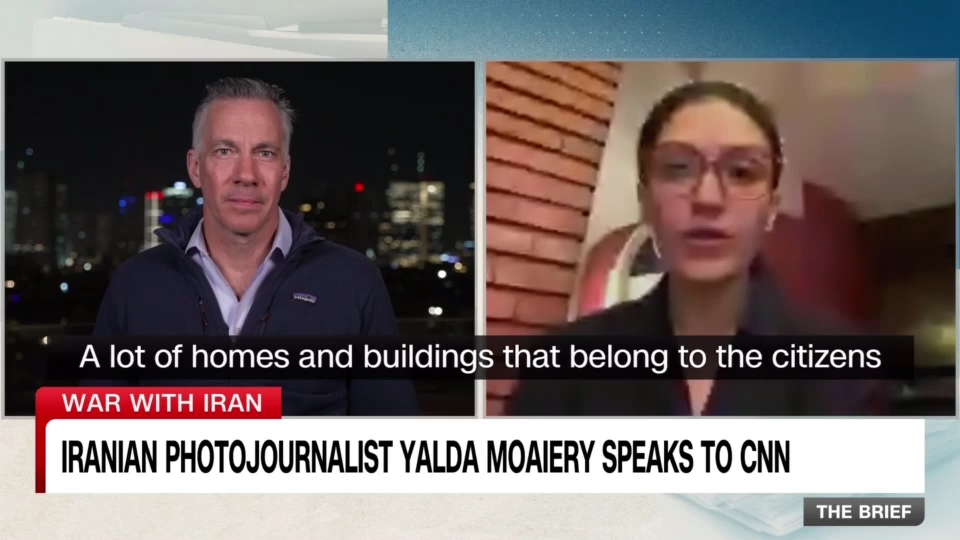
Iranian photojournalist Yalda Moaiery, speaking to CNN from Inside Iran, described a country gripped with both fear and hope as the war enters its second month.
In a rare opportunity to hear directly from someone inside Iran witnessing what his happening in the country, Moaiery told CNN’s Jim Sciutto, that Iran now feels like a “dead city.”
“We do not know if we have water or electricity… the sounds of the bombs, the smokes are everywhere. People are really tired of this,” she said.
When asked if she sees a possibility for the Iranian people to rise up against their government, Moaiery said that is simply not realistic under current conditions. “No, it’s not possible at all. A lot of gunmen are in the streets with their guns and weapons… you cannot do anything against them… it’s complete nonsense.”
Moaiery also pushed back on the idea that the Iranian regime has been weakened. “Nothing has changed… I don’t know how Donald Trump says he can change the regime. I cannot really understand it.”
Despite this, Moaiery said many Iranians are supporting the war and are still holding onto hope that the regime wall fall.
But Moaiery herself expressed more skepticism than her fellow Iranians. “I don’t think so… I don’t see any evidence,” she said.
US will be "finished" with Iran conflict in the next 2-3 weeks, Trump says


The United States could be done with its war with Iran within two to three weeks, President Donald Trump said today.
The president added that it’s possible the war will end sooner if a deal is reached.
“It’s possible that we’ll have a deal because they want to make a deal. They want to make a deal more than I want to make a deal. But in a fairly short period of time, we’ll be finished,” Trump said.
“Now we have a group of people that’s very — that are very different.
They’re much more reasonable,” he said, projecting optimism about talks.
Trump reiterated that the reopening the Strait of Hormuz should be other countries’ problem, saying it’ll be up to them to secure the critical waterway.
“If France or some other country wants to get oil or gas, you go up through the strait and — the Hormuz Strait — they’ll go right up there and they’ll be able to fend for themselves,” he said.
“What happens in the strait, we’re going to have nothing do with,” he added.
Iran threatens to target American tech firms if more leaders are killed

Iran has threatened to attack American tech firms if more of its leaders are killed, the semi-official outlet Fars reported.
Apple, Microsoft, Google, Meta, IBM, HP, Intel, Tesla, Boeing and JP Morgan are among the 17 companies the IRGC threatened to target.
The IRGC called on the employees of American tech firms in the region to “immediately distance themselves from their workplaces” and for residents living near offices of those companies to move away to a safe place.
“Companies that actively participate in terrorist designs will be subject to reciprocal action in response to each assassination,” the IRGC said.
“These companies, starting from 20:00 on Wednesday, April 1 (Tehran time), should expect the destruction of their relevant units in return for each assassination in Iran,” the IRGC said, according to Fars.
Gas prices will come “tumbling down” once US leaves Iran, Trump says


President Donald Trump said Tuesday that gas prices will quickly go down once the US completes its operation in Iran.
The average US gas price has hit $4 a gallon, the highest since 2022.
The president also touched on today’s stock market rally, which came after The Wall Street Journal reported Trump told White House staff that he’d be open to ending the war with Iran even without reopening the Strait of Hormuz.
Trump claimed stock prices rose for two reasons: “We have a safe country” and that there was regime change in Iran.
Some context: As CNN has reported, an end to the war doesn’t mean immediate savings at the pump.
“There’s an old expression — gas prices go up like a rocket and come down like a feather,” said Tom Kloza, an independent oil analyst and adviser to major oil company Gulf Oil.
Iran's president says country willing to stop fighting if not attacked again


Iranian state media reported Tuesday that Iran’s President Masoud Pezeshkian said his country is ready to stop fighting, provided it knows it won’t be attacked again.
“We have never sought tension or war at any stage, and we have the necessary resolve to end this war if the required conditions are met, especially the necessary guarantees to prevent a recurrence of aggression,” Pezeshkian said, according to Press TV.
Press TV reported Pezeshkian’s remarks in an article about the Iranian president’s conversation with European Council President António Costa.
Reports of comments along those lines sent stocks higher around midday today after an earlier rebound from comments by Trump administration officials on ending the war.
Costa’s readout of the call made no mention of the purported comments by Pezeshkian. A European Union official told CNN that “the Iranian president followed the same line during his conversation with the president of the European Council earlier today.”
Press TV reported that Pezeshkian criticized the European Union during the call for not being vociferous enough in its criticism of the US-Israeli war with Iran.
“The EU should calibrate its policies and stances based on international law and in line with the rules of constructive and professional interaction with other parties,” Pezeshkian said.
Meanwhile, Iranian Foreign Minister Abbas Araghchi told Al Jazeera on Tuesday that Iran is not currently in negotiations with the United States, though Iran has received messages from the Trump administration.
Why the war in Iran is likely to end in some kind of compromise
Talks between the United States and Iran “are continuing and going well,” White House press secretary Karoline Leavitt said this week. While President Donald Trump asserted that the US and Israel are winning and Iran wants to make a deal, he and his administration increasingly believe that they can’t promise to reopen the Strait of Hormuz as a prerequisite to declaring “mission accomplished,” sources tell CNN.
As the conflict passes the month mark, CNN’s Nick Paton Walsh explains why it is more likely to end in some sort of compromise, not unconditional surrender by Iran.

Amid the White House showing signs it wants an end to the war with Iran, CNN's Nick Paton Walsh breaks down why the conflict might be resolved with a compromise rather than unconditional surrender.

CNN’s Alayna Treene, Kevin Liptak and Jennifer Hansler contributed reporting to this post.
US journalist kidnapped in Iraq was warned of threats from Iranian proxy, sources say



Kidnapped American journalist Shelly Kittleson had been warned of threats, including abduction, from an Iranian proxy in recent weeks, according to sources familiar with the matter.
Kittleson was abducted in Baghdad on Tuesday.
Kataib Hezbollah is an Iranian-backed militia group that has repeatedly targeted Americans.
According to one source familiar with the warning, the US government recently warned Kittleson of a Kataib Hezbollah plot to kidnap or kill her. The warning came while she was already reporting in Iraq.
Another source said that US and Iraqi officials had been tracking threats by an Iranian proxy against Kittleson, including threats to abduct or kill her, and had warned her to leave multiple times in recent weeks.
“The State Department previously fulfilled our duty to warn this individual of threats against them and we will continue to coordinate with the FBI to ensure their release as quickly as possible,” Johnson said on Tuesday, without elaborating on the threats.
The US Embassy in Iraq has repeatedly warned US citizens to leave the country since the conflict with Iran began in late February, cautioning that Iran-backed militias could attempt to kidnap Americans.
American journalist Shelly Kittleson kidnapped in Baghdad, Al-Monitor confirms


Al-Monitor, a US-based news organization, confirmed the kidnapping of American journalist Shelly Kittleson in Baghdad, Iraq, earlier today and called for her “safe and immediate release.”
Al-Monitor said it was “deeply alarmed” by the abduction of Kittleson, who works as a contributor for the news outlet.
“We call for her safe and immediate release. We stand by her vital reporting from the region and call for her swift return to continue her important work,” the statement added.
Iraq’s Ministry of Interior said in an earlier statement that a female foreign journalist was kidnapped in central Baghdad by unknown individuals Tuesday evening and that security forces have launched an operation to track down those responsible and secure her release.
Two interior ministry officials told CNN, on condition of anonymity due to the sensitivity of the case, that the kidnapped journalist was Kittleson.
A US official told CNN that they are tracking Kittleson’s kidnapping and is working with Iraq to try to secure her release.
A State Department official said that they “are (closely) tracking these reports,” but declined to comment further “due to privacy and other considerations.” “The Trump Administration has no higher priority than the safety and security of Americans,” the State Department official said.
The Committee to Protect Journalists (CPJ) said it was “deeply concerned” by reports of Kittleson’s abduction and urged Iraqi authorities to do everything in their power to locate her and “hold those responsible to account.”
Kittleson is a journalist specializing in the Middle East and Afghanistan, with work published in international, US and Italian outlets, according to Al-Monitor.
CNN’s Dalia Abdelwahab contributed reporting.
Pope Leo tells CNN he hopes Trump “is looking for an off-ramp” to end war with Iran


Pope Leo XIV told CNN today that he hopes US President Donald Trump “is looking for an off-ramp” to end the war with Iran.
“I would certainly continue to give this call to all leaders of the world and say, come back to the table to dialogue,” Pope Leo continued. “Let’s look for solutions to problems. Let’s look for ways to reduce the amount of violence that we’re promoting. That peace, especially at Easter, might reign in our hearts.”
Since he became Bishop of Rome in May, Pope Leo has often spoken out against war, urging dialogue and reconciliation.
Two days ago, on Palm Sunday, the pope told a crowd of worshippers that God “does not listen to the prayers of those who wage war but rejects them.”
The White House, in response to a question about the pope’s Palm Sunday remarks, said that there isn’t anything “wrong” with praying for US troops.
“In fact, I think it’s a very noble thing to do,” said spokesperson Karoline Leavitt. “And if you talk to many service members, they will tell you they appreciate the prayers and support.”