What we covered here
• Trump doubles down: President Donald Trump said he’ll increase his new global tariffs to 15%. The president is digging in on his trade war after Friday’s Supreme Court ruling that duties he issued using sweeping emergency authorities were illegal.
• What’s next: The new levies can take effect for a maximum of 150 days, barring congressional approval for an extension. Trump has signaled there will be protracted legal battles over calls to refund companies billions of dollars for the emergency tariffs.
• Greenland: Trump said Saturday night he is sending a hospital boat to Greenland, which he has long sought US control over, “to take care of the many people who are sick, and not being taken care of there.” It is unclear what he is referring to, and CNN has reached out for additional information.
• Iran tensions: Meanwhile, Trump has said he is mulling a limited military strike to pressure Tehran into a nuclear deal. Top Democrats are urging the president not to conduct military action without consulting Congress.
Trump praises governors at annual dinner that broke from tradition

President Donald Trump praised state leaders at a Saturday dinner for governors, following a back-and-forth over the traditionally bipartisan affair.
“Working with your states wherever we can, we can achieve so much more — your governors, your great people, your great leaders,” Trump said in a speech at the black-tie event.
“You’re just about all very popular. I know every one of you, and you’ve all had a pretty easy time becoming governor. That’s because you’ve done really great work,” he added.
It was unclear how many Democratic governors were in attendance for the dinner.
Some context: Tensions rose earlier this month between Trump and the National Governors Association as the president initially sought to exclude two Democratic governors from a working breakfast Friday at the White House, only to invite them last minute.
Trump and Oklahoma Gov. Kevin Stitt, chair of the National Governors Association, were at odds over whether all the nation’s governors should be invited to the White House. Trump’s administration initially invited only Republicans, leading Stitt to tell governors that the NGA wouldn’t play facilitate the Friday morning event.
Days later, Stitt told governors the White House had reversed course and invited all governors to the Friday meeting. “President Trump said this was always his intention, and we have addressed the misunderstanding in scheduling,” Stitt said in the letter.
But the damage was done. Eighteen Democratic governors said they were boycotting Saturday’s dinner, and some also said they wouldn’t go to the Friday morning meeting.
CNN’s Eric Bradner contributed to this post.
Meanwhile in Washington, demonstrators march to mark anniversary of Ukraine war

Hundreds of people congregated at the National Mall in Washington, DC, Saturday afternoon to march to the residence of the Russian ambassador to the US, marking the four-year anniversary of the start of the Russia-Ukraine war.
The pre-march demonstration included remarks by Jovita Neliupšienė, the European Union ambassador to the US, and Denys Sienik, the deputy chief of mission at the Ukrainian Embassy, who both called for greater US intervention in the conflict.
Ukraine needs more weapons, Sienik said, namely Tomahawk missiles —which President Donald Trump has refused to provide. He and Neliupšienė also called for further sanctions on Russia.
“We have to put all possible pressure to make sure that there is no money, no means to continue this war,” the EU ambassador said.

Andrii Smolenskyi, a Ukrainian soldier speaking at the rally who had been wounded during the war, characterized sanctions to CNN as “the only language” the Kremlin is willing to understand.
Chants throughout the rally and subsequent march called for “more sanctions on Russia,” and condemned Russia as a “terrorist state.”
Nadiya Shaporynska, one of the organizers of the march and the founder of US Ukrainian Activists, told CNN she hopes that ongoing trilateral US-Ukraine-Russia talks will be “fruitful.”
“Ukraine wants to have just peace,” she said. “Just lasting peace, and Ukraine does its best to have peace as soon as possible.”

A handful of signs at the rally and march also appeared to decry the recent disqualification of Ukrainian skeleton racer Vladyslav Heraskevych from the 2026 Winter Olympics after he insisted on wearing a helmet depicting some of the Ukrainian athletes killed throughout the war.
Trump says he's sending a hospital boat to Greenland
President Donald Trump said Saturday that he is sending a hospital boat to Greenland to provide medical care for those in need.
Trump appointed Landry to serve as special envoy to Greenland in December. Landry thanked the president in a post on X, adding he is “proud to work” together with Trump on “this important issue.”
It is unclear what exactly Trump was referring to. CNN has reached out to the White House, Pentagon, Danish Embassy, NORTHCOM, US Navy and Landry’s office for more details.
Trump said last month that he “formed the framework of a future deal” on Greenland with the NATO chief, backing down on his harsh rhetoric over acquiring the semiautonomous Danish territory. The president, who has long sought control of the Arctic island, had ramped up his demands before the announcement, straining the US’ relationship with Europe.
This post has been updated with additional information.
Trump’s tariffs cast cloud of uncertainty over businesses, port of LA director says

A cloud of uncertainty looms over businesses after President Donald Trump announced today that he is increasing his new global tariffs to 15%.
With the disruption caused by the president’s trade war, “hiring has been light, capital investment weak and the overall growth of the economy in the fourth quarter kind of slowed a little bit at 1.4%,” Gene Seroka, the executive director of the port of Los Angeles, told CNN’s Jessica Dean.
Seroka said he foresees “a bumpy road” ahead for the economy.
“It’s going to be very difficult,” he told CNN, adding that consumers will likely see their prices increase.
Trump withdraws endorsement of GOP congressman over tariff war, backs challenger instead

President Donald Trump revoked his endorsement of Rep. Jeff Hurd over the Colorado Republican’s view on Trump’s tariffs, changing his support to Hurd’s primary challenger.
Trump emphasized in the post that “taking back an Endorsement is a difficult decision” for him.
Hurd, a freshman congressman, was among six Republicans who voted this month to effectively repeal the president’s tariffs on Canada. Asked at the time whether he was worried about Trump’s wrath, Hurd responded, “I do the right thing, and what the consequences are, we’ll have to see.”
In the wake of Friday’s Supreme Court ruling that struck down Trump’s sweeping global tariffs, Hurd posted on X in favor of the decision, noting it “underscores the need for Congress to play its proper role in trade policy.”
“Article I assigns Congress the authority to regulate commerce with foreign nations and to impose tariffs. … My vote last week reflected that same principle,” Hurd said.
Trump wrote in his Saturday post that Scheppelman is a “distinguished” critical care nurse practitioner and Navy veteran who “will do everything necessary to Defend our Country, Support our Military/Veterans, and Ensure PEACE THROUGH STRENGTH.”
Shortly after Trump’s endorsement shift, Scheppelman expressed gratitude in a post on X, saying she is “honored to have the President’s trust and support.”
In 2024, Hurd won by 5 points against Democrat Adam Frisch for the Colorado 3rd District seat, which includes the western part of the state.
Trump is doubling down on his trade war. Here’s what you should know

President Donald Trump announced today that he will increase the global tariffs he imposed yesterday from 10% to 15%.
The move comes in response to a Supreme Court ruling that found Trump exceeded his authority when he imposed emergency tariffs on trading partners. Now there will likely be protracted legal battles over how and when the administration will refund companies billions of dollars.
Here’s a roundup of the latest tariffs news:
• Read CNN analysis: While the Supreme Court dealt Trump perhaps the most significant rebuke of his second term, it may have actually given Republicans a gift in disguise, CNN’s Aaron Blake writes.
• The businesses that took on Trump: While many of the country’s largest companies were on the sidelines of the legal fight over Trump’s tariffs, a small wine importer and a toy company CEO are among those who challenged the president.
• Notable exemptions: Trump’s new tariff comes with a few exceptions. In particular, some imports from Canada, Mexico and some other Latin American countries are exempt. However, that doesn’t mean Mexico and Canada are tariff-free. Some of the products exempted from the 15% tax are already covered by other duties Trump levied — including taxes on lumber, steel, aluminum, cars and car parts.
• More Supreme Court ruling responses: Trump called Justice Brett Kavanaugh his “new hero” this morning after Kavanaugh sided with Trump in yesterday’s ruling, while two of his other appointees sided against him. Democratic Kentucky Gov. Andy Beshear, a possible 2028 presidential contender, celebrated the decision, saying in an interview that “the president can’t unilaterally tax the American people.” And Illinois Gov. JB Pritzker sent the administration an invoice demanding refunds for residents.
Here’s some other news to know from the administration:
• Sewage spill response: Trump has authorized the Federal Emergency Management Agency to provide assistance to Washington, DC, to help with the city’s response to a sewage spill in the Potomac River. The issue has been at the center of a clash between federal officials and local leaders.
• US attorney fired: The Justice Department announced that an interim US attorney was fired hours after Virginia judges appointed him to replace a Trump loyalist.
CNN’s Julia Benbrook, Kaanita Iyer, Rashell Marthans, Auzinea Bacon, Elisabeth Buchwald and Katelyn Polantz contributed reporting.
Many Canadian and Mexican imports are shielded from Trump’s new 15% tariff

US President Donald Trump’s new tariff announcement in response to the Supreme Court’s ruling yesterday comes with a few exceptions, notably some imports from Canada, Mexico and a few countries elsewhere in Latin America.
A White House fact sheet released alongside the initial 10% duty says that imports covered by the US-Mexico-Canada Agreement (USMCA) are shielded from the tax, as well as “textiles and apparel articles” from the Dominican Republic, El Salvador, Costa Rica, Honduras, Guatemala, and Nicaragua.
There are other exceptions listed as well, including carveouts for passenger vehicles, agricultural products, electronics, and certain metals and minerals.
However, that doesn’t mean Mexico and Canada are tariff-free. Some of the products exempted from the 15% tax are already covered by duties Trump levied on national security grounds under Section 232 – including taxes on lumber, steel, aluminum, cars and car parts.
Yesterday, Ontario Premier Doug Ford, who’s frequently traded barbs and threats with Trump over trade, vowed to keep “fighting until every last tariff against Canada is dropped.”
What to know about the US military arsenal in the Middle East
We also continue to monitor tensions between the US and Iran this weekend, after President Donald Trump indicated yesterday that he’s considering a limited military strike to pressure Tehran into a nuclear deal.
CNN senior military analyst and former NATO supreme allied commander Adm. James Stavridis broke down the scale of the current US military buildup in the Middle East:

A look at the Supreme Court justices and how they voted yesterday
Supreme Court justices ruled yesterday that President Donald Trump’s sweeping emergency tariffs were a violation of federal law, dealing Trump a rare loss from the conservative-majority high court.
Trump called the justices who ruled against him a “disgrace to our nation.” He reserved particular wrath for two of his appointees, Justices Neil Gorsuch and Amy Coney Barrett, calling them an “embarrassment to their families.”
Majority
- Chief Justice John Roberts: Roberts became chief justice in 2005, after being nominated by then-President George W. Bush. In his opinion yesterday, Roberts said the Trump administration had tried to pitch a “‘transformative expansion’ of the president’s authority over tariff policy.”
- Sonia Sotomayor: The first Hispanic US Supreme Court justice, Sotomayor was nominated to join the court by then-President Barack Obama in 2009. Sotomayor has previously issued sharp critiques of Trump’s use of presidential power.
- Elena Kagan: Another Obama-nominated court justice, Kagan joined the Supreme Court in 2010. Yesterday, she rebuffed some of the reasoning that the three conservative justices ruling against Trump put forward for blocking the tariffs.
- Neil Gorsuch: Nominated by Trump, Gorsuch joined the Supreme Court in 2017. In his concurring opinion yesterday, he said the Constitution gave Congress the power over taxes and tariffs for a reason.
- Amy Coney Barrett: Barrett was also nominated by Trump, becoming part of the Supreme Court in 2020. Trump said Barrett and her fellow conservative justices who ruled his tariffs illegal were “barely” invited to attend his State of the Union address next week.
- Ketanji Brown Jackson: Jackson, who also ruled against Trump’s use of emergency powers on tariffs, was the first Black woman to take a seat on the high court after being nominated by then-President Joe Biden in 2022.
Minority
- Brett Kavanaugh: Another Trump-appointed justice, Kavanaugh was sworn into office in 2018. He filed the dissenting opinion in this case. The law Trump invoked to impose the tariffs “allows the president to impose tariffs somewhat more efficiently to deal with foreign threats during national emergencies,” Kavanaugh wrote, calling Trump’s emergency tariffs “clearly lawful.”
- Clarence Thomas: Nominated to the Supreme Court by then-President George H.W. Bush, Thomas was sworn into office in 1991. In his opinion, Thomas argued that “the power to impose duties on imports can be delegated,” adding that “early Congresses often delegated to the President power to regulate foreign commerce, including through duties on imports.”
- Samuel Alito: Alito joined the court in 2006, after being nominated by George W. Bush. Alongside Thomas and Kavanaugh, he was thanked by Trump for his “strength and wisdom and love of our country” after the ruling was announced.
CNN’s Joan Biskupic, John Fritze, Devan Cole, Tierney Sneed, Aaron Blake, Samantha Waldenberg, Kit Maher and Elisabeth Buchwald contributed to this reporting.
Event canceled after black substance poured onto Kennedy Center's ice rink

Police are investigating after a person allegedly poured a mysterious substance onto the Kennedy Center’s outdoor ice rink, an act the center has described as vandalism.
An unknown individual entered the Kennedy Center close to midnight on Thursday and poured the substance on the rink, the US Park Police said, and led to the cancelation of a performance on Friday.
The Kennedy Center canceled a show scheduled for last night due to the incident.
“We have turned over video footage to the authorities who are investigating this calculated, malicious attack and hold those responsible accountable,” Daravi added.
The incident comes amid numerous cancellations at the performing arts center after several artists pulled out of events following Trump’s takeover of the institution.
In the wake of those cancellations, Trump has said the center will soon be closed for two years for renovations.
What to know about the possibility of companies receiving tariff refunds
As we’ve been reporting today, President Donald Trump is only doubling down on his trade war after the Supreme Court ruled his sweeping emergency trade duties illegal.
Trump announced a short time ago that he’s upping the new global tariffs he announced in the wake of yesterday’s ruling, increasing them from 10% to 15%.
As we process that latest development, legal battles are brewing over another key question: What happens to the tens of billions of dollars that US companies forked over for last year’s emergency tariffs?
The Trump administration — both formally and informally — had promised to refund duties collected if the Supreme Court issued a ruling against them. But neither the administration nor any of the justices have specified exactly how it would work.
“I guess it has to get litigated for the next two years,” Trump told reporters yesterday. He then said it could be “the next five years.”
Ahead of yesterday’s verdict, thousands of businesses, including Costco, sued the US government in an effort to fast-track the refund process. But it’s unclear whether that will happen. Ultimately, businesses seeking refunds will have to look to lower courts, namely the Court of International Trade, for input.
What about consumers? Critics of the Trump administration have decried the economic pain of average Americans, saying they deserve a refund, too, given the tariffs’ impact on prices at the checkout stand.
But that’s unlikely to happen — even indirectly.
Importers pay tariffs, and they typically pass that cost on to retailers, who in turn can pass it on to customers in the form of higher prices. So it’s businesses that stand to potentially receive tariff refunds — not individual consumers.
“Consumers are highly unlikely to start trimming their prices as a result” of refunds, Stephanie Roth, chief economist at Wolfe Research, told CNN. “Walmart is not going to give you a check for the 15% tariff on sneakers you bought from them four months ago.”
CNN’s David Goldman contributed to this report.
Trump announces global tariffs will increase to 15%

President Donald Trump just announced that he will increase the global tariffs he imposed yesterday from 10% to 15%.
The decision comes after the Supreme Court ruled that Trump exceeded his authority when he imposed emergency tariffs on trading partners.
After the 6-3 decision, Trump lashed out at the Supreme Court justices and said he would impose a 10% global tariff using presidential powers under trade law Section 122.
Presidents can impose up to 15% in tariffs using Section 122, but those duties are temporary and require congressional approval after 150 days.
Kentucky Gov. Beshear celebrates “big victory” in Supreme Court tariff ruling

Democrat Kentucky Gov. Andy Beshear, a possible 2028 presidential contender, celebrated Friday’s Supreme Court decision that struck down President Donald Trump’s tariff policy in a Saturday morning interview.
“Americans and American businesses have paid 90% of all of those tariffs,” Beshear said on MS Now’s “The Weekend.” “The president can’t unilaterally tax the American people. That’s what the Supreme Court said. And now I think our people are owed their money.”
Beshear said he should invoice Trump on behalf of the people of Kentucky. Other Democratic governors and potential presidential contenders, like Illinois’ JB Pritzker and California’s Gavin Newsom, have called for a tariff refund of around $1,700 per household.
“When we look at how hard it is to get by right now, everybody talking about rent, or their mortgage, talking about groceries. This was another thousand plus dollars of costs on every Kentuckian,” Beshear said. “The president made life harder, and it’s time that he stops it.”
Illinois governor sends Trump an $8.7 billion invoice for tariff refunds
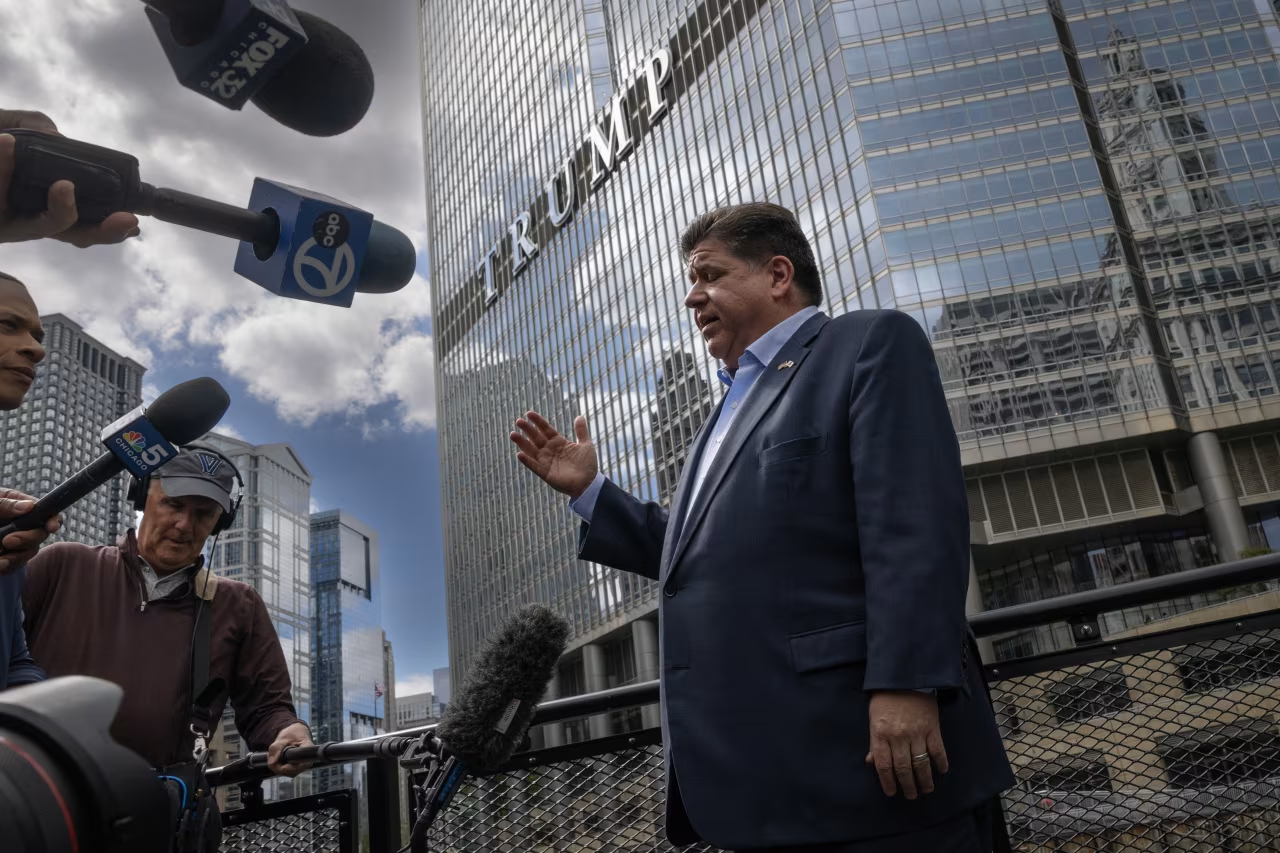
We’ve been reporting over the past two days on calls from businesses to receive a swift refund for costs they incurred due to President Donald Trump’s emergency tariffs. They’ve been joined by prominent Trump antagonists, like California Gov. Gavin Newsom, who are decrying the economic impact of the tariffs.
Another prominent blue-state critic of the Trump administration, Illinois Gov. JB Pritzker, has issued a call for restitution. Pritzker wrote a letter to Trump demanding a refund of $1,700 for every family in the state — a whopping $8.68 billion, by his count — because of the tariffs’ impact on prices for everyday goods. It included an invoice, deemed “Past Due - Delinquent,” for the same amount.
Pritzker’s gubernatorial campaign published the letter and invoice on its website, and the governor shared it on X with a three-word message to Trump: “Cut the check.”
Keep in mind: Importers pay tariffs, and they typically pass that cost on to retailers, who in turn can pass it on to customers in the form of higher prices. So while Trump’s critics argue that his tariffs cost average Americans money, it’s businesses that stand to potentially receive tariff refunds — not individual consumers.
That hasn’t stopped prominent Democrats like Pritzker and Newsom from highlighting what they say has been a negative economic impact on their constituents.
CNN’s David Goldman contributed to this report.
Trump grants emergency support to DC for sewage spill amid fight over who is responsible

President Donald Trump has authorized the Federal Emergency Management Agency to provide assistance to Washington, DC, to help with the city’s response to a sewage spill in the Potomac River.
Department of Homeland Security Secretary Kristi Noem, who oversees FEMA, said in a social media post today that Trump has also directed the Environmental Protection Agency to assist with the spill.
The federal assistance comes as lawmakers from the region and the White House have pointed fingers at each other over who is responsible for the clean up. President Donald Trump has been at odds with Maryland Gov. Wes Moore over the spill.
The spill was caused by a DC Water pipe that ruptured on federal land in Maryland.
Trump wanted Maryland and Virginia to directly ask for help, while Moore argued that the federal government is responsible since the pipe belongs to DC Water and sits on federal land.
FEMA said in a statement today that the agency can now proceed with disaster relief efforts and provide necessary equipment and resources.
The assistance will come as DHS remains shut down after Congress failed to fund the agency. As a result, the Trump administration has frozen new FEMA disaster deployment of aid workers.
Noem referenced the shutdown in her announcement today, blaming Democrats for it and adding that the agency “is committed to providing much needed aid to the Americans impacted by” the spill.
“We will not let our citizens suffer without help,” Noem said.
Earlier this week, DC Mayor Muriel Bowser had put in the request for federal support for the spill.
Read CNN’s analysis on the battle between politicians over the sewage spill here.
Trump calls Justice Kavanaugh a "hero" after tariff ruling
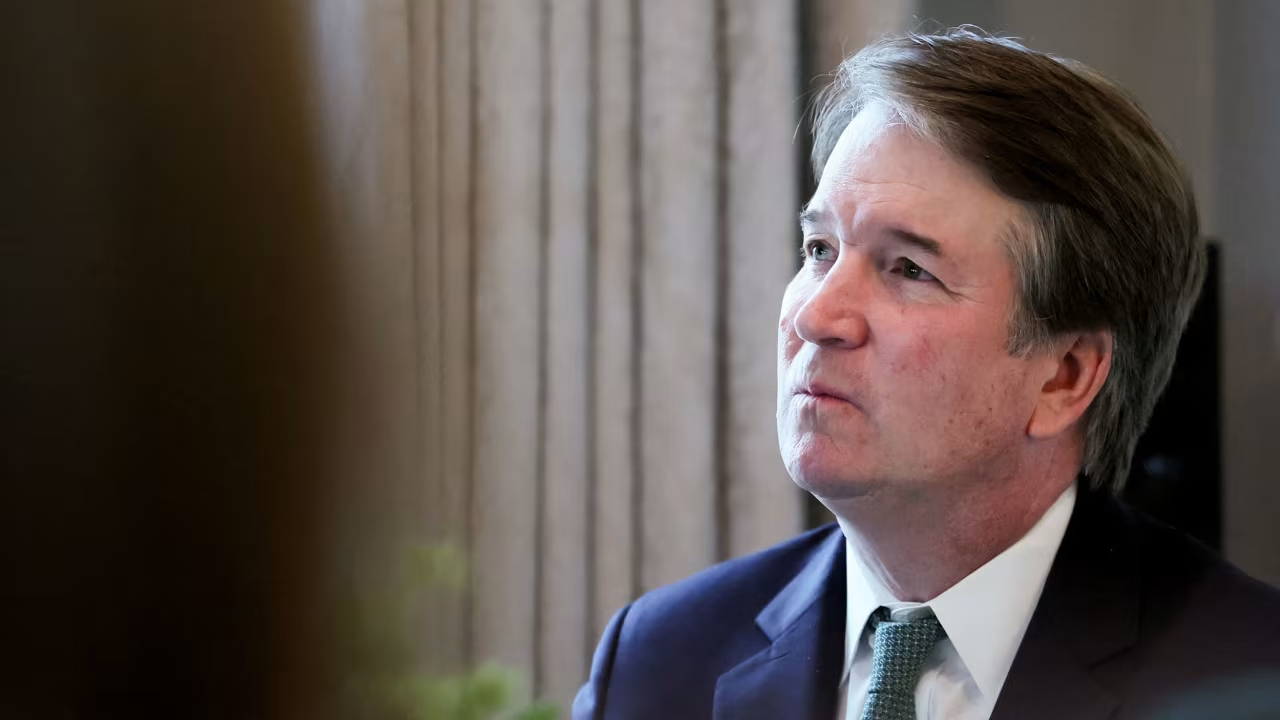
President Donald Trump called Justice Brett Kavanaugh his “new hero” on the Supreme Court after Kavanaugh sided with Trump in yesterday’s ruling on tariffs, while two of his other appointees sided against him.
“My new hero is United States Supreme Court Justice Brett Kavanaugh and, of course, Justices Clarence Thomas and Samuel Alito. There is no doubt in anyone’s mind that they want to, MAKE AMERICA GREAT AGAIN,” Trump said in a social media post this morning.
In the 6-3 decision, the Supreme Court ruled that Trump violated federal law when he unilaterally imposed sweeping tariffs across the globe. Justices Amy Coney Barrett and Neil Gorsuch, both Trump appointees, joined Chief Justice John Roberts and the three liberal justices in the majority.
Trump was clearly angry during a news conference at the White House shortly after the ruling and called the Supreme Court’s decision “deeply disappointing.”
“I’m ashamed of certain members of the court,” Trump said, calling the justices in the majority a “disgrace to our nation.”
Supreme Court ruling could influence Trump's decision on Iran, professor says
President Donald Trump could be spurred on to strike Iran to “divert attention” away from the latest Supreme Court ruling that he violated federal law in his implementation of global tariffs, an international relations professor told CNN today.
“What I fear is that President Trump’s domestic challenges … could really basically speed up President Trump’s decision to attack Iran,” Fawaz Gerges, a professor of international relations at the London School of Economics and Political Science (LSE), told CNN’s Kim Brunhuber.
The US has built up a large military presence in the Middle East, Gerges noted, suggesting that “this is not a simple game.”
“This is the most significant American military deployment in the Middle East since the United States invaded and occupied Iraq in 2003,” he said.
Trump’s latest global levy unlikely to rattle Asian firms, analyst says
US President Donald Trump’s fresh 10% global tariff is unlikely to rattle Asian businesses as they have already acclimatized to an unpredictable US trade policy, a veteran Asia business analyst told CNN.
“Since ‘Liberation Day,’ the world has adjusted to a new environment,” said Song Seng Wun, economic adviser at SDAX, a Singapore-based fintech company, referring to April 2 last year when Trump unveiled a sweeping package of import duties.
The analyst said most businesses will adopt a wait-and-see approach, similar to the previous times Trump announced sudden levies without vital details.
“Based on all the flip-flop and shifts we have seen from the US since last year, companies will move on, rather than waiting to see what the fallout will be from new tariffs,” he said, adding that it is unclear how and if the latest 10% hike will affect nations which have recently struck trade deals with the US.
However, he pointed out that conglomerates from Asian powerhouses like Japan and South Korea have pledged huge investments in America and some major projects are already ongoing. These, he said, might be impacted if the new tariff causes delays in purchasing machinery. But it could also have zero impact if there are exemptions to the latest levy.
“All this will likely cause delays to investment flow to the US,” he said.
Trading partners express uncertainty in wake of ruling on Trump's tariffs
In April last year, Trump announced “reciprocal” tariffs on goods imported from most US trading partners. Yesterday, the Supreme Court ruled that the emergency tariffs are illegal.
Trump has doubled down and signed a new 10% global tariff that kicks in on February 24. The levies can take effect for a maximum of 150 days, barring congressional approval for an extension.
Here’s how other territories have responded to the news:
- European Union: The bloc is analyzing the Supreme Court ruling “carefully” and will continue to advocate for low tariffs, said a spokesperson. Bernd Lange, chairman of the EU’s Committee on International Trade, called the ruling a “positive signal for the rule of law” and may sign that the era of “unlimited” and “arbitrary” tariffs imposed by the president may be coming to an end.
- France: French President Emmanuel Macron said the decision shows it is good to have checks and balances in democracies.“It doesn’t seem bad to have Supreme Courts and therefore a rule of law,” Macron said at the International Agricultural Fair in Paris on Saturday, adding that his country would consider the consequences and adapt.“The fairest possible rules involve reciprocity, not suffering unilateral decisions,” he said.
- South Korea: Ministers met on Saturday to review the ruling and Trump’s new tariff. The country “will examine its future response plans in a direction that best serves the national interest,” said its foreign ministry.
- New Zealand: The nation welcomed the Supreme Court ruling but warned “considerable uncertainty is likely to remain.” Trade and Investment Minister Todd McClay said: “Our exports have been holding up well in the US market… with evidence that in many cases cost increases are being passed on.”
- United Kingdom: Britain expects its privileged trading position with the United States to continue, the government said. But the court’s decision “adds to uncertainty” and “does little to clear the murky waters for business,” the British Chambers of Commerce added.
- Taiwan: The island is “closely watching” US tariff policy, its cabinet said in a statement. It added that the new levy would likely have “limited” effect on Taiwan, based on a preliminary reading of the new order.
- India: India’s commerce ministry said it has “noted” the Supreme Court’s judgement, as well as other developments related to the tariffs. “We are studying all these developments for their implications,” the ministry said in a statement.
This post has been updated to reflect reaction from India’s commerce ministry.
Reuters and CNN’s Lucas Lilieholm, Yoonjung Seo, Todd Symons, Sharon Braithwaite, Joseph Ataman, Wayne Chang, Caitlin Danaher and Kunal Sehgal contributed reporting.