Takeaways from today's final day of opinions
• Birthright citizenship upheld: In a big loss for President Donald Trump, the Supreme Court upheld birthright citizenship, striking down his executive order. Chief Justice John Roberts, calling citizenship “the right to have rights,” wrote for the court that “the Framers of the Fourteenth Amendment extended that promise to ‘every free-born person in this land.’ We keep that promise today.” Read the full opinion.
• Ruling on trans sports: The Supreme Court is letting states ban transgender athletes from playing on girls’ sports teams. The ruling was a major defeat for the LGBTQ movement, and it came a year after the justices allowed states to ban transgender care for minors, such as puberty blockers and hormone therapy.
• Campaign finance: The court also lifted a Watergate-era cap on how much money political parties may spend in coordination with candidates.
• Read more of our key takeaways from the birthright citizenship decision. Here’s what to know and what’s next for transgender athletes.
Updates
(48)Our live coverage has ended
Scroll through the posts below to learn more about today’s Supreme Court opinions.
Supreme Court rulings on birthright citizenship and trans athlete bans: What to know

The Supreme Court ruled on blockbuster cases on its final day of the term: Birthright citizenship, transgender athletes and campaign finance.
In a significant loss for President Donald Trump, the Supreme Court upheld birthright citizenship, striking down his executive order that was a key part of his agenda — even though it was legally dubious from the start.
The high court also ruled to allow states to ban transgender athletes from playing on girls sports teams. The ruling comes amid a political and legal backlash against trans Americans in conservative states. Trump lauded the decision as a “BIG WIN.”
Trump also praised the court lifting a Watergate-era cap on how much money political parties may spend in coordination with candidates.
If you’re just joining us, here’s else you should know:
Birthright citizenship:
- The court’s decision leaves in place the understanding that anyone born in the United States is a citizen, even if that child’s parents are not.
- Trump is now pushing Congress to legislatively get rid of birthright citizenship, which would likely face strong opposition.
- Chief Justice John Roberts wrote the opinion for a majority that included both conservatives and liberals. Three conservative justices — Clarence Thomas, Samuel Alito and Neil Gorsuch — dissented from the decision.
- In a 91-page dissent, Thomas blasted the court, saying his colleagues’ decision “devalues” citizenship as it was understood by the framers of the 14th Amendment. Alito called the decision a “mistake.” He went on to say that the court’s majority ruling “preserves a powerful incentive to enter or remain in this country illegally.”
- One of the main arguments that Trump’s attorneys had raised was that the 14th Amendment required people to be domiciled — or with the intention of remaining — in the US before being entitled to birthright citizenship. The court shot that argument down.
- Tuesday afternoon, the Justice Department has sent a letter to all US attorneys directing them to prioritize investigations and prosecution of “birth tourism schemes.”
Ruling on transgender athletes:
- The court was 6-3 along ideological lines on the issue of whether the Constitution bars the states from banning transgender sports. However, the court’s liberals joined the majority on a separate question of whether the state bans were barred by a federal law — Title IX.
- Justice Brett Kavanaugh stressed that the students involved should be treated with respect in his majority opinion.
- The decision means that laws in more than half of US states that are similar to those enacted in West Virginia and Idaho will also likely stand.
- Justice Sonia Sotomayor writing in a stinging dissent said that the majority had wrongly decided that trans student athletes cannot bring constitutional challenges against the state bans.
- But the liberals agreed with the court’s holding that a federal law barring sex discrimination in schools that receive federal funding does not prohibit such bans.
- The ruling was a major defeat for the LGBTQ movement at the conservative Supreme Court, and it came a year after the justices allowed states to ban transgender care for minors, such as puberty blockers and hormone therapy.
CNN’s John Fritze, Devan Cole, Aileen Graef, Steve Vladeck and Kaanita Iyer contributed to this report.
First on CNN: DOJ directs US attorneys to prioritize prosecuting "birth tourism schemes"


Just hours after the Supreme Court rejected President Donald Trump’s effort to limit birthright citizenship through his executive order, the Justice Department has sent a letter to all US attorneys directing them to prioritize investigations and prosecution of “birth tourism schemes.”
Birth tourism refers to the practice of foreign nationals traveling to the United States primarily to give birth so their child automatically acquires US citizenship.
The Justice Department has previously brought cases against people it has accused of bringing foreign nationals to the United States to deliver their babies.
“In 2024, a husband and wife, Michael Wei Yueh Liu and Jing Dong, were each sentenced to 41 months’ imprisonment for operating a birth tourism scheme with a business named ‘USA Happy Baby Inc.’ that charged Chinese clients tens of thousands of dollars to help them give birth in the United States,” the memo said.
The couple, according to the Justice Department, provided guidance on getting through customs, assisted in obtaining visas and provided housing and transportation.
In 2022, another man, Ibrahim Aksakal was sentenced to 27 months’ imprisonment for conspiring to commit health care and wire fraud after advertising a similar service on Turkish-language social media pages.
The memo written by Assistant Attorney General Colin McDonald directs US attorneys to prioritize bringing criminal cases like these.
Melania Trump praises transgender decision


First lady Melania Trump praised the Supreme Court’s decision allowing states to ban transgender athletes from competing on girls sports teams while reiterating her support for the LGBTQIA+ community.
“America, we can support the rights of the LGBTQIA+ community and also protect opportunities for female athletes. Respect everyone and keep girls’ sports fair,” she wrote on X. “Both ideals are essential.”
The first lady quoted her own book, with a page citation, in writing, “As many of you may know, I fully support the LGBTQIA+ community. But we must also ensure that our female athletes are protected and respected.”
She went on to write on X: “The U.S. Supreme Court has now legally confirmed this opinion: ‘Under Title IX and the Equal Protection Clause of the Fourteenth Amendment, may schools maintain women’s and girls’ sports for biological females? … The answer is yes.’”
Trump has previously spoken to the Log Cabin Republicans, which represents LGBT conservatives.
John Eastman, former Trump lawyer and architect of legal fight against birthright, reacts

The former Trump lawyer and primary architect of the argument against birthright citizenship, John Eastman, was disappointed in the Supreme Court decision but said it was a closer ruling than many expected.
Eastman cast doubt on the idea that Congress could address birthright citizenship through statutory law change. This point was raised by Justice Brett Kavanaugh in his opinion and echoed by House Speaker Mike Johnson to reporters on Tuesday, as well as in a Truth Social post by President Donald Trump.
Eastman added: “So, I don’t think Congress can fix this, unless the court revisits the question on a petition for a rehearing or in a future case.”
Eastman – who is now disbarred – attended both oral arguments in this case in the springs of 2025 and 2026. He celebrated the court’s 2025 decision, restricting temporary injunctions, and said that despite today’s strike down, he still believes that Trump was correct at the time of the executive order and that the Department of Justice did a “tremendous” job arguing.
“The fact that it was a five-four decision on the principal constitutional question, I think demonstrated the argument in favor of the president’s executive order was much stronger than many legal scholars and commentators acknowledged,” Eastman said.
States can bar trans athletes from girls sports, the court says. What happens now?

The Supreme Court this morning weighed in on one of the most divisive corners of the fight over transgender rights, allowing states to ban trans women and girls from competing on women’s sports teams.
Though the ruling likely allows bans in more than half of US states to stand, it did nothing to change the laws in states that allow transgender students to compete on teams that align with their gender identity. Those states can keep their policies.
But there is one thing for certain: Conservative lawmakers and anti-trans activists who oppose trans athletes’ participation will be emboldened to push for bans in states where they do not already exist.
“Why should a girl in Texas have different rights than a girl in Connecticut or New York?” said Paula Scanlan, who swam alongside transgender swimmer Lia Thomas at the University of Pennsylvania, on Fox News.
Scanlan is among a group of people who have called on Congress to pass a national ban on trans women in girls sports. Earlier this year, Republican congressman John McGuire introduced the “Riley Gaines Act,” named after the activist and former swimmer who has emerged at the forefront of the conservative anti-trans movement after opposing Thomas’ position as the first transgender athlete to win an NCAA Division I title.
But many bans impact school-aged children who could benefit greatly from the social, physical and mental aspects of athletics, CNN sports analyst and USA Today columnist Christine Brennan said.
“This is now the needle that the sports world is going to thread to make sure they do not exclude children well before the elite level from the opportunity to learn those life lessons playing sports,” Brennan told CNN’s Wolf Blitzer.
Though it is a clear loss for trans advocates, there may be a silver lining (albeit small) in today’s ruling, CNN analyst Steve Vladeck writes.
Justice Brett Kavanaugh in his majority opinion reasoned that discrimination on the basis of transgender status is tantamount to discrimination on the basis of sex, which is only constitutionally permissible if the policy significantly advances a government interest – a standard known as “intermediate scrutiny.”
This could open the door for challenges to other restrictions on trans people in the future, such as bathroom use, Vladeck said.
House speaker: Congress should act on birthright citizenship, but "I don't know what that is."


House Speaker Mike Johnson said Tuesday that Congress should do “everything that is possible” to end birthright citizenship after the Supreme Court rejected the Trump administration’s bid to do away with the constitutional right, though he “doesn’t know what the remedy is.”
“It certainly is time for us to do everything that is possible. I don’t know what that is,” the Louisiana Republican told CNN’s Manu Raju.
“I think it’s clearly an issue that merits the attention of Congress. I don’t know what the remedy is, how to define it or the timeline,” Johnson added. “It would be premature for me to project that, but I will tell you that it’s a big concern for the American people, because it’s been abused.”
ACLU lawyer who argued before Supreme Court celebrates birthright decision

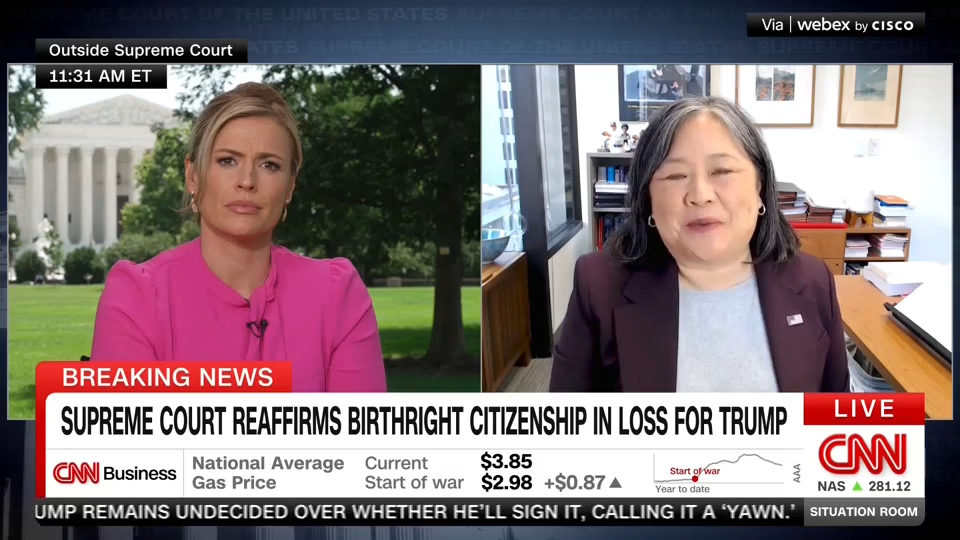
The American Civil Liberties Union’s Cecillia Wang called today’s Supreme Court decision in the birthright citizenship case a “celebration,” and wished “good luck” to Republicans in Congress who attempt to change birthright citizenship law.
“Ask any American what our citizenship rule is, and they will tell you if you’re born here, you’re a citizen, just like everyone else, and that couldn’t be more fundamental to who we are as a nation,” Wang, who argued the case before the justices in April, told CNN’s Pamela Brown.
House Speaker Mike Johnson told reporters on Tuesday after the decision that Congress will deal with the idea of birthright citizenship. In his opinion, Justice Brett Kavanaugh suggested that Congress could hold statutory power under the Constitution to limit birthright citizenship, despite his ultimate decision to rule with the majority that the president’s executive order was illegal.
In April, Wang argued that President Donald Trump’s Executive Order should not hold, and she told the justices that if Congress did not want the Fourteenth Amendment to cover immigrants, that the law would have said so.
“So the Fourteenth Amendment’s birthright citizenship clause, as part of the Reconstruction Amendments of the Constitution, were hard won by African Americans who fought for freedom, who fought to end the notion of caste in this country,” Wang said Tuesday.
“So President Trump, in this executive order, and in so many of his other executive actions, was trying to talk about immigration, but what he was doing was profoundly well beyond immigration policy.”
Trump calls birthright citizenship ruling "massive" win for China
President Donald Trump called the Supreme Court’s ruling on birthright citizenship a “massive” win for China, congratulating President Xi Jinping in a tongue-in-cheek way.
“I would like to congratulate President Xi, and the Great Country of China, on their massive Birthright Citizenship WIN!” Trump said on Truth Social.
Earlier Tuesday, the Supreme Court ruled that the 14th Amendment invalidated a previous executive order from Trump, which sought to strip birthright citizenship for children of parents who are unlawfully in the country or visiting under temporary status.
“Children born in the United States to parents unlawfully or temporarily present are ‘subject to the jurisdiction’ of the United States and are citizens at birth under the Fourteenth Amendment’s Citizenship Clause,” the Supreme Court ruling states.
The Trump administration and other conservatives have argued that some Chinese citizens engage in “birth tourism,” that is, purposely traveling to the United States while in the final stages of pregnancy so a child would have US citizenship. Some Republicans have deemed that a national security issue, given potential connections to the Chinese Communist Party.
Trans athlete says rhetoric around SCOTUS ruling could "lead to further discrimination"


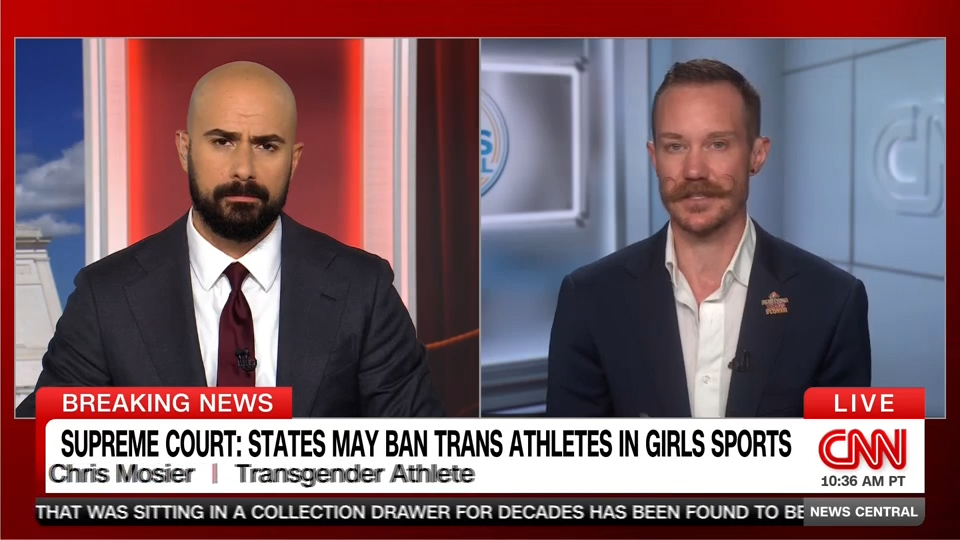
Chris Mosier, a transgender athlete, told CNN today that the Supreme Court ruling that allows states to ban transgender athletes from playing on girls sports teams will have a wide ranging impact on the community.
He said while the ruling itself wouldn’t make it harder for other forms of trans exclusion to be challenged, “the issue here is the rhetoric that comes with challenging transgender people’s existence.”
“Our ability to participate with our peers and sports has been the entry point to this conversation, which we know has expanded out into our classrooms, into our health care system, into our shelter system, and on and on and on,” Mosier told CNN’s Boris Sanchez on CNN News Central.
Mosier went on to argue that the case is not merely about participation in sports but rather about “power” and “control.”
“This is about trying to make it so that we cannot show up and live authentically as the people that we are,” Mosier said.
How many transgender athletes could be impacted by today's ruling?
Complicating the conversation about transgender athletes is a lack of reliable data on how prevalent trans athletes are, whether in recreational youth sports or in cutthroat international competition. This has led advocacy groups on both sides to make wide-ranging and often conflicting estimates.
In the most competitive arenas, however, figures indicate that transgender people make up a sliver of participating athletes and rarely take top prizes.
Since the International Olympic Committee began permitting trans and nonbinary athletes to participate openly in 2003, fewer than a dozen have qualified. Most have competed on the team consistent with their gender assigned at birth, choosing to forgo hormone replacement therapy in order to qualify for competition.
In US college and university athletics, top leagues with trans participation bans in place have struggled to quantify those athletes.
NCAA President Charlie Baker testified before the Senate in 2024 that he was aware of “less than 10” transgender athletes competing in the league – a number amounting to less than .002% of its athletes. And when the NAIA, a smaller college association, effectively banned trans women from participating in most of its categories last year, a spokesperson told the Washington Post it does not track whether there are trans athletes on its teams.
And in younger age groups, the Williams Institute, a think tank at UCLA Law, estimates that as many as 122,000 trans youth age 13 to 17 could be participating in high school sports. It is unclear, however, how many play on the team that aligns with their gender identity, as many of them presumably live in states with bans in place.
Professional transgender athletes worry SCOTUS decision may harm trans children
Two current and former transgender athletes responded to the Supreme Court ruling that allows states to ban trans people from sports teams for women and girls, saying they fear such bans will disproportionately impact young trans athletes.
“I just felt really devastated for all the young kids that are just not going to be able to play sports with their friends,” said Harrison Browne, a former professional hockey player and actor in the Netflix show “Heated Rivalry.”
Browne added: “Being authentically yourself while playing the sport that you love is a right that everybody should have.”
In the past few years, trans athletes have suffered a series of legal and policy blows, mainly impacting trans women: More than half of US states have implemented bans on their participation – ranging from grade level to high school and college-aged players. The White House released an executive order banning trans women’s participation, and both the NCAA and International Olympic Committee have barred trans women from women’s competition.
Team USA runner Chris Mosier said in a social media post, “Treating a first grader the same as we treat a college student athlete, or treating an esports player the same as a soccer player, or a recreational athlete the same as an Olympian or Paralympian doesn’t advance fairness.”
Mosier pointed out that while the ruling allows states to ban trans athletes from participating, “it does not require discrimination.” States still have a choice on whether to regulate trans athletes.
“While today was an incredibly disappointing decision, the policy landscape is essentially the same today as it was before,” Mosier said.
“We need to continue to fight to make sure that no more states implement laws that will ban our ability to be who we are and play the sports that we love, and we need to continue to work to create safer, more inclusive spaces for every athlete at every level of play,” he added.
Trump again praises Slaughter win after birthright loss

President Donald Trump once again praised the Supreme Court’s decision on Monday expanding his executive power after suffering a loss in the birthright citizenship case on Tuesday.
“The biggest and most consequential Decision issued by the Court, by far, is the Slaughter Case, which overturned the very famous Humphrey’s Executor Rule,” he said in a post on Truth Social, adding, “It is an Honor to be the sitting President who, after all these years, WON this very important, and hard fought, Case.”
Trump acknowledged his loss in the birthright citizenship case after the Supreme Court knocked down his effort to get rid of it by executive order, claiming he will work to “correct” it in Congress.
“We had other good Victories, too, and we also had the Birthright Citizenship loss, which we will work to correct in Congress, but the big SLAUGHTER, was SLAUGHTER,” he wrote.
Trump concluded by saying, “The Republican Party was treated very fairly by the United States Supreme Court.” The court sided with Republicans on Tuesday in a case about much money political parties may spend in coordination with candidates.
Trump calls on Congress to end birthright citizenship after Supreme Court loss
President Donald Trump pushed Congress to legislatively get rid of birthright citizenship after the Supreme Court knocked down his effort to end it by executive order.
“The Supreme Court upheld Birthright Citizenship, which is too bad for our Country, but we can easily make it up in Congress through Legislation, with the support of the President, that has now been determined during this process,” Trump said in a post on Truth Social.
“No long and unwieldy Constitutional Amendment is necessary! Congress should start TODAY to work on ending expensive and unfair to our Country, Birthright Citizenship. They will have my Complete and Total Support!” he added.
Ending birthright citizenship through legislation would likely face strong opposition in Congress.
Kavanaugh's opinion could embolden future challenges to trans discrimination
Even as the Supreme Court upheld state bans on transgender athletes’ participation in girls’ and women’s school sports, Justice Brett Kavanaugh’s majority opinion includes an important silver lining that might embolden certain other challenges to discrimination against transgender individuals by government actors.
Specifically, Kavanaugh held that discrimination on the basis of transgender status is tantamount to discrimination on the basis of sex, which is permissible under the Fourteenth Amendment’s Equal Protection Clause only if the discrimination is “substantially related to an important governmental interest,” a standard that the Court calls “intermediate scrutiny.”
In this case, the court held that keeping transgender women off of girls’ and women’s school athletic teams satisfies intermediate scrutiny—because, as Kavanaugh explained, “the interests in safety and competitive fairness are important for purposes of equal protection analysis. And the states’ sex-based classification—limiting women’s and girls’ sports to biological females—is substantially related to those interests.”
But whether other discrimination against transgender individuals, from bathrooms to military service, could also meet this higher standard remains to be litigated in future cases.
It’s still a significant loss for equality advocates—but one that opens the door to at least some skepticism of other governmental discrimination against transgender individuals going forward.
Some female athletes and activists call for girls sport bans to be expanded nationwide

Athletes and activists who oppose trans athletes’ participation in women’s sports are lauding the Supreme Court’s decision to let states ban transgender athletes from playing on teams with women and girls — and some are leveraging the victory to call for more such bans across the nation.
“More work needs to be done. We need to see protections in all 50 states in this country. Why should a girl in Texas have different rights than a girl in Connecticut or New York?” said Paula Scanlan, who swam alongside transgender swimmer Lia Thomas at the University of Pennsylvania, on Fox News.
Scanlan and her fellow former swimmer Riley Gaines have also called on Congress to pass legislation that would enact a nationwide ban.
Gaines emerged at the forefront of the conservative anti-trans movement after opposing Thomas’ position as the first transgender athlete to win an NCAA Division I title, a victory which was later overwritten after pressure from the Trump administration. Today, she called the decision in an Instagram story “long-awaited.”
“Today, women’s sports are protected,” according to another post from her podcast, “The Riley Gaines Show.”
In Maine, which does not have a trans athlete ban, student athlete Cassidy Carlisle and her family protested outside the state Capitol building last year after she competed against a transgender athlete in a skiing competition.
NPR withdraws false report that said Justice Alito retired


NPR has withdrawn its on-air and online reporting that mistakenly said that conservative Justice Samuel Alito retired on Tuesday.
The story was online for more than 10 minutes before being retracted, long enough to send other newsrooms scrambling for confirmation. Supreme Court retirements often coincide with the end of the term, which is Tuesday.
A court spokesperson said that NPR’s reporting on Alito was “inaccurate.”
The NPR story “is causing a lot of confusion right now,” CNN Chief Legal Affairs Correspondent Paula Reid said on air.
Thomas Evans, NPR’s editor-in-chief, said in a statement: “Due to a misunderstanding, NPR’s Supreme Court and Legal Affairs Correspondent Nina Totenberg incorrectly reported that Justice Samuel Alito had retired. Neither Justice Alito nor the Supreme Court Public Information Office has announced his retirement.”
“As soon as the error was realized, the story was retracted and removed from NPR’s website and an on-air correction was broadcast. We regret the error and any confusion this may have caused,” he said. “This afternoon, Mrs. Totenberg will appear on All Things Considered to explain what happened. She has reached out to Justice Alito to apologize.”
Speaker Johnson says he's "very disappointed" in birthright opinion as it's read to him


Republican House Speaker Mike Johnson reacted live to the Supreme Court opinions as they came down while he was holding a press conference.
“It just came down!” a reporter shouted about the birthright citizenship decision.
“Oh dear,” Johnson replied. As a reporter read out the decision, the Louisiana Republican appeared exasperated.
“You could say that’s a textualist, originalist view. However, I do think that this has been grossly abused in recent years,” he said, referring to “birthing tourism.”
“I’m sure the conclusion from this opinion is you’ve got to amend the Constitution to fix that,” he said, noting the hurdles in doing so.
Earlier in the press conference, he said the decision on transgender athletes “sounds like the right result. That’s common sense.”
The Supreme Court adjourns after handing down 58 opinions this term
The Supreme Court handed down 58 opinions in all, including a dozen major rulings, adjourning a momentous term in which the justices have confronted cases dealing with President Donald Trump’s executive power, voting rights and transgender athletes.
CNN tracked the key Supreme Court cases for the 2025-2026 term, which will have far-reaching implications for millions of Americans. Review the outcomes of all 12 major rulings here.
Trump lost on birthright citizenship, but court’s conservatives were heavily divided

Perhaps President Donald Trump’s effort to end automatic birthright citizenship wasn’t as out of the mainstream as Supreme Court watchers had predicted.
Three members of the court’s conservative majority dissented from the decision, and one would have decided the case on much narrower grounds.
In the end, Chief Justice John Roberts managed to shut down the president’s first-day executive order with only one of the court’s conservatives — Justice Amy Coney Barrett — on board with his opinion. The court’s three liberal justices also joined that decision.
If Roberts’ mission was to present a unified front on a theory that was considered fringe just a decade ago, that effort was not successful.
Justice Brett Kavanaugh filed an opinion concurring in the outcome but disagreed that the Constitution barred Trump’s order.