Our live coverage has moved
• Get the latest updates on the war with Iran here.
Updates
(47)Key developments
• Strikes on Iran: US forces targeted Iranian military facilities responsible for launching attacks against warships transiting the Strait of Hormuz, US Central Command said. The military said US forces do “not seek escalation.” A spokesperson for Iran’s armed forces said the airstrikes hit civilian areas.
• US threat: President Donald Trump said American forces destroyed Iranian attackers and warned “we’ll knock them out a lot harder, and a lot more violently” if Iran doesn’t sign a deal soon. He also said the ceasefire is still in effect and Iran “trifled with us.”
• Peace talks: Trump suggested negotiations remain uncertain but ongoing. He also said a US proposal to end the war is “more than a one-page offer” as Iran has not yet finalized its response.
• Tensions at sea: Tehran has laid out new rules for ships seeking to cross the Strait of Hormuz, according to a document seen by CNN.
UAE reports missile and drone attacks from Iran
The United Arab Emirates is currently tackling missile and drone attacks from Iran, the country’s Ministry of Defense said in a statement written in Arabic.
Sounds rang out across the country due to “ongoing engaging operations of missiles and UAVs,” it said Friday morning on X.
“The public is urged to remain calm and follow the safety and security instructions issued by relevant authorities.”
The UAE previously declared its airspace free of threats on April 9, coinciding with the start of the US-Iran ceasefire, but it has continued intercepting attacks.
The UAE has sustained more incoming fire from Iran than any other country in the past two months.
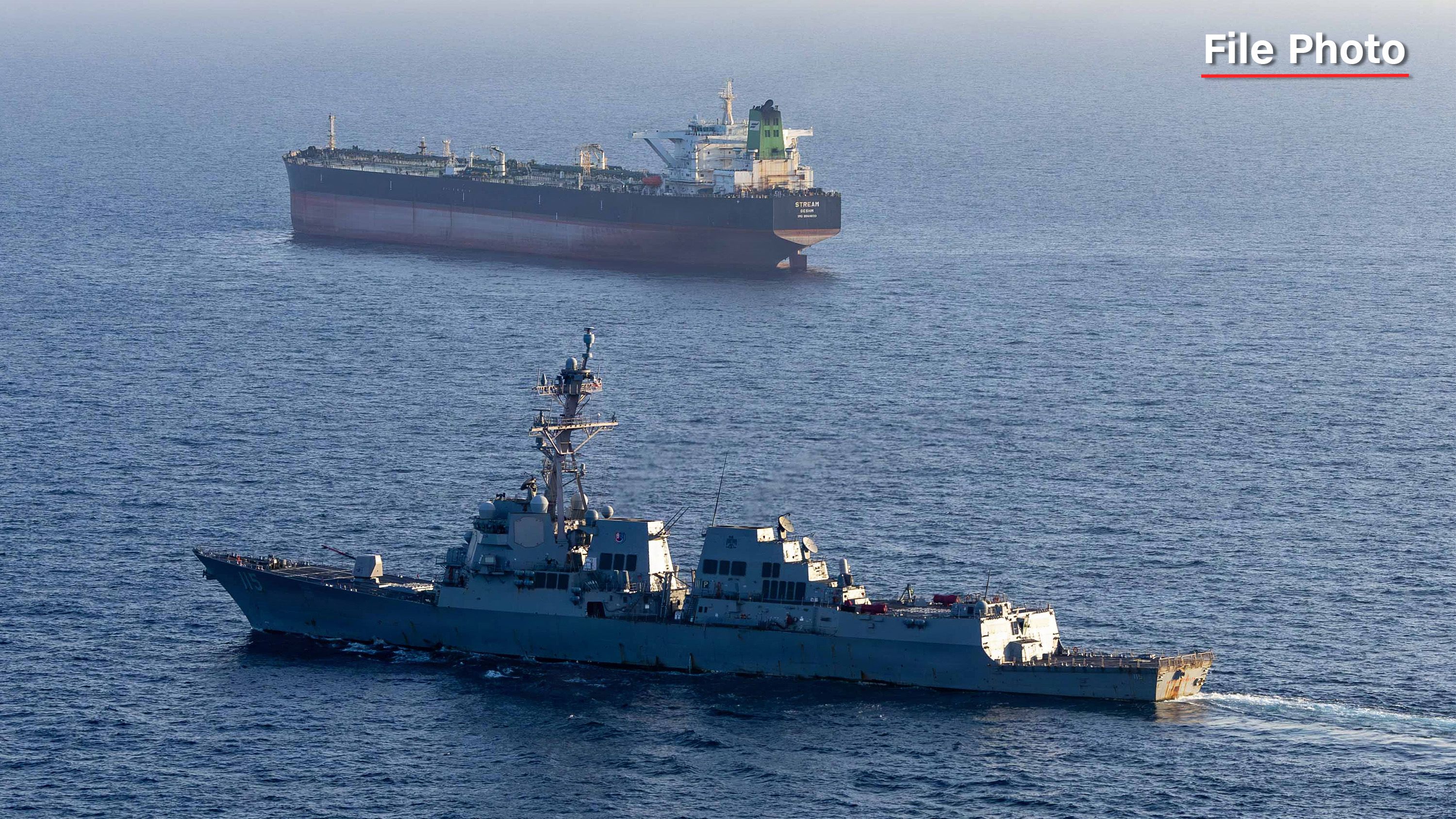
A look at the US destroyers Iran attacked Thursday

Three US Navy guided-missile destroyers fended off a multi-pronged Iranian attack in the Strait of Hormuz on Thursday, US Central Command and President Donald Trump said.
Trump said Iran tried to hit the three destroyers with a mix of drones, fast-attack boats and missiles and were easily defeated.
The three US warships involved – USS Truxtun, USS Rafael Peralta and USS Mason – are Arleigh Burke-class destroyers, part of a fleet of more than 75 in active service, the Navy’s workhorses.

The Arleigh Burke-class ships, just over 500 feet long and displacing 8,200 to 9,700 tons, have a range of defensive armaments.
They carry high-end, multi-million-dollar Standard missiles that can deal with incoming ballistic or cruise missiles. The Sea Sparrow missile system can also deal with shorter-range threats.
If incoming targets get past those systems, US destroyers also carry the Phalanx Close-In Weapons System, a radar-guided 20mm Gatling gun that can fire 4,500 rounds a minute and can be used a last-resort defense.
The destroyers also have a five-inch 127mm gun mounted on their bows that can engage surface targets like the Iranian fast-attack boats.
CENTCOM did not specify what weapons were used to stop Thursday’s Iranian attack.
But Trump gave a flowery description of how the missiles and drones were brought down.
“Missiles were shot at our Destroyers, and were easily knocked down. Likewise, drones came, and were incinerated while in the air. They dropped ever so beautifully down to the Ocean, very much like a butterfly dropping to its grave!” he posted.
Iran and US are still working towards a peace deal. Catch up on the headlines

President Donald Trump said Thursday that a US proposal aimed at ending the conflict with Iran was more extensive than a “one-page offer,” as Tehran continues reviewing messages from Washington delivered through Pakistani mediators.
Here’s what Trump has said about the peace deal with Iran:
- Trump said Thursday to reporters that Iran’s offer “basically said they will not have nuclear weapons, they are going to hand us the nuclear dust and many other things we want.” In terms of whether Iran has agreed to that, Trump said, “They have agreed.” According to Iranian media, Tehran has not yet finalized its response to the US proposal.
- Trump also addressed the ceasefire, saying that it remains in effect. “You won’t have to know if there’s no ceasefire,” he told reporters Thursday. “You’ll just have to look at one big glow coming out of Iran.”
- The situation has settled down now after US and Iranian forces exchanged fire in and along the Strait of Hormuz, according to Iranian state media. There have been no reports so far of civilian casualties, the Islamic Revolutionary Guard Corps (IRGC) said, citing a state media reporter in the country’s southern Hormozgan province, which is home to the Iranian coast and islands along the strait. Trump described the strikes as “just a love tap” and “they trifled with us.”
- Trump also warned Thursday that if Iran doesn’t sign a deal soon, “we’ll knock them out a lot harder, and a lot more violently” after American forces destroyed Iranian attackers targeting three US Navy destroyers as they transited the strait.
CNN’s Billy Stockwell, Zachary Cohen, Alejandra Jaramillo, Hira Humayun, Mitchell McCluskey and Alessandra Freitas contributed to this report.
How China can make a difference in the Iran war
US President Donald Trump is due to meet with Chinese leader Xi Jinping next week. While Chinese officials played a role in building the current ceasefire, analysts say that Beijing may not be in a rush to ramp up pressure on Tehran just yet. CNN’s Steven Jiang has more.


Trump says US proposal to Iran was "more than a one-page offer"
President Donald Trump said Thursday that a US proposal aimed at ending the conflict with Iran was more extensive than a “one-page offer,” as Tehran continues reviewing messages from Washington delivered through Pakistani mediators.
Asked whether Iran had responded to what was described as a one-page proposal, Trump pushed back on the characterization.
“Well, it’s more than a one-page offer. It’s an offer that basically said they will not have nuclear weapons, they are going to hand us the nuclear dust and many other things that we want,” Trump told reporters.
Asked if Iran has agreed to that, Trump said, “They have agreed. When they agree it doesn’t mean much because the next day they forgot they agreed.”
“And you know, we’re dealing with different sets of leaders,” Trump added.
Iran has not yet finalized its response to the US proposal, according to Iranian media, which reported that Tehran is still reviewing “messages” from the Americans relayed through Pakistani intermediaries.
Trump says it would be obvious if ceasefire had lifted: "One big glow coming out of Iran"

President Donald Trump said Thursday that a ceasefire with Iran remains in effect despite fresh military clashes in and around the Strait of Hormuz, warning that it would be obvious if the ceasefire were over.
“You won’t have to know if there’s no ceasefire,” Trump told reporters when asked about the matter during an impromptu stop near the Lincoln Memorial Reflecting Pool. “You’ll just have to look at one big glow coming out of Iran.”
The president downplayed the latest escalation while touting the US military response.
“They trifled with us today,” Trump said. “We blew them away, they trifled, I call that a trifle.”
The president later suggested negotiations with Iran remain uncertain but ongoing.
A deal with Iran “might not happen, but it could happen any day,” Trump said.
Trump’s remarks came after United States Central Command said US forces carried out strikes against Iranian military facilities responsible for launching missile, drone and small boat attacks against US Navy destroyers transiting the Strait of Hormuz.
Iran will soon be celebrating a "great victory" in war, VP says
Iranians will soon be celebrating a “great victory” in the war with US and Israel, First Vice President Mohammad Reza Aref said, state-run Press TV reported on Thursday.
The comments come as both sides exchanged fire in the Strait of Hormuz Thursday. Iran accused the US of violating the ceasefire and the US said it doesn’t seek escalation and the ceasefire remains in place.
US President Donald Trump warned that “we’ll knock them out a lot harder, and a lot more violently” if Iran doesn’t sign a deal soon. Separately, he told ABC News the ceasefire is still in effect, describing the strikes as “just a love tap.”
Trump says ceasefire still in effect, calls US strikes on Iran facilities “just a love tap"

President Donald Trump on Thursday said the ceasefire with Iran remains in effect following an exchange of fire.
“The ceasefire is going. It’s in effect, ” Trump told ABC News’ Rachel Scott in a phone interview, describing the strikes as “just a love tap.”
The US military carried out strikes on Iranian military facilities it said were responsible for attacks on American warships transiting the Strait of Hormuz.
Trump’s remarks come after a spokesperson for Iran’s armed forces earlier today claimed that the US violated the ceasefire by targeting an Iranian oil tanker heading toward the Strait of Hormuz.
Trump warns Iran to sign a deal "fast" after attacks on US destroyers in Strait of Hormuz

President Donald Trump said Thursday that American forces destroyed Iranian attackers targeting three US Navy destroyers as they transited through the Strait of Hormuz, warning that “we’ll knock them out a lot harder, and a lot more violently” if Iran doesn’t sign a deal soon.
“Three World Class American Destroyers just transited, very successfully, out of the Strait of Hormuz, under fire. There was no damage done to the three Destroyers, but great damage done to the Iranian attackers,” Trump wrote in a Truth Social post.
“They were completely destroyed along with numerous small boats, which are being used to take the place of their fully decapitated Navy,” Trump added.
“Missiles were shot at our Destroyers, and were easily knocked down,” Trump continued. “Likewise, drones came, and were incinerated while in the air. They dropped ever so beautifully down to the Ocean, very much like a butterfly dropping to its grave!”
The president warned Iran against escalating tensions further, writing that “if they had the chance to use a Nuclear Weapon, they would do it, without question — But they’ll never have that opportunity and, just like we knocked them out again today, we’ll knock them out a lot harder, and a lot more violently, in the future, if they don’t get their Deal signed, FAST!”
Trump’s post came after United States Central Command said US forces struck Iranian military facilities responsible for launching what it described as “unprovoked” missile, drone and small boat attacks against American warships transiting the strait.
US and Iran exchanged fire around the Strait of Hormuz. Here's what happened

As the US awaits Iran’s response to its latest proposal to end the war, the two countries exchanged fire in and around the Strait of Hormuz.
Here’s what we know right now:
- Iran accused the United States of carrying out attacks on its territory after semi-official media outlets reported explosions Thursday night. A spokesperson for Iran’s armed forces then said US airstrikes hit civilian areas along the coasts of Qeshm Island, Bandar Khamir and Sirik.
- Iran responded with “reciprocal action” by attacking US military vessels east of the strait and south of the port of Chabahar, the spokesperson said in a video address carried by state media.
- US Central Command said US forces targeted Iranian military facilities responsible for launching a series of “unprovoked” missile, drone and small boat attacks against American warships transiting the Strait. It said, “No US assets were struck.”
- In its statement, US Central Command added that US forces do “not seek escalation,” but that military is “ready to protect American forces.”
- Iranian state media reported the situation is “back to normal now” and there have been no reports so far of civilian casualties, according to the Islamic Revolutionary Guard Corps.
Other news to note:
- President Donald Trump said he spoke with European Commission President Ursula von der Leyen, who confirmed the call, and said they were united in that “Iran must never possess a nuclear weapon.”
- Brazilian President Luiz Inácio Lula da Silva said Thursday the war with Iran will cause “more damage” than the US president realizes after the two leaders met in Washington, DC.
- Iran’s attempts to force shippers to comply with a new protocol for transiting the Strait of Hormuz will affect not just the Middle East region but the “entire world,” US Ambassador to the United Nations Mike Waltz said.
CNN’s Billy Stockwell, Zachary Cohen, Alejandra Jaramillo, Mitchell McCluskey, Alessandra Freitas and Hira Humayun contributed reporting to this post.
Situation in Iran coastal cities "back to normal" after exchange of fire, state media says

The situation has settled down now after US and Iranian forces exchanged fire in and along the Strait of Hormuz, according to Iranian state media.
There have been no reports so far of civilian casualties, the Islamic Revolutionary Guard Corps (IRGC) said citing a state media reporter in the country’s southern Hormozgan province which is home to the Iranian coast and islands along the strait.
US forces strike military facilities in Iran as countries exchange fire


US forces targeted Iranian military facilities responsible for launching a series of “unprovoked” missile, drone and small boat attacks against American warships transiting the Strait of Hormuz, US Central Command said on Thursday.
“U.S. forces intercepted unprovoked Iranian attacks and responded with self-defense strikes as US Navy guided-missile destroyers transited the Strait of Hormuz to the Gulf of Oman, May 7,” CENTCOM said in a press release.
The Iranian facilities targeted by US forces included “missile and drone launch sites, command and control locations; and intelligence, surveillance and reconnaissance nodes,” according to CENTCOM.
“Iranian forces launched multiple missiles, drones and small boats as USS Truxtun (DDG 103), USS Rafael Peralta (DDG 115), and USS Mason (DDG 87) transited the international sea passage. No US assets were struck,” the CENTCOM statement added.
An Iranian state media report said that commercial facilities at the Bahman Pier on Qeshm Island had been targeted in an exchange of fire between Iranian security forces and “the enemy.”
In its statement US Central Command said that the US forces do “not seek escalation” but that the military is “ready to protect American forces.”
Iran accuses US of striking port cities and oil tankers
Iran accused the United States of carrying out attacks on its territory after semi-official media outlets reported explosions Thursday night.
A spokesperson for Iran’s armed forces said US airstrikes hit civilian areas along the coasts of Qeshm Island, Bandar Khamir and Sirik.
He also claimed that the US violated the ceasefire by targeting an Iranian oil tanker heading toward the Strait of Hormuz.
Iran responded with “reciprocal action” by attacking U.S. military vessels east of the strait and south of the port of Chabahar, the spokesperson said in a video address carried by state media.
Earlier, Iran’s Mehr News Agency said explosions were heard in the Bandar Abbas and Qeshm area but added that “no official bodies have commented on the cause of these sounds.”
The semi-official Tasnim News Agency speculated, citing unnamed sources, that the United Arab Emirates could be behind the attack on Qeshm but said this was not confirmed.
CNN has asked US Central Command and the United Arab Emirates for comment.
Meanwhile, Nour News, an outlet affiliated with the Islamic Revolutionary Guard Corps, said a passenger pier on Qeshm Island was reportedly hit. Iran’s Fars News Agency also reported that residents in Bandar Abbas heard sounds resembling explosions from various parts of the city.
What happened during the meeting between Marco Rubio and Pope Leo XIV


US Secretary of State Marco Rubio met with Pope Leo XIV today, at a time when the war with Iran has contributed to a historic period of tension between Washington and the Vatican.
It marked the second meeting between the Chicago-born pope and Rubio, who is a devout Catholic. The pope usually meets with heads of state or government, so it was a significant diplomatic gesture for him to meet formally with Rubio.
Here’s the context: US President Donald Trump has repeatedly attacked the pontiff for his disapproval of the US war against Iran. On Monday, Trump said the pope was “endangering a lot of Catholics and a lot of people” and claimed Leo is happy with Iran having a nuclear weapon.
On Tuesday, Leo said people are free to criticize him, although they should “do so with the truth,” and that “the mission of the Church is to preach the Gospel and peace.” He also said the church has for years “spoken out against all nuclear weapons, so there is no doubt on that point.”
Here’s what to know about the meeting:
- The topics: A Vatican spokesman said the discussions between Rubio and Leo covered the Middle East, including Iran and Lebanon, conflicts in Africa, and the situation facing the Cuban population. The US State Department said in a readout that the two discussed “the situation in the Middle East and topics of mutual interest in the Western Hemisphere.”
- The sentiment: The Holy See press office described the conversation as cordial, adding “the shared commitment to cultivate good bilateral relations … was renewed.” The State Department said the meeting “underscored the strong relationship between the United States and the Holy See and their shared commitment to promoting peace and human dignity.”
- The gifts: Rubio, who acknowledged that Leo is a “baseball guy,” gifted the pope a small crystal football with the seal of the State Department. The pontiff gave Rubio a pen made from olive wood, which he noted is the plant of peace.
Trump says EU chief agrees Iran "can never have a nuclear weapon"

President Donald Trump said Thursday that he spoke with European Commission President Ursula von der Leyen about Iran and ongoing trade negotiations with the European Union — warning tariffs could increase if the bloc does not fulfill certain commitments.
“We discussed many topics, including that we are completely united that Iran can never have a Nuclear Weapon,” Trump wrote in a Truth Social post, adding that it was a “great call.”
Iran is still reviewing “messages” from the US via Pakistani mediators and has not yet finalized its response to a US proposal to end the war.
Trump also said he pressed von der Leyen on trade commitments tied to what he described as a “Historic Trade Deal” reached in Turnberry last year.
“I’ve been waiting patiently for the EU to fulfill their side of the Historic Trade Deal we agreed in Turnberry, Scotland, the largest Trade Deal, ever! A promise was made that the EU would deliver their side of the Deal and, as per Agreement, cut their Tariffs to ZERO!” Trump continued.
The president said he agreed to give the European Union until the United States’ 250th anniversary before raising tariffs “to much higher levels.” It’s unclear under what authority Trump could impose such duties given a Supreme Court ruling that invalidated his tariffs policy earlier this year.
Von der Leyen confirmed the call with Trump later Thursday, saying the pair discussed the situation in the Middle East and are united that “Iran must never posses a nuclear weapon.”
“We also discussed the EU–U.S. trade deal. We remain fully committed, on both sides, to its implementation. Good progress is being made towards tariff reduction by early July,” she posted on X.
War with Iran will cause “more damage” than Trump realizes, Brazil’s Lula says
Brazilian President Luiz Inácio Lula da Silva argued that the war in Iran will cause “more damage” than US President Donald Trump realizes after the two leaders met in Washington, DC, on Thursday.
The presidents discussed an array of issues during the bilateral meeting, including security and trade.
“I think the invasion of Iran will cause more damage than he thinks,” Lula said at a news conference that followed the meeting.
He added that Trump “thinks the war in Iran is over.”
Lula said he offered to mediate any diplomatic talks and help resolve the conflict.
Trump said in a social media post that the meeting with the Brazilian president “went very well.” Trump added that the two sides plan to continue talks in the coming months.
The Brazilian president said he handed Trump a copy of the 2010 nuclear agreement brokered by Brazil and Turkey with Iran, arguing the deal was “much better” than later efforts pursued by the US.
Iran's new system to control Strait of Hormuz will affect "entire world," Waltz says

Iran’s attempts to force shippers to comply with a new protocol for transiting the Strait of Hormuz will affect not just the Middle East region but the “entire world,” according to US Ambassador to the United Nations Mike Waltz.
“That doesn’t just affect this region. It affects the entire world,” he added.
The US representative made the comments at a press conference to discuss a draft UN Security Council resolution, backed by the US in conjunction with Bahrain, Saudi Arabia, the United Arab Emirates, Kuwait and Qatar. It “requires Iran to cease attacks, mining and tolling” in the strait, CNN has reported. Earlier this week, US Secretary of State Marco Rubio said the draft resolution poses a “real test for the UN.”
In opposition to the resolution, Iranian Foreign Minister Abbas Araghchi has written to UN Secretary-General António Guterres, UN member states and others, calling the draft “one-sided and incomplete.”
The latest on US-Iran diplomatic efforts and the Strait of Hormuz
Iran has not yet finalized its response to a proposal from the United States to end the war, saying that it is still reviewing “messages” from the Americans through Pakistani mediators, according to Iranian media.
Meanwhile, Iran has laid out a set of new rules for ships seeking to cross the Strait of Hormuz.
If you’re just joining us, here are the top headlines:
- Diplomatic efforts: Iran is expected to reply to mediators today regarding the United States’ proposed deal, a regional source told CNN. Both sides are believed to be advancing toward an agreement.
- Iran’s new rules for the Strait of Hormuz: A document titled “Vessel Information Declaration,” which CNN has seen, contains more than 40 questions which transiting vessels must complete. These questions include country of origin, destination country and other details.
- Tense situation in the Strait: No new incidents have been reported over the past 24 hours in the Strait of Hormuz, according to maritime authorities, and shipping traffic has dropped to near-zero. But the security situation in the region remains volatile and Maersk CEO Vincent Clerc warned the increased cost of disruption to global shipping would need to be passed on to customers.
- Cost of oil: Oil prices are falling today on signs that the US and Iran are moving closer to a deal that may reopen the Strait. Meanwhile, Shell reported a $1.3 billion jump in profits, driven in part by wild swings in oil prices triggered by the war and higher prices for gasoline and jet fuel.
- Top Iran officials meet: Iran’s president said he held a two-and-a-half-hour meeting with the country’s new supreme leader, Mojtaba Khamenei, according to local media. It marks the first in-person meeting between the two. Khamenei has not been seen publicly since he was named the supreme leader in March.
- Conflict in Lebanon: Israel said a senior Hezbollah commander was killed in a strike in Beirut on Wednesday. Hezbollah has yet to confirm the alleged killing. The strikes come in the midst of a shaky ceasefire. The third round of talks between Israel and Lebanon is set for next Thursday and Friday in Washington, DC, according to a State Department official and an Israeli source.
- A holy meeting: US Secretary of State Marco Rubio and Pope Leo XIV discussed “the situation in the Middle East,” conflicts in Africa and the situation facing the population in Cuba, according to a readout from the State Department and a Vatican spokesperson. US President Donald Trump repeatedly lashed out at the pontiff over his opposition to the Iran war.
From CNN’s Hanna Ziady, Tal Shalev, Sarah Tamimi, Eleni Giokos, Nadeen Ebrahim, Aida Karimi, Sana Noor Haq, Lauren Kent, Jennifer Hansler, Billy Stockwell, Aileen Graef, Victoria Butenko, Svitlana Vlasova, Michelle Velez and Maisie Linford contributed reporting to this post.
Shipping traffic through the Strait of Hormuz drops to near-zero

Over the past 48 hours, commercial vessel traffic through the Strait of Hormuz has dropped to one of its lowest points ever, according to data from MarineTraffic reviewed by CNN. The public dataset does not show any vessels transiting between the Arabian Sea and Persian Gulf over the past 48 hours.


GPS interference remains prevalent: Several shipping vessels appear to cross the strait, but at least four of them are apparently broadcasting false locations either on land or atop shallow sandbars where it would be extremely hazardous for cargo vessels to operate. GPS “spoofing” can also be seen off the coasts of Sharjah and Dibba al-Fujairah in the United Arab Emirates, where multiple ships simultaneously converge on the same location.
It’s important to note that this dataset only shows ships broadcasting their locations; vessels that have “gone dark” or are actively being affected by GPS interference may not appear or may be misrepresented.
In recent weeks, traffic through the Strait of Hormuz has dropped significantly as Iran’s military has targeted commercial interests in the region.