Our live coverage has ended
Get the latest updates on the war with Iran here.
Key developments
• Ship seizure: Iran’s military warned it would respond after the US Navy fired on and seized an Iranian cargo ship in the Gulf of Oman, according to state media.
• US-Iran talks: Vice President JD Vance and top US officials will travel to Pakistan for another round of talks on the war with Iran on Monday. Tehran has not publicly confirmed it will attend, with some state media outlets suggesting the talks may not happen. The ceasefire, which the US and Iran have accused each other of violating, expires on Wednesday.
• Complex negotiations: The talks face key sticking points, including control of Iran’s uranium stockpiles and the reopening of the Strait of Hormuz, where global energy supply has been choked for weeks.
Crude oil jumps more than 4% on Iran tensions


Crude oil prices jumped more than 4% after the US seized an Iranian ship and questions hang over a second round of peace talks, with Tehran yet to confirm participation.
The US is maintaining its naval blockade on Iranian vessels and ports, while Iran over the weekend reimposed control over the Strait of Hormuz, a vital waterway through which 20% of the world’s oil exports flowed before the war began on February 28
As crude is surging and traders worry about the latest risks to the global energy supply, gas prices at the pump in the US remain relatively lower.
According to AAA, average gas prices are $4.048/gallon, lower than prices notched one week ago.
But analysts say that won’t last.
Patrick De Haan, head of petroleum analysis at online price tracker GasBuddy, noted that although average gas prices have fallen in the past week, prices will start rising again as soon as Monday in the US.
Sunday evening, De Hann posted on X: “48 of the nation’s 50 states have seen #gasprices decline in the last week, with the national average down 9.5c/gal to $3.976/gal, while diesel has fallen in 46 states with the average down 11.7 cents to $5.500/gal. We likely start to see prices rising again tomorrow afternoon.”
Gas prices will tick up again as the latest crude oil spike filters through to America’s gas stations.
Photo shows Israeli soldier damaging Christ statue in Lebanon and military says it's investigating


The Israeli military has opened an investigation after a photo was shared on social media showing an Israeli soldier damaging a statue of a crucified Jesus Christ in southern Lebanon.
The photo, taken in the predominantly Christian village of Debel, shows the figure of Christ leaning against the cross. The figure appears upside down, removed from the cross. The picture, posted on Sunday, shows an Israeli soldier seemingly hitting the head of the figure with a hammer or ax.
“We certainly condemn this shameful act because it offends our religious feelings and is an attack on our sacred beliefs,” Maroun Nassif, the deputy head of the Debel municipality, told CNN.
The Israel Defense Forces (IDF) said in a statement that it views the incident with “great severity,” and the soldier’s conduct is “wholly inconsistent with the values expected of its troops.” The IDF’s Northern Command is investigating the incident. “Appropriate measures will be taken against those involved in accordance with the findings,” the IDF said.
The IDF said it is working to assist the community in restoring the statue to its place.
Debel is one of 55 Lebanese towns and villages inside a swath of southern Lebanon currently occupied by Israeli forces. It is approximately four miles west of Bint Jbeil, a town which the IDF has surrounded as it tries to root out what it says is a Hezbollah stronghold there.
Oil prices rise as Strait of Hormuz remains restricted and ceasefire nears expiration

Oil prices climbed Sunday as Iran once again blocks the passage of most ships through the Strait of Hormuz, a key waterway for one-fifth of the world’s crude, and a tenuous US-Iran ceasefire approaches its expiration on Wednesday.
Brent crude, the international benchmark, was up about 7% to $96.88, after settling on Friday at its lowest level since March 10 on news Iran would re-open the strait. US crude was up 7% to $90.33.
But on Saturday, Iran said it was closing the waterway to most traffic again, blaming the United States for “breaches of trust.” The US Navy has since fired on and seized an Iranian-flagged cargo ship that tried to bypass its blockade in the Gulf of Oman, marking another escalation in tensions over the region’s waterways.
No tankers passed through the Strait of Hormuz on Sunday, according to tracking data.
US gas prices, which reached a national average of $4.05 a gallon on Sunday, may not return to under $3 a gallon until “next year,” Energy Secretary Chris Wright told CNN on Sunday, while not ruling out the possibility that the benchmark is reached “later this year.”
Iranian military warns it will respond after US ship seizure, state media reports

Iran’s military has warned it will respond after US forces fired upon and seized an Iranian-flagged container ship in the Gulf of Oman on Sunday.
“The ‘aggressor United States,’ by violating the ceasefire and engaging in maritime highway robbery, attacked an Iranian commercial vessel in the waters of the Sea of Oman,” Iran’s military said, according to Iran’s state broadcaster IRIB in a post on Telegram.
The military added that the US had destroyed the ship’s navigational equipment and deployed troops on the deck, “effectively carrying out an act of aggression against it.”
“We warn that the Armed Forces of the Islamic Republic of Iran will soon respond to and retaliate against this U.S. armed piracy,” the post concluded.
US forces fired “several rounds” at Iranian-flagged ship’s engine room, military says


The US military confirmed a US destroyer fired “several rounds” towards an Iranian-flagged ship that was attempting to violate its naval blockade.
In a statement released on Sunday, US Central Command said the USS Spruance intercepted the Iranian-flagged “Touska” as it traveled towards an Iranian port in violation of the blockade, detailing an event that was announced on social media earlier in the day by President Donald Trump.
“After Touska’s crew failed to comply with repeated warnings over a six-hour period, Spruance directed the vessel to evacuate its engine room,” CENTCOM said in a statement.
It then “disabled Touska’s propulsion” by firing several rounds into the engine room, CENTCOM went on to say.
Since the start of the blockade, the US has “directed 25 commercial vessels to turn around or return to an Iranian port,” the military added.
Trump says it's "no more Mr. Nice Guy" in negotiations with Iran
As we await more details on the potential US-Iran peace talks in Pakistan this week, CNN’s Julia Benbrook reports on how US President Donald Trump says he’s approaching negotiations with Tehran:

In a recent Truth Social post, President Trump says the US is offering a “very fair and reasonable deal" but also warns he’ll “do what needs to be done” if it’s rejected. CNN's Julia Benbrook reports.

US seizes Iranian-flagged ship as the status of peace talks remains unclear. Catch up here

The US Navy fired on and seized an Iranian-flagged cargo ship that tried to bypass the US naval blockade in the Gulf of Oman, according to President Donald Trump, marking the latest escalation in tensions over the region’s waterways.
It came hours after Trump announced that US representatives are traveling to Islamabad, Pakistan, for negotiations with Iran. Tehran has not publicly confirmed it will send officials to the meetings, though Iranian sources told CNN a delegation will arrive in Pakistan on Tuesday.
Here’s a roundup of our top headlines from the past few hours:
- The blockade standoff in the Gulf of Oman came as Iran maintained its own maritime enforcement in the Strait of Hormuz. No tankers passed through the vital waterway today, according to ship tracking data, making Sunday one of the quietest days in the channel since the conflict began. Tehran has said it will continue restricting the strait for as long as the US blockade is in place.
- The US delegation traveling to Iran is set to include Vice President JD Vance, special envoy Steve Witkoff, and the president’s son-in-law Jared Kushner, according to the White House. Iranian sources told CNN the delegation from Tehran would be made up of the same officials from the last round of talks in Pakistan, while various Iranian media agencies cast doubt on whether Tehran had committed to the talks at all.
- If US and Iranian delegations indeed sit down for further negotiations, several hurdles need to be resolved. Key issues include the fate of Iran’s uranium stockpiles, curbs on Iran’s uranium enrichment, and reopening the Strait of Hormuz.
- Israeli Prime Minister Benjamin Netanyahu addressed the Iran war at a news conference in Jerusalem on Sunday, saying the conflict “is not over yet” and that “any moment could bring us new development.” While joint US-Israeli strikes began the war in Iran, Washington has led the current push for a peace deal.
CNN’s Alejandra Jaramillo, Sophia Saifi, Max Saltman, Tori B. Powell, Tim Lister, Oliver Sherwood, Julia Benbrook, Alayna Treene, Catherine Nicholls and Ivana Kottasová contributed to this reporting.
Minutes before ship seizure post, Iranian ambassador criticized US blockade

Minutes before President Donald Trump announced US forces had seized an Iranian container ship in the Gulf of Oman, Iran’s ambassador to Pakistan slammed the US in a social media post, writing that “faultlines (sic) remain” as long as the US continues to blockade the Strait of Hormuz and Iranian ports.
Ambassador Reza Amiri Moghadam wrote that the US “cannot keep violating the international law, double down on your blockade, threaten Iran with further war crimes, insist on unreasonable demands” and “pretend to be pursuing ‘Diplomacy.’”
“As long as the naval blockade remains, faultlines remain,” the post concluded.
Iranian sources told CNN earlier that Iran is sending a negotiating team to Islamabad for talks with the US on Tuesday, though Tehran has not officially confirmed its participation. On Sunday, Trump said that at American team would head to Pakistan and would be there by “tomorrow evening.”
Trump says US Navy fired on and seized Iranian-flagged vessel in blockade standoff

President Donald Trump said Sunday that US forces fired on and seized an Iranian-flagged cargo ship after it tried to get past the US naval blockade in the Gulf of Oman.
“Today, an Iranian-flagged cargo ship named TOUSKA, nearly 900 feet long and weighing almost as much as an aircraft carrier, tried to get past our Naval Blockade, and it did not go well for them,” Trump wrote in a Truth Social post.
“The U.S. Navy Guided Missile Destroyer USS SPRUANCE intercepted the TOUSKA in the Gulf of Oman, and gave them fair warning to stop. The Iranian crew refused to listen, so our Navy ship stopped them right in their tracks by blowing a hole in the engineroom. Right now, U.S. Marines have custody of the vessel.”
Trump’s announcement comes as he accused Iran of violating the current ceasefire agreement with its actions in the vital waterway. Tehran has once again blocked the passage of most ships through the strait, alleging US “breaches of trust.”
With more talks possible in Pakistan, here are some key issues the US and Iran may discuss

With the ceasefire due to expire in days, US President Donald Trump says an American negotiating team will travel to Pakistan to re-engage Iran in negotiations.
Tehran has not yet officially announced that it’s sending diplomats back to Islamabad for further talks, though Iranian sources familiar with the negotiations earlier told CNN a team would arrive there Tuesday.
If US and Iranian delegations indeed sit down for further talks in Pakistan, they will have plenty to discuss. Several hurdles still need to be resolved from the last round of negotiations.

The fate of Iran’s uranium stockpiles
Trump suggested this week that Iran agreed to ship its stockpile of highly enriched uranium to the US, a claim that was quickly rebuked by a senior Iranian official who said the demand was a “non-starter.”
Iran has about 400 kilograms of 60% enriched uranium. One proposal that has been floated involves unfreezing Iranian assets in exchange for Tehran turning over its stockpile.
Iran has asked for major sanctions relief and unfreezing of assets north of $20 billion, a source familiar with the negotiations told CNN.
Curbs on uranium enrichment
The length of any suspension to Iran’s enrichment program remains another point of contention. An Iranian official who spoke to CNN rejected Trump’s assertion that Tehran agreed to halt the program indefinitely, saying Iran “will never accept” being an “exception from international law.”
During talks last weekend, American negotiators proposed a 20-year pause on Iran enriching uranium, a source familiar with the discussions told CNN. Iran responded with a proposal for a five-year suspension, which the US has rejected, according to a US official.

Reopening the Strait of Hormuz
The world breathed a sigh of relief on Friday when Iran announced it would reopen the key shipping route, which has been effectively shuttered for almost two months.
But the reprieve was short-lived. Iran says it is reimposing strict limits on shipping in response to Trump saying a US blockade on Iranian ports will continue until a deal is reached. So far on Sunday, marine traffic data showed no tankers have crossed the strait.
CNN’s Mitchell McCluskey, Frederik Pleitgen, Alayna Treene and Kevin Liptak contributed reporting.
Pakistan’s prime minister speaks to Iranian president — but no mention of talks

Pakistani Prime Minister Shehbaz Sharif had a “warm and cordial” phone call with Iranian President Masoud Pezeshkian on Sunday, according to a Pakistani readout of the conversation.
Pakistan remains “fully committed to its honest and sincere efforts to advance regional peace and security,” Sharif told the Iranian president.
While Sharif thanked Pezeshkian for sending a “high-powered delegation” to Islamabad for talks with the United States last week, the readout of the 45-minute call included no hints as to when the next round of negotiations might be.
US President Donald Trump says an American delegation is headed to Pakistan for talks with Iran — but Iran hasn’t officially confirmed that negotiations will take place.
Iranian media reports said Iran’s participation in a second round of talks has not been confirmed, even though Iranian sources earlier told CNN that an Iranian delegation would arrive in Islamabad on Tuesday.
No tankers have crossed the Strait of Hormuz on Sunday


No tankers have crossed the Strait of Hormuz today, according to tracking data, making Sunday one of the quietest days in the waterway since the conflict began.
This follows the announcement by Iran’s Islamic Revolutionary Guard Corps on Saturday that the strait was again closed to traffic.
Earlier today, two sanctioned tankers carrying liquid petroleum gas were heading out of the Persian Gulf when they were abruptly turned around by Iran’s armed forces, according to Iranian state-affiliated news agency Tasnim.
Video from ship tracking site Marine Tracker shows many vessels anchored. These are reflected by the small circles bunched on either side of the strait. The remaining vessels traveled in loops to avoid entering the waterway.
Some small vessels have appeared to enter the channel, but these mainly consist of tug boats or Iranian-flagged vessels.
Here's a look back at the last round of US-Iran talks in Pakistan

Last weekend, delegations from the US and Iran met in Islamabad for a marathon 21 hours of talks, but eventually left Pakistan without a deal to end the war.
US Vice President JD Vance suggested that the primary sticking point was Iran’s refusal to abandon its nuclear program, while the leader of the Iranian negotiators, Mohammad Bagher Ghalibaf, said the US failed to gain the trust of the Iranian delegation.
With a new round of talks reportedly due to begin in the coming days, here’s a closer look at how last weekend unfolded:
- Iran’s Foreign Minister Abbas Araghchi and Vance arrived in Islamabad and separately met with Pakistani Prime Minister Shehbaz Sharif before beginning the face-to-face talks on Saturday afternoon.
- A few hours into the talks, experts in economic, military, legal and nuclear issues from both sides met with each other, Iran’s government said.
- In the early hours of Sunday morning local time, Iran’s semi-official Tasnim News Agency reported that the delegations had begun a new round of trilateral talks, also saying that significant challenges remained.
- Hours later, Vance held a news conference, where he announced that the sides had not reached an agreement, despite what he called “substantive discussions” and the US offering its “final and best offer.”
- Meanwhile, Iran’s Tasnim blamed “US overreach and ambitions” for preventing “a common framework and agreement.”
CNN’s Laura Sharman, Lex Harvey, Betsy Klein, Sophia Saifi, Sophie Tanno, Issy Ronald, Mohammed Tawfeeq, Kevin Liptak, Tim Lister and Aida Karimi contributed to this reporting.
Iran's state media yet to confirm Tehran delegation will attend talks
President Donald Trump says a US delegation is heading for talks with Iran in Pakistan, and the American team is taking shape — but there is as yet no official confirmation from Iran that negotiations will take place.
IRIB, the Iranian state-run broadcaster, reported that Iran’s participation in the talks had not yet been confirmed by Iranian officials. “There are currently no plans to participate in the next round of Iran-US talks,” IRIB said, citing unnamed Iranian sources.
The Iranian semi-official Fars News Agency said a final decision on whether Iran would take part in the second round of negotiations “could not yet be confirmed or ruled out.”
Fars quoted “sources inside Iran” as saying the overall outlook for talks wasn’t “particularly positive.” It added that another source said “that as long as the US maritime blockade continues, Iran won’t even consider a second meeting in Islamabad.”
The semi-official Tasnim News Agency reported on Sunday that “Iran has no current plan to send a negotiating delegation.” Tasnim said there would be no talks while the US continues to impose a maritime blockade on Iranian ports.
CNN cannot verify the information reported by IRIB, Fars and Tasnim, but a little earlier, Iranian sources told CNN that an Iranian team would arrive in Pakistan on Tuesday
A look at the delegations set to meet for talks in Pakistan this week

We’ve been bringing you reporting that a second round of negotiations between the United States and Iran is expected to take place in Islamabad, Pakistan, in the coming days.
Here’s a look at the delegations expected to participate in the talks on behalf of both countries:
United States
- JD Vance: The US vice president, a one-time Iran war skeptic, was involved in securing the current two-week ceasefire between the US and Iran, as well as the recent ceasefire between Israel and Lebanon, a senior administration official told CNN. Last month, we reported that Iranian representatives preferred to engage with Vance over other US officials.
- Steve Witkoff: A wealthy real estate developer, Witkoff has been friends with US President Donald Trump for decades. Alongside Kushner, he helped negotiate a ceasefire in Gaza, and has also sat down for talks with Russian President Vladimir Putin on the war in Ukraine.
- Jared Kushner: Kushner is the husband of Trump’s daughter Ivanka. He served as a chief Middle East negotiator in Trump’s first term and built deep relationships with leaders in the region, having informally advised administration officials on negotiations with Arab leaders, Trump administration officials and people close to Kushner told CNN last year.
Iran
- Mohammad Bagher Ghalibaf: The leader of the Iranian delegation in Pakistan, Ghalibaf is also the speaker of Iran’s Parliament. A regime insider with a reputation for suppressing dissent, Ghalibaf has emerged as a key interlocutor with the Trump administration throughout the war.
- Abbas Araghchi: Iran’s foreign minister, Araghchi has participated extensively in past nuclear negotiations with Western powers. Weeks before the US and Israel began its attacks on Iran, Araghchi told CNN that Tehran had “lost trust” in the US, but that he was “confident” that Iran and the US could “achieve a deal” on Tehran’s nuclear program.
- Ali Bagheri Kani: Kani is another key hardline negotiator who has also been instrumental in previous talks with the US, including on nuclear negotiations.
CNN’s Lex Harvey, Kristen Holmes, Kylie Atwood, Stephen Collinson, Alayna Treene and Frederik Pleitgen contributed to this reporting.
After hours of turmoil US-Iran talks are back on. Can the two sides reach a deal?

Direct talks between Iran and the US are back on, something that could give President Donald Trump the victory he wants, and the economic stability the world needs.
Trump took to his social media platform to say “representatives are going to Islamabad, Pakistan — they will be there for tomorrow evening, for negotiations.” Iranian sources say they are sending a team too.
The US president is confirming what residents of the city have already suspected. Road closures have been seizing the country’s leafy capital, as vans disgorge military style kit bags and American personnel to match at top hotels.
Hotels used in talks last week have already asked patrons leave as the country shudders into another quasi-lockdown.
And as the buzz in the capital builds, one question above all is on people’s lips here — is Trump coming too?
He’s unlikely to want to miss out on putting his name next to a deal. But negotiators need to get there first - and it won’t be easy.
Iran’s top negotiator, parliament Speaker Mohammad Bagher Ghalibaf, is also likely to attend and earlier warned “the gaps remain significant.”
Tensions escalated spectacularly on Saturday with Iranian gun boats suddenly shooting up a tanker in the Strait of Hormuz because they said Trump had failed to match their unblocking of the vital shipping lane.
Yet a day later, talks are on — because both sides still want a deal.
Vance to attend talks in Pakistan, White House says, amid confusion over US delegation



Vice President JD Vance will attend the next round of Iran talks in Pakistan along with special envoy Steve Witkoff and the president’s son-in-law Jared Kushner, the White House has told CNN.
It comes despite President Donald Trump denying that the vice president would attend the latest round of talks, telling MS Now that it was due to security concerns. Trump’s comments fueled confusion over which officials would be present for the talks in Islamabad, with the president saying his “representatives” would be there tomorrow evening.
For context: The Secret Service does not want Vance and the president in the same place at the same time, not only as it relates to traveling to the region amid the ongoing war and the security risks, but also for domestic travel as well, according to sources familiar with Secret Service policy.
If Trump were to ultimately decide to travel to Pakistan should a final deal materialize, it’s likely that Vance would need to return to the US first.
The new negotiations will be over a week after Vance was present in Pakistan along with Witkoff and Kushner for a first round of talks. Those negotiations ended without a deal to end the conflict.
In response to the conflicting messages over the US delegation, a White House official told CNN: “things changed.”
US energy secretary says gas prices may not fall below $3 a gallon until 2027

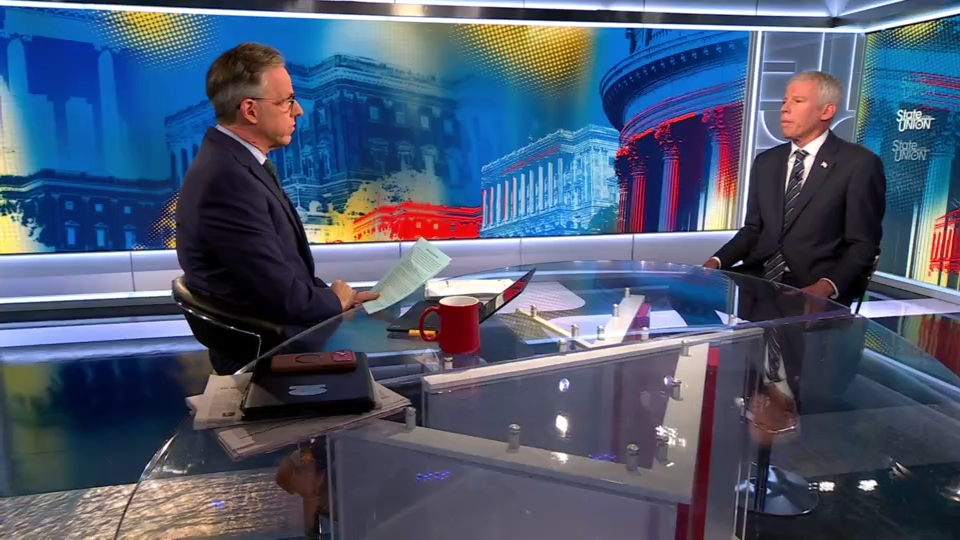
Gas prices may not return to under $3 a gallon until “next year,” US Energy Secretary Chris Wright said today, while not ruling out the possibility the benchmark is reached “later this year.”
“But prices have likely peaked and they’ll start going down. Certainly with a resolution of this conflict … prices across the board on energy prices will go down,” Wright told Jake Tapper on CNN’s “State of the Union.”
Gas prices have surged more than a dollar per gallon for regular unleaded since the conflict with Iran began, driven up mainly by disruptions to global oil flows through the Strait of Hormuz.
Six weeks ago, Wright told Tapper price hikes at the pump would be short lived, saying, “in the worst case, this is a weeks, this is not a months thing.”
Asked about President Donald Trump’s post on social media this morning that said “The United States loses nothing” with the Strait of Hormuz closed, Wright responded, “Putting this 47-year conflict to an end and preventing Iran from getting nuclear weapons, of course, has come with short-term disruption.”
“I think we’ve managed it fantastically, though,” Wright added.
The average cost of a gallon of regular gasoline is $4.05 today, down from a recent peak of $4.17, but much higher than the $2.98 drivers were paying before the US-Israeli conflict with Iran began on February 28.
Trump’s approval at 37% amid dissatisfaction over economy and Iran war, poll finds


President Donald Trump’s approval stands at 37% amid dissatisfaction with his handling of the economy and the war with Iran, according to an NBC News/SurveyMonkey poll of US adults released this morning.
CNN’s Poll of Polls aggregate, including the new poll, currently puts Trump’s approval rating at an average of 38%, similar to readings over the past several months.
In the NBC/SurveyMonkey poll, conducted March 30 to April 13, Trump’s approval rating for handling inflation and the cost of living stands at just 32%, down from about 40% a year ago, with about half of Americans now saying they strongly disapprove of his work on the issue.
The survey finds that 29% of Americans call the economy their top issue, edging out the 24% who choose threats to democracy.
Meanwhile, roughly two-thirds of Americans disapprove of Trump’s handling of the war with Iran, with 54% strongly disapproving. The poll, which was in the field when Trump announced a temporary ceasefire, did not find a significant shift in opinion following the announcement. As the pollsters note, support among self-described supporters of the MAGA movement remains high, with 87% saying they approve of Trump’s handling of the war.
A 61% majority of Americans say the US should take no further military action in Iran, with 16% saying it should continue with airstrikes only and 23% that the US should consider options including the use of ground forces.
The NBC News/SurveyMonkey poll was conducted online from March 30-April 13 and surveyed 32,433 US adults, with a margin of error of plus or minus 1.8 percentage points.