How UNGA Day 3 unfolded
• Netanyahu speaks at UN: Israeli Prime Minister Benjamin Netanyahu lambasted Tehran, dramatically claiming that if he hadn’t attacked Iran, “we’d all be dead.” He also persisted in his bitter feud with New York Mayor Zohran Mamdani, accusing him of antisemitism and distorting facts about Israel. Dozens of people protesting Netanyahu’s policies were detained in the city ahead of the speech.
• Palestinian leader’s speech: Palestinian Authority President Mahmoud Abbas addressed the UN via video after again being denied an entry visa by the Trump administration. He called on global leaders to hold Israel accountable and for the implementation of the stalled 20-point Gaza ceasefire plan.
• US-Iran talks: Meanwhile, Iran presented a proposal to the US outlining the reopening of the Strait of Hormuz and resuming negotiations toward a “final deal,” Iranian Foreign Minister Abbas Araghchi said. Tehran presented the proposal through mediators this week.
Key headlines from Day 3 of the UN General Assembly


Palestinian Authority President Mahmoud Abbas urged the international community to hold Israel accountable and to ensure the viability of the two-state solution in the face of the ongoing Israeli expansion of settlements in the occupied West Bank and the war in Gaza.
The Trump administration banned Abbas from entering the United States for the UNGA, forcing the aging leader to speak virtually from Ramallah in the occupied West Bank.
Catch up on the rest of his remarks from Day 3 of the UNGA:
- On Trump: The Palestinian leader rejected the Trump administration’s entry visa ban as “unlawful punitive measures,” adding that “denying the Palestinian delegation access to the UN headquarters is a violation of the United States’ obligations as the host country.”
- On Palestine: He also said Palestinian people are facing “one of the most dangerous times” in their history after three years of war in Gaza.
- On a ceasefire: Abbas called for implementing the stalled 20-point ceasefire plan brokered under US President Donald Trump. He said the Palestinian Authority had undergone the reform measures required by the plan, but the Trump administration has hardly engaged publicly with the Palestinian Authority.


And if you’re just joining us, here are other headlines from today:
- US-Iran talks: Iran presented a proposal to the US outlining the reopening of the Strait of Hormuz and resuming negotiations toward a “final deal,” Iranian Foreign Minister Abbas Araghchi said. Tehran presented the proposal through mediators this week.
- Russia meets with US envoys: Kirill Dmitriev, the head of the Russian sovereign wealth fund (RDIF) and Kremlin special envoy, met with Trump’s envoys Steve Witkoff and Jared Kushner to discuss US-Russia cooperation and a peaceful resolution to the conflict in Ukraine, according to sources with direct knowledge.
- War in the Middle East: As world leaders gathered this week at the UN General Assembly amid growing concern over conflict in the Middle East and the closure of the Strait of Hormuz, French President Emmanuel Macron said France will deploy defense assets including military personnel to help protect a major Saudi oil export facility damaged in a recent Houthi attack.
- Meanwhile, Abdullah al-Alimi Bawazir, the vice president of Yemen’s internationally recognized government, called for securing the Bab al-Mandeb Strait, the critical waterway located at the mouth of the Red Sea, which is under threat from Houthi forces seeking to control and blockade the shipping lane.
CNN’s Oren Liebermann, Billy Stockwell, Jennifer Hansler, Zahra Ullah, Mitchell McCluskey, Pierre Bairin and Mohammed Tawfeeq contributed reporting.
Climate change "does not recognize borders," says Nepal's PM


Nepal’s Prime Minister Balendra Shah decried the impact the climate crisis has had on his country in an impassioned speech Thursday night, weeks after catastrophic flooding that killed at least 1,400 people in his country and dozens more across the border in China’s Tibetan region, with thousands more still missing.
Late last month, a 2,000-foot-wide mass of rock and glacier ice broke off Langtang Lirung, plunging 7,000 feet into the river below, releasing the same amount of energy as a magnitude 5.2 earthquake. The impact instantly melted ice and unleashed a flood wave that roared more than 20 miles downstream at devastating speed.
More the 5,500 remain missing in Nepal, and at least 500 more on the Chinese side, according to official reports.
Shah underscored that his country “contributes less than 0.1% of global greenhouse emission,” yet is paying a “colossal price” for the severity of the crisis.
Shah went on to highlight that climate change “destroys roads, bridges, schools, homes, farms, and livelihoods.” He added: “It destroys clean energy infrastructure that we need to fuel our future, and and it forces a poor country to borrow money to repair damage it did not cause,” referring to the many hydroelectric plants that were damaged by the flooding.
As the country begins to reckon with the mammoth task of rebuilding, Shah appealed for help from other countries.
He proposed to establish a “Himalay Climate Resilience Mechanism” led by Nepal, India and China, which would share satellite data and expertise, monitor dangerous glacial lakes and strengthen early warning systems.
“When disaster strikes, let us coordinate assistance across borders,” Shah said.
Netanyahu lambasted Iran and attacked Mamdani during UNGA remarks. Catch up here


Israeli Prime Minister Benjamin Netanyahu delivered remarks Thursday at the UN General Assembly as pro-Palestinian protesters marched toward the United Nations headquarters in response.
During his speech, Netanyahu lambasted Iran, accused New York City Mayor Zohran Mamdani of antisemitism and of distorting facts about Israel.
His remarks at the UN come amid protests over his appearance in New York and international condemnation of illegal Israeli settlements in the occupied West Bank, which have accelerated under his government.
Here’s what else Netanyahu said:
- Lambasting Iran: Netanyahu dramatically claimed that if he hadn’t attacked Iran, “We’d all be dead.” The US and Israel launched the opening strikes of the war on Iran in late February, and Israel launched unilateral strikes on Iran during the so-called “12-Day War” in June 2025. He also told the assembly the fall of the Iranian government is “only a matter of time,” predicting that one day the Iranian people “will be free.”
- Diplomats walk out: Netanyahu provoked a polarized reaction as he took to the podium, and a large number of diplomats walked out of the room. Others stood and applauded the Israeli leader. “If there are any other moral cowards who haven’t yet left this hall, please do so now,” Netanyahu said.


- Protesters arrested: Dozens of protesters were detained by the New York Police Department ahead of Netanyahu’s speech. Demonstrators with Jewish Voices for Peace, a human rights organization that advocates for Palestinian rights, gathered to call for an end to Israel’s war. After Netanyahu’s speech, hundreds of protesters also marched through the New York City streets toward the United Nations headquarters.
- Ongoing public feud: Netanyahu also attacked Mamdani and claimed that “since you were elected mayor of this city, many Jews no longer feel safe in New York.” The NYC mayor responded to the accusations in a statement, saying Netanyahu “used his speech to repeat baseless lies meant to sanitize his genocide of Palestinians.”
CNN’s Jeff Winter, Bryan Gingras, Mitchell McCluskey, Tal Shalev, Oren Liebermann and Aditi Sangal contributed reporting.
Iran says it presented new proposal to restart talks with US and re-open Strait of Hormuz


Iran has presented a proposal to the United States that it says would re-open the Strait of Hormuz and restart negotiations toward a “final deal,” Iranian Foreign Minister Abbas Araghchi said Thursday.
The proposal, presented to the US through mediators this week, calls for the US to meet certain conditions within seven days to restart the talks and re-open the strait, Araghchi said. The foreign minister declined to elaborate on the conditions but said that they were “nothing more” than what was included in the Islamabad Memorandum of Understanding.
That agreement, which was reached by the two countries in June, included provisions on sanctions relief; the release of frozen assets; and a cessation of military operations, including in Lebanon.
In response to Araghchi’s comments, a White House official told CNN they are having “positive and constructive discussions through the mediators.”
“The United States is in a very strong position with control of the Strait of Hormuz, so we are not in a rush. Nearly 22 million barrels of oil left the strait last night,” the official said.
The seven-day period for the US to meet the conditions would begin the day after the US agreed to the proposal, Araghchi told a group of journalists and experts on the sidelines of the UN General Assembly.
The foreign minister said they are awaiting a response from the US. He claimed that Tehran is not in a hurry, but said Iran believes it would be better if the US accepted and talks restarted before the US midterms in early November.
This post has been updated with comment from a White House official.
Russian presidential envoy met with Witkoff and Kushner in New York


Kirill Dmitriev, the head of the Russian sovereign wealth fund (RDIF) and Kremlin special envoy, met with US President Donald Trump’s envoys Steve Witkoff and Jared Kushner in New York on Thursday to discuss US-Russia cooperation and a peaceful resolution to the conflict in Ukraine, according to sources with direct knowledge.
The sources said Dmitriev was in New York to continue peacemaking efforts and Russia-US dialogue following a meeting between Russian President Vladimir Putin and the US envoys earlier this month.
On Wednesday, US Secretary of State Marco Rubio and Russian Foreign Minister Sergey Lavrov met on the sidelines of the UN General Assembly.
During this week’s assembly, Trump repeated his belief that the two sides will reach a deal as Russia’s war in Ukraine continues.
Yemen's vice president warns of "false promises" from the Houthis

Abdullah al-Alimi Bawazir, the vice president of Yemen’s internationally recognized government, cautioned world leaders not to be “reassured by false promises” from the Houthi rebels.
He called for securing the Bab al-Mandeb Strait, the critical waterway located at the mouth of the Red Sea, which is under threat from Houthi forces to control and blockade the shipping lane.
“We firmly believe that restoring the Yemeni state and restoring the security of Bab el-Mandeb are inseparable,” al-Alimi said.
He also appealed directly to the people of Yemen, declaring that “our struggle is not against any Yemeni citizen, nor against the sons of any region, governorate, any sect or social group.”
“We seek a safe, stable, prosperous Yemen that safeguards the dignity of its citizens, rebuilds its economy, provides education for its children, jobs for its youth, security for its families,” the vice-president said.
Pro-Palestinian protesters march toward the United Nations headquarters in New York


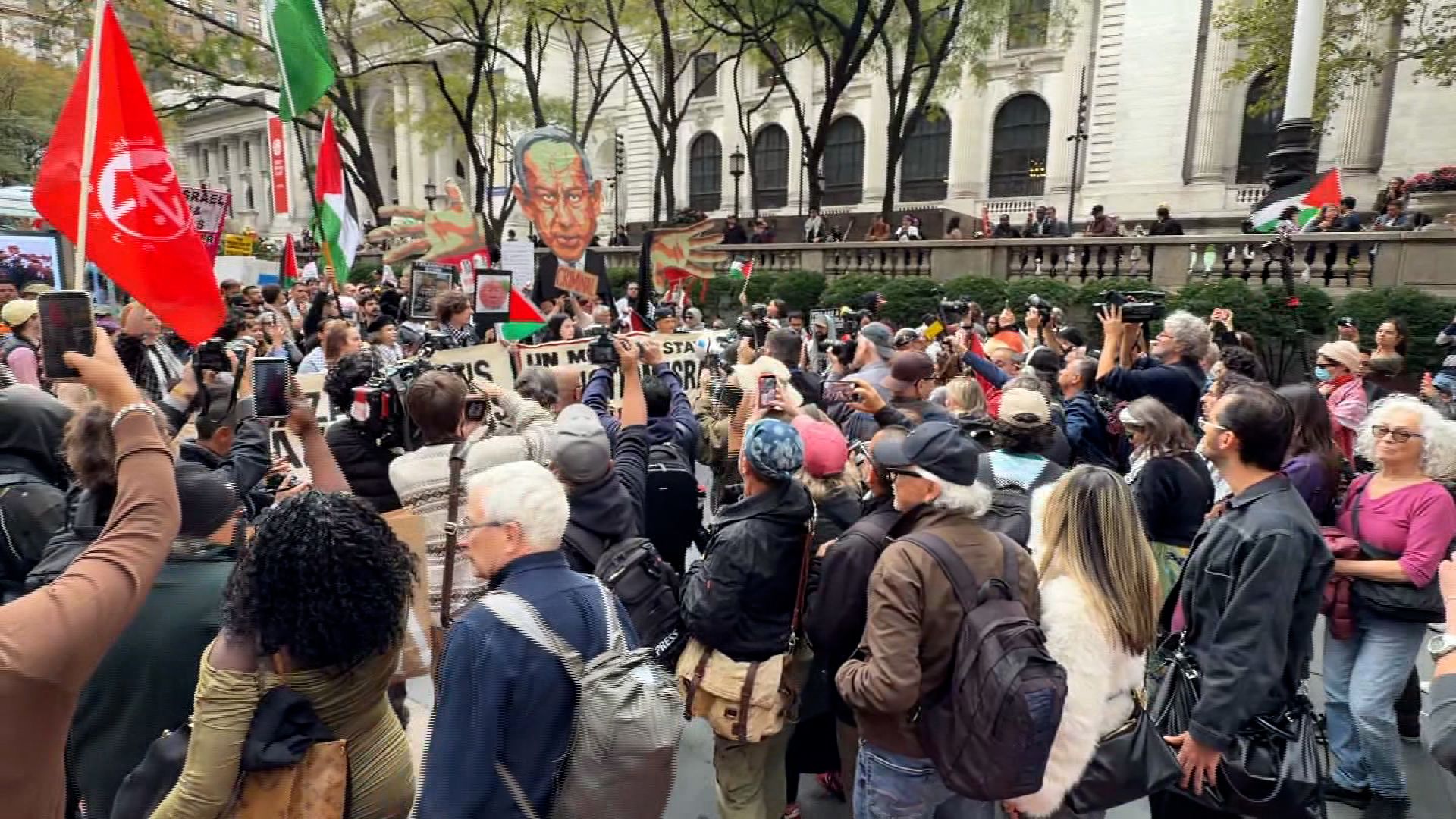
Hundreds of protesters are marching through the streets of New York City toward the United Nations headquarters, after Israeli Prime Minister Benjamin Netanyahu delivered remarks at a General Assembly session today.
Among their chants is, “Free Palestine,” “Gaza,” and “Netanyahu, you can’t hide. We charge you with genocide.”
Protesters were seen waving Palestinian flags, including a few orthodox Jewish men.
France to send defense assets including troops to protect Saudi oil site


As world leaders gather at the UN General Assembly amid growing concern over conflict in the Middle East and the closure of the Strait of Hormuz, French President Emmanuel Macron said France will deploy defense assets including military personnel to help protect a major Saudi oil export facility damaged in a recent Houthi attack.
Speaking in a televised interview with TF1 and France 2 on Thursday, Macron said France had finalized discussions with Saudi Arabia to help secure the Yanbu energy export complex on the Red Sea coast.
Macron said the facility previously handled more than 5 million barrels of oil per day and described protecting regional energy infrastructure as part of a broader effort to prevent disruptions to global fuel supplies.
Macron said he had recently hosted Saudi Crown Prince Mohammed bin Salman, Iraq’s prime minister and leaders from Jordan and Lebanon as part of efforts to secure alternative energy routes and maintain supplies.
France has already increased its military presence in the region, sending Rafale fighter jets to the United Arab Emirates and deploying the nuclear-powered aircraft carrier Charles de Gaulle to the Mediterranean as the conflict expanded across the Middle East.
Mamdani responds to accusations Netanyahu made in his UN speech

New York City Mayor Zohran Mamdani responded to Israeli Prime Minister Benjamin Netanyahu’s UN speech, which included accusations of antisemitism and distorting facts about Israel.
“As he has done time and again, Prime Minister Netanyahu used his speech to repeat baseless lies meant to sanitize his genocide of Palestinians. Yet no lie can change the fact that he remains the subject of an International Criminal Court arrest warrant alleging war crimes and crimes against humanity,” Mamdani said in his statement.
The International Criminal Court issued an arrest warrant for Netanyahu but the United States is not a member of the court and had made clear it will not arrest Netanyahu.
Netanyahu predicts fall of Iran's government and blasts Europe for settlement sanctions


Israeli Prime Minister Benjamin Netanyahu told the UN General Assembly on Thursday that the fall of the Iranian government is “only a matter of time,” predicting that one day the Iranian people “will be free.”
During his address, Netanyahu displayed a Starlink satellite, saying Tehran’s leaders fear technology “that allows people to access truth, to exercise choice, to exercise freedom of thought, and freedom of speech.” He said he would leave the device with the assembly’s president to pass on to the Iranian delegation, which was absent from his speech. Netanyahu has frequently used gimmicks and visual aids during his UN speeches to emphasize a point, often related to Iran.

The Israeli prime minister, facing critical elections next month, also directed sharp criticism towards other international actors.
He accused European countries who recently announced they would impose sanctions on Israeli settlements in the occupied West Bank of succumbing to “antisemitic mobs.” He lashed out at Qatar, alleging it has spent “untold billions to spread lies” about Israel.
Netanyahu also called Turkish President Recep Tayyip Erdoğan a “tyrant” and said that Turkey has become “a super-spreader of antisemitic lies.” He accused Erdoğan of hosting Hamas leaders, jailing journalists and opposition leaders, and occupying northern Cyprus.
Netanyahu attacks Mamdani in running public feud, saying, “Shame on you!”


In an ongoing public feud, Israeli Prime Minister Benjamin Netanyahu attacked New York City Mayor Zohran Mamdani, accusing him of antisemitism and “spitting in the face of truth.”
“Shame on you! Shame on you for distorting the facts,” said Netanyahu. “Shame on you for inverting victim and aggressor. Shame on you for spitting in the face of truth, Mr. Mamdani. Since you were elected mayor of this city, many Jews no longer feel safe in New York. They tell me this isn’t the city we remember.”
Defending Israel’s conduct during three years of war in Gaza, Netanyahu said, “Here’s a simple truth: Israel didn’t commit genocide. Israel prevented genocide, and that’s exactly what Mr. Mamdani’s Hamas buddies would have done to us had we not stopped them.” An independent United Nations inquiry and multiple human rights organizations have accused Israel of genocide against Palestinians during the war in Gaza.
Before leaving for New York, Netanyahu said he would come to the UN to “tell the truth about our heroic soldiers, and I’m going to tell the truth about you.”
Earlier this week, Mamdani doubled down on his criticism of Netanyahu, calling him a war criminal, even as he acknowledged he did not have the authority to arrest the Israeli leader while he is in New York, despite making the promise during his campaign.
Mamdani shares video ahead of Netanyahu speech


Zohran Mamdani posted a video showing the planting of an olive tree at Gracie Mansion along with Palestinian families from Gaza at the mayor’s residence in New York City.
The video, shared on X on Thursday, showed them all sharing a meal afterwards. Olive trees and specifically olive branches are symbols of peace.
This comes amid an escalating feud between Mamdani and Benjamin Netanyahu over the Israeli prime minister’s trip to New York for the United Nations General Assembly.
On Tuesday, Netanyahu released a video on social media accusing Mamdani of supporting Hamas and “inciting riots against New York Jews.” Netanyahu said that he would come to the UN “to tell the truth about our heroic soldiers, and I’m going to tell the truth about you.” Netanyahu has already used Mamdani as part of his electoral campaign on a billboard that said, “They want Netanyahu to lose. Don’t let them win.”
Mamdani has disputed the accusations made in the video, describing Netanyahu as the “architect of a horrific genocide against Palestinians.”
Mamdani had previously doubled down on his criticism of Netanyahu, calling him a war criminal, even as he acknowledged he did not have the authority to arrest the Israeli leader while he is in New York, something he had promised to do during his mayoral campaign.
CNN’s Oren Leibermann, Tal Shalev, Maureen Chowdhury and Gloria Pazmino contributed to this report.
Netanyahu begins his UN speech by lambasting Iran
Israeli Prime Minister Benjamin Netanyahu began his speech at the UN General Assembly by lambasting Iran and dramatically claiming if he hadn’t attacked Iran, “We’d all be dead.”
The US and Israel launched the opening strikes of the war on Iran in late February, and Israel launched unilateral strikes on Iran during the so-called “12-Day War” in June 2025.
Notably, during an incredibly short trip to the UN in which the Israeli leader is not even spending the night, Netanyahu’s schedule does not include meetings with anyone from the Trump administration. Netanyahu last met President Donald Trump in the US in August, but without any press or cameras.
One month before a critical election for Netanyahu, Trump has yet to endorse Israel’s longest-serving leader. But it’s unclear if such an endorsement would help, given how unpopular Trump’s decision to end the war with Iran has been in Israel.
Ahead of his speech at the UN General Assembly, Netanyahu met the leaders of Slovenia and Greece. During his short stay in New York, he is also scheduled to meet the leaders of Panama, Paraguay, Ethiopia, Argentina, Bolivia and Papua New Guinea.
Large number of diplomats walk out as Netanyahu begins address


Israeli Prime Minister Benjamin Netanyahu provoked a polarized reaction as he took to the podium at the UN General Assembly on Thursday.
A large number of diplomats walked out of the room. Others stood and applauded the Israeli leader.
Some chanted “Am Yisrael Chai,” which translates to “The people of Israel live.”
“If there are any other moral cowards who haven’t yet left this hall, please do so now,” Netanyahu said as he began his address.
NOW: Israeli Prime Minister Benjamin Netanyahu is delivering remarks
Israeli Prime Minister Benjamin Netanyahu is now delivering remarks at the UN General Assembly.
Netanyahu’s speech comes amid protests of his appearance in New York and international condemnation of illegal Israeli settlements in the occupied West Bank, which have accelerated under his government.
Hungarian president speaks of new era of governance and relationships

Hungarian President Andras Baka suggested that his government will embrace a new approach to governance and accountability in his remarks to the United Nations General Assembly today.
Noting the new government that formed in Hungary this year, Baka said, “[Hungarians] expected more than a change of government. They expect public life to change, rule of law, a state that serves rather than controls, courts that decide without pressure, a press that challenges power, and public money that is used for public goods.”
Baka’s speech and approach were in stark contrast to that of former Hungarian Prime Miniser Victor Orban, who was in power for 16 years. Orban was ousted this year’s April election, after Prime Minister Peter Magyar’s Tisza party won a two-thirds parliamentary majority.
Baka was elected to the largely ceremonial role in August.
Baka’s speech also broke from Orban’s friendly stance toward Moscow and condemned the Russian invasion of Ukraine. The Hungarian president affirmed “Ukraine’s right to self-defense, its sovereignty, and territorial integrity within its internationally recognized borders, and the right of its people to decide their own future.”
European Council president calls for end to threats against international courts


In a speech calling for multilateralism at the UN General Assembly, European Council President António Costa called for others to follow international law and respect legal institutions.
Costa called for the protection of the institutions that apply international law.
“Threats and attacks on the International Criminal Court and its staff and authorities are unacceptable,” he said.
While Costa did not name the United States, President Donald Trump and his administration have repeatedly targeted the ICC.
During his address at the UN on Tuesday, Trump called for all countries that are members of the ICC to “resign from this rogue institution immediately.”
US Secretary of State Marco Rubio has pledged to “dismantle” the court and has sanctioned top ICC officials.
Protesters taken into custody in Manhattan ahead of Netanyahu's UN speech




Dozens of protesters — including actress Susan Sarandon — were seen being detained by the New York Police Department this afternoon ahead of Israeli Prime Minister Benjamin Netanyahu’s speech at the UN General Assembly.
Demonstrators with Jewish Voices for Peace, a human rights organization that advocates for Palestinian rights, gathered in Midtown Manhattan to call for an end to Israel’s war and to protest Netanyahu’s visit to New York.
The protesters blocked traffic as they chanted “stop the bombs” and “end the killing” while holding banners displaying calls to “stop arming Israel.” The crowd also declared that Netanyahu “can’t hide” and is “wanted for genocide.”

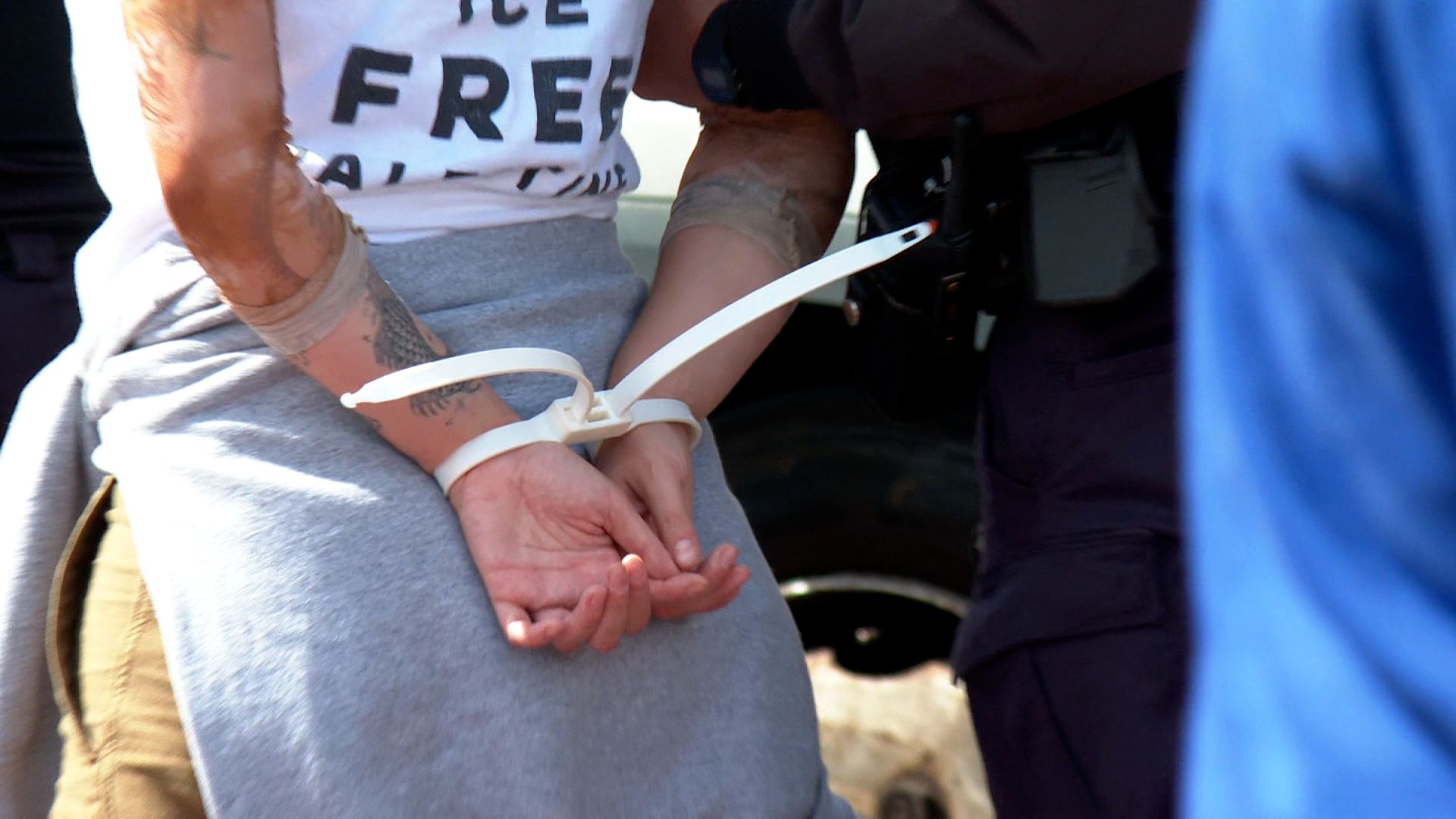
NYPD officers arrived at the scene of the protest after 12 p.m. ET and warned demonstrators to clear the street. Around 30 people remained sitting and standing on the street.
After delivering another warning, officers began detaining protesters at around 1 p.m. Sarandon was among those led to NYPD buses and taken into custody. CNN has reached out to Susan Sarandon’s team.
Actress and political activist Cynthia Nixon was among the participants wearing shirts demanding to “fund people not bombs.” Playwright Tony Kushner, photographer Nan Golden, poet Eileen Myles and Chelsea Manning were also there. Congressional candidate Brad Lander participated in the demonstration as well.
Remember: In 2024, the International Criminal Court issued an arrest warrant for Netanyahu, accusing him and others of committing war crimes following the Hamas October 7 attacks. The prime minister’s office dismissed the warrants as “absurd and antisemitic.”
A 2025 report commissioned by the UN Human Rights Council concluded that Israel committed genocide against Palestinians in Gaza –– findings that were similarly rejected by the Israeli government.


Israel's Benjamin Netanyahu arrives at UN
Israeli Prime Minister Benjamin Netanyahu has arrived at the United Nations where he will deliver an address to the General Assembly later today.
Video on his X account showed him entering the building with his spouse Sara Netanyahu.