Our live coverage has ended
Get the latest updates on the war with Iran here.
Key developments

• Defense hearing: US Defense Secretary Pete Hegseth slammed opposition to the Iran war during a congressional hearing, describing lawmakers who criticize the effort as “the biggest adversary.” The hearing marks the first time he has testified since the conflict began and comes as the White House is seeking roughly $1.5 trillion for its defense budget.
• US blockade: US President Donald Trump and aides met with energy executives yesterday to discuss measures that could be taken to continue the blockade of Iranian ports for months, if needed, and how to limit the effects on consumers. Iran’s oil minister, meanwhile, urged Iranians to cut consumption.
• Peace talks: Pakistan could receive Iran’s revised peace proposal by Friday, sources say, as Trump responded to the current deadlock in peace talks by warning Iran “better get smart soon,” posting a mocked-up image of himself on his Truth Social platform holding a gun.
Hezbollah is breaching ceasefire and "we’re hitting them back,” Netanyahu’s adviser says
In an interview with CNN’s Jim Sciutto, Israeli Prime Minister Benjamin Netanyahu’s foreign policy adviser Ophir Falk blamed Hezbollah for renewed fighting, saying it had repeatedly breached the ceasefire.
“Hezbollah is breaching the ceasefire. That’s not surprising, and we’re hitting them back very hard,” Falk said.
Falk accused the Iran-backed group of targeting Israeli civilians, saying Israel is responding by striking Hezbollah militants.
“Hezbollah … has taken Lebanon hostage for the past decade or so… and they target civilians and we target Hezbollah terrorists. That’s the main difference between us.”
US "studying and reviewing" possibility of reducing troops in Germany, Trump says

President Donald Trump said that the United States is reviewing the possibility of reducing the number of troops in Germany, a day after saying German Chancellor Friedrich Merz “doesn’t know what he’s talking about” on Iran.
“The United States is studying and reviewing the possible reduction of Troops in Germany, with a determination to be made over the next short period of time,” Trump wrote on Truth Social on Wednesday.
Merz had said earlier this week that the United States was “being humiliated” by Iran. On Wednesday, before Trump’s latest Truth Social post, the chancellor said his relationship with the American president remains “good.”
Trump has scorned European allies and the NATO alliance for what he sees as insufficient help in the US-Israeli war against Iran. Germany is home to Ramstein Air Base, which is the headquarters for US Air Forces in Europe — including the unit that does “airlift, airdrop and aeromedical evacuation operations” — and a North Atlantic Treaty Organization installation, according to its website.
As Iran tensions mount, Israel’s military intercepts aid flotilla headed to Gaza
While tensions in the Middle East centered on Iran, Israeli forces intercepted an aid flotilla in international waters bound for Gaza.
In a post to X, the Global Sumud Flotilla said military speedboats self-identified as “Israel” approached it, with personnel on the speedboats pointing assault weapons at the flotilla members, telling them to move to the front of the vessel.
“Israeli military boats have illegally surrounded the flotilla in international waters and threatened kidnapping and violence,” the flotilla said in another X post.
Flotilla spokesperson Gur Tsabar told CNN there had been no confirmed detentions so far but that contact with Israeli forces was made at 8:47 p.m. Greece time (1.47 p.m. ET), 671 miles from Israel.
Israel’s Foreign Ministry said on X that it boarded a “PR stunt flotilla” and alleged that it found “condoms and drugs” on board. The flotilla spokesperson called the Israeli claim and accompanying video “misinformation” and said it was not related to the flotilla’s vessels.
A video from the flotilla filmed from inside one of its vessels shows a radio with a voice emanating from it identifying itself as the Israeli navy.
“Please change your course and return to your port of origin,” it says.
Greenpeace confirmed that its affiliated vessel Arctic Sunrise received the radio warning and that contact had been lost with several flotilla vessels after communication channels were jammed.
The flotilla set sail from Barcelona on April 12, as a “carefully structured civilian intervention at a moment of escalating violence and humanitarian crisis,” according to its website.
The Global Sumud Flotilla has made previous attempts to get aid to Gaza. In October of last year, it was intercepted by Israeli forces. On that occasion the navy boarded vessels and detained hundreds including Swedish activist Greta Thunberg.
"Next stop: 140." Iran's Ghalibaf mocks Trump over oil price


Mohammad Bagher Ghalibaf, speaker of Iran’s parliament, mocked US President Donald Trump over rising oil prices and what he described as Washington’s “blockade theory.”
Blaming what he called “junk advice” given to the Trump administration by figures “like (Treasury Secretary Scott) Bessent,” Ghalibaf said on his X account that the US blockade on the Strait of Hormuz had contributed to oil prices rising toward $120 a barrel. (At one point Wednesday, Brent crude was trading at $116 a barrel).
“Next stop: 140,” Ghalibaf said, adding that, “The issue (with the blockade) isn’t the theory, it’s the mindset.”
Ghalibaf also mocked Trump’s suggestion over the weekend that it wouldn’t be long before a build-up of excess oil caused permanent damage to Iran’s energy infrastructure.
“What happens is, that line explodes from within, both mechanically and in the earth,” Trump said Sunday on Fox News. “Something happens where it just explodes. They say they only have about three days left before that happens. And when it explodes, you can never rebuild it the way it was.”
Ghalibaf appeared to reference that interview, saying, “three days in, no well exploded. We could extend to 30 and livestream the well here (on X).”
US commander says 42 ships redirected by naval blockade of Iranian ports

US Central Command chief Adm. Brad Cooper on Wednesday touted the “highly effective” naval blockade against Iran as he announced that US forces have redirected 42 commercial vessels attempting to enter or exit the country’s ports.
“Right now there are 41 tankers with 69 million barrels of oil that the Iranian regime can’t sell,” Cooper said in a statement posted by CENTCOM. “That’s an estimated $6 billion-plus from which Iran’s leadership cannot financially benefit.”
Cooper added, “The blockade is highly effective and U.S. forces remain fully committed to total enforcement.”
Iran’s Ghalibaf urges unity amid divisions, says Trump seeks surrender


Mohammad Bagher Ghalibaf, the speaker of Iran’s parliament, said US President Donald Trump is trying to force Iran to “surrender” by applying economic pressure and exploiting internal divisions, according to remarks circulated by Iranian media outlets.
Ghalibaf, a key negotiator in ceasefire talks with the US and a strategic leader during the war, said Iran’s adversaries were trying to weaken the country from within through what he described as “siege tactics and media manipulation.”
He called on the public to maintain unity, arguing it is the main way to counter what he termed a new enemy “conspiracy.”
“Every divisive action is part of the enemy’s plan,” Ghalibaf said, adding that Iranian officials are “all followers of the supreme leader’s orders.”
He did not elaborate on the divisions. However, according to unofficial Iranian media outlets, a joint parliamentary statement signed on April 27 and backed by around 261 of 290 lawmakers expressed support for Iran’s negotiating team, including Ghalibaf.
The move was presented as a collective declaration of political support and unity rather than a formal parliamentary vote, local media outlets reported.
In recent days, there have been repeated calls for unity from various officials, including the president, members of parliament and Friday prayer imams, urging people to avoid criticizing one another.
Vance acknowledges concerns over US readiness amid Iran war

Vice President JD Vance said Wednesday that he is closely monitoring US military readiness, dismissing a report in The Atlantic that suggested he had raised concerns about missile depletion amid the war with Iran.
Vance said during an interview on Fox News’ “The Will Cain Show” that he reviewed the article because it attributed comments to the vice president that he is “100% certain” he never made, adding that much of the reporting relied on unnamed sources.
“What I feel confident about … is that nobody who actually knows what I think, nobody who’s close to me was speaking to that reporter,” Vance said, arguing the story would have been “totally different” if it had relied on people familiar with his views.
Pressed on whether he has concerns about US readiness, Vance acknowledged that it is part of his role to stay vigilant.
“Of course I’m concerned about our readiness, because that’s my job,” the vice president said.
At the same time, Vance expressed confidence in the administration’s national security leadership, pointing to Defense Secretary Pete Hegseth and Joint Chiefs Chairman General Dan Caine, saying they are doing “an amazing job.”
Vance went on to say that he and President Donald Trump remain focused on ensuring the military is prepared, while cautioning viewers against taking every report at face value.
“We’ve got a great military,” Vance said, “so don’t believe everything you read.”
Iranian oil minister urges energy conservation amid US naval blockade

Iranian Oil Minister Mohsen Paknejad urged the public to cut consumption, calling “conservation and saving” a general principle “and a religious duty,” as he dismissed the impact of the US naval blockade.
“The enemy will achieve nothing through a naval blockade of Iran,” Paknejad said, according to Iranian official media on Wednesday.
He said there was “no worry” about the steady supply and distribution of fuel, adding that oil industry personnel are working around the clock to prevent any disruption in services.
“We saw during the war that many countries resorted to managing and reducing consumption due to fuel shortages,” Paknejad added.
The Iranian government has already started taking measures to avoid possible shortages of fuel and goods. Last week it launched a broad energy-conservation campaign amid the blockade, Iranian media outlets reported.
Government offices across Iran have been instructed to cut electricity use by up to 70% after 1 p.m., while households are being encouraged to reduce consumption with incentives such as discounts on electricity bills for those who lower their usage.
Disruption to shipping, and therefore imports, has also hurt Iran’s already fragile economy, “placing 50% of Iranian jobs at risk and pushing an additional 5% of the population into poverty,” according to Hadi Kahalzadeh at the Quincy Institute, a foreign policy think tank.
Iran’s economy was in dire straits before the conflict. Income per person fell from about $8,000 in 2012 to $5,000 in 2024, hit by inflation, corruption and sanctions.
Trump says negotiations to end war with Iran are happening “telephonically”


President Donald Trump said Wednesday that negotiations to end the war with Iran are happening “telephonically,” lamenting the long travel required to send a delegation to Islamabad as talks have yet to bring an end to hostilities.
“We have talks, we’re having talks with them now, and we’re not flying anymore with 18-hour flights every time we want to see a piece of paper,” the president said in remarks from the Oval Office.
“We’re doing it telephonically, and it’s very nice. I make a call, or I have my people make a call, and you know the answer in 15 — I always like face to face, you know, I consider it better,” he continued. “But when you have to fly 18 hours every time you want to have a meeting, and you know what the meeting is all about, and you know they’re going to give you a piece of paper that you don’t like before you even leave, it’s ridiculous, and they’ve come a long way.”
Pakistan could receive Iran’s revised peace proposal by Friday, sources say. Trump has responded to the current deadlock in peace talks by warning Iran “better get smart soon,” posting a mocked-up image of himself on his Truth Social platform Wednesday morning holding a gun.
“The question is whether or not they’re going to go far enough, so at this moment, there will never be a deal unless they agree that there will be no nuclear weapons,” Trump added from the Oval Office.
Trump tells CNN Iran and Ukraine wars could end “on a similar timetable”

President Donald Trump told CNN Wednesday that wars in Iran and Ukraine could end “on a similar timetable,” following a conversation he had with Russian president Vladimir Putin.
“I think Ukraine, militarily, they’re defeated,” Trump said, appearing to misspeak when he meant to refer to Iran.
“You wouldn’t know that by reading the fake news, but militarily, maybe look, there are 159 ships – every ship is right now under water, typically, that’s pretty good… it’d be hard for them to make a naval comeback now,” he continued. “Do you think they’re doing well, where they have no navy, no air force, no anti-aircraft apparatus?”
Trump had previously forecast the Iran war, which the US launched on Feb. 28, to last four to six weeks. The Ukraine war has been underway since 2022, and there is no end in sight.
Earlier in the remarks, Trump said he talked “a little bit about Iran” with the Russian president, but Thursday’s call was mostly “about Ukraine.”
“I think we’re going to come up with a solution relatively quickly,” he said. ”I hope, I think, we’d like to see a solution that’s good.”
Trump says Putin offered to help with Iran's uranium stockpiles in phone call

President Donald Trump says his Russian counterpart Vladimir Putin offered to assist in the war with Iran during a telephone call Wednesday, specifically in relation to enriched uranium.
“He would like to be of help. I said, before you help me, I want to end your war,” Trump told CNN’s Kaitlan Collins in the Oval Office.
Earlier, Trump said the conversation with Putin was “very good,” and that a solution to the conflict in Ukraine would come “relatively quickly.”
“He told me he’d like to be involved with the enrichment. He can help us get it,” Trump said.
Moscow has previously proposed taking control of Iran’s stockpile of enriched uranium, mirroring its role in the 2015 Joint Comprehensive Plan of Action.
Trump on Wednesday did not explicitly rule out Iran shipping its uranium to Russia, but suggested he was more interested in resolving the Ukraine war.
“I’ve known him a long time. I think he was ready to make a deal a while ago,” he said of Putin. “I think some people made it difficult for him to make a deal.”
Hegseth defends protections for US troops while pressed on attack that killed six soldiers


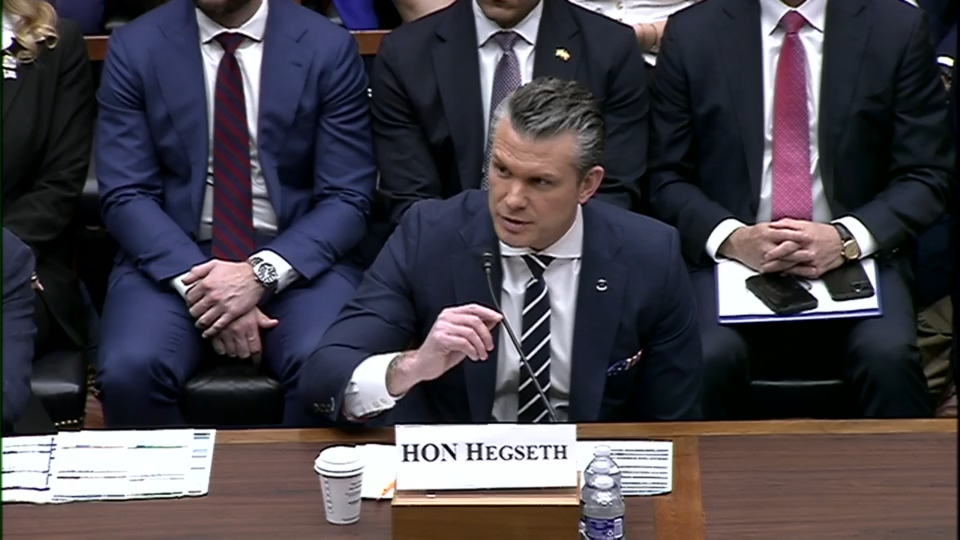
US Defense Secretary Pete Hegseth claimed today that the military put in “maximum defensive posture” capabilities in the Middle East before the war with Iran began in late February, but declined to specifically comment on the defenses in Kuwait where six US soldiers were killed in an Iranian drone attack.
Democratic Rep. Patrick Ryan pressed Hegseth on what defenses existed at the Shuaiba port in Kuwait where six Army Reserve soldiers were killed on March 1 in a strike on a makeshift operations center. CNN has previously reported that the operations center was not fortified against aerial threats like drones or missiles.
Patrick read reporting from CBS News in which survivors of the attack said there was not proper air defense at the position in Kuwait despite requests.
“Secretary Hegseth, that is obviously in direct contradiction to what you said from the Pentagon podium the next day. So are you saying that these soldiers, our soldiers, who survived this horrific attack, are lying?” Patrick said.
“What I’m saying is before the commencement of the conflict, we put in maximum defensive posture we could, we moved … 7,500 troops off of the X based on the intel,” Hegseth said.
“There’s a much larger picture at play here that included integrated air defenses, bunkers, moving people off the X to ensure they were not part of the target,” Hegseth continued. “We moved those troops and all across the theater, thousands of troops off the X, off of their bases because we knew what Iran was going to try to strike, we knew there could be a tragic moment where something could get through. Of course, that’s the consequence of conflict.”
Hegseth, when pressed later by Democratic Rep. Chris Deluzio about Pentagon officials’ statements dismissing claims that the port in Kuwait hadn’t been adequately defended, described the line of questioning as “disparaging.”
“I’m not calling our troops liars, and I don’t know if what you’re representing is correct or not,” he said. “I’ll take you at your word on that, but all I know is that we took every effort possible at the commencement of this campaign to ensure the defense of our troops.”
"On the front lines, we are not ceasing fire," Israel's military chief says in Lebanon


During a visit to southern Lebanon, Israel’s military chief Eyal Zamir told troops they are to continue operating on the “front lines,” as Israel continues to trade attacks with Hezbollah.
Zamir said that for now, the military would not go beyond what Israel calls the “Forward Defense Line” – an Israeli-occupied zone in southern Lebanon. But he stressed that threats to Israeli troops, even beyond the so-called Forward Defense Line and the Litani River, would be eliminated.
Under a previous ceasefire, the Litani River, just a few kilometers from Israel’s northern border, was intended to be a demarcation line – north of which Hezbollah would withdraw its fighters to, creating a de-facto buffer zone with Israel.
The Israeli military is currently holding positions up to 10 kilometers (6.2 miles) deep in Lebanon, an Israeli military official told CNN last month. Some government ministers have said they want to go even deeper, with declarations of plans to control territory all the way up to the Litani River.
Israel has reiterated that its troops would remain in southern Lebanon to combat threats to its troops and residents across the border in northern Israel
Putin and Trump discuss Iran ceasefire in 1.5 hour call, Kremlin says

Russian President Vladimir Putin and US President Donald Trump discussed the ongoing ceasefire with Iran, among other topics, in a 1.5 hour call today, according to Kremlin spokesperson Yury Ushakov.
Russia initiated the call, which was “frank and businesslike” in tone, Ushakov told reporters Wednesday.
Putin and Trump also discussed the war in Ukraine, with Putin raising the possibility of a ceasefire to coincide with Victory Day on May 9, when Russia celebrates the Soviet Union’s victory over Nazi Germany in World War II.
This post has been updated with additional details about the call between Putin and Trump.
US has spent $25 billion on Iran war, defense official says



The US military has spent roughly $25 billion on the war with Iran since it began in late February, the Pentagon’s top financial officer told lawmakers on Wednesday.
Most of that spending is on munitions, but some of it is on maintenance and replacing equipment, Jules “Jay” Hurst told the House Armed Services Committee.
The precise cost of the war has eluded lawmakers and has increasingly become a political issue as Congress considers President Donald Trump’s $1.5 trillion defense budget request for fiscal 2027.
“I’m glad you answered that question, because we’ve been asking for a hell of a long time, and no one’s given us the number,” Rep. Adam Smith, the top Democrat on the committee, said in response to Hurst.
Democratic Rep. Ro Khanna grilled Defense Secretary Pete Hegseth on that price tag, telling him that experts disagree with the Pentagon’s figure. The congressman also made the case that the war is increasing food and gas prices for Americans.
“I would simply ask you what the cost is of an Iranian nuclear bomb,” Hegseth responded.
Khanna also asked Hegseth how much tax payer money was spent on the strike on an elementary school in Iran in the early days of the war, to which the secretary said “that unfortunate situation” is under investigation. “But I wouldn’t tie a cost to that,” he added.
Hegseth told Khanna that any supplemental funding request for the war with Iran specifically would be less than $25 billion, “but there’s a lot more we would ask for beyond just Iran.”
Thirteen US service members have been killed to date in the war, which is currently subject to a fragile ceasefire.
Democrat congressman argues with Hegseth over success of US blockade

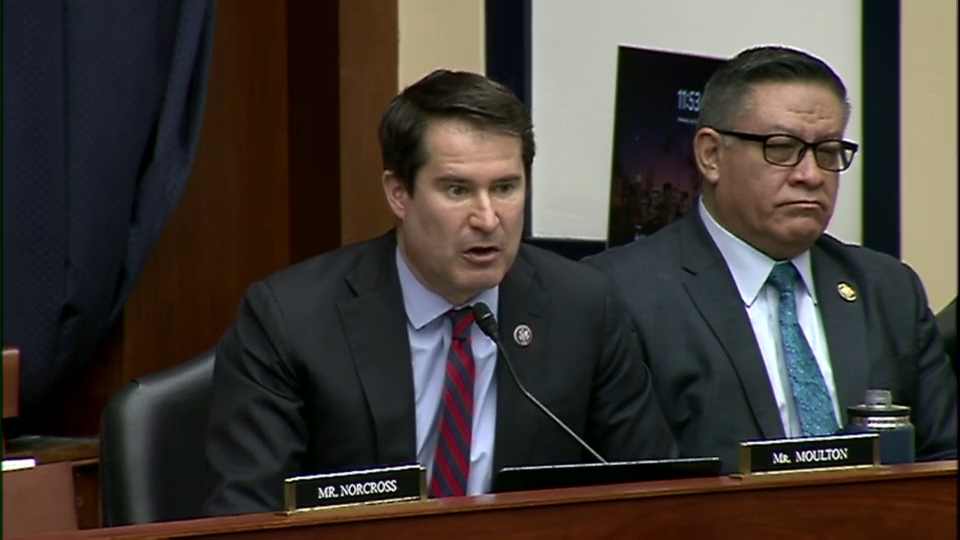
Democratic Rep. Seth Moulton and Defense Secretary Pete Hegesth – both veterans, and critics, of the Iraq War – sparred over whether the US blockade of Iranian ports is anything to claim victory over.
“How is this war going? Do you think we’re winning?” Moulton asked Hegseth at the House Armed Services Committee hearing.
“Militarily, on the battlefield? It’s been an astounding military success,” Hegseth replied. “Absolutely.”
“Do you call Iran closing the Strait of Hormuz winning?” Moulton countered.
Hegseth began to describe the US naval blockade, but Moulton cut him off with a reference to the War of 1812, when the British military set fire to parts of the US capital.
Moulton: “They blockaded us and then we blockaded their blockade. That’s like saying, ‘Tag, you’re it.’ Or, you know, if President Madison had said, ‘Well, the British just burned down Washington, but don’t worry, we’re going to burn it down as well.’”
Trump says he won't lift blockade until Iran negotiates on nuclear program


US President Donald Trump said Wednesday that he has rejected the Iranian proposal of lifting the US blockade and opening the Strait of Hormuz.
He first wants some guarantees on curbing the Iranian nuclear program, telling Axios in a phone interview that “they can’t have a nuclear weapon.”
“The blockade is somewhat more effective than the bombing. They are choking like a stuffed pig. And it is going to be worse for them. They can’t have a nuclear weapon,” Trump added.
While Trump praised the efficacy of the blockade, he would not discuss potential military plans during the interview.
“They want to settle. They don’t want me to keep the blockade. I don’t want to [lift the blockade], because I don’t want them to have a nuclear weapon,” he said.
"Who you cheering for here?" Hegseth rejects claim that Iran war is a "quagmire"

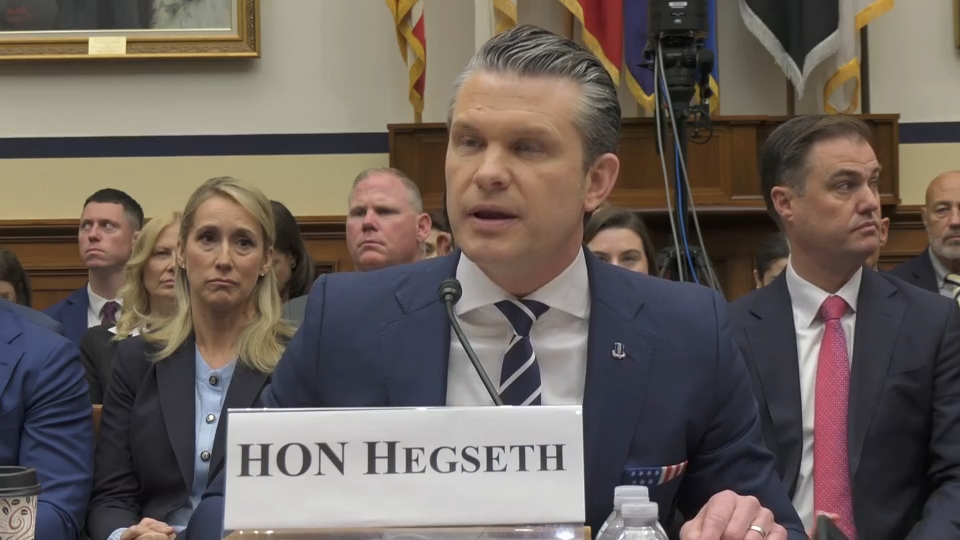
US Defense Secretary Pete Hegseth offered a fiery defense of the war with Iran after a lawmaker called the conflict a “quagmire” that the country is “stuck in.”
“My generation served in a quagmire in Iraq and Afghanistan. Years and years of, of nebulous missions and utopian nation-building that led us to nothing,” Hegseth said in response to Democratic Rep. John Garamendi.
The secretary went on to accuse the congressman of “stain(ing) the troops,” though Garamendi, at the top of his remarks, thanked US service members “for their bravery.”
Garamendi also accused Hegseth and President Donald Trump of “lying to the American public about this war from day one.”
The UAE was “chained” by OPEC, expert tells CNN

The United Arab Emirates has been “chained” by OPEC and forced to stick to quotas that “don’t make sense for its economic strategy,” an Emirati expert said.
In an interview with CNN’s Becky Anderson, Tareq Alotaiba, a fellow in the Middle East Initiative at Harvard University’s Belfer Center, said that the Persian Gulf state has evolved economically beyond its need for the Organization of the Petroleum Exporting Countries, or OPEC, from which Abu Dhabi has announced it will withdraw.
This also includes OPEC+, a larger group that consists of other oil producers such as Russia.
Alotaiba said that the UAE’s decision to leave OPEC would give it “flexibility” to not only meet demands of customers but also to set its strategy in terms of exports.
Abu Dhabi’s national oil company, ADNOC, has previously announced it plans to raise oil production capacity to 5 million barrels per day by 2027. The OPEC quota is around 3.4 million barrels.
When asked whether the UAE’s decision could weaken OPEC or affect the country’s relationship with other gulf countries in the group, Alotaiba said that gulf states were resilient in resolving disagreements.
He added that the UAE’s shift toward Western allies “makes sense,” given its integration into complex economies in the West and its Western allies’ support during Iran’s attacks on the country.
The UAE has done a “cost benefit analysis,” Alotaiba said, and “OPEC lost out.”