Our live coverage has ended
• Follow the latest updates on the war with Iran here.
What we know so far
• High-stakes talks: Iranian officials have arrived in Pakistan for Saturday’s closely watched negotiations with the US. President Donald Trump has warned that he’ll renew and intensify US strikes if a peace deal can’t be reached, and Pakistan’s prime minister described this weekend as a “make-or-break moment.”
• Conflict in Lebanon: Fighting between Israel and Iran-backed Hezbollah has threatened to derail peace efforts. Lebanese and Israeli diplomats spoke today and will meet in the US on Tuesday. Iran’s parliament speaker said earlier that negotiations with the US are contingent on a ceasefire in Lebanon.
• Economic impact: Few vessels carrying oil and other critical shipments are traveling through the Strait of Hormuz, despite the ceasefire. Iran’s chokehold on global oil supply has driven major consumer price hikes in the US and sent ripple effects around the world.
Iran's delegation in Pakistan has 71 people, including technical experts, says state media

Iran’s delegation in Islamabad is made up of 71 people, including negotiators, experts, media representatives and security, state media Tasnim reported on Saturday.
Mohammad Bagher Ghalibaf, Iran’s parliament speaker, is leading the delegation, which also includes Foreign Minister Abbas Araghchi, Tasnim reported.
“Given the complexity and high sensitivity of the negotiations between Iran and the United States, the Iranian delegation includes not only the main negotiators but also technical and expert committees for necessary consultations,” the report said.
The Trump administration’s 15-point proposal, which has not been revealed in full, is said to include Iran committing to no nuclear weapons, handing over its highly enriched uranium, limits on Tehran’s defense capabilities, and the reopening of the Strait of Hormuz.
The US delegation will be led by Vice President JD Vance, special envoy Steve Witkoff, and Jared Kushner, President Donald Trump’s son in law.
Gen Z Trump voters on the war with Iran
CNN met with conservative students at the University of Texas Rio Grande Valley, in Edinburg, Texas, before the ceasefire deal in Iran was brokered. Here’s what they think about the war.

CNN met with conservative students at the University of Texas Rio Grande Valley, in Edinburg, Texas, before the ceasefire deal in Iran was brokered. Here’s what they think about the war.

Iran FM greets officials with handshake, smile in Islamabad, according to Iran media

Footage released by semi-official Mehr News Agency shows Iranian foreign minister Abbas Araghchi arriving at an unnamed location in Islamabad, where he steps out of his car with a smile and greets officials with a handshake.
Araghchi then walked a red carpet flanked by onlookers and an Iranian flag, where he was presented with a bouquet of flowers, according to the footage published at around 5.30 a.m. local time.

Images published separately on Araghchi’s Telegram account showed Araghchi standing on the delegation plane next to what the captions said were the school bags and photos of children killed in a US military strike on an elementary school in Minab on the first day of the war.
That strike killed at least 168 children and 14 teachers according to Iranian state media.
The strike was deemed accidental and likely due to outdated information about a nearby naval base, according to two sources briefed on the preliminary findings of an ongoing US military investigation into the incident.
Ahead of talks with US, Iranian negotiator says "we have goodwill, but we do not trust"

As he arrived at the Islamabad airport for talks with the United States, Iran’s top negotiator said that his delegation has hope but does not trust its American counterparts.
“We have goodwill, but we do not trust,” Mohammad Bagher Ghalibaf, the country’s parliament speaker, told Iran’s state media.
Ghalibaf said if the US is “ready for a genuine agreement,” then Iran could be as well.
“Unfortunately, our experience of negotiating with the Americans has always ended in failure and violations of commitments,” he added.
The war with Iran is costing Americans
Consumer prices spiked last month and inflation in the United States is higher than any other time under President Donald Trump. CNN’s Matt Egan explains how the Middle East conflict is costing Americans.

Consumer prices spiked last month and inflation in the United States is higher than any other time under President Donald Trump. CNN’s Matt Egan explains how the Middle East conflict is costing Americans.

Here’s what you should know ahead of this weekend’s critical US-Iran peace talks

The Iranian delegation, led by Parliament Speaker Mohammad Bagher Ghalibaf, has landed in Islamabad, Pakistan, for high-stakes weekend peace talks with the US.
Ghalibaf is accompanied by Foreign Minister Abbas Araghchi and other top officials from Tehran. Video showed the delegation making their way down the steps from an aircraft and being received by several Pakistani officials.
Pakistan’s prime minister has described Saturday’s talks between the US and Iran as a “make-or-break moment.”
Catch up on other news here:
- More on the meetings: The high-stakes negotiations are expected to be both indirect and direct, a US official and a regional source told CNN. According to the regional source, the two sides are likely to agree on the agenda for the talks through Pakistani mediators. Then they are expected to move to face-to-face discussions later in the day. Advocates for US citizens detained in Iran say they are hopeful the detainees’ cases will be raised in the negotiations.
- Trump’s comments: US President Donald Trump said US negotiators — who are currently headed to Pakistan — are primarily focused on ensuring Tehran cannot obtain a nuclear weapon. The president also claimed that the Strait of Hormuz will reopen soon — with or without Iran’s cooperation. And earlier Friday, Trump warned that he’ll renew and intensify US strikes if a peace deal can’t be reached.
- Lebanon talks: Lebanese and Israeli diplomats spoke by phone Friday and are planning to meet next week to discuss a potential ceasefire in the ongoing Israel-Hezbollah conflict, the office of Lebanese President Joseph Aoun said. Israeli Ambassador Yechiel Leiter confirmed the plans to meet in Washington, DC, on Tuesday, but said that “Israel refused to discuss a ceasefire with the Hezbollah terrorist organization.”
- Hezbollah statement: For its part, the Iran-backed paramilitary group urged the Lebanese government to refrain from direct negotiations with Israel after the death of 13 Lebanese security personnel in Nabatiyeh on Friday.
- US personnel targeted: Personnel from the US Embassy in Baghdad came under multiple drone attacks by an Iraqi militia on Wednesday, a State Department official said Friday. The official did not specify which militia was deemed to be responsible for the attack. They noted that “all personnel are safe and accounted for.”
CNN’s Mitchell McCluskey, Sophia Saifi, Jennifer Hansler, Sophia Saifi, Max Saltman, Eyad Kourdi and Tamara Qiblawi contributed reporting.
Trump says focus of Iran deal is nukes and that Strait of Hormuz will reopen "automatically"


President Donald Trump said today that the Strait of Hormuz will reopen soon — with or without Iran’s cooperation — and that US negotiators currently headed to Pakistan are primarily focused on ensuring Tehran cannot obtain a nuclear weapon.
“I think it’s going to go pretty quickly. And if it doesn’t, we’ll be able to finish it off one way the other,” Trump said of efforts to ensure free passage through the strait, which Iran has choked off.
Speaking at Joint Base Andrews before a fundraising visit to the Trump Winery in the Piedmont region of Virginia, the president said his main focus in a deal with Iran was curtailing the country’s nuclear capabilities.
“No nuclear weapon. That’s 99% of it,” he said.
Asked if the deal would also include the strait, Trump said it would.
“Yeah, but that will open up automatically,” he replied, adding later he believed the channel would be open “fairly soon.”
Vice President JD Vance is jetting to Pakistan to lead the US delegation in talks with Iran. Trump said of Vance Friday afternoon: “I wish him luck. He’s got a big thing.”
Saturday negotiations expected to include both mediators and direct talks, sources say


Saturday’s high-stakes negotiations in Islamabad between the United States and Iran are expected to be both indirect and direct, a US official and a regional source told CNN today.
According to the regional source, the two sides are likely to agree on the agenda for the talks through Pakistani mediators and then are expected to move to face-to-face discussions later in the day.
Past rounds of talks have largely been indirect, through Omani mediators, although there were some direct contacts during nuclear negotiations last spring. Special envoy Steve Witkoff, a member of the US negotiating team, has also had direct contact with Iranian Foreign Minister Abbas Araghchi, who will be in Pakistan for the Iranian delegation.
Israeli and Lebanese diplomats spoke today and will meet in DC next week, officials say


Lebanese and Israeli diplomats spoke by phone Friday and are planning to meet next week to discuss a ceasefire, the office of Lebanese President Joseph Aoun said in a social media post.
In a call mediated by US Ambassador to Lebanon Michael Issa, Israeli Ambassador Yechiel Leiter and Lebanese Ambassador Nada Hamadeh Moawad agreed to meet at the US State Department in Washington next Tuesday “to discuss the declaration of a ceasefire and the date for the start of negotiations between Lebanon and Israel under US sponsorship,” the post reads.
Leiter issued a statement Friday confirming the Tuesday meeting, but said that “Israel refused to discuss a ceasefire with the Hezbollah terrorist organization.”
CNN previously reported that the three countries’ ambassadors would hold talks in Washington today aimed at securing future negotiations.
Lebanon had earlier maintained that it will not negotiate without a ceasefire, and Israel has rejected the notion of ending hostilities with Hezbollah as a condition for talks.
On Friday, Hezbollah urged the Lebanese government to refrain from negotiating with Israel after days of intense bombardment; the days after Wednesday’s ceasefire between the US and Iran have been the deadliest in Lebanon since September 2024, with over 350 dead and more than 1,200 injured.
Advocates hopeful cases of US citizens detained in Iran will be raised in negotiations
Advocates for US citizens detained in Iran said Friday that they are hopeful their cases will be raised in US-Iran negotiations that begin on Saturday.
Kamran Hekmati and Reza Valizedeh have both been detained in Iran for more than a year, believed to be held in Tehran’s notorious Evin Prison. There are mounting concerns about their health and well-being. Both have been designated as wrongfully detained by the US State Department.
Family advocates said they have received assurances that the negotiating team, led by Vice President JD Vance, special envoy Steve Witkoff and Jared Kushner, is aware of the detained Americans and that they will raise their status during upcoming negotiations.
Another source familiar with the matter said their names have been conveyed in the past to the negotiating team, but they could not say whether they will definitely be raised in the talks on Saturday.
Valizadeh, an Iranian-American journalist, had worked in exile for Persian language outlets, including the US-funded Radio Farda. He returned to Iran in March 2024 to visit his elderly parents and was arrested in September of that year.
Hekmati was arrested last year and sentenced to prison time by Iranian authorities for visiting Israel more than a decade ago for his son’s bar mitzvah, according to family members who spoke to CNN.
Before the start of the US-Israeli war against Iran, the Trump administration designated Iran as a state sponsor of wrongful detention.
In remarks in early March, US Secretary of State Marco Rubio condemned Iran as “the worst offenders in the world of hostage-taking.”
Iranian delegation arrives in Pakistan for talks with US


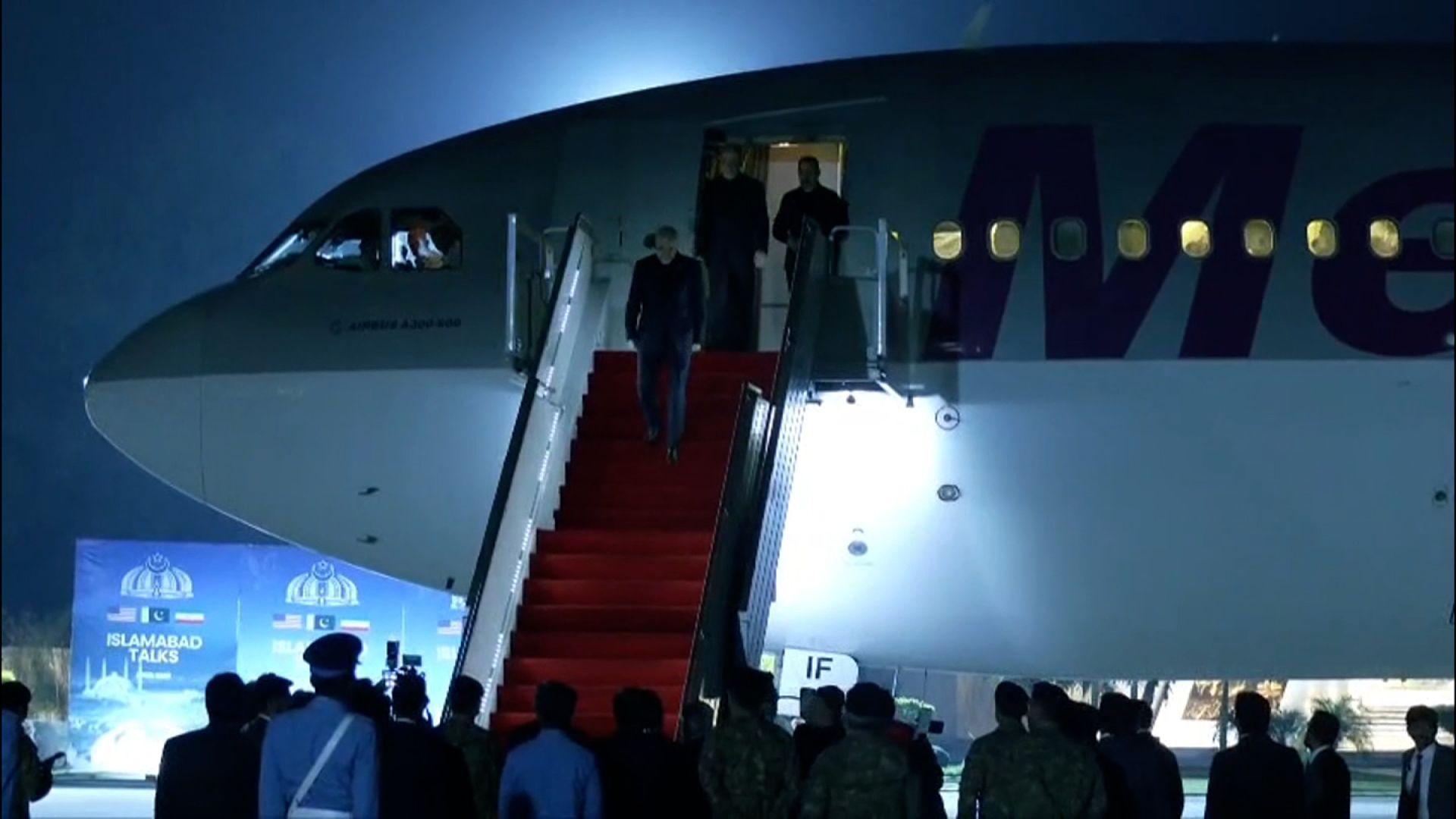
The Iranian delegation, led by Parliament Speaker Mohammad Bagher Ghalibaf, has landed in Islamabad, Pakistan, for talks with the US, Iran’s semi-official Fars News Agency reported.
Ghalibaf is accompanied by Foreign Minister Abbas Araghchi, Supreme National Security Council Secretary Ali Akbar Ahmadian, Central Bank Governor Abdolnaser Hemmati, as well as some members of parliament, Fars reported.
Fars noted that Tehran had accepted the terms of the two-week ceasefire but that if hostilities resume, they “will once again set US interests in the region and the Israeli regime on fire.”
The Iranian delegation was received by several Pakistani officials in Islamabad, including Foreign Minister Ishaq Dar, the foreign ministry said in a statement.
The ministry expressed “hope that parties would engage constructively” and advocated for reaching a “lasting and durable solution to the conflict,” the statement continued.
Roar of fighter jets over Islamabad as city awaits Iranian delegation


The night sky over Pakistan’s capital thundered with the rumble of fighter jets as we waited for the arrival of Iran’s delegation to ceasefire talks with the US.
Data from flight tracking website Flightradar24 showed a pair of passenger aircraft that left Iran earlier today descending into Islamabad.
The tracking data shows the pair of aircraft landed at Nur Khan Airbase in Rawalpindi, the landing strip just outside Islamabad reserved for VIP visits and state delegations – raising the possibility that the roar above had been a ceremonial air escort provided by Pakistan’s military.
Semi-official news agency Fars reported that the Iranian delegation has arrived in Islamabad, though neither Pakistan nor the US has confirmed that.
Hezbollah urges Lebanese government to refuse negotiations with Israel


Hezbollah is urging the Lebanese government to refrain from direct negotiations with Israel after the death of 13 Lebanese security personnel in Nabatiyeh on Friday.
Israeli Prime Minister Benjamin Netanyahu said Thursday that Lebanon had issued “repeated” requests for negotiations. Netanyahu added that he had instructed his cabinet to begin “direct” talks with Lebanon aimed at disarming Hezbollah and establishing peaceful relations with Israel “as soon as possible.”
Meanwhile, a Lebanese official told CNN that there would be “no negotiations under fire” and that they had not been officially notified of any talks.
The first days of the ceasefire with Iran were the deadliest seen in Lebanon since September 2024, with at least 357 dead and at least 1,223 injured in Israeli strikes, according to the Lebanese Ministry of Health.
Pakistan's prime minister says "this is a make-or-break moment" as US-Iran talks loom

As Pakistani-brokered talks between Iran and the US loom in Islamabad, Pakistan’s Prime Minister Shehbaz Sharif addressed his country in a televised address on Friday.
“This is a make-or-break moment,” Sharif said. “I ask all of you to pray that these talks are successful and countless lives are saved and the world shall see peace.”
Sharif praised Pakistani army chief Field Marshal Asim Munir, a close ally of US President Donald Trump, and Foreign Minister Ishaq Dar for putting “out the flames of war.”
The prime minister added that tomorrow, “God willing,” leadership from both the US and Iran will be present in Pakistan for negotiations.
“The Pakistani leadership will make sure these talks are successful by putting in their best efforts,” Sharif said. “It is all in God’s hands.”
This morning, US Vice President JD Vance boarded a plane bound for the negotiations in Pakistan, saying that he was “looking forward” to the talks.
“As the president of the United States said,” Vance told reporters, “If the Iranians are willing to negotiate in good faith, we’re certainly willing to extend the open hand.”
Personnel from US embassy in Iraq "came under multiple drone attacks" on Wednesday
Personnel from the US Embassy in Baghdad “came under multiple drone attacks by an Iraqi terrorist militia near the Baghdad International Airport” on Wednesday, a State Department official said Friday.
The official did not specify which militia was deemed to be responsible for the attack. They noted that “all personnel are safe and accounted for.”
There have been scores of attacks against US personnel and facilities in Iraq by Iranian-aligned proxies since the start of the US-Israel war against Iran. The Wednesday incident takes on further significance, however, because it took place on the first full day of the ceasefire agreed upon between the US and Iran.
The US Embassy said in a security alert on Wednesday that “Iran-aligned Iraqi terrorist militias conducted several drone attacks near the Diplomatic Support Center and Baghdad International Airport.”
Deputy Secretary of State Christopher Landau summoned Iraqi Ambassador to the US Nizar Khirullah on Thursday “to express the U.S. government’s strong condemnation of the egregious terrorist attacks by Iran-aligned militia groups launched from Iraqi territory against U.S. diplomatic personnel and facilities, including the April 8 ambush of U.S. diplomats in Baghdad,” according to a State Department readout.
What's happening on the ground and over negotiations ahead of US-Iran talks

CNN’s Nic Robertson reports from Pakistan’s capital as they prepare to host the ceasefire talks between Iran and the US.

Deadly Israeli strikes hit Lebanon today and leaders’ rhetoric remained combatative even as talks between the US and Iran are scheduled this weekend.
If you’re just catching up, here’s what you need to know.
What’s happening on the ground:
- Deadly strikes on Lebanon: The first days of the Iran ceasefire were the deadliest Lebanon has seen since September 2024. Thirteen members of Lebanon’s security forces were killed today in the southern city of Nabatieh in what local authorities described as “the largest Israeli assault (there) since the start of the war.” It came days after massive Israeli strikes on Wednesday killed at least 300 people.
- Humanitarian crisis: The World Health Organization said humanitarian needs remain “immense” across the Middle East, particularly in Iran and Lebanon, and warned of rising environmental damage caused by the war too. Lebanon’s civil defense also told CNN a “pattern of … double-tap strikes has also been observed,” endangering the lives of rescue teams there.
- Strait of Hormuz: A CNN analysis of shipping data shows that just one oil tanker, which is sanctioned by the US, transited the Strait of Hormuz today, as of 5:30 p.m. Tehran time (10 a.m. ET).
- Israeli polls: Most Israelis don’t believe the US and Israel won the war against Iran, according to three polls released on Thursday. The polls also found more than half the country opposes the US-led ceasefire.
- Crucial oil pipeline struck: A key Saudi Arabian pipeline, which allows a significant portion of the kingdom’s oil to bypass the Strait of Hormuz, was struck earlier this week, according to media reports.
- Ireland’s fuel protests: Protests over soaring prices in Ireland have caused at least 250 gas stations to run out of fuel and traffic on large swathes of highways to come to a standstill.

What’s happening in talks:
- Trump’s warning: Rhetoric remains combative ahead of scheduled talks between the US and Iran starting Saturday. President Donald Trump warned that the US will resume its military action with even more intensity if it doesn’t reach a deal with Iran. But Iran’s parliament speaker Mohammad Bagher Ghalibaf said negotiations with the US can’t even begin until there’s a ceasefire in Lebanon and Iran’s blocked assets are released. And Iran-backed Hezbollah leader Naim Qassem vowed to continue fighting Israel “until the last breath.”
- Ambassadors’ meeting: Ambassadors representing Israel, Lebanon and the US will hold the first round of preparatory talks today, laying the groundwork for future negotiations between Israel and Lebanon, according to an Israeli official and source familiar.
- A “tense” call: Netanyahu came to understand that if he didn’t call for direct talks with Lebanon yesterday, Trump might simply declare a ceasefire after a “tense” phone call between the two leaders, sources told CNN.
CNN’s Maisie Linford, Kit Maher, Jeremy Diamond, Thomas Bordeaux, Adam Pourahmadi, Sophie Tanno, Niamh Kennedy, Tal Shalev, Kevin Liptak, Dana Karni, Oren Liebermann, Sarah Tamimi, Nadeen Ebrahim and Mostafa Salem contributed reporting.
Trump says Iranians "have no cards" ahead of negotiations


President Donald Trump continued amping up pressure on Iran ahead of this weekend’s negotiations, saying Tehran has “no cards” other than short-term “extortion” with the Strait of Hormuz.
“The Iranians don’t seem to realize they have no cards, other than a short term extortion of the World by using International Waterways,” Trump posted on Truth Social. “The only reason they are alive today is to negotiate!”
Europe could face jet fuel shortages in three weeks, industry body warns

Europe could face systemic jet fuel shortages if the Strait of Hormuz doesn’t reopen in a “significant and stable way” within the next three weeks, a group representing the airport industry has warned.
The Airports Council International Europe (ACI) – which represents over 600 airports across the continent – called for the EU to take immediate measures to avoid such a scenario in a letter to the European Commission yesterday, which was obtained by CNN today.
Some of the measures it suggested include collective EU purchasing and a temporary relaxation on the regulations hindering the continent’s ability to import jet fuel.
The group also urged the European Commission to conduct its own assessment and monitoring of jet fuel production and availability.
If a supply crunch come to pass, the group warned, it would severely disrupt air travel and “significantly harm the European economy,” worsening the impact of rising oil prices.
Any fuel shortages would affect Europe’s exports, 26% of which are handled by airports, as well as citizens as peak summer travel season approaches, the group noted.
CNN has contacted the European Commission for comment.
Jet fuel prices have doubled since the US and Israel went to war with Iran and supplies are likely to remain constricted for months even if Iran opens the Strait of Hormuz quickly, Willie Walsh, the director general of the International Air Transport Association (IATA), said Wednesday.
The first days of the Iran ceasefire were the deadliest Lebanon has seen since 2024

The first days of the fragile ceasefire between the US and Iran have turned out to be extremely deadly for Lebanon, with hundreds of people killed by Israeli strikes, including at least 357 on Wednesday.
Iran has said the strikes violate the truce, which it claims included Lebanon. Pakistan, which mediated the truce, also said Lebanon was included — but Israel and the United States say Lebanon was not part of the deal.
Lebanese President Joseph Aoun said Friday that 13 members of his country’s security forces were killed in the southern city of Nabatieh in what was described by the local authorities as “the largest Israeli assault (there) since the start of the war.”
On Wednesday, just hours after the truce was first announced, Israel launched a massive wave of strikes that killed more than 300 people, including at least 30 children, and wounded more than 1,223, according to Lebanese authorities. This marked Lebanon’s deadliest day since September 2024. The toll has risen sharply over the past few days and Lebanon’s health ministry warned Friday that it is likely to climb even further.
The International Rescue Committee also said it was one of the heaviest days of violence in years.
The Israel Defense Forces acknowledged it had struck “in the heart of the civilian population,” but claimed it had killed at least 180 “Hezbollah terrorists” and taken steps to mitigate harm to civilians.
Israel continued to strike Lebanon on Friday, even after US President Donald Trump told NBC News in an interview Thursday that he asked Israeli Prime Minister Benjamin Netanyahu to be “a little more low-key” in operations in Lebanon.
Mourners in the city of Tyre attend a funeral following a deadly strike: