Arches National Park is home to the world's highest concentration of natural sandstone arches. Be sure to check back next week for the Summer in the Park series finale: Everglades National Park.
Illustration by Stewart Scott-Curran
Arches National Park —
The park's arches consist of sandstone that contains iron oxide that give them that red coloring.
Courtesy National Park Service
Arches National Park —
Kait Thomas, interpretative ranger at Arches National Park, stands in the Fiery Furnace below Twin Arches.
Courtesy National Park Service
Arches National Park —
The desert hairy scorpion grows to between four and seven inches long and can live up to 20 years.
Courtesy National Park Service
Arches National Park —
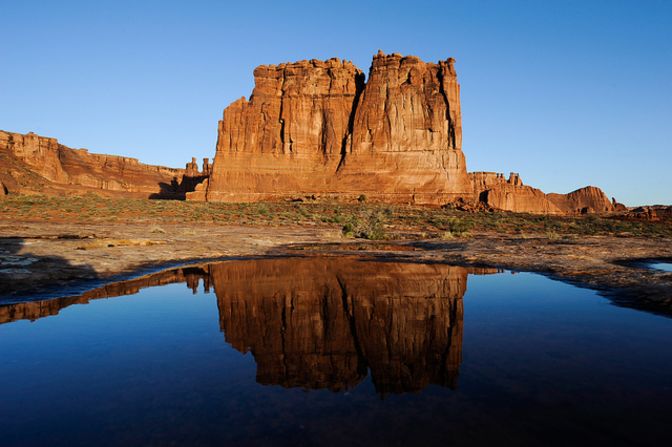
Ephemeral Pools, seen here in front of Organ rock, fill with rain water and are home to tiny ecosystems of plants and organisms.
Courtesy National Park Service
Arches National Park —
Gopher snakes are nonvenomous. They are often mistaken for rattlesnakes because they have similar markings and can vibrate their tails.
Courtesy National Park Service
Arches National Park —
The Wolfe Ranch trail contains ample rock art. Humans began migrating to Arches about 10,000 years ago.
Courtesy National Park Service
Arches National Park —
The collared lizard pursues prey by running on its hind legs. Its stride can be up to three times the length of its bodies.
Courtesy National Park Service
Arches National Park —
Turret Arch, seen here through North Window, is one of three giant arches on the Windows trail. North Window and South Window are arches known together as the Spectacles.
Courtesy National Park Service
Arches National Park —
The peregrine falcon uses a dive called a stoop to snatch smaller birds in mid-flight.
Courtesy National Park Service
Arches National Park —
These arches, which together are known as Double Arch, are two of more than 2,000 arches in the park.
Courtesy National Park Service
Arches National Park —
Sunset in the Salt Valley marks the beginning of the day for nocturnal wildlife living in Arches National Park.