Elizabeth Holmes testifies in trial over Theranos: Latest news | CNN Business

Elizabeth Holmes testifies in her own criminal trial

theranos elizabeth holmes split
A jury has returned verdicts in the trial of Theranos founder Elizabeth Holmes
2:12 • Source: CNN Business
theranos elizabeth holmes split
2:12 • CNN Business

What we covered here

  • Elizabeth Holmes, the disgraced founder and former CEO of Theranos, resumed testifying Tuesday in her criminal trial.
  • In a surprise move, Holmes took the stand Friday afternoon, shortly after federal prosecutors rested their case. She testified again briefly on Monday.
  • Holmes faces 11 federal fraud charges over allegations that she knowingly misled investors, doctors and patients about her company’s blood testing capabilities in order to take their money. Holmes has pleaded not guilty and faces up to 20 years in prison.
24 Posts

Elizabeth Holmes took the stand for roughly 6 hours, by far her longest testimony to date

Elizabeth Holmes testified for roughly six hours on Tuesday before court adjourned for the Thanksgiving holiday. It was her third day on the witness stand and by far her longest testimony so far.

During her testimony, Holmes touched on a number of allegations pertinent to the government’s case. She acknowledged the company decided not to disclose its use of modified third-party blood analyzer devices to a key retail partner. Holmes also admitted that she herself added Pfizer and Schering-Plough logos on Theranos reports, which witnesses have said misled them into thinking the pharmaceutical companies had endorsed the startup’s technology and the findings in the reports.

Holmes is set to continue her testimony on Monday, with court beginning at around 10 or 10:30 am PT.

Before jurors were excused, Judge Edward Davila reminded them that they are not to discuss the trial. The judge said that while family members may ask, “Gee, what have you been up to,” he urged them to “pass the mashed potatoes and not engage in any conversation with anyone [about the trial].” 

He also cited the ongoing pandemic, and flu season. “Make good choices,” he said. “Be safe.”

Elizabeth Holmes said former Safeway CEO pushed for Theranos partnership to launch to boost retailer's stock price

Earlier in the trial, former Safeway CEO Steve Burd testified that he had been frustrated by Theranos’ delays in moving forward with a partnership that the retailer hoped would let customers get their blood tests done while shopping. But Holmes offered up a different take on Tuesday.

She testified that once the Walgreens partnership shifted, at the retailer’s request, to have tests analyzed in a central lab until its proprietary devices had received regulatory approval to deploy in its stores, that altered the timeline for Safeway as well. The reason: Theranos couldn’t be inconsistent, putting its devices in Safeway stores and not Walgreens.

Holmes testified that Walgreens was devoting more resources towards launch, which ultimately happened in fall of 2013. (Burd previously testified: “We always tried to help them in any way we could,” noting “we’re a big company with lots of resources.”)

Despite the regulatory questions, Burd “really wanted to push forward with launch,” Holmes testified, speaking to a time frame in late 2012. She said Burd “really wanted to launch before his retirement.” (Safeway announced Burd’s retirement in January 2013.) There was also another reason communicated, she testified: Safeway’s stock was suffering and Burd thought this announcement could help.

Holmes says board was told about the use of third-party testing machines

Holmes testified about her high-profile board, which included former Secretaries of State George Shultz and Henry Kissinger, and former Defense Secretary James Mattis, among others.

In particular, she discussed an October 2013 board meeting, which jurors previously heard about when Mattis took the stand as a government witness. She testified that trade secrets – including the use of modified third-party machines to test small samples – were discussed at that meeting.

When Mattis was asked during his testimony whether he recalled discussion or disclosure about the use of third-party machines to run “a significant portion” of tests on a list of offerings, he said: “I don’t recall that. Our point was that we were better than them. We were faster, we were cheaper. We were more accurate than others. So I don’t recall that ever coming up.”

Asked by the prosecution whether Mattis was ever told by Holmes that there were some trade secrets he was not allowed to know, he testified: “No.”

Holmes testified that board members received $150,000 salaries and that Kissinger was paid a $500,000 consulting fee as well.

Elizabeth Holmes said she reviewed glowing Wall Street Journal opinion piece before it published

Elizabeth Holmes after going through security during her trial at the Robert F. Peckham Federal Building November 23, 2021 in San Jose, California.

Confirming one of the government’s allegations, Elizabeth Holmes testified Tuesday that she did have the opportunity to review a glowing opinion piece in the Wall Street Journal about Theranos. The article coincided with the startup’s 2013 Walgreens partnership announcement and the broader unveiling of the startup after years of operating in stealth mode. 

Holmes testified that she wasn’t the only person at Theranos who reviewed the draft of his piece, as jurors have previously heard. Holmes also said that while she was interviewed for the piece, so were other employees and board members.

She also testified that Grow Marketing, a public relations firm that advised on media relations and with which Theranos worked, liaised with the author as well.

The government had alleged that, prior to its publication, Holmes approved the piece, which contained misleading claims about the company’s capabilities at the time. The piece has frequently been brought up in the courtroom, as the company included it in materials such as investor presentations with several witnesses.

In a statement to CNN Business in September, Journal spokesperson Steve Severinghaus said: “Editors make publishing decisions based on their independent judgment.” 

The statement continued, “Our writer asked Elizabeth Holmes to confirm complicated facts on a technical subject, not to approve publication. Our writer visited Theranos, spoke with numerous sources in and outside the company about its technology, and had his blood tested on a Theranos machine that appeared to offer credible results. If that was all a deception, then the responsibility lies with Ms. Holmes and Theranos.” 

The opinion writer has since passed away.

Elizabeth Holmes said she did not tell Walgreens that Theranos used third-party machines to test patient samples

Elizabeth Holmes acknowledged in her testimony Tuesday that she did not tell Walgreens, one of her startup’s key retail partners, that Theranos used third-party devices to test patient samples.  

In what she called an “invention,” Holmes said the company modified commercial blood analyzers to test small samples, something intended to accommodate a large volume of tests after the initial plan to have Theranos’ proprietary devices in Walgreens stores was delayed.  

Holmes said the decision not to disclose its use of third-party machines came at the advice of the company’s lawyers to avoid losing trade secret protection for its devices.

“The advice was to keep it confidential so Theranos had a chance to profit off that invention,” she said. (The government has alleged that one of the ways Theranos misled investors was by representing that patients tests were conducted on Theranos-manufactured devices.)

Holmes testified that she disclosed to the US Food and Drug Administration its use of commercial machines because the government agency assured it would have trade secret protection and wouldn’t be shared publicly. Holmes testified that Theranos submitted a nonpublic patent application for its modified invention to protect it as a trade secret and was ultimately granted the patent.

Walgreens and Theranos entered an agreement in 2010. Sometime thereafter, an issue arose and Theranos ultimately agreed to do what Walgreens wanted: the retailer had determined that Theranos’ blood analyzer devices should not go into its stores until they had received regulatory approval. Instead, Theranos set up a central lab where tests results from Walgreens Wellness Centers would be processed until it got to the next phase of its partnership. 

Striking a partnership with Walgreens lent significant credibility to the startup. Together, the two built “wellness centers” within some Walgreens locations. It was the company’s only active direct-to-consumer partner before things came crashing down for Theranos.

Elizabeth Holmes mentions a key name in her testimony for first time: her ex-boyfriend and Theranos COO Ramesh Balwani

Before the start of the trial, Elizabeth Holmes’ attorneys indicated in court documents that she was likely to take the stand to testify herself about her alleged decade-long psychologically, emotionally and sexually abusive relationship with her ex-boyfriend and former Theranos COO, Ramesh “Sunny” Balwani. These allegations, which Balwani’s attorneys have denied, are intended to speak to her state of mind at the time of the alleged fraud.

During her first two brief days on the stand, Balwani’s name did not come up. But early Tuesday, Holmes mentioned his name for the first time, testifying that Balwani was involved in negotiations with Walgreens.

Holmes attorneys had indicated in pre-court documents that she may speak to the “reasons why she believed, relied on, and deferred to Mr. Balwani.” Put simply: She may claim she lacked the intent to deceive because, due to the nature of their relationship, she believed what she was being told about the company’s technology and its business dealings. 

Holmes and Balwani are both accused of engaging in a multi-million dollar scheme to defraud investors from 2010 to 2015, and of defrauding doctors and patients who paid for the company’s blood testing services from 2013 to 2016. The two face multiple federal fraud and conspiracy charges. Both have pleaded not guilty and could face up to 20 years in prison and a fine of $250,000, plus restitution for each count of wire fraud and conspiracy. 

While indicted together more than three years ago, their trials were separated due to the tensions of the anticipated defense by Holmes. Balwani’s attorneys acknowledged in a separate filing that Holmes’ plans to introduce evidence that Balwani verbally disparaged her and controlled what she ate, how she dressed, and who she interacted with, “essentially dominating her and erasing her capacity to make decisions.” The filing calls the allegations “deeply offensive to Mr. Balwani” and “devastating personally to him.”

Balwani’s trial is set to begin next year.

Balwani’s name came up repeatedly during the government’s case. Jurors heard witnesses recite text messages between Holmes and Balwani to illustrate how the two were privately corresponding about key moments in the company’s history. Several former employees were also asked about the nature of their relationship. 

Daniel Edlin, a college friend of Holmes’ brother who served as a senior product manager at Theranos for several years, said he was aware the two were dating and living together. The prosecution probed him for information about the power dynamic between the two. In terms of who was in charge at Theranos, Edlin said Balwani would defer to Holmes on certain things.

“Generally, Elizabeth was the CEO and she had, kind of, the final decision-making authority,” he testified. When asked if Edlin ever saw Balwani overrule a decision Holmes made at Theranos, Edlin testified: “I can’t recall a specific moment.”

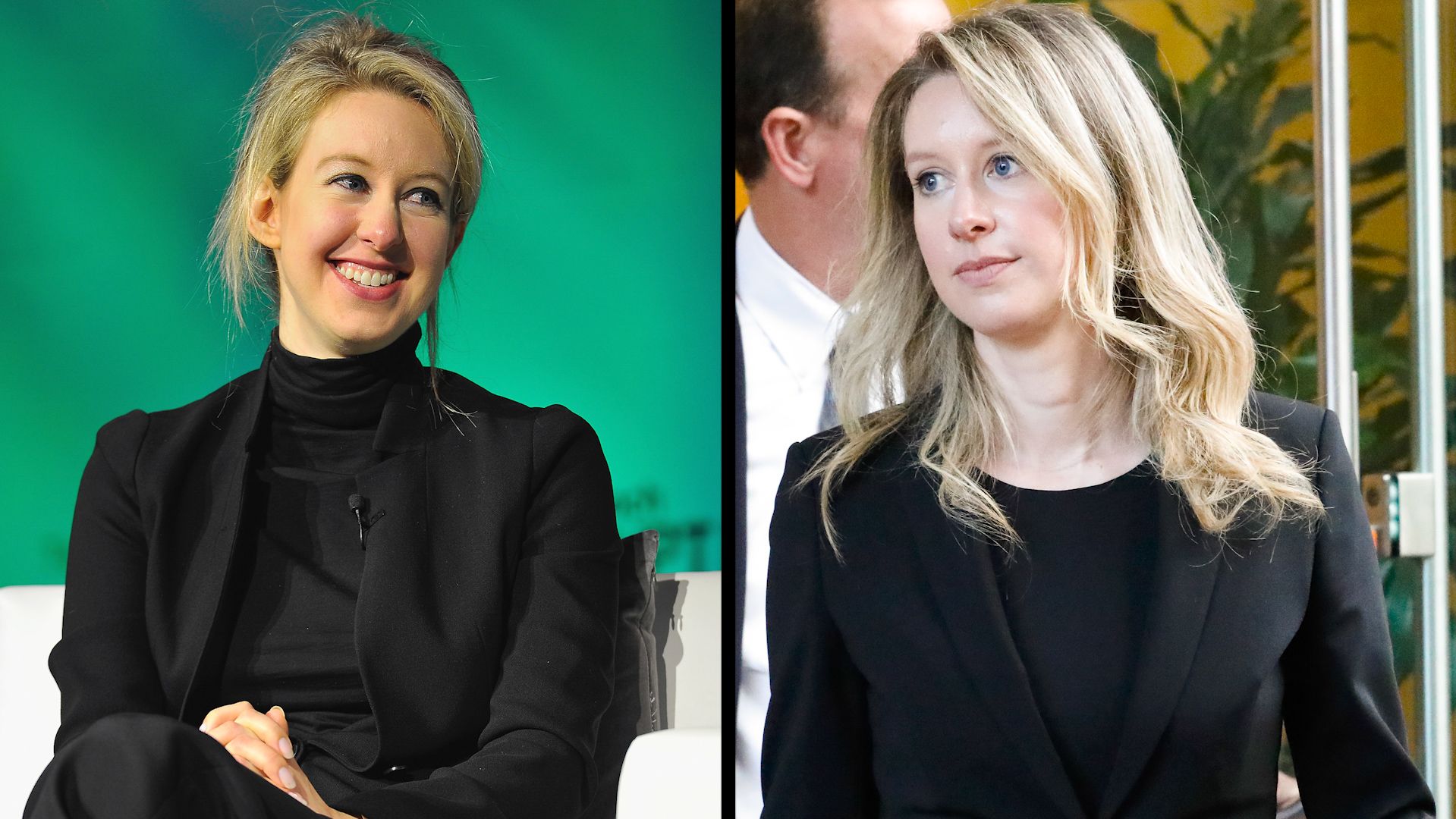
Elizabeth Holmes admits she added Pfizer and Schering-Plough logos to Theranos reports. Investors said this misled them

Elizabeth Holmes testifying at the federal court in San Jose, California, on Tuesday, Nov. 23, 2021.

Elizabeth Holmes admitted on the stand Tuesday that she added Pfizer and Schering-Plough logos to reports prepared by Theranos before sending them to Walgreens as her startup pursued a partnership with the retailer in 2010. 

Numerous witnesses, including investors and retail executives, have testified that they believed the reports were prepared by the pharmaceutical companies and indicated they had endorsed the startup’s technology and the findings in the reports.

Holmes testified she added the logos “because this work was done in partnership with those companies and I was trying to convey that.”

The government alleged that Theranos doctored reports appearing to validate its technology from the two major pharmaceutical companies and then sent those to investors and retail partners as it sought their money. 

In her testimony Tuesday, Holmes acknowledged some regret, saying that she heard witness testimony during this case. “I wish I had done it differently.”

On the Pfizer report specifically, Holmes testified that Theranos had worked with pharmaceutical company for years on the study that the report focused on. “The devices worked and I thought the data was really good,” she said. “And I wanted to share it with them.”

Holmes also testified about a central claim that has been repeatedly shown during the government’s case: That Theranos systems had been comprehensively validated by 10 of the 15 largest pharmaceutical companies.  

Walking through a presentation made to Walgreens in 2010 as Theranos sought a partnership with the retailer, Holmes testified to what that statement meant: “That our systems … had been tested against standards by these companies.”

Elizabeth Holmes arriving at the federal court in San Jose earlier today.

Elizabeth Holmes takes the stand for third day of testimony

Theranos founder and former CEO Elizabeth Holmes along with her mother Noel Holmes (L) and partner Billy Evans arrive for her trial at the Robert F. Peckham Federal Building November 23, 2021 in San Jose, California. 

Elizabeth Holmes’ third day on the stand kicked off with questions focusing on how she relied on her scientists – namely Ian Gibbons, a biochemist who joined Theranos in 2005 and who died by suicide in 2013 – to provide her with updates on what would be possible with the next iteration of the company’s technology, 4.0.

Holmes testified that the 4.0 system was significant because it would allow Theranos to run “any test.” 

In an email ahead of a meeting with GlaxoSmithKline in 2010, Holmes asked scientists at Theranos for information on three points she wants to “highlight and quantify as numerically as possible.” Those included central claims, such as why and how it would make tests cheaper, how they’d achieve cost savings, and how it will be capable of the full range of tests.  

Gibbons replied: “I think we have demonstration capabilities fully equivalent to lab methods in areas where we have done assay development.” He also provided some benchmarks for how the company is faster, as well as that cost savings will accrue from small sample size and no blood draw requirement.

Black turtlenecks and 'blood energy drink' for sale: The scene outside the courthouse before Elizabeth Holmes' third day of testimony

Press and members of the public once again began lining up in the early morning hours outside the Robert F. Peckham Federal Building in San Jose to try to secure a ticket for a seat inside the courtroom where Elizabeth Holmes is set to resume her testimony for the third day. 

By 5 am local time Tuesday, there was already a small crowd of around 40 people. Holmes’ testimony on Monday drew what appeared to be largest crowd to the trial to date.

Adding to the courthouse spectacle: Danielle Baskin, a 33-year-old artist, was outside selling items associated with the Theranos founder, including black turtlenecks and “blood energy drink.”

Baskin told reporters she came to the courthouse because she wanted to see Holmes in person and discover “what it was like experiencing her energy.”

She was warned once by security about not being allowed to sell on federal property. Once the courthouse gates opened, she resumed displaying her products, only to be warned again. She said she told the security person it was “performance art,” though she was actually selling the items.

It’s unclear if anyone purchased her products – and there were only limited supplies available. Baskin had just two blonde wigs for sale.

The main courtroom where the trial has been underway for months is first-come, first-served and has just 34 open seats available. (A number of other seats are reserved for Holmes’ family and friends, as well as the prosecution.) There’s also an overflow room, with live audio and a video feed, which has another roughly 45 seats. Otherwise, there is no way to view Holmes’ testimony because the court does not permit any audio or video recording of the trial. 

After an unexplained nearly two hour delay Monday, Holmes testified for less than two hours before court recessed at 1pm local time. Court is expected to go from 9 am PT to 4 pm PT Tuesday, which would mark Holmes’ longest time on the stand so far.

Holmes' second day of testimony aimed to poke holes in her 'intent to deceive'

Elizabeth Holmes testifying on stand at the federal court in San Jose, California, on Monday, Nov. 22, 2021.

In the criminal trial of Elizabeth Holmes, US prosecutors must convince jurors that the former Theranos CEO and founder intended to deceive investors, doctors and patients about the capabilities of her company’s technology for financial gain.

In her second day on the witness stand, Holmes’ testimony focused on the rosy picture she had about the company’s capabilities, pointing out a number of people – including scientists inside Theranos – who contributed to that:

  • Holmes testified to being unaware of any concerns with the validation reports Theranos prepared for Pfizer and Schering-Plough from the companies despite jurors having heard criticisms from scientists at both in earlier testimonies. Jurors heard scientist Dr. Constance Cullen testify to finding Holmes “cagey” and being unimpressed when she evaluated the company’s capabilities for Schering-Plough in 2009. But Holmes testified she is was given a different impression of Cullen’s stance. Holmes’ attorney Kevin Downey presented a 2010 email from a Theranos employee who relayed feedback from an apparent call with Cullen about opportunities with Merck (which merged with Schering-Plough). “All in all, it was awesome, I think,” the email said.
  • Channing Robertson, Holmes’ Stanford chemical engineering professor who became Theranos’ first board member, has come up a number of times during Holmes’ time on the stand, as someone who was highly qualified and involved in the company. Holmes testified that he served as Theranos’ “chief technical architect.” In an email presented in court, Robertson relayed to Holmes in October 2009, “We had our first group meeting today to start talking about assessing new technologies, thinking ahead and thinking out of the box.”
  • Ian Gibbons, a biochemist who joined Theranos in 2005 and who died by suicide in 2013, also came up. Downey asked: “Did there come a time in early 2010 when Theranos’ scientists and engineers told you that they believed it was feasible for Theranos systems to be configured so that they could run any blood test?” Holmes testified: “Yes.” Downey then displayed an email from Gibbons: “I believe the technology has the potential for rapid expansion of our ability to do general chemistry assays…”

Overall, Holmes’ nearly three hours on the stand focused on the company’s origins to demonstrate that it was built on the premise of doing real science and that, to her knowledge, its early steps were promising.

As Thomas Joo, a professor at UC Davis School of Law who specializes in corporate governance and white collar crime told CNN Business before the trial got underway: “The most difficult thing to prove is intent. Did she intentionally lie in order to trick people?”

Elizabeth Holmes ends second brief day testifying in her own criminal trial

Theranos founder and former CEO Elizabeth Holmes along with her mother Noel Holmes (R) and partner Billy Evans arriving earlier today for her trial at the Robert F. Peckham Federal Building in San Jose, California. 

Elizabeth Holmes testified for less than two hours Monday before court adjourned. Her time on the stand, which was cut short by a long, unexplained delay at the start of the court session, marked her second brief day testifying in her own criminal trial.

Much of Holmes’ testimony Monday focused on what she described as Theranos’ success with pharmaceutical companies in its earlier years. Holmes previously testified for about an hour on Friday afternoon, where she spoke about the company’s origin.

After the jury was excused Monday, Judge Edward Davila warned again about loud keyboards, adding that “perhaps it sounds a little ridiculous” that the topic keeps coming up. “I understand your desire, your need, your obligations to perhaps record or in some way memorialize these proceedings but you need to do it in a respectful manner,” he said.

Davila once again asked asked people to “self police,” noting the importance of the jury being able to concentrate fully on the evidence. He added that he’d be “similarly concerned” if it was someone loudly chewing gum — that it is the noise, rather than the keyboards, that are the issue.

Court is back in session Tuesday at 9 am PT and Holmes will be back on the stand.

Elizabeth Holmes focuses testimony on Theranos' 'successes' with pharmaceutical companies

In her testimony Monday, Elizabeth Holmes appeared to address one of the government’s allegations: that it misrepresented to investors that its technology had been “examined, used, and validated” by several pharmaceutical companies.

The government alleged that Theranos doctored reports appearing to validate its technology from two major pharmaceutical companies — Pfizer and Schering-Plough — and then sent those to investors and retail partners as it sought their money. 

Holmes said Theranos provided a report to Pfizer in late 2008 in connection with a contract it struck with the company in 2006. Asked whether Pfizer provided feedback that she’s aware of on that report, Holmes testified: “I don’t think on the report specifically, no.” Former Pfizer scientist Shane Weber, who was tasked with assessing Theranos around that time, testified he concluded the company did not have any “diagnostic or clinical interest to Pfizer” and conveyed to Holmes that the company would not be working with it. Holmes testified that Theranos continued to interact with Pfizer about potential work.

Holmes also testified that Theranos did a validation study for Schering-Plough and provided a report to the company. Dr. Constance Cullen, a former scientist for Schering-Plough, previously testified she had been unimpressed with the company. But Holmes testified she thought Cullen had a favorable view of its technology, citing information relayed to her by a Theranos employee who’d spoken with Cullen.

However, Holmes did not address the allegation that she sought to mislead by sending validation reports affixed with Pfizer and Schering-Plough logos.

Holmes spent roughly the first hour of her time on the stand testifying about what she described as successful studies done with pharmaceutical companies.

Referring to a slide from 2009 titled “completed successes,” Holmes testified that the list was her team highlighting for her the various studies it had done with other companies. Among the big names listed: Pfizer, Novartis, AstraZeneca, Mayo Clinic and Merck. Asked what qualified as a success, Holmes said it meant that “we had successfully achieved the objectives of the program.” 

With Novartis, for example, Holmes testified that Theranos’ tests were compared to traditional tests, and she recalled the results “being really good.” She also testified that Merck, for example, had been happy with the study results and expressed interest in helping find a clinical study for use of Theranos’ technology – but that never happened.

Holmes discusses attempts to partner with DoD

Elizabeth Holmes testified that Theranos attempted to partner with the Department of Defense in 2008 and 2009 on several studies after she said the company had developed its 3.0 blood analyzer device.

She testified that one study was associated with whether markers in blood could help predict PTSD, another on diabetes management, and another on dealing with infection in trauma patients. She said Theranos tried to partner with the DoD’s Telemedicine and Advanced Technology Research Center, or Tatric.

The company was not successful in formalizing a partnership, she testified.

The prosecution has alleged that one way Theranos misled investors was through misrepresentations about its work with the military.

Elizabeth Holmes testifies that she believed miniaturizing lab tests "was a really big idea"

Former Theranos founder and CEO Elizabeth Holmes going through security after arriving for court at the Robert F. Peckham Federal Building on November 22, 2021 in San Jose, California. 

In her testimony Monday, Elizabeth Holmes walked through the evolution of Theranos’ original blood-testing device, from the first demonstration of its technology in Switzerland for pharmaceutical company Novartis in 2006 to a version 3.0 of the device finalized by the end of 2007.

“We thought this was a really big idea,” Holmes testified about the company’s 3.0 device. She said that was because the robots used in traditional labs hadn’t been miniaturized. Holmes also testified that automation could help cut down on human error in lab testing.

The company’s 3.0 device took roughly one year to develop after the Novartis demo to address the significant challenges with that initial device. She testified that earlier challenges had to do with its cartridge, not assays or software.

Elizabeth Holmes takes the stand after nearly two-hour wait

Elizabeth Holmes is taking the stand, nearly two hours after the court day was set to begin. No reason for the delay was provided.

A delayed start to the court day

The trial was supposed to resume at 9 am PT on Monday. But more than 40 minutes after that start time, Judge Edward Davila was still not yet on the bench. Lead prosecutor Jeff Schenk and Holmes’ lead defense attorney Kevin Downey were also not in the courtroom.

Elizabeth Holmes arrives at the courthouse

Elizabeth Holmes, center, walks into federal court in San Jose, California, on Monday, Nov. 22, 2021.

Elizabeth Holmes arrived at the San Jose courthouse shortly before 8 am local time. She was accompanied by her mother, Noel, who has been with her every day, as well as her partner, Billy Evans, who has also frequently attended the trial.

Inside the courthouse, Holmes stopped to give a couple of hugs, while walking hand-in-hand with her mother. A group of nine people, including Noel and Billy, formed outside the courtroom door, waiting for it to open. The group appeared to be Holmes’ support for her anticipated second day on the stand.

Holmes’ testimony also appears to have drawn the biggest crowd of the trial to date, with folks arriving earlier than the other high-interest court day: opening statements.

Why the defense decided to have Elizabeth Holmes take the stand now

Elizabeth Holmes leaving the courtroom with her partner after her first testimony on Friday.

Until last week, it was unclear not just whether Elizabeth Holmes would take the stand, but whether her defense team would put on a case.

Holmes’ attorney John Cline indicated in an October hearing: “I can’t tell you at this point who we’re going to call as witnesses. We may. That’s all that I can say. We may not put on a case. We may call Ms. Holmes; we may not.”

Then on Friday, shortly after the prosecution rested its case, the defense surprised onlookers by calling Holmes to the stand as its third witness – at 3pm on a Friday. She testified for roughly one hour before court recessed for the weekend.

There are a host of reasons why the defense may have called Holmes to the stand when it did. It may have been something as simple as having expected the testimony of its second witness to stretch through the end of the day.

But Mark MacDougall, a white-collar defense lawyer and former federal prosecutor, said it could also have been a strategy. “Putting Elizabeth on the stand for a short time on Friday could be intended to acclimate her – just before the weekend break – to the stress of testifying in court,” he told CNN Business. 

While there’s no indication whether the defense will call additional witnesses, she may have been called third in order to better set up other witnesses for the defense. Before the start of the trial, for example, pre-court documents indicated she may claim she was the victim of a decade-long abusive relationship with Ramesh “Sunny” Balwani, her ex-boyfriend and the former COO of Theranos. (Balwani is set to face federal prosecutors over the same charges as Holmes next year; he has pleaded not guilty.)

“If the defense still plans to call psychological experts or other witnesses who may talk about Elizabeth’s state of mind, that testimony will be much more effective if the jurors have already heard Elizabeth’s story in her own words,” said MacDougall.

People start lining up in the middle of the night for a seat in court to hear Elizabeth Holmes' testimony

Members of the press and the public began lining up in the early morning hours Monday outside the Robert F. Peckham Federal Building in San Jose to try to snag a seat inside the courtroom where Elizabeth Holmes is set to resume her testimony.

By 3:30 am local time, a small line had already formed; one person said they arrived at 1 a.m. The main courtroom where the trial has been underway for months is first-come, first-served and has just 34 seats available. (A number of other seats are reserved for Holmes’ family and friends, as well as for the prosecution.) There’s also an overflow room with live audio and video feed, which has another roughly 45 seats. Otherwise, there is no way to view Holmes’ testimony because the court does not permit any audio or video recording of the trial. 

The trial, now on week 12, is in session from 9am PT to 1pm PT Monday and all day Tuesday before it recesses for the Thanksgiving holiday.

Elizabeth Holmes first day on the stand in her criminal trial

Elizabeth took the stand in the San Jose courtroom on the first day of the defense's case on Friday November 19.

Elizabeth Holmes, the disgraced founder and former CEO of Theranos, took the stand in her criminal trial on Friday afternoon in the San Jose courtroom during the first day of the defense’s case. She is also expected to testify on Monday and Tuesday, the only days court is in session.

Whether Holmes would testify was a big question looming over the trial. She has attended the trial each day, typically with her mother and occasionally her partner. On Friday, her partner, mother and at least one person who appeared to be her friend were in attendance. She was smiling as she took the stand and during much of her testimony.

Off the bat, Holmes’ attorney Kevin Downey asked her if she believed Theranos had developed technology that was capable of running any blood test. “I did,” Holmes testified. 

“We worked for years with teams of scientists and engineers to miniaturize all the technologies in a laboratory. The core part of that was a formula for being able to run tests on small samples and run that formula,” Holmes testified, adding that by 2009 or 2010, the company had a “breakthrough.” 

Downey then stepped backed to establish the background of the company’s origin, including how she was a chemical engineering student at Stanford University and her first patent application.

“I started with talking to my parents and they let me take the money that they had saved for me to be able to go to college to work on my patent,” she testified. “Then I went to try to raise or borrow money.”

“Were you able to?” her attorney asked.

“I was,” she replied.

Read the full story.

Download the CNN app

Scan the QR code to download the CNN app on Google Play.

Scan the QR code to download the CNN app from Google Play.

Download the CNN app

Scan the QR code to download the CNN app from the Apple Store.

Scan the QR code to download the CNN app from the Apple Store.