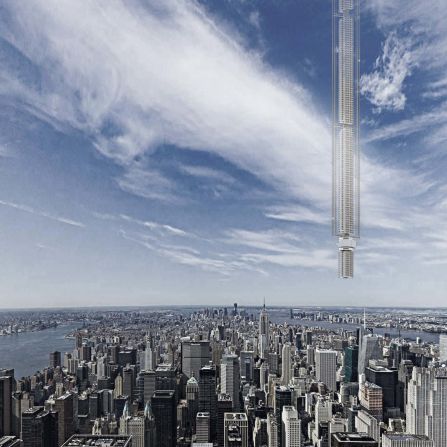
Analemma Tower, New York City —
Clouds Architecture Office has unveiled plans for a futuristic skyscraper dubbed the "Analemma Tower." The building would hover majestically above the ground because it would be attached -- wait for it -- to an actual asteroid, in space, that is forcibly put into orbit around the earth.
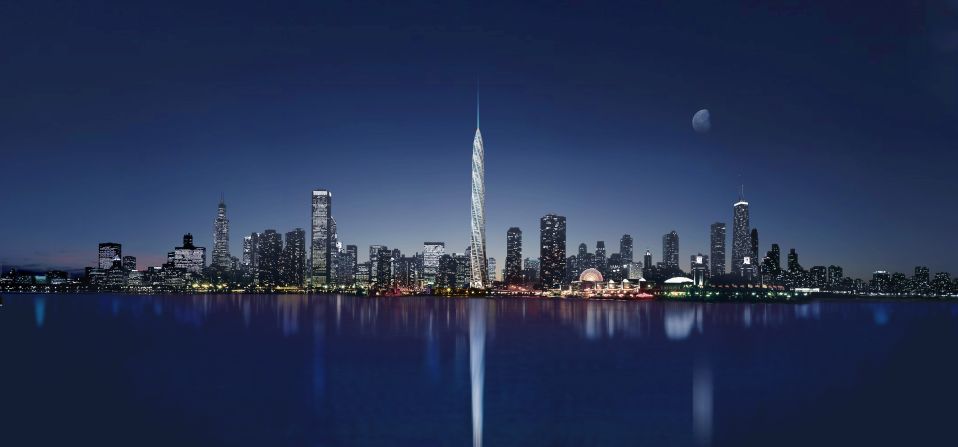
The Chicago Spire, Santiago Calatrava —
How different Chicago's skyline would have looked if Calatrava's 2005 design had been built. One thousand four hundred and fifty eight feet (444 meters) of slender twisted steel and glass, the Chicago Spire would have knocked the Willis Tower (formely the Sears Tower) down a peg, trumping it by a whole two meters and a whole lot of style.
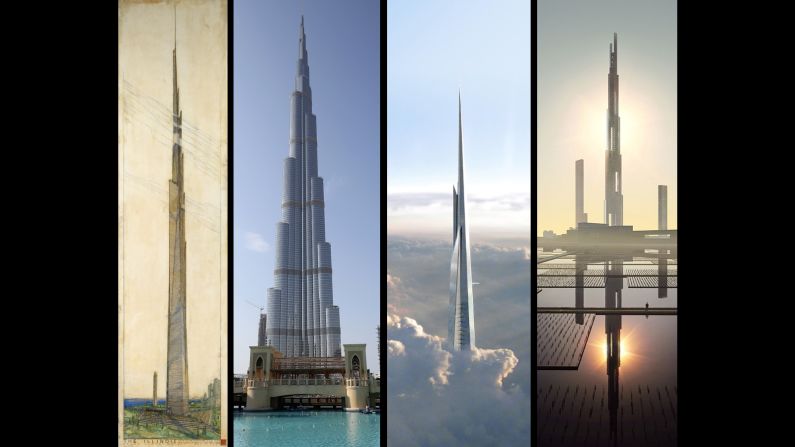
The Mile High Illinois, Frank Lloyd Wright —
Wright's design (left) was ambitious: a mile-high skyscraper in 1956 was no mean feat. It would have been four times higher than the world's tallest build at the time, and just under twice the height of the world record holder today.
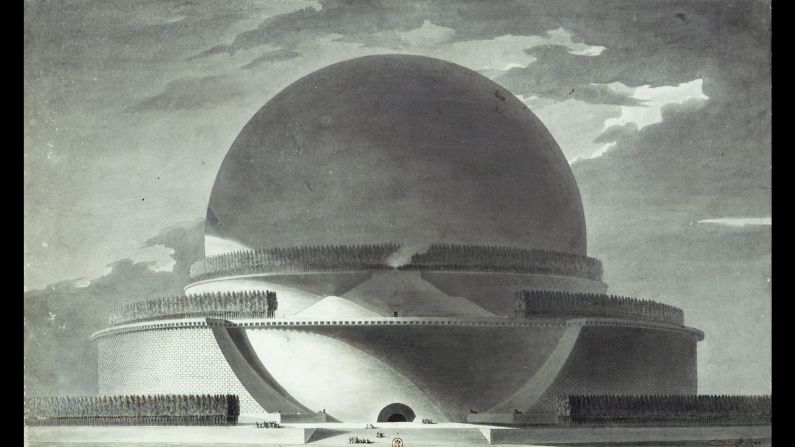
Cenotaph to Newton, Etienne-Louis Boullee —
Spheres were integral to the work of mathematician Sir Isaac Newton, in life and, at one time, in death. The great scientist worked out the force holding us to the big sphere beneath our feet, and French architect Etienne-Louis Boullee thought it would be a fitting shape to remember him by. In 1784 he drew up plans for a grand, 500 foot (150 m) cenotaph -- eight meters taller than Strasbourg Cathedral, the highest building at the time.
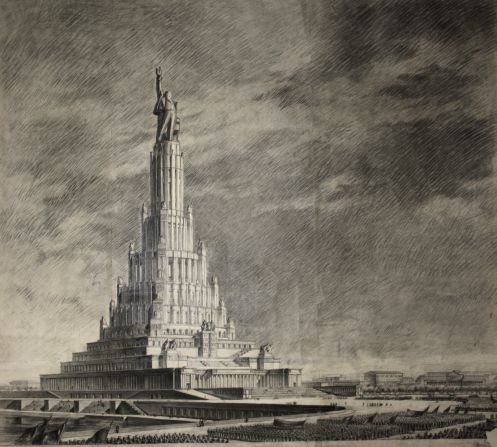
Palace of the Soviets, Boris Iofan —
Boris Iofan's colossal design for the Palace of the Soviets has become one of the finest examples of an architectural moonshot that fell to earth. The imposing design was the winning entry of an international competition in 1931 for a new administrative and congress hall in Moscow, Russia.
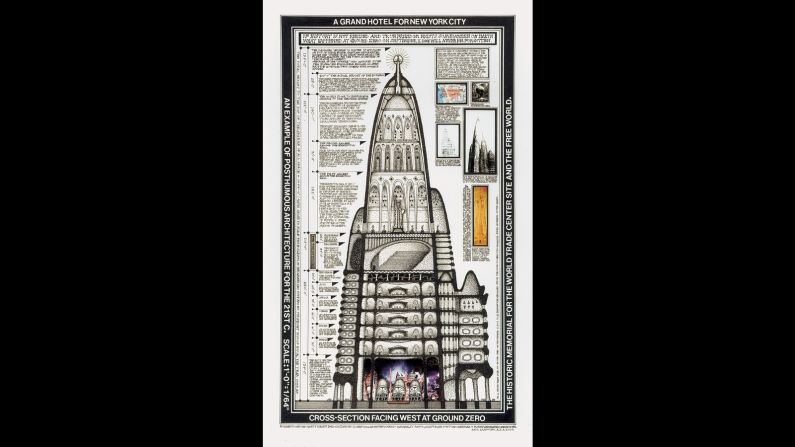
The Hotel Attraction, Antoni Gaudi —
The late Catalan architect Antoni Gaudi's project -- the Sagrada Familia in Barcelona could be finished by 2030 -- but the one that got away was the Hotel Attraction in New York. The futurist building designed in 1908 would have been 1,246 feet (380 meters) tall, around the same size as the Empire State Building, featuring a 400 foot (121 meter) high chamber in honor of past U.S. presidents. Details surrounding the proposed building are vague -- little was known about the project until 1956 -- but it is believed that Gaudi presented the plans in person in New York.
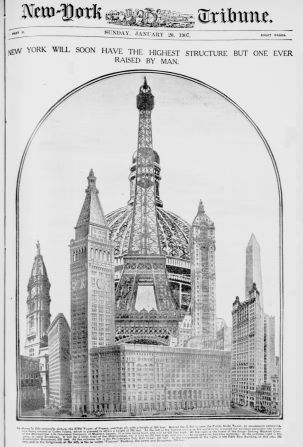
The Coney Island Globe Tower, Samuel Friede —
The Coney Island Globe Tower, seen at the rear of this New York Tribune cover, was the ambitious megastructure dreamed up by Samuel Friede. Proposed in May 1906, it was to include a 700 foot (213 meter) sphere with multiple floors, containing everything from restaurants to garden to a bowling alley -- not to mention the world's largest ballroom and a theme park. All in all, it would have fitted 50,000 people and operate 24 hours a day.
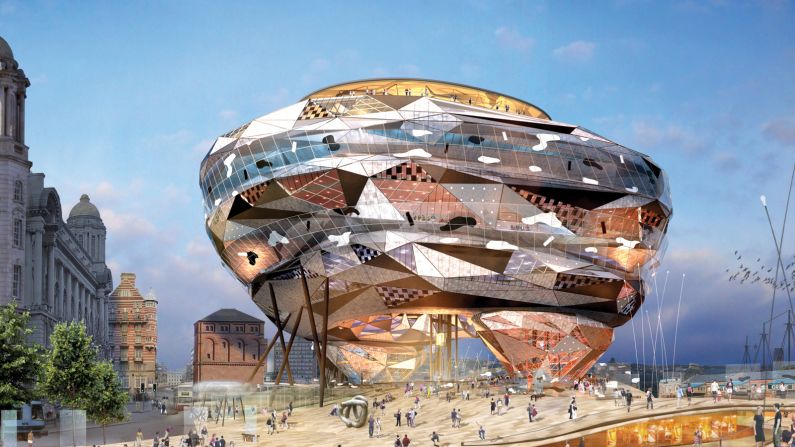
Fourth Grace, Will Alsop —
It was supposed to be the centerpiece of Liverpool, England's redevelopment as European Capital of Culture in 2008. As it stands, all that remains of the Fourth Grace (also known as The Cloud) are these beautiful renderings. The concept, which was once described as a "diamond knuckleduster" by The Guardian, won an architectural competition in 2002 for a fourth building to sit alongside Liverpool's Three Graces - the Royal Liver Building, the Cunard Building and the Port of Liverpool building.
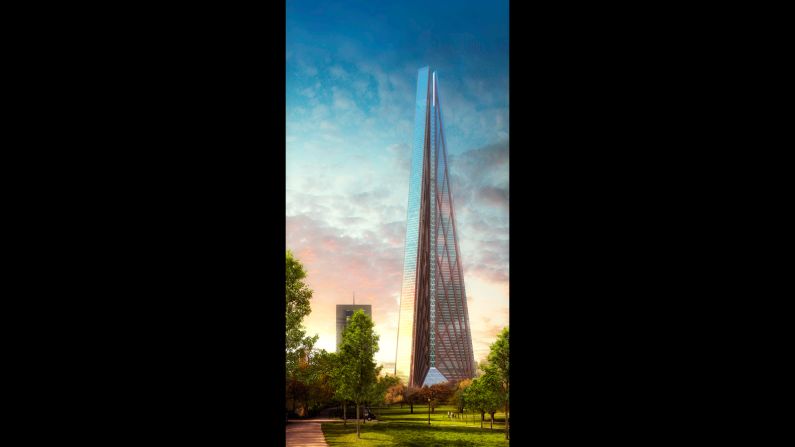
Russia Tower, Foster + Partners —
Three miles from Red Square, a very different type of monument was supposed to have been erected. One thousand nine hundred and sixty eight feet (600 meters) high with room for 25,000 people, Russia Tower was closer to a vertical city -- over 600 feet higher than its nearest rival in Europe. It was also to be one of the most eco-friendly skyscrapers in the world: the largest to be naturally ventilated, with three 'arms' tapering towards the summit and a 'green' spine; triple-glazed to reduce heat loss and photovoltaics supplying energy demands and feeding back into the grid when in surplus.
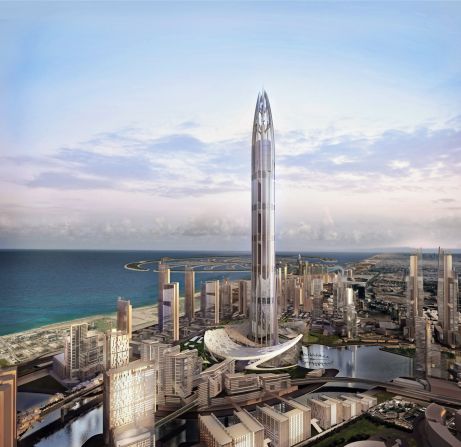
Nakheel Harbour and Tower, Woods Bagot —
Nakheel Harbour and Tower in Dubai failed to fly when, six years after being proposed, it was canceled in December 2009. The 3,280 feet (one kilometer) high tower was first mooted as the centerpiece of Palm Jumeirah, the vast man-made archipelago in the Persian Gulf, although it was later re-located closer to the Dubai Marina. The design for the mixed-use complex drew on Islamic monuments of the past according to the architects, invoking the Harbor of Alexandria, the bridges of Isafahan, the gardens of Alhambra and the promenade of Tangier -- but like the Lighthouse of Alexandria, the plan, estimated to cost $38 billion, came crumbling down.
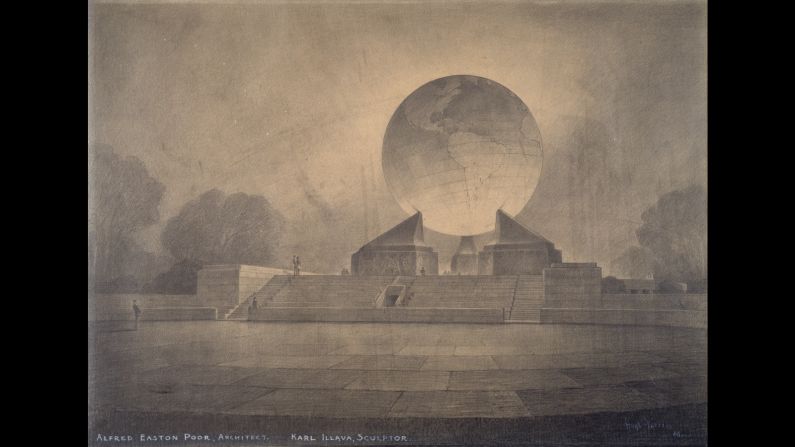
Second World War Memorial, Alfred Easton Poor and Karl Illava —
Little is known about Poor and Illava's concept for a Second World War memorial -- Nadja Bartels, director of the Tchoban Foundation admits as much. The Foundation, which exhibited this concept drawing by Hugh Ferriss at its show "American Perspectives" in 2015, speculated that it could have been envisioned for Central Park, New York, Bartels arguing the monolithic design invokes Boullee's concept for Newton's Cenotaph. Sketched by Ferriss, a trained architect who moved into drawing buildings rather than designing them, the monument would have been the second of Illava's in Central Park -- his memorial to the 107th Infantry was completed in 1927.