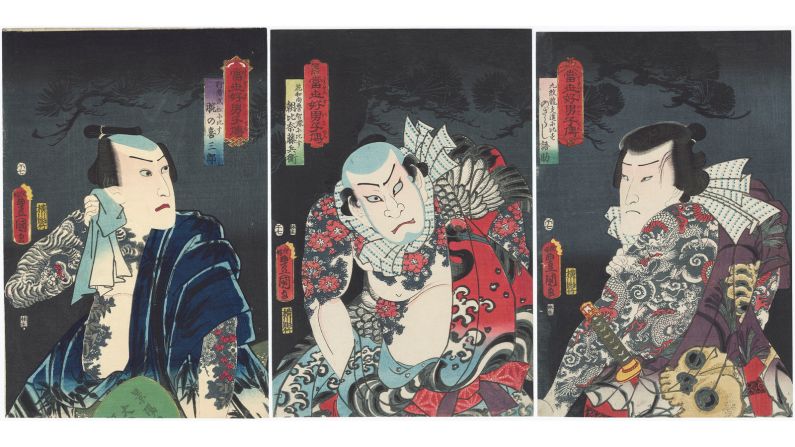
A triptych from "A Contemporary Water Margin: Pine, Bamboo, and Plum" (1858) by Utagawa Kunisada —
Artist Utagawa Kunisada was one of the first to popularize tattoos in woodblock prints in the 19th century. Here he's depicted three actors in various roles, their tattoos meant to evoke characters from the books and plays of the day.
Courtesy Museum of Fine Arts, Boston
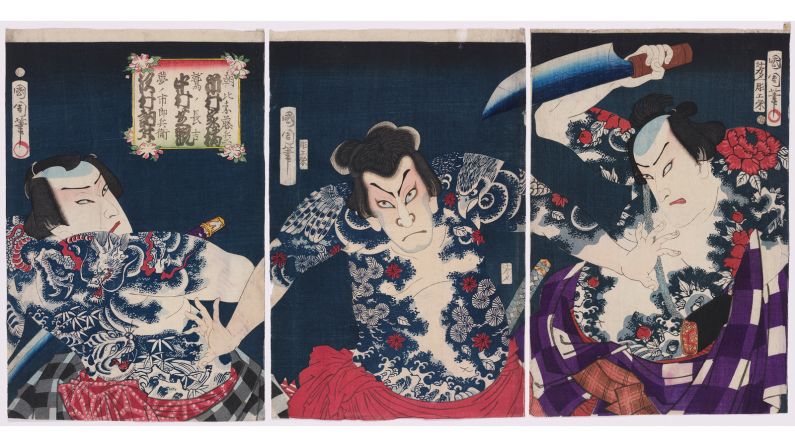
A scene from "The Drum Announcing a Sumo Match Resounds in the Yoshiwara" (1868) by Toyohara Kunichika —
While this production was set in the distant past, the actors in this kabuki scene are covered in the peony, dragon and eagle tattoos that were popular during the Edo period.
Courtesy Museum of Fine Arts, Boston
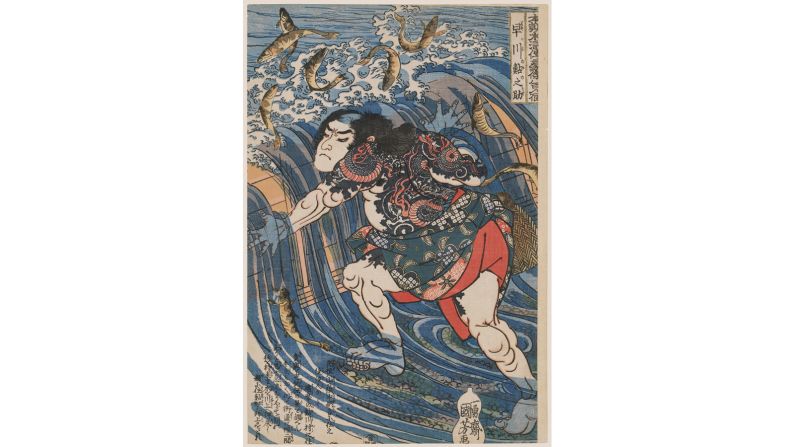
"Hayakawa Ayunosuke" from the "Eight Hundred Heroes of Our Country's Water Margin" (c.1830) by Utagawa Kuniyoshi —
Many real historical figures were also given contemporary tattoos. Hayakawa Ayunosuke, for example, was a samurai in the 16th century, long before the rise of this type of tattoo work was widespread. Call it creative license.
Courtesy Museum of Fine Arts, Boston
"Yan Qing, the Graceful" from the "One Hundred and Eight Heroes of the Popular Water Margin" (c.1827-30) by Utagawa Kuniyoshi —
Kuniyoshi covered the martial artist Yan Qing, a character known for his fine looks, with lions and peonies, which were symbols of wealth, strength and good fortune.
Courtesy Museum of Fine Arts, Boston
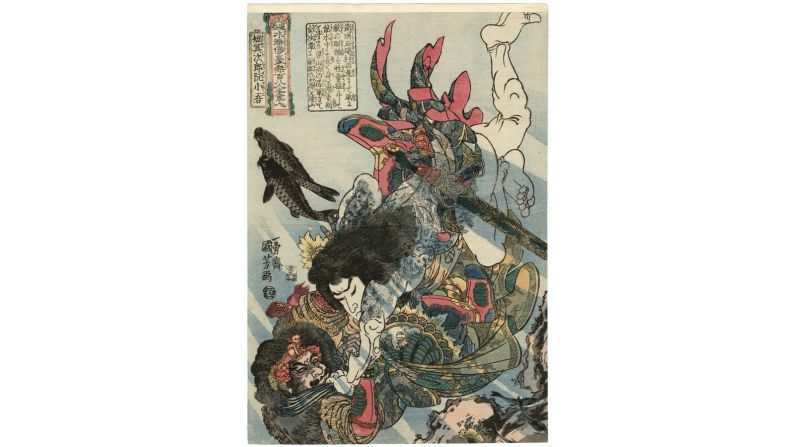
"Ruan Xiaowu, the Short-lived Second Son" from the "One Hundred and Eight Heroes of the Popular Water Margin" series (c. 1827-30) by Utagawa Kuniyoshi —
The leopard on the fictional Ruan Xiaowu's back (his face is hidden near his left shoulder) suggests strength and ferocity.
Courtesy Museum of Fine Arts, Boston
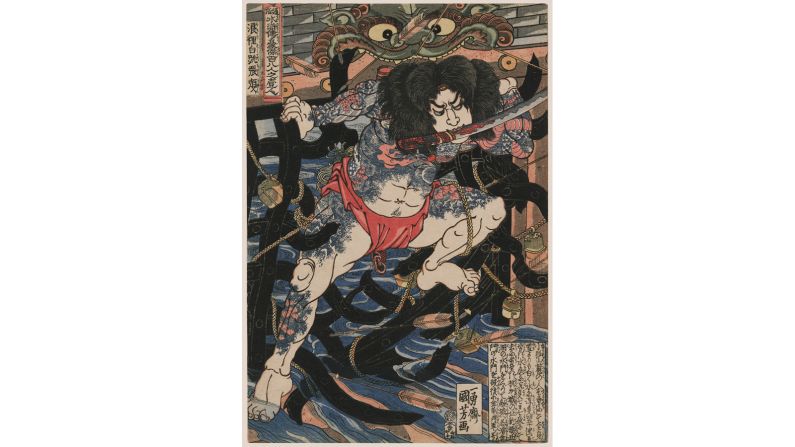
"Zhang Shun, the White Streak in the Waves" from the "One Hundred and Eight Heroes of the Popular Water Margin" series (c. 1827-30) by Utagawa Kuniyoshi —
Zhang Shun, one of the character's from "One Hundred and Eight Heroes of the Popular Water Margin," is covered in ivy leaves, a waterfall and a snake that twists around his body. They hint at the characters strength and swimming skills.
Courtesy Museum of Fine Arts, Boston
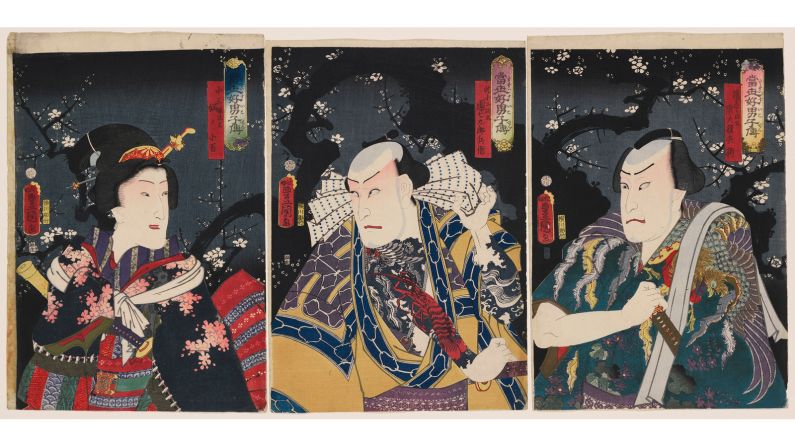
A triptych from "A Contemporary Water Margin: Pine, Bamboo, and Plum" (1859) by Utagawa Kunisada —
The actor at center, is playing a character named Danshichi Kurobei, a fishmonger. The prominent lobster tattoo on his arm alludes to his profession.
Courtesy Museum of Fine Arts, Boston
"Onoe Kikugorō V as Oniazami Seikichi" from the "Flowers of Tokyo: Kunichika's Caricatures" series (1872) by Toyohara Kunichika —
The thistles on the actor's thighs and arms here are a reference to his character's name. (Oniazami Seikichi translates to "demon thistle.")
Courtesy Museum of Fine Arts, Boston
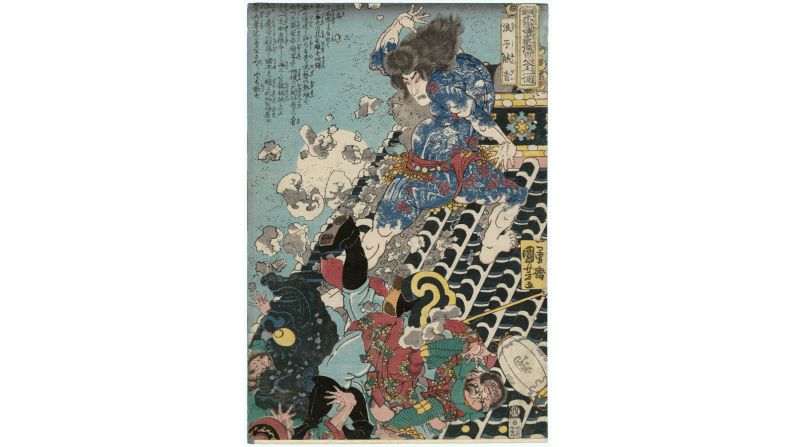
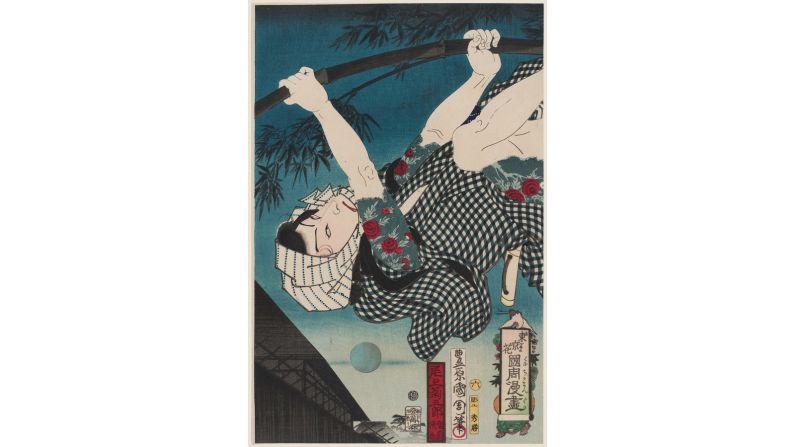
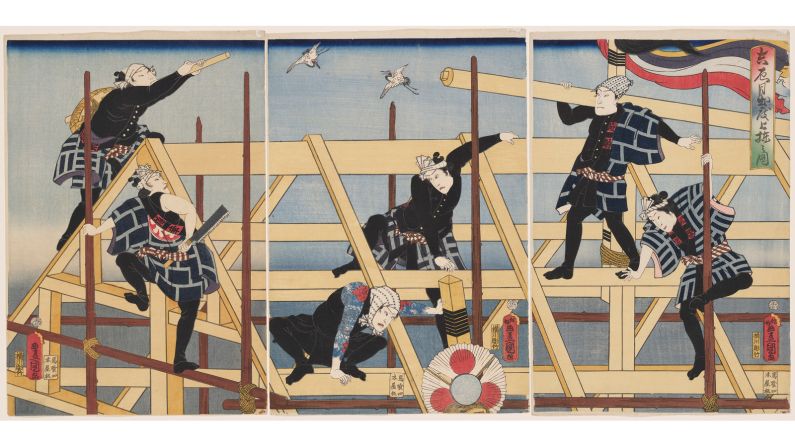
"A Roof-Raising Ceremony on an Auspicious Day" (1860) by Utagawa Kunisada —
Tattoos were particularly favored by laborers, including construction workers. The tattooed arms of the crouching man were somewhat typical.
Courtesy Museum of Fine Arts, Boston
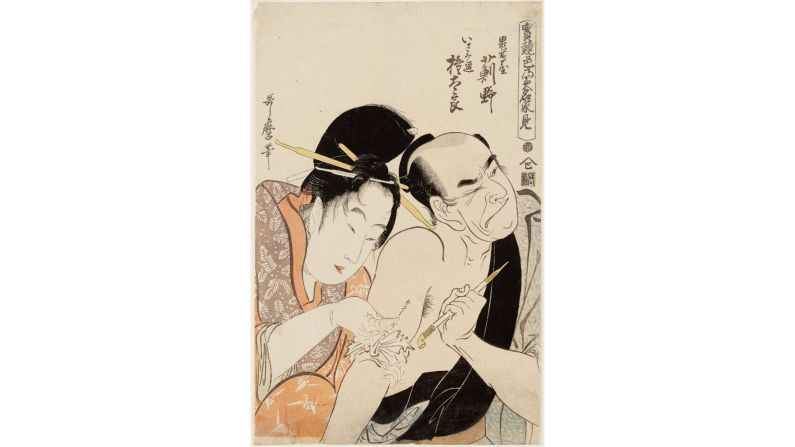
"Onitsutaya Azamino and Gontarō, a Man of the World" from the "True Feelings Compared: The Founts of Love" series (c. 1798-99) by Kitagawa Utamar —
Homemade tattoos were a sign of romantic devotion in the 18th century. Here, Azamino, a courtesan, inscribes her name and the word "life" on her lover's arm.
Courtesy Museum of Fine Arts, Boston
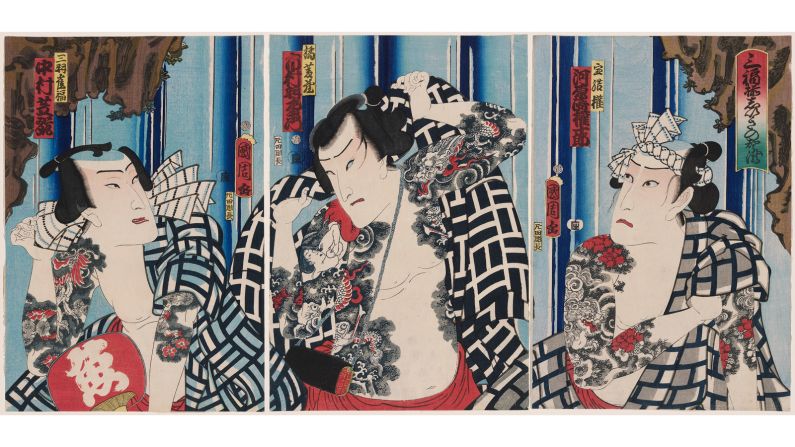
"Unity of Three Happinesses: Favorite Actors Before a White Waterfall" (1863) by Toyohara Kunichika —
Here, three actors pause at a waterfall while on a pilgrimage. The man in the center's tattoo tells the story of a woman who swam to the underwater Dragon Palace to get back a jewel stolen by the Dragon King. (The woman is on his right arm, the dragon on his left.)
Courtesy Museum of Fine Arts, Boston
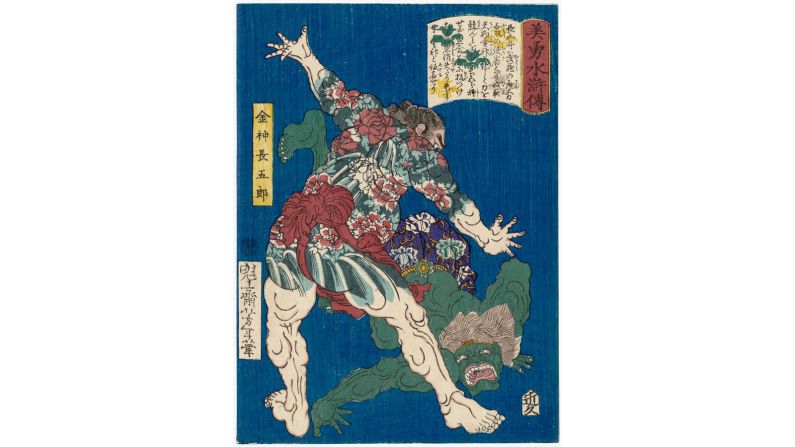
"Konjin Chōgorō" from the "Water Margin of Beauty and Bravery" (1866) by Tsukioka Yoshitoshi —
Konjin Chōgorō, a legendary sumo wrestler, defeats a guardian god during an encounter in a ruined temple. He's covered in peonies and a waterfall.
Courtesy Museum of Fine Arts, Boston
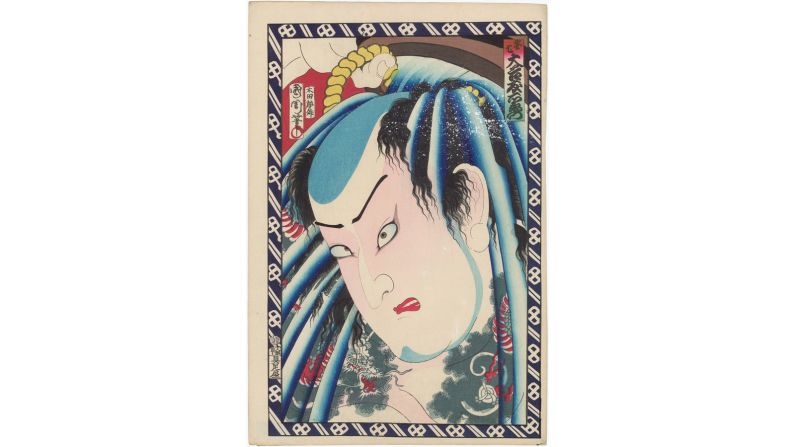
"Actor Ōtani Tomoemon V as Danshichi" (1869) by Toyohara Kunichika —