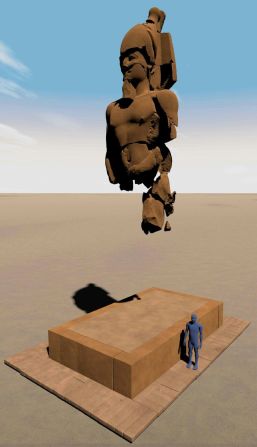
An archaeological team at the ancient city of Heliopolis, in modern-day Cairo, pieced together more than 6,000 fragments of a statue of King Psamtik I to calculate its original size and shape and create a 3D visualization.
Courtesy of Chr. Breninek
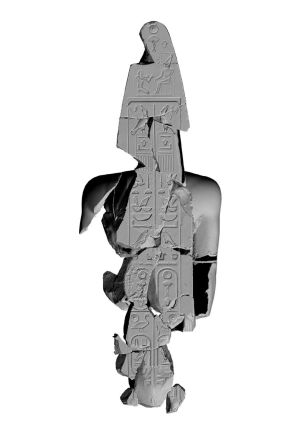
This visualization of the back pillar of the quartzite statue shows an inscription giving the full title of King Psamtik. Christopher Breninek worked on the visualizations for the Heliopolis Project.
Courtesy of Chr. Breninek
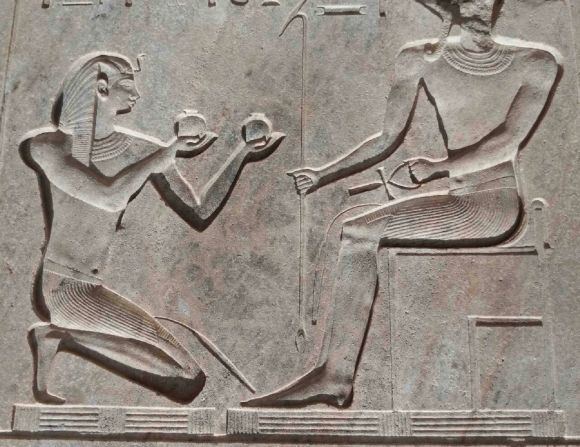
The back pillar also shows an intricately carved scene of Psamtik kneeling in front of the creator-god Atum of Heliopolis.
Courtesy D. Raue
King Psamtik I ruled Egypt between 664 and 610 BC, founding the 26th dynasty. He has been credited with the reunification of Egypt following a long period of internal tensions.
Courtesy D. Raue
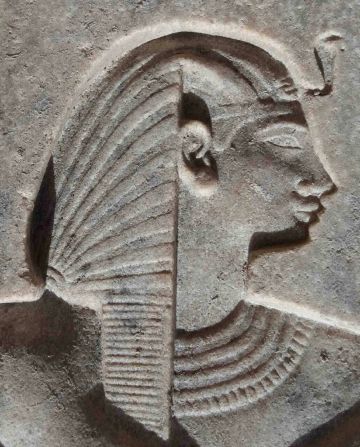
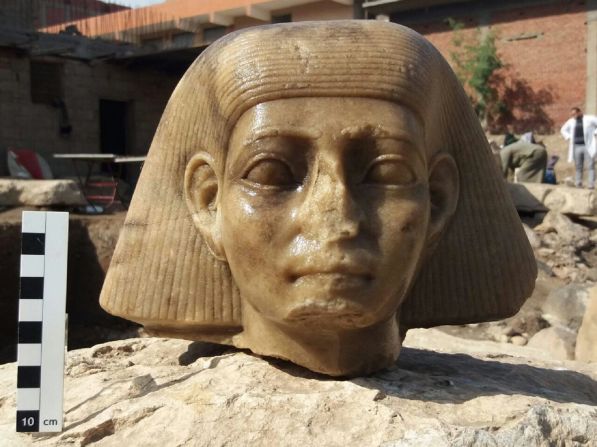
Other finds at the site include this head, also made from quartzite, dating to around 650 BC. Quartzite is a particularly durable material, and is therefore difficult to carve. Excavation leader Dietrich Raue says they may have used quartzite for its color variations -- the statue of Psamtik moves from purple to pink to dark brown.
Courtesy D. Raue
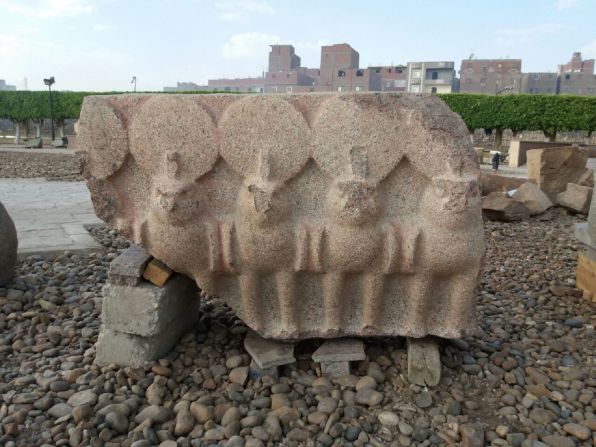
A falcon frieze was found at the ruins of the temple of Nektanebo I, in Heliopolis. Nektanebo I was the first king of the 30th dynasty of Egypt.
Courtesy D. Raue
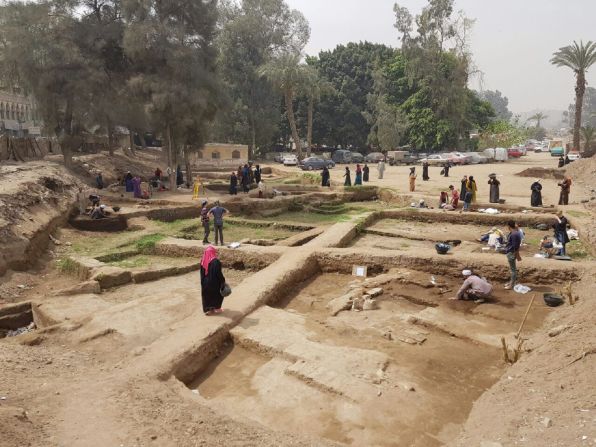
The ancient city of Heliopolis is now located in Matariya, a northeastern suburb of Cairo. The area has suffered political troubles and tensions since the 2011 revolution.
Courtesy D. Raue
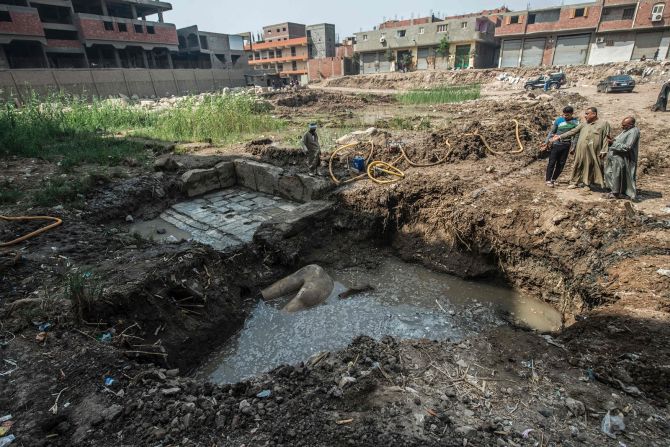
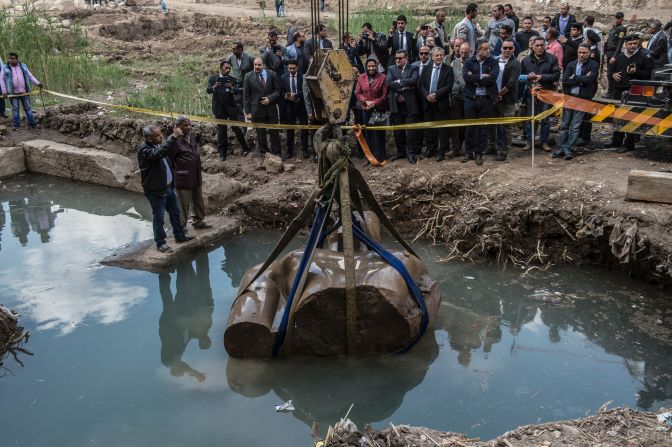
In 2017, when archaeologists first found fragments the statue, it was submerged in a pit of groundwater.
KHALED DESOUKI/AFP/Getty Images
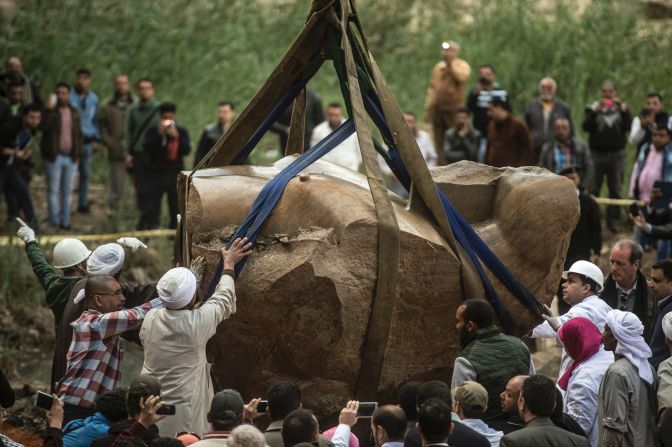
The discovery of the statue drew crowds of spectators, who watched as the heavy torso was lifted out of the pit.
KHALED DESOUKI/AFP/Getty Images
At first, researchers thought the colossus depicted Ramses II, one of ancient Egypt's most famous pharaohs.
KHALED DESOUKI/AFP/Getty Images
Here an Egyptian worker stands beside part of the head -- now known to have depicted to Psamtik I.