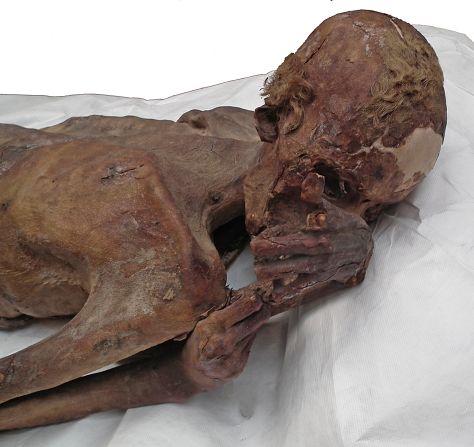
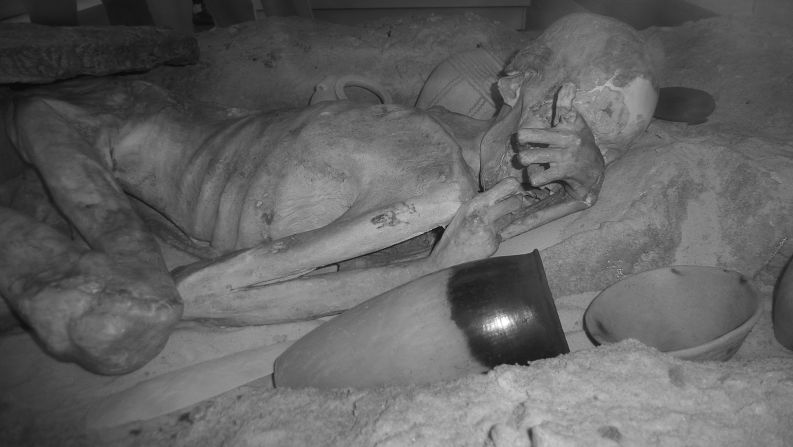
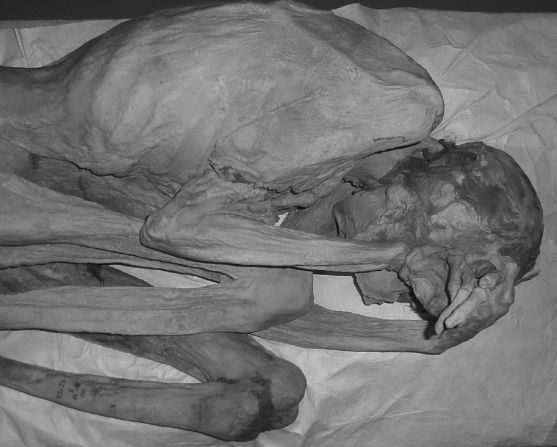
Researchers found a tattoo on the upper arm of this Egyptian mummy. He is thought to have lived around 5,000 years ago and was between 18 and 21 years old when he died from a stab wound to the back.
Courtesy of the Trustees of the British Museum
This mummy is one of The British Museum's most treasured objects, and has been on display for 100 years. He is remarkably well-preserved, having been buried in hot desert conditions.
Courtesy of the Trustees of the British Museum
Dark smudges on the upper arm of the male mummy had been left unexamined until now. Using infrared imaging researchers could make out tattoos on his upper arm, of two slightly overlapping horned animals.
Courtesy of the Trustees of the British Museum
The horned animals have been identified as a wild bull and a Barbary sheep -- like the one pictured here that is carved onto a ceremonial palette from Predynastic Egypt. The characteristic out-turned horns and hump at the shoulder can be seen in the mummy's tattoo.
Courtesy of Ashmolean Museum, University of Oxford
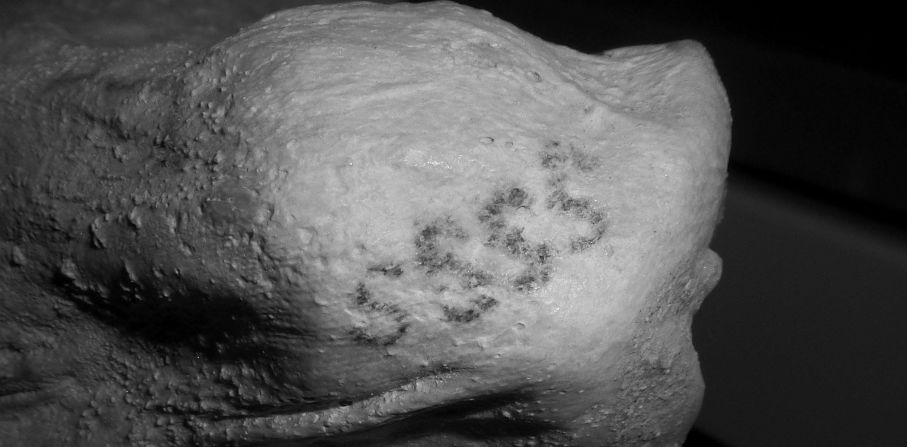
This female mummy, from the same period (between 3351 and 3017 BC) is also part of the British Museum's collection. Previously archaeologists had thought that tattooing only applied to women.
Courtesy of the Trustees of the British Museum
The female mummy has several tattoos, including a row of "S" shaped motifs running over her right shoulder. This motif often appears in Predynastic pottery decoration.
Courtesy of the Trustees of the British Museum
A ritual scene painted on a Predynastic pottery jar depicts multiple S-motifs and a man holding a curved implement, perhaps a crooked stave -- which is thought to be a symbol of power and status. Similar shapes were tattooed on the female mummy.