Saturn and its moons | CNN Business

CNN values your feedback

1. How relevant is this ad to you?
2. Did you encounter any technical issues?
Thank You!
Your effort and contribution in providing this feedback is much appreciated.
Close
Ad Feedback
Business
Markets
Tech
Media
Calculators
Videos
Markets Tech Media Calculators Videos
Watch Listen Live TV
My Account
  • Settings
  • Newsletters
  • Topics you follow
  • Sign out
Your CNN account Sign in to your CNN account

My Account
  • Settings
  • Newsletters
  • Topics you follow
  • Sign out
Your CNN account Sign in to your CNN account

Live TV Listen Watch
Edition
US
International
Arabic
Español
Edition
  • US
  • International
  • Arabic
  • Español

Markets
Tech
Media
Calculators
Videos

Follow CNN
Download the CNN App

  • World
    • Africa
    • Americas
    • Asia
    • Australia
    • China
    • Europe
    • India
    • Middle East
    • United Kingdom
  • US Politics
    • Elections 2026
    • Trump
    • Facts First
    • CNN Polls
    • Redistricting Tracker
    • Epstein Files
  • Business
    • Tech
    • Media
    • Calculators
    • Videos
  • Markets
    • Pre-markets
    • After-Hours
    • Fear & Greed
    • Investing
  • Health
    • Life, But Better
    • Fitness
    • Food
    • Sleep
    • Mindfulness
    • Relationships
  • Entertainment
    • Movies
    • Television
    • Celebrity
  • Tech
    • Innovate
  • Style
    • Arts
    • Design
    • Fashion
    • Architecture
    • Luxury
    • Beauty
    • Video
  • Travel
    • Destinations
    • Food & Drink
    • Stay
    • News
    • Videos
  • Sports
    • Football
    • Tennis
    • Golf
    • Motorsport
    • US Sports
    • Olympics
  • Science
    • Space
    • Life
    • Unearthed
  • Climate
    • Solutions
    • Weather
  • Weather
    • Video
    • Climate
  • Ukraine-Russia War
  • Israel-Hamas War
  • Features
    • As Equals
    • Call to Earth
    • Freedom Project
    • Impact Your World
    • Inside Africa
    • CNN Heroes
  • Watch
    • Live TV
    • Featured
    • CNN Fast
    • Shows A-Z
    • CNN 10
    • CNN TV Schedule
  • Listen
    • All There Is with Anderson Cooper
    • Chasing Life with Dr. Sanjay Gupta
    • The Assignment with Audie Cornish
    • Terms of Service with Clare Duffy
    • CNN 5 Things
    • All CNN Podcasts
  • Games
    • Daily Crossword
    • Jumble Crossword
    • Photo Shuffle
    • Sudoblock
    • Sudoku
    • 5 Things Quiz
  • About CNN
    • Photos
    • Investigations
    • CNN Profiles
    • CNN Leadership
    • CNN Newsletters
    • Work for CNN

Download the CNN App
Space and Science
Space and Science
Ad Feedback

Saturn and its moons

Updated 8:42 AM EST, Thu January 26, 2017
Link Copied!
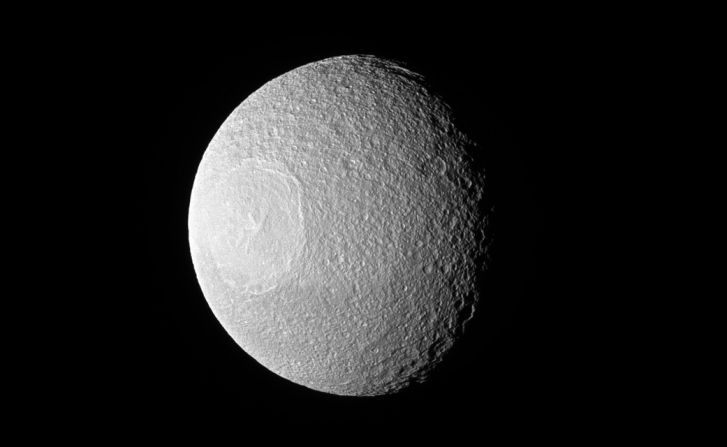
Tethys is one of Saturn's larger icy moons. This photo was snapped by NASA's Cassini spacecraft in November 2016 from a distance of approximately 228,000 miles (367,000 kilometers).
NASA/JPL-Caltech/Space Science Institute
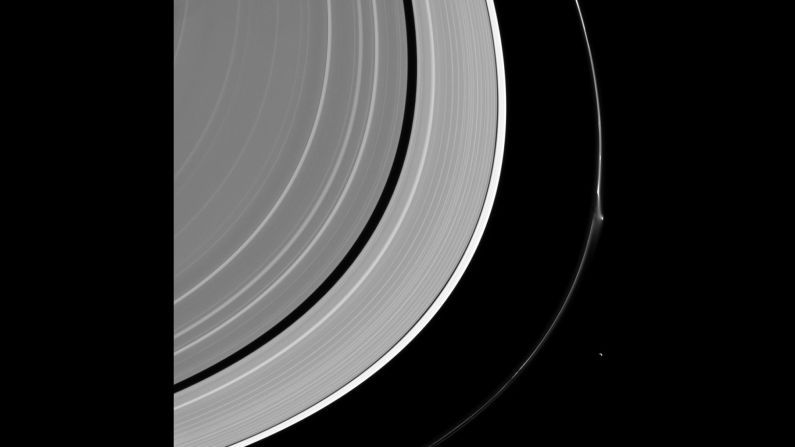
A bright disruption in Saturn's narrow F ring suggests it may have been disturbed recently by the interaction of a small object embedded in the ring itself. They are hard to see, but their handiwork reveals their presence, and scientists use the Cassini spacecraft to study these stealthy sculptors of the F ring.
NASA/JPL-Caltech/Space Science Institute
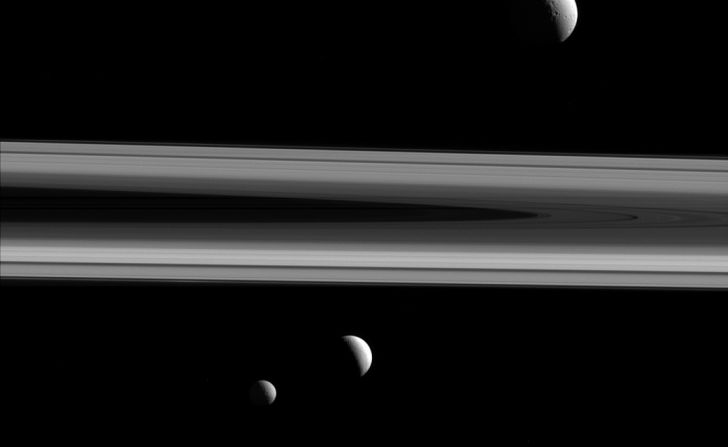
Saturn's moons Tethys, Enceladus and Mimas are shown in this image taken by the Cassini spacecraft on December 3, 2015. Tethys is above the rings, Enceladus is below the rings in the center of the image, and Mimas is below and to the left. Cassini has been exploring Saturn and its moons since 2004. The mission is scheduled to end in September 2017.
NASA
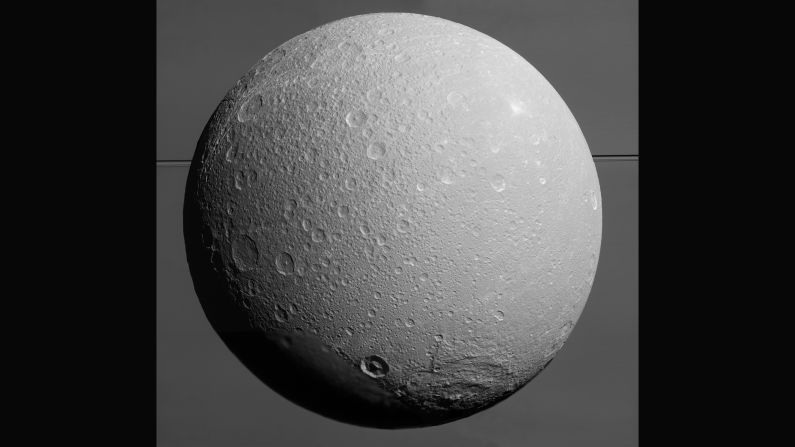
Saturn's icy moon Dione, with giant Saturn and its rings in the background, was captured in this mosaic of images just prior the <a href="index.php?page=&url=http%3A%2F%2Fsaturn.jpl.nasa.gov%2F" target="_blank" target="_blank">Cassini spacecraft's</a> final close approach to the moon on August 17, 2015. Scientists combined nine visible light images to create the mosaic. Cassini was at distances ranging from approximately 106,000 miles (170,000 kilometers) to 39,000 miles (63,000 kilometers) from Dione when the images were taken.
Saturn's icy moon Dione, with giant Saturn and its rings in the background, was captured in this mosaic of images just prior the Cassini spacecraft's final close approach to the moon on August 17, 2015. Scientists combined nine visible light images to create the mosaic. Cassini was at distances ranging from approximately 106,000 miles (170,000 kilometers) to 39,000 miles (63,000 kilometers) from Dione when the images were taken.
NASA
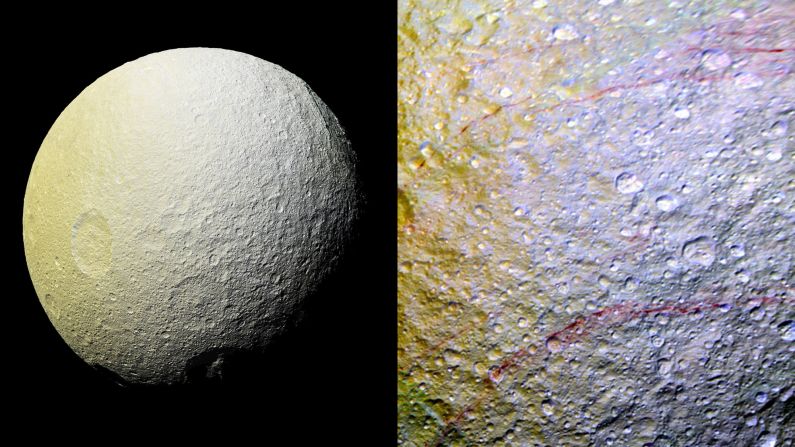
NASA's Cassini spacecraft has spotted mysterious reddish streaks on the surface of Saturn's icy moon Tethys. The red streaks are only a few miles wide but several hundred miles long. The images were taken in April. Scientists aren't sure what's causing the streaks.
From NASA
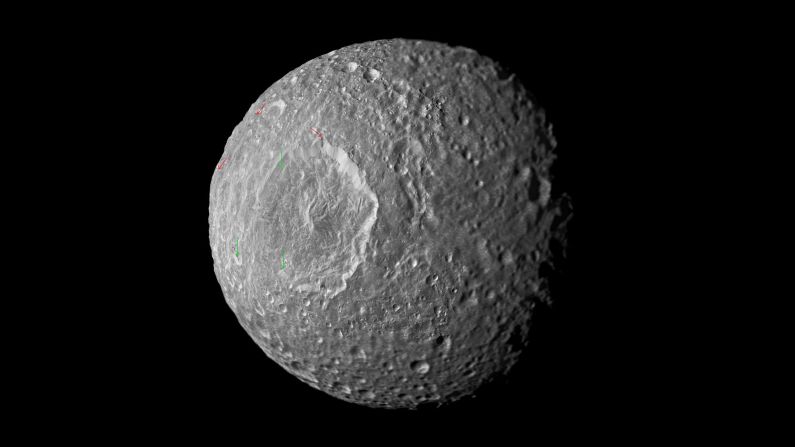
This mosaic of Saturn's moon Mimas was created from images taken by Cassini in February 2010. A recent study indicates the moon may contain a liquid water ocean.
NASA/JPL-Caltech/Space Science Institute
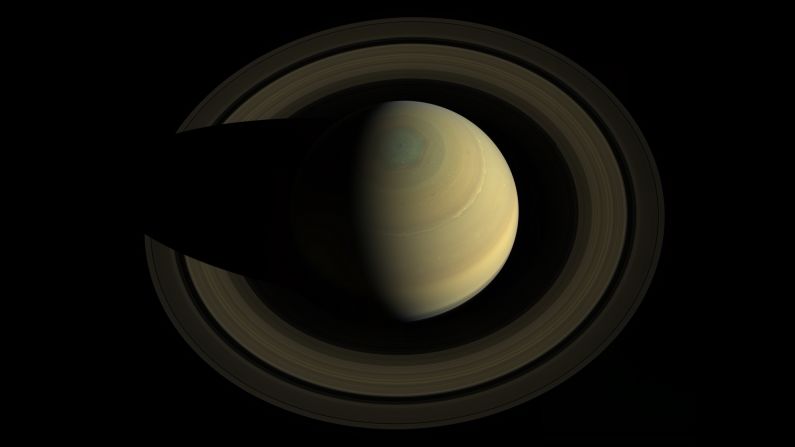
Cassini glided high above Saturn in October 2013 to capture this 36-image mosaic of the ringed planet. The colors of the planet appear natural, just as the human eye would see them.
NASA/JPL-Caltech/SSI/Cornell
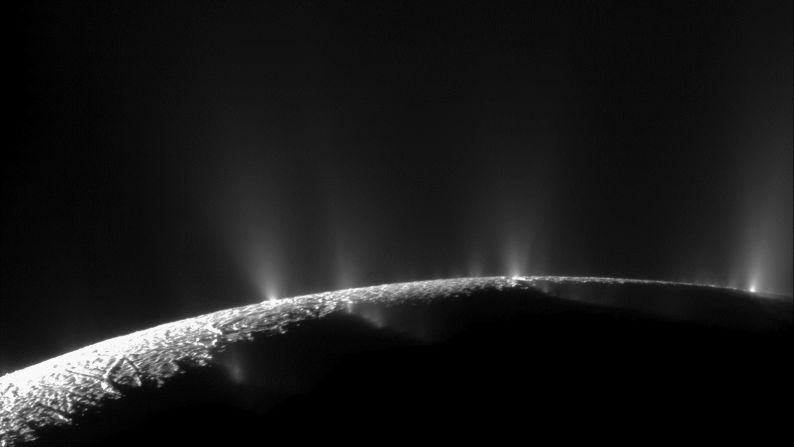
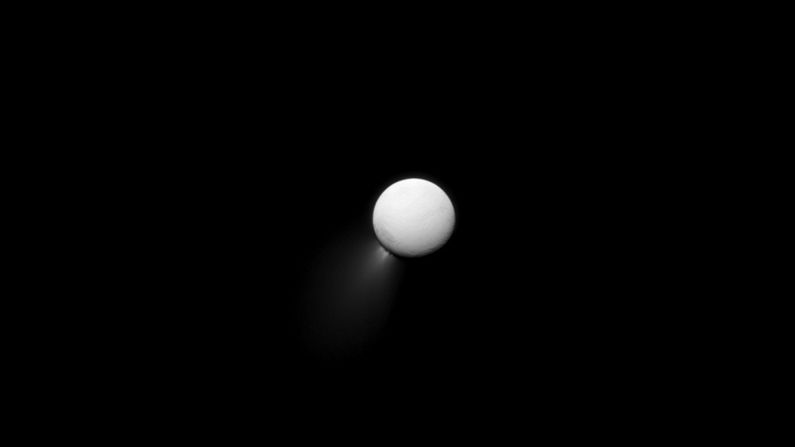
Plumes of water ice and vapor shoot up from the surface of Saturn's moon Enceladus in this two-image mosaic taken by Cassini in November 2009. Analysis by NASA scientists indicated that water can reach the Saturnian moon's surface.
NASA/JPL-Caltech/SSI
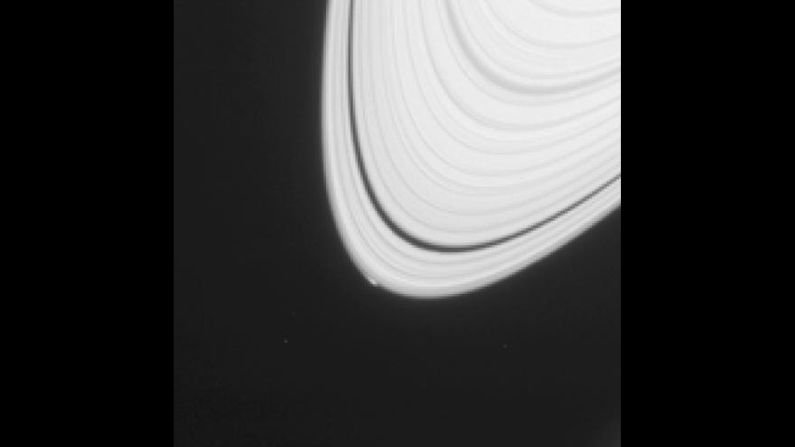
A small, bright blip can be seen on the outermost edge of Saturn's rings in this image taken in April 2013. The bump in the smooth ring structure is an icy object that could provide clues to how Saturn's moons formed.
NASA/JPL
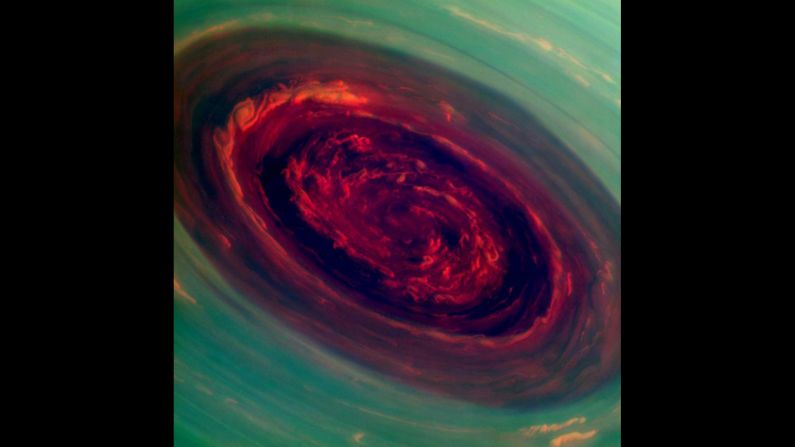
This false-color image of Saturn's north polar storm looks like a giant red rose surrounded by green foliage. Measurements indicate the storm's eye is a staggering 1,250 miles across with cloud swirling as fast as 330 mph.
NASA/JPL-Caltech/SSI
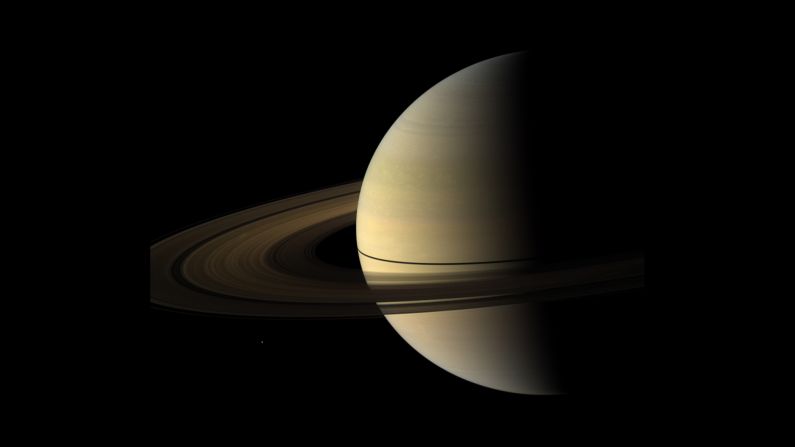
Saturn's rings cast a narrow shadow on its surface in this image taken in August 2009.
Universal History Archive/UIG via Getty Images
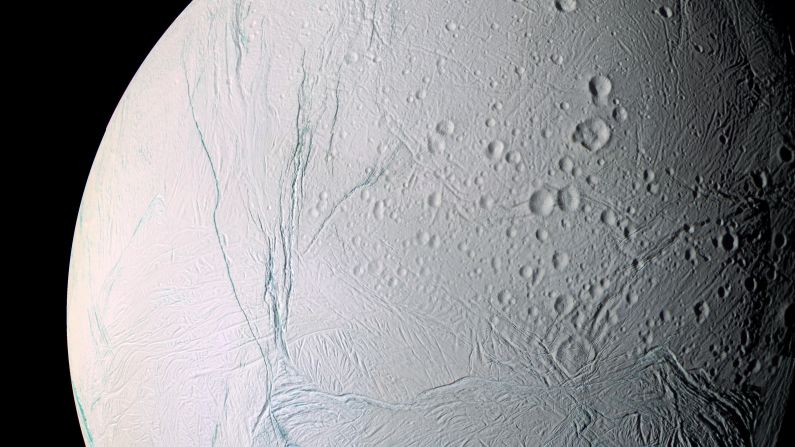
The scars of time and space mark the surface of Saturn's moon Enceladus. Saturn has at least 62 moons in its orbit.
NASA/JPL/Space Science Institute
The Saturn-facing side of Enceladus is illuminated by light bouncing off the planet. Plumes of water ice can be seen streaming off the moon's southern pole.
NASA/JPL-Caltech/Space Science Institute
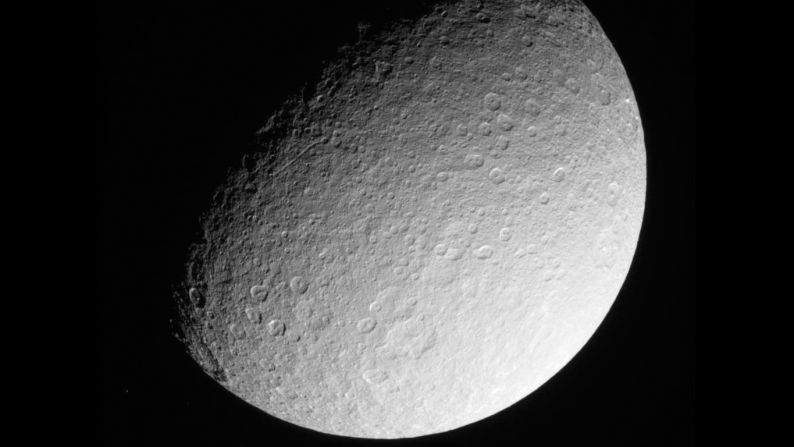
Saturn's moon Rhea is seen from approximately 174,181 miles away in this March 2013 image.
NASA/JPL/Space Science Institute
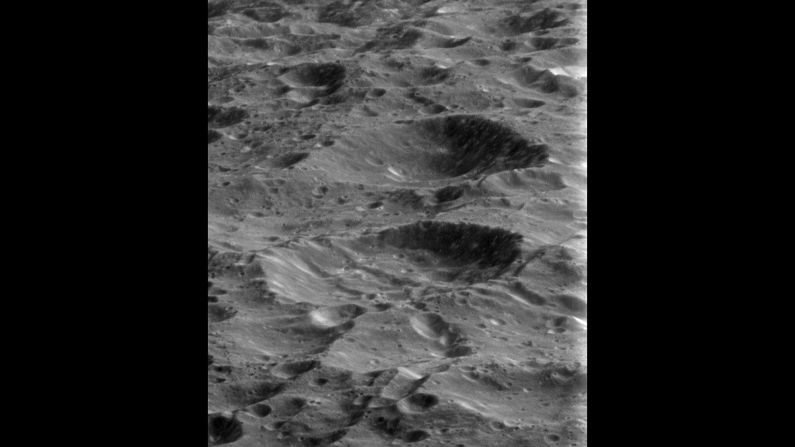
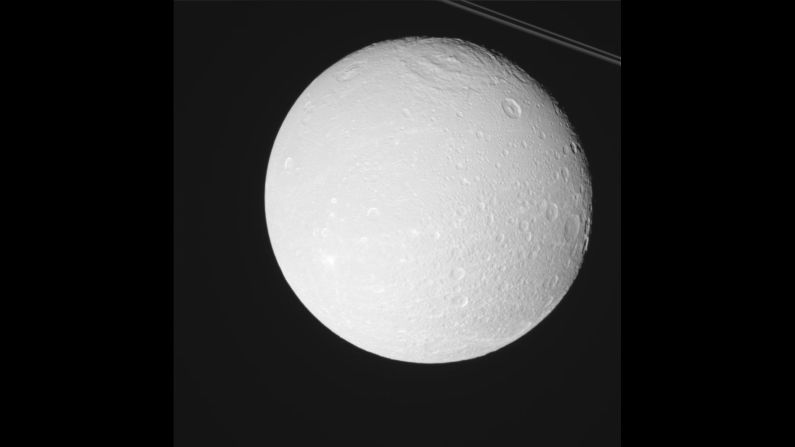
Rhea's surface is pockmarked with craters from billions of years of impacts. The moon is Saturn's second-largest, with a diameter of 949 miles.
NASA/JPL-Caltech/Space Science Institute
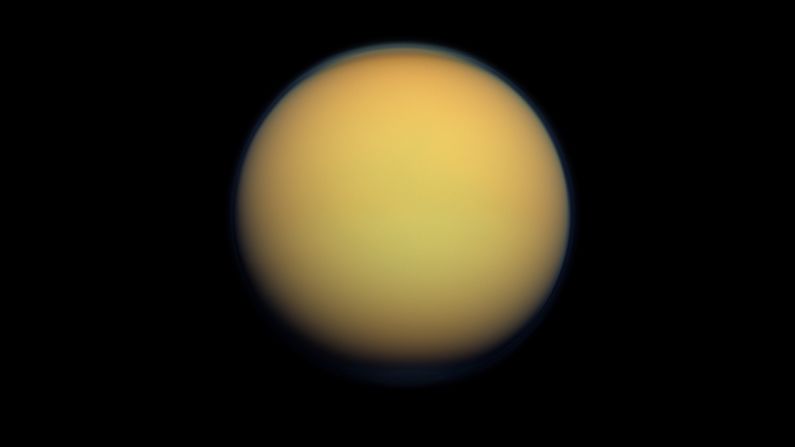
Saturn's largest moon, Titan, has a diameter of 3,200 miles. It looks like a fuzzy orange ball because of its atmosphere.
NASA/JPL-Caltech/Space Science Institute
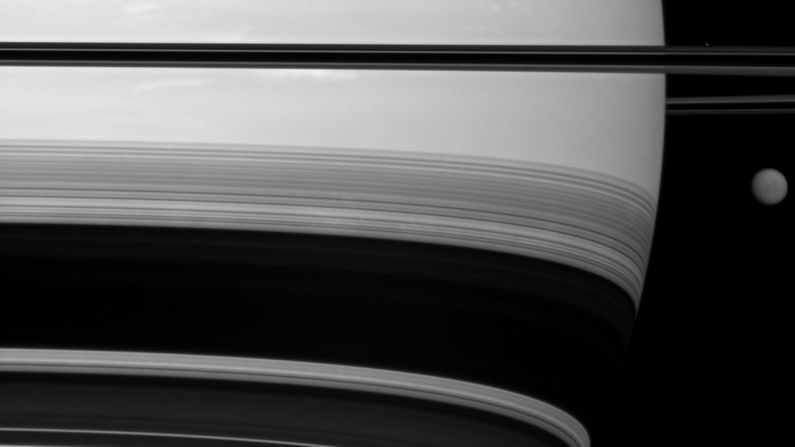
Though it's the largest moon orbiting Saturn, Titan is dwarfed by Saturn itself.
NASA/JPL-Caltech/Space Science Institute
Saturn has a small moon called Dione orbiting about 234,000 miles away. That's about the same distance Earth is from its moon.
NASA/JPL/Space Science Institute
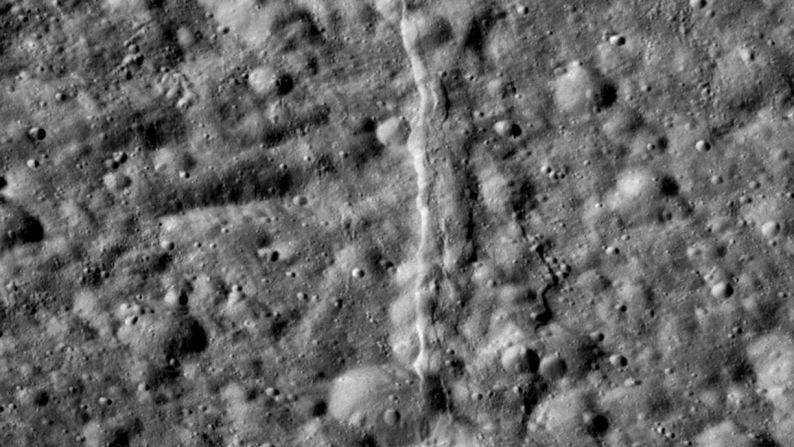
The surface of Dione is seen in this May 2012 image.
NASA/JPL/Space Science Institute
Tethys, top left, is dwarfed by Saturn as it orbits the planet, though scientists think the moon is much larger than Saturn's ring system.
NASA/JPL-Caltech
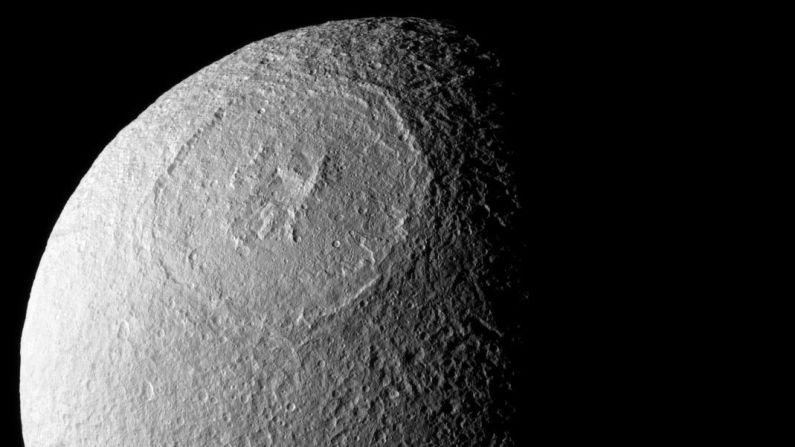
The Odysseus Crater spans 280 miles across the northern hemisphere of Tethys.
NASA/JPL/Space Science Institute
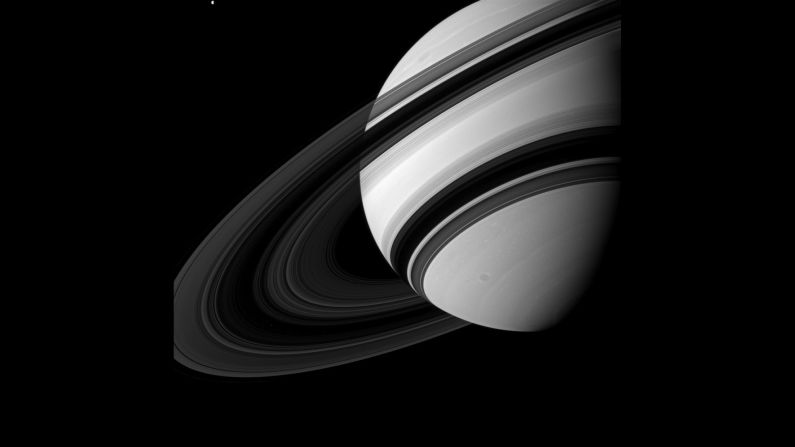
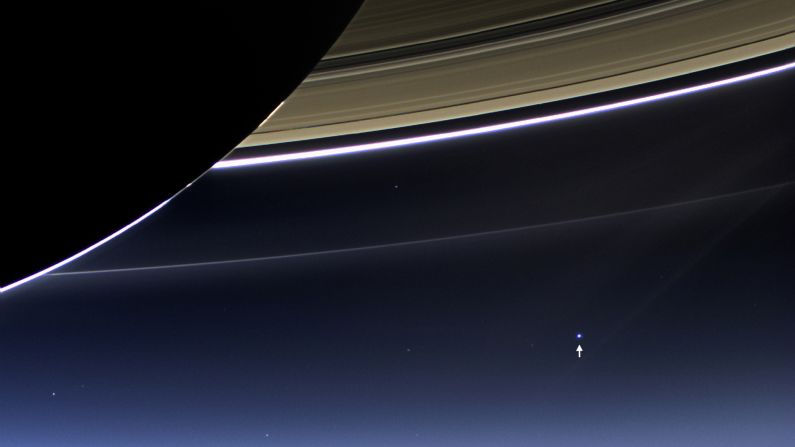
The small bright dot seen in the bottom right is not another Saturn moon. It's Earth. The distance between Saturn and our planet is constantly changing because both are constantly in motion. When they are closest together during their orbits, Saturn is 746 million miles away from Earth. At its farthest, they are just over a billion miles apart. <a href="index.php?page=&url=http%3A%2F%2Fwww.cnn.com%2F2014%2F06%2F27%2Ftech%2Fgallery%2Fcassinis-top-discoveries%2Findex.html" target="_blank">See Cassini's top 10 discoveries about Saturn</a>
The small bright dot seen in the bottom right is not another Saturn moon. It's Earth. The distance between Saturn and our planet is constantly changing because both are constantly in motion. When they are closest together during their orbits, Saturn is 746 million miles away from Earth. At its farthest, they are just over a billion miles apart. See Cassini's top 10 discoveries about Saturn
NASA/JPL-Caltech/Space Science Institute

My Account
  • Settings
  • Newsletters
  • Topics you follow
  • Sign out
Your CNN account Sign in to your CNN account

Live TV Listen Watch
  • World
    • Africa
    • Americas
    • Asia
    • Australia
    • China
    • Europe
    • India
    • Middle East
    • United Kingdom
  • US Politics
    • Trump
    • Facts First
    • CNN Polls
    • Elections 2026
    • Redistricting Tracker
    • Epstein Files
  • Business
    • Tech
    • Media
    • Calculators
    • Videos
  • Markets
    • Pre-markets
    • After-Hours
    • Fear & Greed
    • Investing
  • Health
    • Life, But Better
    • Fitness
    • Food
    • Sleep
    • Mindfulness
    • Relationships
  • Entertainment
    • Movies
    • Television
    • Celebrity
  • Tech
    • Innovate
  • Style
    • Arts
    • Design
    • Fashion
    • Architecture
    • Luxury
    • Beauty
    • Video
  • Travel
    • Destinations
    • Food & Drink
    • Stay
    • News
    • Videos
  • Sports
    • Football
    • Tennis
    • Golf
    • Motorsport
    • US Sports
    • Olympics
  • Science
    • Space
    • Life
    • Unearthed
  • Climate
    • Solutions
    • Weather
  • Weather
    • Video
    • Climate
  • Ukraine-Russia War
  • Israel-Hamas War
  • Features
    • As Equals
    • Call to Earth
    • Freedom Project
    • Impact Your World
    • Inside Africa
    • CNN Heroes
  • Watch
    • Live TV
    • Featured
    • CNN Headlines
    • Shows A-Z
    • CNN 10
    • CNN TV Schedule
  • Listen
    • All There Is with Anderson Cooper
    • Chasing Life with Dr. Sanjay Gupta
    • The Assignment with Audie Cornish
    • Terms of Service with Clare Duffy
    • CNN 5 Things
    • All CNN Podcasts
  • Games
    • Daily Crossword
    • Jumble Crossword
    • Photo Shuffle
    • Sudoblock
    • Sudoku
    • 5 Things Quiz
  • About CNN
    • Photos
    • Investigations
    • CNN Profiles
    • CNN Leadership
    • CNN Newsletters
    • Work for CNN

Business
Watch Listen Live TV
My Account
  • Settings
  • Newsletters
  • Topics you follow
  • Sign out
Your CNN account Sign in to your CNN account
Follow CNN

Download the CNN app

Most stock quote data provided by BATS. US market indices are shown in real time, except for the S&P 500 which is refreshed every two minutes. All times are ET. Factset: FactSet Research Systems Inc. All rights reserved. Chicago Mercantile: Certain market data is the property of Chicago Mercantile Exchange Inc. and its licensors. All rights reserved. Dow Jones: The Dow Jones branded indices are proprietary to and are calculated, distributed and marketed by DJI Opco, a subsidiary of S&P Dow Jones Indices LLC and have been licensed for use to S&P Opco, LLC and CNN. Standard & Poor’s and S&P are registered trademarks of Standard & Poor’s Financial Services LLC and Dow Jones is a registered trademark of Dow Jones Trademark Holdings LLC. All content of the Dow Jones branded indices Copyright S&P Dow Jones Indices LLC and/or its affiliates. Fair value provided by IndexArb.com. Market holidays and trading hours provided by Copp Clark Limited.

Terms of Use Privacy Policy Ad Choices Accessibility & CC About Newsletters Transcripts Sitemap

© 2026 Cable News Network. A Warner Bros. Discovery Company. All Rights Reserved.
CNN Sans ™ & © 2016 Cable News Network.

Download the CNN app

Scan the QR code to download the CNN app on Google Play.

Scan the QR code to download the CNN app from Google Play.

Download the CNN app

Scan the QR code to download the CNN app from the Apple Store.

Scan the QR code to download the CNN app from the Apple Store.