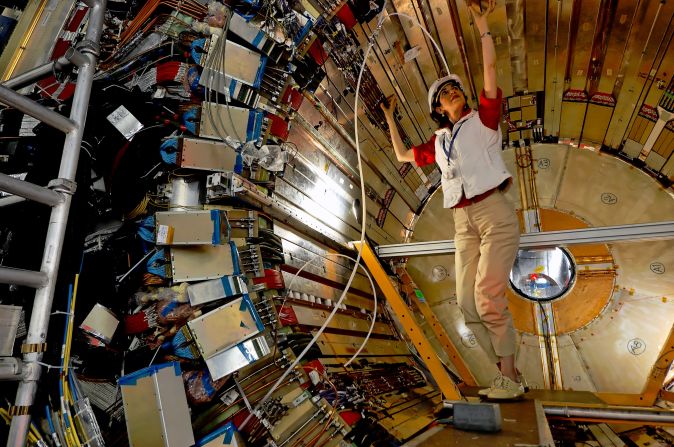
As an experimental physicist at CERN, Fabiola Gianotti is looking for dark matter, extra dimensions and an elusive particle which could prove theories about the structure of the universe.
Mike Struik
Gianotti and colleagues await the Large Hadron Collider's first observable proton-proton collision, after its launch in November 2009.
CERN
A photon source is seen in the CERN visitors' center in Switzerland. Gianotti says she finds particle collisions "very interesting from a scientific point of view, but also beautiful, from an aesthetic point of view."
Getty Images
In the early hours of March 30, 2010, shortly after the ATLAS detector achieved a record-breaking, high-energy collision, Gianotti (left) declared "It's the beginning of a new era of physics exploration."
CERN
Last December, hundreds of scientists gathered to hear and applaud Gianotti's update on the ATLAS team's search for the Higgs Boson particle.
CERN
Gianotti, who studied piano at Milan Conservatory, says it is common for physicists to be attracted to music. "Einstein was a very good violinist," she says.
CERN
Gianotti accompanies theoretical physicist Stephen Hawking on a tour of the ATLAS cavern in 2006.
CERN
The daughter of a geologist and literature teacher, Gianotti jokes that she often argues with her brother, an electrical engineer, "with me saying that an engineer does not have the vision of a physicist and him saying that a physicist is not even able to fix a lightbulb."
"Of course, mankind has made giant steps forward," Gianotti, pictured here in 2011, says. "However, what we know is really very, very little compared to what we still have to know."
AFP/Getty Images
CERN runs the world's biggest particle collider, located on the outskirts of Geneva. One of the first tasks assigned to the giant machine has been to step up the quest for the Higgs Boson to resolve one of physics' great puzzles: why some particles have mass and others have little, or none.